By CentralBankNews.info
The European Central Bank (ECB), which earlier today held its policy rates steady, repeated its guidance that rates are expected to “remain at present or lower levels for an extended period of time” as it trimmed its inflation forecast and raised its growth forecasts for the coming years.
Mario Draghi, ECB president, told a press conference the moderate economic recovery was proceeding in line with expectations of “a prolonged period of low inflation, to be followed by a gradual upward movement in HICP inflation rates toward levels close to 2 percent.”
The ECB, which cut it benchmark refinancing rate by 50 basis points in 2013 to a record low of 0.25 percent, trimmed its forecast for inflation to 1.0 percent in 2014, down from its previous forecast of 1.1 percent, but maintained the 2015 forecast at 1.3 percent.
For 2016 the ECB expects average inflation of 1.5 percent, rising to 1.7 percent in the fourth quarter of 2016, still below the ECB’s target of inflation below but close to 2.0 percent. Draghi stressed that projections three year in advance were based on several assumptions, including unchanged exchange rates and lower oil prices.
In February, inflation in the 18-nation euro area was unchanged from January and December at 0.8 percent, and Draghi expects inflation to remain at current levels in coming months
The euro area’s economy is slowly improving and Draghi said confidence indicators up to February show continued “moderate growth in the first quarter of 2014” as domestic demand is expected to improve while exports benefit from global demand.
However, unemployment remains high – the January unemployment rate was steady at 12 percent – and continued paydown of debt by the public and private sector will continue to weigh on the pace of economic recovery.
“The risks surrounding the economic outlook for the euro area continue to be on the downside,” Draghi said, adding developments in global financial markets and emerging market economies, along with geopolitical risks, have the potential to negatively affect the economy.
Gross Domestic Product in the euro area expanded by 0.3 percent in the fourth quarter of 2013, the third consecutive quarter of growth after six quarters of contraction, for annual growth of 0.5 percent, the first quarter in eight quarters with a positive annual growth rate.
The ECB staff revised upwards its forecast for 2014 GDP growth to 1.2 percent, up from 1.1 percent previously forecast, and 1.5 percent growth in 2015, up from 1.3 percent. For 2016 the ECB forecast growth of 1.8 percent.
“The information and analysis now available fully confirm out decision to maintain an accommodative monetary policy stance for as long as necessary,” Draghi said, adding the ECB governing council was “firmly” reiterating its forward guidance based on the subdued outlook for inflation given the broad-based weakness of the economy, a high degree of underutilized capacity and subdued money and credit creation.
Draghi also repeated the last month’s statement that the ECB was closely monitoring the money markets and ready to consider all instruments to maintain the “high degree of monetary accommodation and to take further decisive action if required.”
The Healthcare Crisis of the Century
By Alex Daley, Chief Technology Investment Strategist
It’s hardly a state secret that we Americans are getting old. Both in raw numbers and as a percentage of the overall population, the 65+ cohort is growing rapidly as the baby boomers slide into retirement.
On the plus side, these data confirm that more Americans are living to a ripe old age than ever before—many of them in good health well into their seventies and eighties.
But all too often, with age comes susceptibility to ever more serious ailments and a diminishing quality of life—especially if you contract a disease that obliterates your innate sense of self and destroys everything that makes life worth living.
That’s what Alzheimer’s disease does. This most common type of dementia was first described by the German physician Dr. Alois Alzheimer more than a century ago… but to this day science isn’t sure what exactly it is and what causes it.
It is also increasing in incidence, as would be expected with an aging population:

(Source: Alzheimer’s Association, 2012 Alzheimer’s Disease Facts and Figures, Alzheimer’s & Dementia, Volume 8, Issue 2.)
Right now, about 5.2 million Americans suffer from Alzheimer’s—already a large number—but in just 26 years that number will have more than doubled, to 11 million.
Here’s just a glimpse at the monstrous healthcare costs we’re facing:
- In 2013, the direct costs of caring for those with Alzheimer’s to American society totaled an estimated $203 billion, of which $142 billion came from taxpayers through Medicare and Medicaid.
- Total payments for health care, long-term care, and hospice for people with Alzheimer’s and other types of dementia are projected to increase from $203 billion in 2013 to $1.2 trillion in 2050.
- This dramatic rise includes a 500% increase in combined Medicare and Medicaid spending.
It’s a serious healthcare crisis in the making—significant today, and on its way to astronomical levels in short order—putting an ever greater amount of stress on a medical establishment that is already coming apart at the seams.
What About a Cure?
As I’ve mentioned before, despite decades of research, until recently scientists knew precious little about the specifics and causes of Alzheimer’s. Their best guess was that it involved a combination of genetic, environmental, and lifestyle factors. But there was no reliable biomarker that would help indicate who would be affected, let alone a sure pathway to a treatment.
The best the pharmaceutical industry managed to come up with were treatments that slowed down, rather than stopped, the progression of the disease—and even then only for a short period of time. In fact, to this day there are just five FDA-approved drugs to treat Alzheimer’s at all, and none is particularly effective.
According to a stark appraisal from Consumer Reports Health, “When compared to a placebo, most people who take one will not experience a meaningful benefit.”
The Alzheimer’s Association reports that on average, the five approved AD drugs show some efficacy for only about six to twelve months, but only in approximately half of the individuals who take them.
Nevertheless, despite their lack of efficacy, these drugs posted some impressive sales figures before cheaper generics became available. A real breakthrough in the treatment of Alzheimer’s, the scientific world agrees, would be a game-changer for modern medicine.
And that breakthrough may just be on the way. Right now, there’s a small company that looks like it may beat its competitors to the finish line.
Metallic Catalysts
Alzheimer’s disease diminishes the ability of neurons in the brain to communicate with one another. That ultimately leads to neuronal death and, over time, destroys memory and thinking skills.
Although scientists have yet to pinpoint a single cause for the disease, they’re getting far closer to understanding the disease than ever before.
Beta-amyloid plaques, for example—the infamous “plaques” that form in the brain as part of the disease’s development—show links with chronic and persistent infections, such as gingivitis. Also, the interaction of these amyloid plaques and biological metals (zinc, iron, copper, etc.) seems to result in deterioration of brain cells.
It was once thought that beta-amyloid plaques were the primary cause of the damage to neurons seen in AD, because they’re the most visible when the brain of a deceased AD patient is dissected. But now a growing number of researchers believe that the small, still-soluble beta-amyloid oligomers may be the main culprits because they’re often found in the spaces between neurons (synapses), where they are believed to disrupt communication by interacting with the metals and creating a short circuit. With nothing firing across the synapses, information is no longer transmitted from one neuron to another, and the cells start to die off from lack of use.
One small biotech startup has been moving forward with the development of compounds to render these biological metals inactive, preventing this short circuit and allowing the brain to resume normal function or even heal.
Today, that company sits on the cusp of what may prove to be the single most important data readout on the subject since its inception—a trial that should prove whether this technique shows as much efficacy in a large group of human patients as it has shown in animal testing and in anecdotal evidence from early human trials.
In the months since we started following this small company, many investors have caught on to its potential. Once a tiny company with a $30 million market cap, news of its successes, including positive readouts from a study of the much smaller but related Huntington’s disease, have driven the stock up nearly 400% in the last year.
While that might sound like much of the good news has been priced in, we beg to differ. Global investment firm Deutsche Bank, for instance, recently pegged the global Alzheimer’s drug market at $20 billion per year. With no real competition in the market, the company could easily capture 20% of that market—or about $4 billion annually.
Even if this small company can only realize a quarter of that revenue after working through big pharmaceutical partners to manufacture and distribute the treatment, it could see $1 billion in annual revenues.
If we compare this company to other companies with similar revenues in the same industry, it means that in the long run, its shares could be worth 10x what they trade at today, even after the recent run-up—and that’s with many very conservative assumptions along the way. A real breakthrough treatment could make these numbers seem ridiculously small.
But investors won’t have to wait that long to make money. Positive trial results, which are due in March, could easily double the share price as the company moves steadily closer to market. Of course, there aren’t any guarantees, but the company doesn’t even have to provide groundbreaking news at this point. If early trial results can simply be repeated, the potential is enormous.
Click here to learn more about this amazing Alzheimer’s breakthrough and the potential windfall that could happen just weeks from now.
The article The Healthcare Crisis of the Century was originally published at caseyresearch.com.
Serbia holds rate as cautious monetary policy warranted
By CentralBankNews.info
Serbia’s central bank maintained its policy rate at 9.5 percent, noting that inflation had now returned to the bank’s target range in January but adding that caution was warranted in monetary policy due to “heightened volatility in international financial markets” that is dampening investor sentiment and may negatively influence capital flows.
The Bank of Serbia (NBS), which intervened on foreign exchange markets on Monday after repeated interventions last month to support the dinar currency, also stressed the need for caution last month, saying the country was still in need for external financing despite rising exports.
“By keeping the key policy rate on hold, the NBS aims to support price and financial stability in the medium term,” the central bank said, adding that consistent implementation of fiscal consolidation measures should diminish the country’s exposure to external risks and strained liquidity in global financial markets in connection with reduced asset purchases by the U.S. Federal Reserve.
Further steps in reducing the country’s foreign exposure and maintain economic stability and growth would come from the expected conclusion of an agreement with the International Monetary Fund, the central bank said.
Talks between the IMF and Serbia’s government started last month on a new agreement but the government needs to narrow its deficit further and save some 400 million euros.
Serbia’s inflation rate rose to 3.1 percent in January from 2.2 percent in December, returning to the central bank’s target range of 2.5 percent to 5.5 percent, around a 4.0 percent midpoint.
The central bank cut its rate by a net 175 basis points in 2013 as inflation slowed to a low of 1.6 percent in November. The bank expects inflation to rise in coming months due to higher administered prices and the one-off impact of higher value-added-tax on some goods in January.
Serbia’s economy pulled out of recession in 2011 and 2012, with Gross Domestic Product expanding by an annual rate of 2.6 percent in the fourth quarter of 2013.
The bank, which has forecast growth of 1.5 percent in 2014, said manufacturing was growing in the beginning of this year, laying the foundation for growth this year that will be helped by a recovery of the euro area and the start of negotiations on accession to the European Union (EU).
AUDUSD: Bullish, Pressure Builds On The 0.9080/5 Levels
AUDUSD: A fourth day of upside gain is now underway as AUDUSD looks to retake the 0.9080/5 levels. This if seen will pave the way for a push higher towards the 0.9150 level where a break will set the stage for a run at the 0.9200 level and subsequently the 0.9250 level. Its daily RSI is bullish and pointing higher suggesting further strength. On the downside, support lies at the 0.8972 level, its Mar 06 2014 low where a break will aim at the 0.8900 level. Below here will aim at the 0.8890 level where a violation will aim at the 0.8850 level. A turn below here will set up the pair for move further lower for towards the 0.8800 level. All in all, the pair continues to face further upside risks.
Article by www.fxtechstrategy.com
ECB maintains rate, to release forecasts today
By CentralBankNews.info
The European Central Bank (ECB) maintained its benchmark refinancing rate at a record low of 0.25 percent, as expected by most economists, along with its other main rates, including the marginal lending facility rate at 0.75 percent and the deposit rate at 0.0 percent.
In a brief statement following a meeting of the ECB’s governing council, the bank said Mario Draghi, ECB president, would comment on the reason for the decision at a press conference.
At the press conference, Draghi will present the ECB’s latest economic forecasts, including its projection for 2016.
Despite the recent improvement in the euro area’s economy, Draghi has said in recent months that inflation will remain low for “a prolonged period” and provided the guidance that rates will be kept “at present of lower levels for an extended period of time.”
Last month, Draghi also said the ECB was ready to consider all available instruments and “to take further decisive action if required” to ensure that higher money market rates don’t raise the cost of financing for businesses and thus prevent a faster economic recovery.
Inflation in the 18-nation euro zone was steady at 0.8 percent in February, the same as in January and December, and well below the ECB’s target of inflation that is below, but close to 2 percent.
In its current forecast, which will be updated later today, the ECB forecasts average inflation of 1.1 percent in 2014 and 1.3 percent in 2015.
The Gross Domestic Product of the euro area expanded by 0.3 percent in the fourth quarter of 2013 from the third quarter for annual growth of 0.5 percent, the first quarter in eight quarters that the growth rate has been positive.
The ECB currently forecasts economic growth of 1.1 percent in 2014 and 1.5 percent in 2015.
BOE maintains stance, reinvests maturing bond proceeds
By CentralBankNews.info
The Bank of England (BOE) maintained its Bank Rate at 0.5 percent, as widely expected, along with its current stock of assets at 375 billion pounds as reinvests 8.1 billion of cash it received from the redemption of one of its bonds.
The BOE has held its Bank Rate at the current level for five years since March 2009 and is expected to maintain it for about another year before raising it to control inflation from the growing economy.
In addition to cutting its rate in March 2009, the BOE also embarked on so-called quantitative easing by purchasing assets to hold down long-term interest rates.
One of these bonds issued by the UK Treasury, known as gilts, matured this month and the BOE will maintain the size of its asset purchases by reinvesting the proceeds in other bonds, a move that was flagged by the BOE as part its forward guidance to financial markets about its future policy stance.
In August the BOE said it would not raise interest rates until the unemployment rate fell to 7.0 percent but strong growth and a swift decline in the unemployment rate to 7.2 percent in the three months to December forced the U.K. central bank to revise its guidance in February.
Instead of linking any changes in its monetary policy stance to a single economic indicator, the BOE said it would only raise rates when there was less economic slack in the economy.
Policymakers have repeatedly stressed that there are in no rush to raise rates and the first rate increase is first likely in the spring of 2015.
The U.K.’s Gross Domestic Product expanded by 0.7 percent in the fourth quarter of 2013 for annual growth of 2.7 percent, up from 1.9 percent in third quarter.
A further easing in inflation to 1.9 percent in January, the first time since November 2009 that inflation was below the BOE’s 2.0 percent target, has helped ease some of the pressure on the BOE to use higher interest rates to push down inflation.
WTI Crude Declines For Third Day Amid Rise in US Stockpiles
Prices for the North American West Texas Intermediate (WTI) extended losses for a third day in a row as US government data revealed distillate and crude stockpiles climbed, while the tension in the Ukraine eased.
Crude prices were dragged to its lowest level in two weeks, clearing previous gains seen on Monday as Russian troops came into Crimea over the weekend.
West Texas Intermediate (WTI) for April delivery dropped 0.39% to $101.03 a barrel on the New York Mercantile Exchange on Thursday, while the Brent crude for April settlements added 20 cents at $107.96 a barrel on the London-based ICE Futures Europe exchange. The European benchmark was at a premium of $6.84 to WTI.
WTI – US Crude Stockpiles
According to reports from the EIA, the Energy Department’s statistical arm, distillate stockpiles added 1.41 million barrels in the week ending Feb 28. Analysts forecasted to see a drop by 1 million barrels.
Meanwhile, stockpiles in Cushing, the delivery point for New York-traded contracts, dropped by 2.66 million barrels to 32.1 million, according to the EIA.
“The drop in the price has been magnified amid growing U.S. inventories and decreasing geopolitical risks,” said Hong Sung Ki, a commodities analyst at Samsung Futures Inc. in Seoul.
While in France, the International Energy Agency said its monitoring the oil and gas market constantly as the tension in Ukraine eases. The European Union will be gathering for an emergency meeting later in the day to discuss consequences for Russia after the country’s Foreign Minister Sergei Lavrov refused the US efforts to ease tensions in the Crimean peninsula.
Visit www.hymarkets.com to find out more about our products and start trading today with only $50 using the latest trading technology today
The post WTI Crude Declines For Third Day Amid Rise in US Stockpiles appeared first on | HY Markets Official blog.
Article provided by HY Markets Forex Blog
Stocks in Europe Climbs; ECB and BoE In Spotlight
Stocks in Europe traded higher on Thursday as the market are focusing on the ECB meeting and BoE’s rate decision, with both meeting taking place later in the day.
Futures for the European Euro Stoxx 50 traded 0.08% higher at 3,138.50, while Germany’s DAX futures rose 0.08% higher at 9,556.80.
At the same time the French CAC 40 futures edged 0.10% higher to 4,400.30, while futures for the UK’s benchmark FTSE 100 added 0.13% to 6,766.00.
Stocks – European Central Bank (ECB) Meeting
Market analysts are mixed on the outcome of the anticipating ECB meeting as to whether the bank would implement further monetary policy action.
The bank’s current rate is at 0.25% after the bank decided to keep its benchmark rate and keep the deposit facility rate unchanged at 0%.
On Monday, the ECB President Mario Draghi said that the current rate of inflation of 0.8% was below the bank’s target and added that “we know that the longer inflation stays at the current level, the higher the risk.”
Stocks – Bank of England (BoE) In Focus
Analysts are forecasting there will be no change in the Bank’s monetary policies in March. The most recent speeches from the Monetary Policy Committee members have indicated they feel at ease with the market’s predictions of the first rate climb could be in the first half of 2015.
“Today’s BoE rate meeting will be a non event from a policy point of view. It goes without saying that rates and asset purchases will remain on hold at 0.5% and £375 billion respectively. That said, coming into today’s meeting the pound strengthened slightly following yesterday’s strong Services PMI data release which caps off an impressive week as far as UK PMIs go,” analysts from Commerzbank Corporates and Markets commented.
Visit www.hymarkets.com to find out more about our products and start trading today with only $50 using the latest trading technology today
The post Stocks in Europe Climbs; ECB and BoE In Spotlight appeared first on | HY Markets Official blog.
Article provided by HY Markets Forex Blog
Malaysia holds rate, to keep eye on financial imbalances
By CentralBankNews.info
Malaysia’s central bank maintained its Overnight Policy Rate (OPR) at 3.0 percent, as expected, and said inflation is expected to be affected by higher domestic costs and it would “continue to monitor for signs of destabilizing risk of financial imbalances.”
Bank Negara Malaysia’s (BNM) mention of the risk of financial imbalances signals its concern over inflation from an expanding economy and the impact of disruptions in supply from adverse weather and higher domestic costs from the government’s cut in fuel subsidies in September, higher utility tariffs in January and coming changes in taxes in April.
BNM has held its benchmark OPR rate steady since May 2011 but economists are expecting the central bank to start tightening later this year to stem inflation which rose to a higher-than-expectd 3.4 percent in January, continuing the acceleration seen since December 2012 when it was 1.2 percent.
The central bank has acknowledged the rise in inflation and expects it this year to top 2013’s average rate of 2.1 percent and has said it may exceed the long-term inflation average of 3.2 percent. However, subdued external price pressures and moderate domestic demand will also contain the impact of some of these cost pressures on inflation.
“For the Malaysian economy, latest indicators point to further improvement in exports and continued expansion in private sector investment spending. Going forward, this trend is expected to continue,” the central bank said.
Malaysia’s Gross Domestic Product rose by 2.1 percent in the fourth quarter from the third quarter for annual growth of 5.1 percent, up from 5.0 percent. Average growth in 2013 was 4.7 percent, down from 2012’s 5.6 percent, but the government expects growth this year of 5.0 percent to 5.5 percent.
Exports are expected to continue to benefit from the recovery in advanced economies and from regional demand while investment activity should remain robust on the back of private sector investment in manufacturing and services.
Domestic demand, however, is expected to moderate due to the consolidation of the public sector and the return of private consumption to its long-term average, the central bank said.
The central bank described the global economic expansion as “moderate” and while advanced economies are improving, it was still modest and uneven. Growth in Asia is also supported by a better external sector while domestic demand is moderating in some economies.
“Conditions in the international financial markets continue to be volatile as markets adjust to policy shifts in a number of major economies and to geopolitical developments,” BNM said.
Wave Analysis 06.03.2014 (DJIA Index, Crude Oil)
Article By RoboForex.com
Analysis for March 6th, 2014
DJIA Index
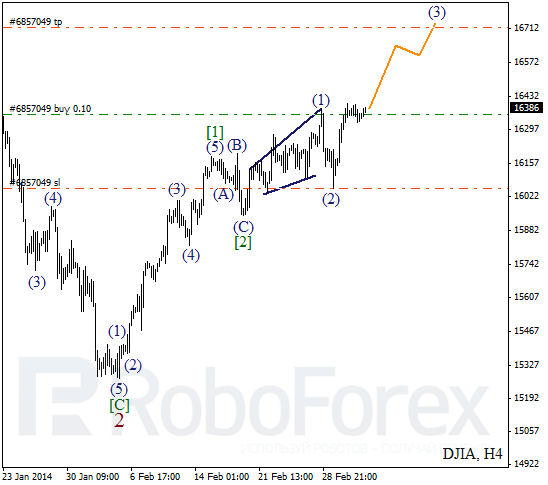
Index is still being corrected. Earlier, price completed bullish wedge pattern inside the first wave. Probably, right now Index is extending wave (3). Instrument may start new ascending movement during Thursday.
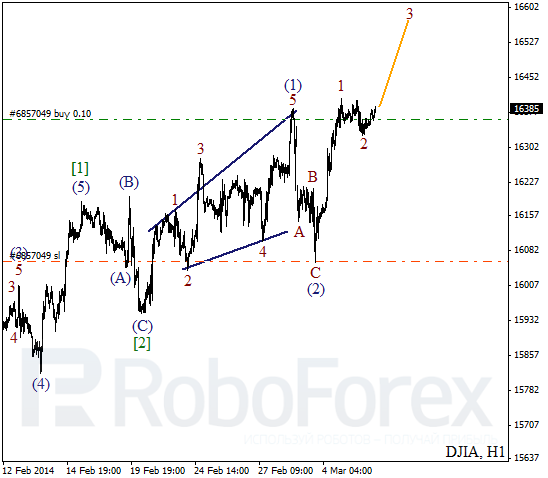
More detailed wave structure is shown on H1 chart. After completing zigzag pattern inside wave (2), Index formed bullish impulse inside wave 1. It looks like instrument is about to finish the second wave and may reach new maximums while forming the third one.
Crude Oil
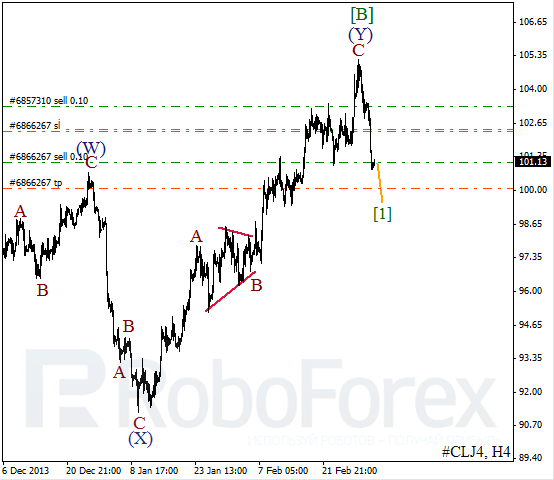
Oil started forming initial impulse inside wave [1], that’s why my yesterdays’ sell order was opened just in time. Most likely, after short pause, price will continue falling down.
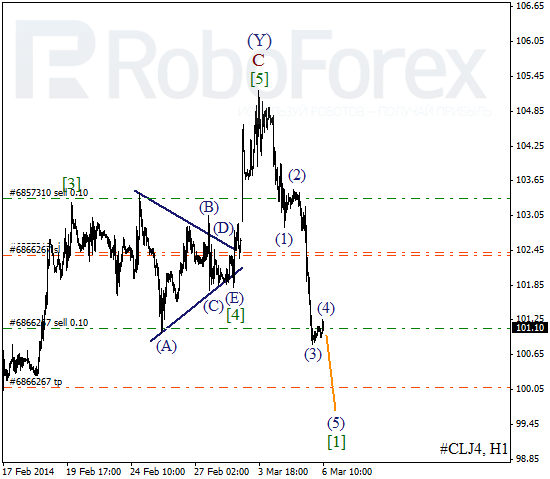
As we can see at the H1 chart, wave [5] of C turned out to be quite short. On minor wave level, right now price is finishing the fourth wave inside impulse [1]. During correction, I opened another sell order. Instrument is expected to start moving downwards in the nearest future.
RoboForex Analytical Department
Article By RoboForex.com
Attention!
Forecasts presented in this section only reflect the author’s private opinion and should not be considered as guidance for trading. RoboForex LP bears no responsibility for trading results based on trading recommendations described in these analytical reviews.
