Jan. 28 (Bloomberg) — John Paulson made a personal profit of $5 billion in 2010 after making $4 billion in 2007, the Wall Street Journal reported, citing people close to his investment firm Paulson & Co. Inc. Bloomberg’s Deirdre Bolton reports in today’s Movers & Shakers. (Source: Bloomberg)
Morning Market Snapshot: January 28th, 2011
Good Morning. It’s Friday, January 28, 2011. At this hour, U.S. equity futures are mixed. Overseas, the Asian markets were mixed , while the European markets are also mixed. Borders (BGP) receives refinancing commitment from GE Capital (GE)…Verizon (VZ) acquires Terrmark (TMRK) for $1.4B…Overstock.com (OSTK) files complaint against Goldman Sachs (GS) and Bank of America (BAC)…Microsoft (MSFT) sees business PC sales outpacing consumer sales…Pfizer (PFE) announced that the waiting period under the Hart-Scott-Rodino Antitrust Improvements Act of 1976 has been terminated in connection with the tender offer by its wholly-owned subsidiary, Parker Tennessee Corp., to purchase all outstanding shares of common stock of King Pharmaceuticals (KG) for $14.25 per share…
Forex News: US GDP rises by 3.2% in 4th Quarter
By CountingPips.com
The first “advance” estimate GDP report for the fourth quarter of 2010 showed that the US economy grew at a rate of 3.2 percent, according to today’s release by the U.S. Commerce Department.
The GDP number came in slightly below expectations as market forecasts were expecting the GDP to advance by 3.5 percent for the quarter.
The third quarter economic growth grew by a real 2.6 percent following a 1.7 percent growth rate in the second quarter and a 3.7 percent gain in the first quarter.
Overall for the 2010 calendar year, economic growth advanced by 2.9 percent after declining for the calendar year in 2009 by 2.6 percent.
On an annual basis, from the fourth quarter of 2009 to the fourth quarter of 2010, economic growth rose by 2.8 percent.
The second GDP estimate with more complete data will be released on February 25, 2010.
Forex Daily Market Commentary
By GCI Forex Research
Fundamental Outlook at 0800 GMT (EDT + 0400)
USD
Activity in FX markets was fairly subdued given the lack of news flow. The yen used the opportunity to claw back some of yesterday’s downgrade-driven losses against the dollar. EURUSD traded 1.3696-1.3744, USDJPY 82.58-82.98. The Nikkei 225 is -1.1% lower at the time of writing. Earlier the S&P 500 breached the 1300 level for the first time since Sept. 2008, but closed just below. Headline durable goods unexpectedly dropped but the ex-transportation figure increased, albeit by less than anticipated. Jobless claims jumped due to inclement weather and the Martin Luther King Day holiday, which indicates the jump does not reflect a material weakening in the labor market. Q4 GDP and the University of Michigan confidence index are due. Treasury Secretary Geithner speaks on the economy at Davos.
EUR
The euro benefited from hawkish remarks by ECB Executive Board member Bini-Smaghi. He highlighted his concerns over the effects of imported inflation in the Eurozone, noting that second-round effects can only be avoided if domestic inflation is “significantly lower than 2%”.
Greek Prime Minister Papandreou said Greece would not need to restructure its debt, but acknowledged that extending the maturity of EU/IMF loans would be beneficial and would help to calm financial markets. ECB President Trichet said a strong economic union is needed to strengthen EU ties and to keep those nations that exceed deficit and debt limits accountable.
We maintain our EURUSD forecasts as our team does not envisage an ECB rate hike until Q4. We also believe that over-optimism on a solution to Eurozone sovereign worries could ultimately lead to disappointment when any changes to the EFSF are finally announced.
TECHNICAL OUTLOOK
EURGBP targets 0.8672/91.
EURUSD BULLISH Targets the upper boundary of the 1.3741/86 resistance zone; break through this would expose 1.3825. Support at 1.3637.
USDJPY BEARISH Rise through 82.67 and 83.13 has exposed 83.68. Near term support is at 81.85.
GBPUSD BULLISH The pair eyes initial resistance 1.6017 ahead of 1.6059. Support comes in at 1.5843.
USDCHF BEARISH Focus is on 0.9390 ahead of 0.9301 key low. Initial resistance is at 0.9523.
AUDUSD BEARISH Momentum has shifted downside towards 0.9833/0.9804 support zone. Near-term resistance is at 1.0022.
USDCAD NEUTRAL 1.0004 and 0.9889 mark the near term directional triggers.
EURCHF BULLISH Break of 1.3069 would expose 1.3118. Near term support is defined at 1.2827.
EURGBP BULLISH Remains bullish targeting 0.8672/91 resistance zone. Initial support lies at 0.8582.
EURJPY BULLISH Positive momentum; initial resistance is at 114.94, breach of this would expose 115.68 next. Initial support lies at 112.45.
Forex Daily Market Commentary provided by GCI Financial Ltd.
GCI Financial Ltd (”GCI”) is a regulated securities and commodities trading firm, specializing in online Foreign Exchange (”Forex”) brokerage. GCI executes billions of dollars per month in foreign exchange transactions alone. In addition to Forex, GCI is a primary market maker in Contracts for Difference (”CFDs”) on shares, indices and futures, and offers one of the fastest growing online CFD trading services. GCI has over 10,000 clients worldwide, including individual traders, institutions, and money managers. GCI provides an advanced, secure, and comprehensive online trading system. Client funds are insured and held in a separate customer account. In addition, GCI Financial Ltd maintains Net Capital in excess of minimum regulatory requirements.
DISCLAIMER: GCI’s Daily Market Commentary is provided for informational purposes only. The information contained in these reports is gathered from reputable news sources and is not intended to be U.S.ed as investment advice. GCI assumes no responsibility or liability from gains or losses incurred by the information herein contained.
U.S. Advanced GDP on Tap
By Anton Eljwizat
Yesterday, Standard & Poor’s announced that their downgrading Japan’s credit ranking from AA- to AA, due to the sluggish economy that doesn’t seem to know how to address its sovereign debt of $11 trillion. This was the first time in nine years that S&P has cut Japan’s credit ranking.
The market, of course, had an immediate impact to this turn of events, and the Japanese yen instantly depreciated against all the major currencies, including a 100 pips fall against the U.S. dollar and the euro and the British pound. In the meantime since then, the yen has corrected come of its losses, but the Japanese currency is still trading at relatively low levels. It now seems that any further comment regarding the Japanese debts are likely to create similar responses in the market.
As for today, several significant economic releases are expected from around the globe. Here are the leading two:
• 10:30 GMT, Swiss KOF Economic Barometer
This is an index, which is designed to predict the direction of the economy over the next six months. The expectations are that the index result will be 2.09. However, if the end result will beat expectations, the CHF might strengthen as a result.
• 13:30 GMT, U.S. Advance Gross Domestic Product (GDP)
The GDP measures that change in the total value of all goods and services produced by the economy, and thus considered to be the primary gauge of the economy’s health. If the end result will reach projection to a 3.5% rise, the dollar might see a rising trend against its major currency rivals.
Forex Market Analysis provided by ForexYard.
© 2006 by FxYard Ltd
Disclaimer: Trading Foreign Exchange carries a high level of risk and may not be suitable for all investors. There is a possibility that you could sustain a loss of all of your investment and therefore you should not invest money that you cannot afford to lose. You should be aware of all the risks associated with Foreign Exchange trading.
Choppy Market Expecting USD Gains after Friday’s GDP Report
By Greg Holden
The events of this week have resulted in a rather sporadic and choppy trading environment.
Dismal GDP figures from Britain pushed harshly on sterling’s recent strength. Meanwhile, President Obama’s State of the Union address left many investors optimistic about broader tax overhauls and a possible reduction in corporate taxes, but speculators have already begun to anticipate Congressional gridlock instead of the cooperation necessary to undertake such measures.
Following today’s surprise jump in US unemployment claims, the greenback’s prices against the other major currencies appears uneasy. The EUR/USD was moving higher, breaching 1.3720 this morning, while the GBP/USD also rose towards 1.5980 before paring its recent gains and currently trading at 1.5955.
Rising consumer confidence has helped lift risk appetite, leading many traders away from the greenback and precious metals and back into higher yielding assets such as the EUR and CHF. But many have stated that the recent rise of these riskier currencies was too rapid and a technical correction could be developing before the week’s close.
Tomorrow’s Advance GDP publication from the United States (13:30 GMT) represents the only remaining figure to carry a significant impact on the major currencies this week.
The median estimate among the Market News International survey of economists is for a growth of 3.5%, but other forecasts range from 2.9% to 5.4%. Most investors are expecting a moderate level of growth in the US economy, in line with Obama’s overtures towards economic recovery in his State of the Union address this week.
It is possible that such a positive level of growth could signal another buy-in to American equities, pushing the USD higher in the short-run prior to the week’s end. This would also support the notion of a technical correction to the recent downturn in dollar values against most other currencies.
Forex Market Analysis provided by ForexYard.
© 2006 by FxYard Ltd
Disclaimer: Trading Foreign Exchange carries a high level of risk and may not be suitable for all investors. There is a possibility that you could sustain a loss of all of your investment and therefore you should not invest money that you cannot afford to lose. You should be aware of all the risks associated with Foreign Exchange trading.
S&P Cuts Japan’s Credit Ratings; Yen Falls in Response
Source: ForexYard
Yesterday’s most significant economic news was clearly the S&P’s announcement that Japan’s credit ratings will be downgraded from AA- to AA. The Japanese yen saw sharp falls against all the major currencies in response. In addition, disappointing U.S. economic data have weakened the dollar against the euro and the British pound.
Economic News
USD – Dollar Weakens Following Disappointing Economic Data
The U.S. Dollar fell against most of its major currency rivals on Thursday’s trading session. The dollar fell about 60 pips vs. the euro, and the EUR/USD pair reached a daily high of 1.3757. The greenback also dropped about 60 pips vs. the British.
The dollar fell yesterday after a report showed that the number of Americans that filed for the first time for unemployment benefits rose by 51,000 to 454,000 in the week ended in January 22. The end results failed to reach expectations for 407,000 claims. In addition, the total value of new purchase order placed with manufacturers for durable goods unexpectedly fell in December by 2.5%, failing to reach projection for a 1.6% rise.
The dollar’s fall has been moderated due to some positive data. The number of Americans singing contracts to buy previously owned homes rose in December by 2.0%, following a revised 3.1% gain the prior month. Positive data from the American housing sector are vital for the economy, as this remain the most fragile sector in the industry. In addition, orders for U.S. Capital equipment increased in December for the second month in a row. Bookings for equipment like computers and communications gear climbed by 1.4 after a 3.1% gain in November.
As for today, the most significant news event from the U.S. economy looks to be the Advance Gross Domestic Product (GDP). The GDP measures the change in the value of all goods and services produced by the economy, and its release usually has a large impact on the market. Traders are also advised to follow the Consumer Sentiment report which will be released from the University of Michigan.
EUR – Euro Strengthens After ECB Warns Of Imported Inflation
The euro rose against most of the major currencies during yesterday’s trading session. The 17-nation currency gained about 60 pips vs. the U.S. dollar and about 30 pips against the British pound. The euro also saw a 120 pip gain vs. the Japanese yen.
The euro strengthened yesterday after two leading European Central Bank policymakers warned of a rising trend of imported inflation. The policymakers have issued the warning after inflation exceeded the ECB’s preferred level of just below 2% for first time in two years in December, hitting 2.2 %.
Lorenzi Bini Smaghi, one of the six ECB executive board members, said that a permanent and repeated increase in the prices of imported products will tend to impact on inflation in the advanced countries, including the euro area. Bini Smaghi added that the ECB should address the rising inflation; otherwise monetary policy has to become more restrictive than it should be which leads to slower growth.
Looking ahead to today, the most significant economic release from the euro-zone seems to be the M3 Money Supply report. This report measures the change in the total quantity of domestic currency in circulation and deposited in banks. A positive data has potential to further support the 17-nation currency against its major rivals.
JPY – Yen Tumbles as S&P Cuts Japan’s Credit Ratings
The Japanese yen fell against all its major currency counterparts yesterday. The yen fell about 90 pips vs. the U.S. dollar, and about 120 pips vs. the euro. The yen also dropped about 150 pips against the British pound, and the GBP/JPY cross reached as high as the 132.65 level.
The Japanese currency slid yesterday after Japan’s credit rating was downgraded for the first time in nine years by the Standard & Poor’s. Japan’s credit rating was lowered to AA- from AA. The credit rating was lowered due to persistent deflation and as political gridlock undermined efforts to reduce an $11 trillion debt burden. As a result, the yen instantly slid against all the major currencies.
As for today, no significant release is expected from the Japanese economy. Traders are advised to follow official comments from the Japanese leadership regarding the credit rating cut; any development on this issue is likely to have a large impact on the Japanese currency today.
Crude Oil – Crude Oil Falls To $85.10 a Barrel
Crude oil prices continued to plunge on Thursday’s trading session. Crude began yesterday’s trading session at $87.50 a barrel. The session began with a fall to $86.30 a barrel, which was promptly corrected. Yet by midday another sharp fall took place, and crude reached as low as $85.10 a barrel.
Crude dropped yesterday on concern that the pace of fuel demand recovery in the U.S. will falter. The U.S. is the world’s biggest crude-consuming nation, and a reduced demand for oil in the U.S. has a negative impact on crude prices. In addition, crude fell after Japan’s credit rating was cut by Standard & Poor’s, which stated that the Japanese government lacks a coherent strategy to reduce the nation’s debt.
Looking ahead to today, traders are advised to follow the leading economic releases from the U.S. and the euro-zone as these usually have a large impact on crude prices. Traders should also follow any developments regarding the Japanese credit cut, as this may also play a leading role in today’s trading.
Technical News
EUR/USD
There is a very distinct bullish channel formed on the 4-hour chart, as the pair is currently floating in the middle of it. In addition, as the MACD on the daily chart continues to point upwards, it seems that the pair might see another bullish session today. Going long with tight stops might be the right choice today.
GBP/USD
The cable has been range-trading over the past 12 days, staying between the 1.5750 and the 1.6000 levels. Currently, after the pair saw another failed attempt to cross the 1.6000 level, a bearish correction might be in place, with potential to reach as low as the 1.5800 level.
USD/JPY
The USDJPY pair saw a sharp 100 pips climb yesterday, reaching as high as the 83.20 level. Since then, the pair is gradually correcting losses, and is currently treading near the 82.70 level. As a bearish cross has just taken place on the 4-hour chart’s Slow Stochastic it looks that the bearish correction might proceed today. Going short with tight stops might be the right strategy today.
USD/CHF
The USD/CHF pair has been flat trading for the past three days, as the pair is constantly trading near the 0.9430 level. Nevertheless, as the daily chart’s RSI is cross the 30-line, it seems that a bullish move might be impending. Going long might be the preferable choice today.
The Wild Card
Gold
Ever since gold peaked at $1,422 an ounce about three weeks ago, it has steadily corrected its gains, and is currently trading near the $1,310 level. In addition, as both the MACD and the RSI on the daily chart are providing bearish indications, it seems that gold may drop further today. This might be a great opportunity for forex trader to join a very popular trend.
Forex Market Analysis provided by ForexYard.
© 2006 by FxYard Ltd
Disclaimer: Trading Foreign Exchange carries a high level of risk and may not be suitable for all investors. There is a possibility that you could sustain a loss of all of your investment and therefore you should not invest money that you cannot afford to lose. You should be aware of all the risks associated with Foreign Exchange trading.
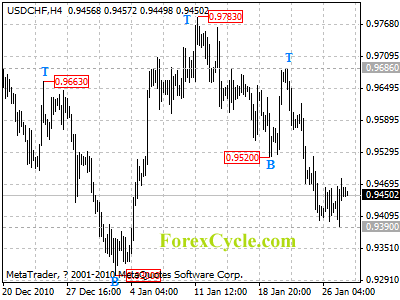
USDCHF remains in downtrend from 0.9783
USDCHF remains in downtrend from 0.9783, the bounce from 0.9390 is treated as minor consolidation of downtrend. Range trading between 0.9390 and 0.9550 would likely be seen in a couple of days. As long as 0.9550 resistance holds, downtrend could be expected to resume and one more fall towards 0.9300 previous low is still possible. Only break above 0.9550 could indicate that the fall from 0.9783 had completed at 0.9390 already, then the following upward move could bring price back to 0.9600-0.9700 area.
Soros Says Greece, Ireland Can’t Wait for Restructuring
Jan. 27 (Bloomberg) — Billionaire investor George Soros talks about the European sovereign debt crisis, the outlook for commodities and the U.S. deficit. He speaks with Erik Schatzker on Bloomberg Television’s “On The Move” from the World Economic Forum meeting in Davos, Switzerland.
What Most People Don’t Realize About The Fed’s Superpowers
Bob Prechter’s Conquer The Crash reveals whether the Fed really can rescue the US economy
By Elliott Wave International
Since its creation in 1913, the primary intended role of the U.S. Federal Reserve Bank has been that of protector. In theory, the central bank was bestowed with the power to shape monetary policy in a way that would keep both booms and busts in check. The two main tools at its disposal — interest rates and money creation — would provide a “ceiling of normalcy” above expansions AND a “net of safety” below contractions.
To this day, the financial mainstream holds great faith in the Fed’s ability to fulfill its save-the-day duties — as these recent news items make plain:
- “Why Raising Fed Funds Rate Is Positive For Equities.” (Seeking Alpha)
- “Fed’s Moves Lift All Asset Classes.” (Associated Press)
- “US Stocks Erasing Losses: The aggressive moves of the Fed have been an important driver for the stabilization of stock prices.” (Bloomberg)
But of all the variables the Fed creators took into account, there’s one glaring factor they neglected to consider: Namely, it cannot force consumers to spend, creditors to lend, or businesses to borrow. The events of 2007-2009 “credit crunch” and the subsequent “Great Recession” made that obvious. Remember how the government was upset at banks for sitting on the bailout funds instead of lending them out to consumers? And consumers weren’t exactly lining up on the street to get a loan, either.
The Fed’s inability to change social mood is the central theme in Chapter 13 of EWI President Bob Prechter’s NY Times business bestseller book Conquer the Crash. There, Bob describes the Fed’s strategy of lowering the federal funds rate to stimulate spending to be as effective as “pushing on a string.” Writes Bob:
“The primary basis for today’s belief in perpetual prosperity and inflation with an occasional recession is what I call the ‘Potent Directors Fallacy.’ It is nearly impossible to find a treatise on macroeconomics today that does not assert or assume that the Federal Reserve Board has learned to control both our money and our economy. Many believe that it also possesses the immense power to manipulate the stock market. The very idea that it can do these things is false.”
And so begins one of the most groundbreaking studies into the very real INABILITY of the Fed to fell the great bears of economic declines, or to feed the great bulls of economic vigor.
The best part is, you can read Chapter 13 of Conquer the Crash in its entirety FREE via a Club EWI resource “You Can Survive And Prosper In A Deflationary Depression.” The free report also includes SEVEN other chapters of Conquer the Crash that shed equal light on some of the most misleading notions of mainstream economic wisdom.
Don’t stay in the dark. Read all 8 chapters today by joining the rapidly expanding free Club EWI community today. Here’s what you’ll learn:
- Chapter 10: Money, Credit and the Federal Reserve Banking System
- Chapter 13: Can the Fed Stop Deflation?
- Chapter 23: What To Do With Your Pension Plan
- Chapter 28: How to Identify a Safe Haven
- Chapter 29: Calling in Loans and Paying off Debt
- Chapter 30: What You Should Do If You Run a Business
- Chapter 32: Should You Rely on Government to Protect You?
- Chapter 33: A Short List of Imperative “Do’s” and Crucial “Don’ts”
Keep reading this free report now — all you need to do is create a free Club EWI profile.
This article was syndicated by Elliott Wave International and was originally published under the headline Basic Wave Patterns: How a Zigzag Differs from a Flat. EWI is the world’s largest market forecasting firm. Its staff of full-time analysts led by Chartered Market Technician Robert Prechter provides 24-hour-a-day market analysis to institutional and private investors around the world.
