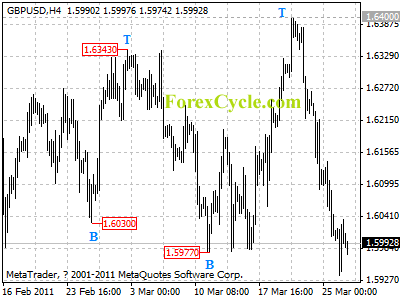
GBPUSD’s fall extended to 1.5936

GBPUSD’s fall from 1.6400 extended further to as low as 1.5936. Resistance is at 1.6045, as long as this level holds, downtrend from 1.6400 could be expected to continue, and next target would be at 1.5800-1.5900 area. However, a break above 1.6045 will indicate that a cycle bottom is being formed on 4-hour chart, then another rise towards 1.6400 previous high could be seen.

gbpusd

Forex Signals

Nokia Up 5% on Analyst Upgrade to ‘Buy’ at Goldman Sachs

Nokia Corp. (NOK) is up 4.55% to $8.73 in the early trade, after Goldman Sachs lifted its rating to “buy” from “neutral.” Goldman analysts have reportedly said the company is now in a period of “maximum uncertainty, creating a long-term opportunity for value investors.” The analysts also said that the market was being too pessimistic over Nokia’s recent joint venture with Microsoft Corp. (MSFT), according to news reports citing the analyst move.

Still Enough Time to “Conquer the Crash?”

Why a New York Times Bestseller Remains Relevant Now
March 28, 2011

By Elliott Wave International

“If you were fortunate enough to have read the first edition of Robert Prechter’s Conquer the Crash, your money was safe and sound as stocks, real estate, commodities and many bonds plummeted.”
Conquer the Crash, 2nd edition, (quote from inside book sleeve)

The New York Times bestseller Conquer the Crash published in 2002: As the quote above suggests, Bob Prechter advised readers to avoid risky assets and embrace cash and cash equivalents.

But did the 2007-2009 declines represent all of the bear market? And is the “Great Recession” over?

Many financial commentators believe the answer to both questions is “yes.” The latest Elliott Wave Theorist reports on attitudes toward the rally of the past two years:

“…sentiment measures today do not indicate caution, skepticism and disbelief but rather multi-year extremes in optimism among five sets of market players: individual investors, futures traders, options traders, newsletter advisors and mutual fund managers.”

Regarding the economic outlook, the March Elliott Wave Financial Forecast notes a recent business story headline which reads, “Good Times Ahead.” The story quotes a top banker saying, “Businesses have plenty of capital and are starting to expand again.”

The same issue of the Financial Forecast also reminded subscribers that the fear of inflation remains widespread:

“When Fed Chairman Ben Bernanke touched on the ‘politically volatile subject of inflation’ in [recent] Congressional testimony, the blogosphere erupted with proclamations about runaway prices across the board. Here’s one sample, ‘There can be only one possible result. Inflation of everything we use is going to explode.'”

Yet Robert Prechter has another perspective on market optimism, a business climate “turnaround,” and notions of runaway inflation. That is why he updated the second edition of Conquer the Crash to include 188 new pages.

These new pages include “updated lists of banks, insurers and Treasury-only money market funds in the U.S., top-rated for safety.”

More than ever, Prechter emphasizes safety. In a word, it’s the key to conquering a severe market downturn. Follow the advice about safety in CTC, 2nd edition, and you’ll be better prepared for a deflationary depression.

Elliott Wave International has put together a FREE, 8-lesson report based on Conquer the Crash, 2nd edition. This free, 42-page report can help you prepare for the future — financially and economically!Why not read 8-Lesson: Conquer the Crash Collection”? It’s FREE!

Become a member of Club EWI (membership is also free), and you’ll have immediate access to “8 Lesson: Conquer the Crash Collection.” Just follow this link and you’re on your way to financial peace of mind.

This article was syndicated by Elliott Wave International and was originally published under the headline Still Enough Time to “Conquer the Crash?”. EWI is the world’s largest market forecasting firm. Its staff of full-time analysts led by Chartered Market Technician Robert Prechter provides 24-hour-a-day market analysis to institutional and private investors around the world.

Wosnitzer Says Goldman `Fudges the Line’ on Volcker Rule

March 28 (Bloomberg) — Robert Wosnitzer, former corporate bond salesman at Lehman Brothers Holdings Inc., talks about Goldman Sachs Group Inc.’s Special Situations Group. Goldman has shut two units that made bets with the company’s money because such proprietary trading by banks will be prohibited under the Volcker rule approved by Congress last year. Still, the Special Situations Group, known as SSG, continues to make investments and named a new global head last month. Wosnitzer talks with Erik Schatzker on Bloomberg Television’s “InsideTrack.” (Source: Bloomberg)

Week Ahead Market Report: 3/28/2011

Investors this week will continue to monitor the news out of Japan and Libya, as President Obama prepares to address the nation tonight. Good morning, Im Sayoko Murase, with the Week Ahead Market Report for March 28, 2011.

How to “Outsmart” the Financial Market

By Jared Levy, Editor, Smart Investing Daily, taipanpublishinggroup.com

Yesterday was one of the most exciting days of my life. At 12:00 a.m. Thursday, my first book, titled Your Options Handbook, hit the shelves for sale around the world. It is the culmination of many years of work and observations. I’m not writing today to sell you a copy (although I certainly wouldn’t mind if you picked one up!), but rather to share some excerpts from one of the chapters with you.

Yesterday was also Harry Houdini’s birthday. Harry was a gifted and talented escape artist who defied death many times throughout his career. He was shackled in Chinese water torture cells, locked in steamer trunks and thrown into the ocean, and even buried alive! He survived all these amazing and dangerous escapes, but yet a relatively minor physical feat may have led to his untimely end.

Harry’s death, caused by secondary infection and inflammation stemming from a ruptured appendix, was purportedly set in motion by a student, J. Gordon Whitehead, who delivered multiple punches in succession to Houdini’s stomach in Houdini’s dressing room. Houdini was known for his ability to be struck in the abdomen without feeling pain.

You see, Harry had made this claim for years and had taken blows before without incident. He was caught off guard and didn’t have time to tighten his stomach muscles when Whitehead immediately began landing blows. In this weakened, unprepared state, those punches may have ended up costing Harry his life.

How Does This Relate to the Financial Markets?

In the stock market, we can find ourselves in weakened “mental states” for many reasons. Perhaps we had a string of losing trades and have lost a substantial amount of capital, which may make us not only vulnerable, but skittish, scared and desperate, all of which may cause us to make trading mistakes.

With all that is going on around the world and the increased volatility out there, the only place we can exercise calm and control is with ourselves.

To prevent trading mistakes, you must not only have a solid investment plan in place, but also make yourself aware of your “psychological capital.” Denise Shull, a prominent trading psychologist and coach, contributed a chapter in my options trading book on this subject.

In the book, she notes:

Psychological capital includes your technical knowledge of the stock market, but 99% of it is the net account balance of how you feel — energetic, clearheaded, and calmly confident. If that describes your state, you in effect have a psych cap account of a million dollars.

If you don’t or haven’t slept well, haven’t eaten, or are angry at your teenager, your psych cap has been debited and your trading decisions will not be of the same quality that they could be.

In short, you can think of psych cap as the state of mind and body when you truly and completely feel good. To relate the idea to something you might be familiar with, a synonym might be frame of mind.

Here are a couple of exercises from my options trading book to keep your psych capital at its peak. Remember it’s all about having awareness and control over your emotions!

(By the way, options trading doesn’t have to be complicated. Sign up for Smart Investing Daily and let me and my fellow editor Sara Nunnally simplify the stock market with our easy-to understand articles.)

Psych Cap Exercise No. 1: Getting Clear-Headed

Define your strategy — that is, a written, one-paragraph plan with a list of specific pieces of information and market events you will look for in order to know when you want to enter the market. After you have that list, write out (again, in one paragraph) what you are going to do to enter the market and next, and more importantly, what signals or events will tell you to exit the market.

This exercise should be done on a Saturday or Sunday afternoon or a holiday. In other words, at some point when the financial markets are truly not open and you can’t be looking at the charts! What is the reason for this? You want to know it by heart and it is easy to fool yourself if you try to do this while you are simultaneously looking at the market. Write out in detail the objective signals and parameters you are looking for (soup to nuts).

Now, let me point out (in case it isn’t clear) that this exercise actually requires that you work hard. It isn’t that easy. But think about it…if it were that easy then wouldn’t everyone be able to do it? You want to do not only the work that others won’t bother to do but also the kind of work that others don’t even know to do.

After all, remember that they are focusing on analyzing the numbers while you are figuring out how to analyze the financial markets, other people’s perceptions and your own semiconscious biases.

By getting the basic market stuff out of the way on the weekend, you can be focused on exploring all of your perceptions (explicit and conscious) while simultaneously remembering to put all of your decisions within the overt context of the foundation question:

What will other people be likely to perceive when I want out of my trade?

Remember, the key to being successful in the financial markets is not just knowing what “you believe” about the markets, but rather what the masses “perceive” is happening and how they will act.

Psych Cap Exercise No. 4: Get a Grip

Try to get a handle on these feelings outside of investing or trading; that will make them much easier to recognize when you are under the influence of the stimulation of moving markets. All you are looking for is the footprint in your body/psyche of an intuitive feeling versus an impulsive or compulsive “I have to do something” feeling.

The truth is that our psyches are actually very good at pattern recognition. Some would argue that in fact, pattern recognition defines intelligence. (Think about many of the problems in an IQ test; many are pattern matching.)

Likewise, we have a tendency to see patterns in market data where none exist. I suggest that tendency takes us back to our aversion to uncertainty and our need to feel as if we are in control, or the behavioral gang’s “Illusion of Control.”

Learning to differentiate the physical experience of intuition versus the physical experience of an impulsive (compulsive?) feeling gives you the objective you want to shoot for!

Takeaways

If you’re thinking that this psychological action doesn’t apply to investing and stock markets, think again. There are two primary — and some might say primal — emotions that drive markets: fear and greed. Being centered and calm and having a well-formed plan are crucial to investment portfolio management.

Know your plan of attack and your strategy and write it down. If your strategy looks irrational on paper, it probably is! Go through the details of what you want out of an investment and what you believe the risks are. Remember that you DON’T have to make every trade.

Know yourself, your tendencies and the emotions that are present in your life. If you are making investment decisions because of other factors, you are probably making a mistake. You may get lucky and make money, but in a weak emotional state, you may not be prepared if things go wrong.

Editor’s Note: The results are in. On December 31, the WOW model portfolio showed subscribers how they could have racked up a cool $1 million. If that’s not enough, it just posted big winners of up to 171%, 204% and 311%… in January alone! To mark the occasion, we’re guaranteeing 200 “first responders” a special offer plus four free picks… Go here to get your free options picks.

About the Author

Jared Levy is Editor of WaveStrength Options Weekly, our options trading research service and Co-Editor of Smart Investing Daily, a free e-letter dedicated to guiding investors through the world of finance in order to make smart investing decisions. His passion is teaching the public how to successfully trade and invest while keeping risk low.

Jared has spent the past 15 years of his career in the finance and options industry, working as a retail money manager, a floor specialist for Fortune 1000 companies, and most recently a senior derivatives strategist. He was one of the Philadelphia Stock Exchange’s youngest-ever members to become a market maker on three major U.S. exchanges.

He has been featured in several industry publications and won an Emmy for his daily video “Trader Cast.” Jared serves as a CNBC Fast Money contributor and has appeared on Bloomberg, Fox Business, CNN Radio, Wall Street Journal radio and is regularly quoted by Reuters, The Wall Street Journal and Yahoo! Finance, among other publications.
What’s In The News: March 28, 2011

The Wall Street Journal reports NASDAQ OMX (NDAQ) and IntercontinentalExchange (ICE) remain in discussions for a possible joint bid for NYSE Euronext (NYX), but hurdles are yet to be overcome including what price to offer…WSJ also reporting Google (GOOG), MasterCard (MA) and Citigroup (C) are teaming up to embed mobile payment technology in Android mobile devices that would allow consumers to pass their smartphones in front of a reader to make a purchase…The Detroit News is reporting that, due to reports that faulty side front windows have shattered, Honda (HMC) issued its second recall in the last week for the 2011 Odyssey minivan…Bloomberg reports that, in an effort to reduce debt, roller bearings maker Schaeffler Group is selling $2.5B worth of Continental AG (CTTAY) shares…Finally, Reuters reports Roche (RHHBY) won’t be up for sale and one investor’s exit from the group’s controlling shareholder pact doesn’t mean the family is running away from the Swiss drugmaker. Roche Vice Chairman Andre Hoffmann, also spokesman for the family group, says the shareholders would continue to protect Roche’s independence.

European Wrap: Usual Monday dross; By FastBroker Research Team

Written by FastBrokers House

EUR/USD sits at 1.4045, some 9 pips below where it was when I came onboard.  Buy orders seen 1.4000/20, sell orders 1.4090/00 and neither set of orders ever really looked threatened.

Cable down at 1.5975 from early 1.6010, having been as low as 1.5934 at one stage.  Stops tripped through 1.5980 and 1.5950 accelerating the sell-off.  Investment bank selling noted.  Also reports of large sell order in GBP/AUD going through early, said to be linked to insurance payments for Queensland floods.

EUR/GBP up at .8795 from early .8775, real money buying noted out of the gate.   Talk of stops above 8820, but also conflicting reports of sell orders lined up in .8820/30 area.  In the end we got as high as .8819 before turning south.

AUD/USD up at 1.0280 from early 1.0260, having been as high as 1.0314 as 1.0300 barrier option interest was taken out.  Talk of decent GBP/AUD sell interest helped buoy the pairing.  As did the Reserve Bank of Australia tipping huge capital inflows (see above)

USD/CHF down at .9185 from early .9210,  EUR/CHF down at 1.2903 from around 1.2943, having been as low as 1.2889. Swissy garnered a little strength from IMF raising spectre of early SNB rate hike.

USD/JPY unchanged at 81.70 in very quiet trade.


Market Commentary provided by FastBrokers.

Disclaimer: FastBrokers’ market commentary is provided for information purposes only and under no circumstances should be regarded neither as an investment advice nor as a solicitation or an offer to sell/buy any financial product. FastBrokers assumes no responsibility or liability from gains or losses incurred by the information herein contained.

Risk Disclosure: There is a substantial risk of loss in trading futures and foreign exchange. Please carefully review all risk disclosure documents before opening an account as these financial instruments are not appropriate for all investors.

Asian market wrap; By FastBroker Research Team

Written by FastBrokers House
2011-03-28 00:00

EUR/USD opened lower in Asia after closing in NY at 1.4080 on Friday. The heavy losses suffered by Angela Merkel in German regional elections were the main reason. Heavy stops were triggered below 1.4050 but strong bids emerged starting at 1.4020 and they stalled bearish momentum. Ranges: EUR/USD 1.4019/69, EUR/CHF 1.2912/54

USD/JPY has ground its way higher throughout the day as the bulls have been heartened by reports that Kampo has been consistently buying during last week and also that the offers near 82.00 are much smaller than they were on the intervention day. Ranges: 81.33/78, EUR/JPY 114.19/94

The AUD has maintained the strength shown last week with option buyers now joining in on the M&A flows. Barrier options at 1.0300 are stalling for now but bullish momentum remains strong. Ranges: 1.0232/66

Cable also opened lower after the London riots and the Posen comments also added to bearish sentiment. It was unable to break below strong bids near 1.6000 but the much deeper European market is likely to test it again. Ranges: Cable 1.5998/1.6020, EUR/GBP .8758/85

Market Commentary provided by FastBrokers.

Disclaimer: FastBrokers’ market commentary is provided for information purposes only and under no circumstances should be regarded neither as an investment advice nor as a solicitation or an offer to sell/buy any financial product. FastBrokers assumes no responsibility or liability from gains or losses incurred by the information herein contained.

Risk Disclosure: There is a substantial risk of loss in trading futures and foreign exchange. Please carefully review all risk disclosure documents before opening an account as these financial instruments are not appropriate for all investors.