Why Many Investors Are Struggling To Make Money In 2011

By James Woolley

At the time of writing we are coming to the end of the first quarter of 2011, and it appears as if investors are finding it difficult right now. You only have to visit some of the investing forums to see evidence of this. So why is 2011 proving to be such a challenging year for investors so far?

Well for a start there is the obvious fact that the markets are trading lower than they were earlier in the year. This means that most mid and large cap stocks will have fallen in line with the overall markets. Plus it has also been the case that many smaller stocks have fallen quite a lot as well, which doesn’t always happen.

There will be a lot of traders and investors who will have minimized their losses by using tight stop losses or selling most, if not all of their stocks at the first sign of a downturn. There will be others who are in it for the long run and continue to hold good quality growth stocks despite the recent downturn. However many investors will have banked a few losses or seen their overall portfolio take a hit.

The fact is that you really get to separate the really good investors from the average or poor ones whenever the overall market falls. Anybody can make money in a bull market when most stocks keep on rising because you could be invested in pretty much any mid or large stock and still make decent amounts of money.

However I have noticed that a lot of pretty good investors have not fared too well in 2011. This is most probably because there is an awful lot of unrest around the world at the moment. We have had the Japanese tsunami which has caused major problems in Japan, and there are the obvious problems in Libya and a few other middle eastern countries. All of which makes it very difficult to predict where the markets are headed.

Before all these problems there was an optimistic feel about the markets. Companies were reporting much better earnings and the major economies were starting to look a lot better. However these unforeseeable events have certainly dented this optimism and we now find ourselves at the mercy of world events to a large extent.

So it is easy to see why 2011 has been such a difficult year to make money for many stock market investors. It is not going to get any easier either in my opinion because even if the markets do not fall very much from now on, we are still heavily influenced by events around the world, and unfortunately no-one can possibly predict how they will turn out at this precise moment.


About the Author

Click here to read a full review of the Portfolio Prophet ETF software, and to read all about Zecco Trading, one of the leading online stock brokers.
Big Forex Trading Profits ‘ Use Good Strategies To Earn This

By Cedric Welsch

If you want to be a player in the Forex market, you are not alone. Many investors have been able to use Forex trading for maximum profit, and you can easily get your own piece of the pie. Trading in the market is an excellent way to make your money work for you. There are numerous strategies that you can use to maximize the profits that you earn. Before you lay any of your money down though, it is a good idea to have your, “battle plan,” already mapped out.

Before investing your money, you should watch the market for a good 2 weeks or so, at the very least. Make investment choices using the ideas that you already have, but don’t put any real money down. Play and trade with imaginary money, and see how well you do. Learn whether the strategies you are planning to use are likely to bring you the returns you desire. You should also watch general trends. Is it in an upward or downward slope?

Choosing your currency pairs ahead of time is a good idea as well. Different pairs will have different ask spreads, along with different bid spreads, the volatility will also be different. The reason you choose your currency pairs in the beginning is because the pair that you choose, might dictate the trading strategy, or “battle plan,” you finally decide to implement.

Next you should decide what kind of trader you would like to be. Some people have had great success with technical trading. If you are a technical trader, you will likely use different indicators to try and predict price fluctuations electronically. Other traders have done well with news trading. News traders, as the name indicates, trade based on information they’ve learned by following World news and events. They also use tools called Forex Trading Calendars. These calendars document when a news event occurs that will likely affect price changes.

Sometimes the Forex market can be intimidating to a newbie because of the math that can be involved with trading. You might come across terms like moving averages, stochastic, and movements in the market, etc. If you feel nervous about these terms, you should take a little more time learning the market before you start investing.

Either take a beginners course, or study on your own for at least 6 months before you start investing. If you study like this, you will find the this type of investment to be an easy and quick way to make money, and you will be able to use Forex trading for maximum profit.

About the Author

Better and reliable fx news is irreplaceable to forex success.
Including broker forex review with that news reading should be wise.

FOREX: Large Currency Speculators trim USD Shorts. GBP, JPY positions fall.

By CountingPips.com

The most recent Commitments of Traders (COT) report, released on Friday by the Commodity Futures Trading Commission (CFTC), showed that futures speculators decreased short positions of the US dollar against the other major currencies. Non-commercial futures positions, those taken by hedge funds and large speculators, were overall net short the US dollar by $27.77 billion against other major currencies as of March 29th. This is a decline from the total short position of $29.82 billion on March 22nd, according to the CFTC data and calculations by Reuters which calculates the dollar positions against the euro, British pound, Japanese yen, Australian dollar, Canadian dollar and the Swiss franc.

This week’s notable changes included Japanese yen positions declining sharply after two straight weeks of increases, British pound sterling positions falling back towards the short side after a gain last week and Australian dollar positions rising to the highest level in over a year.

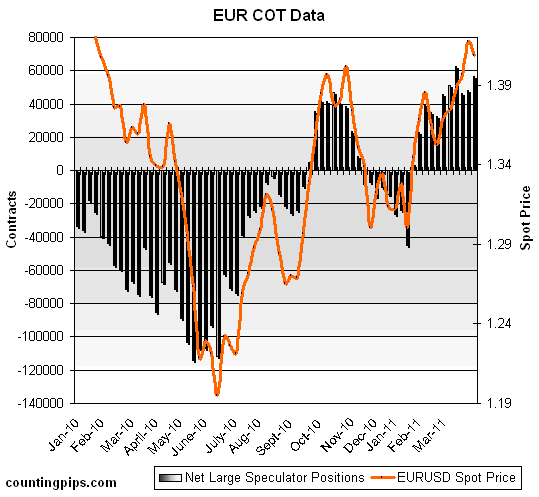
EuroFx: Currency speculators increased their net long positions for the euro against the U.S. dollar for second consecutive week. Futures positions in the euro rose to a total of 56,630 long positions as of March 29th following a total of 48,353 long positions on March 22nd.

euro cot

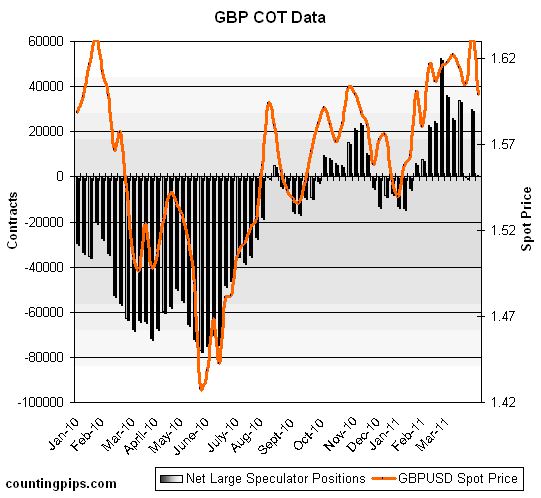
The COT report is published every Friday by the Commodity Futures Trading Commission (CFTC) and shows futures positions as of the previous Tuesday. It can be a useful tool for traders to gauge investor sentiment and to look for potential changes in the direction of a currency or commodity. Each currency contract is a quote for that currency directly against the U.S. dollar, where as a net short amount of contracts means that more speculators are betting that currency to fall against the dollar and net long position expect that currency to rise versus the dollar. The graphs overlay the forex spot closing price of each Tuesday when COT trader positions are reported for each corresponding spot currency pair.

GBP: British pound sterling bets fell as of the March 29th data release. GBP fell to a total of 743 long contracts as of March 29th after registering 29,724 long contracts on March 22nd.

GBP cot, british pound sterling GBPUSD

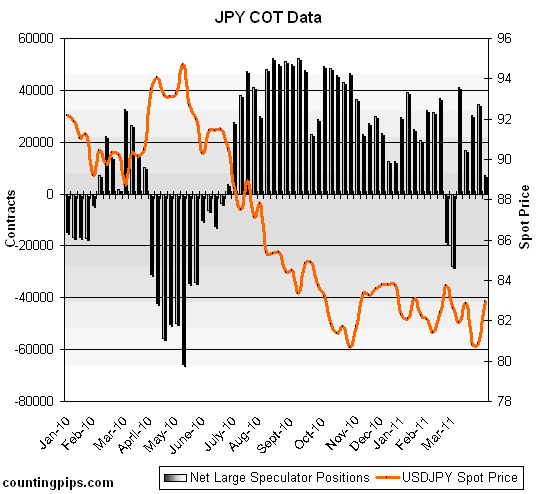
JPY: The Japanese yen net contracts fell sharply after advancing for two straight weeks. Yen contracts dropped to a total of 7,052 long contracts following a total of 34,525 net long contracts reported on March 22nd.

USDJPY, JPY COT Data

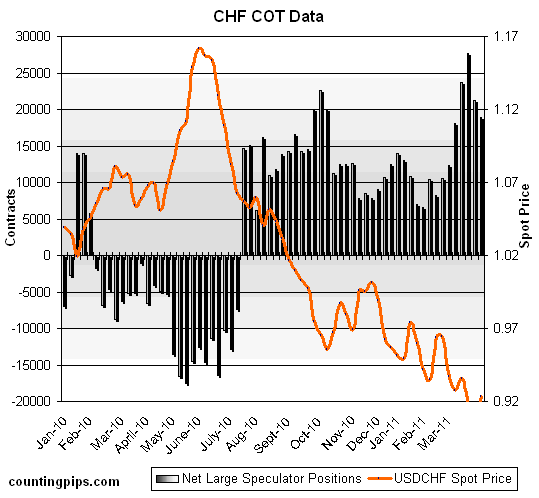
CHF: Swiss franc long positions fell for second straight week as of March 29th. Franc positions declined to a total of 18,957 net long contracts as of March 29th following a net of 21,301 long contracts on March 22nd.

USDCHF, CHF COT Data

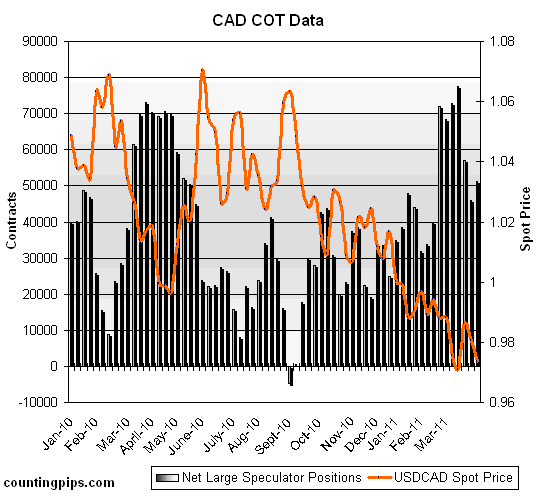
CAD: The Canadian dollar positions turned higher after a decline for two consecutive weeks. CAD positions rose to a total  of 51,245 contracts as of March 29th. CAD net contracts had declined to a total of 45,977 net long contracts as of March 22nd.

USDCAD COT Data

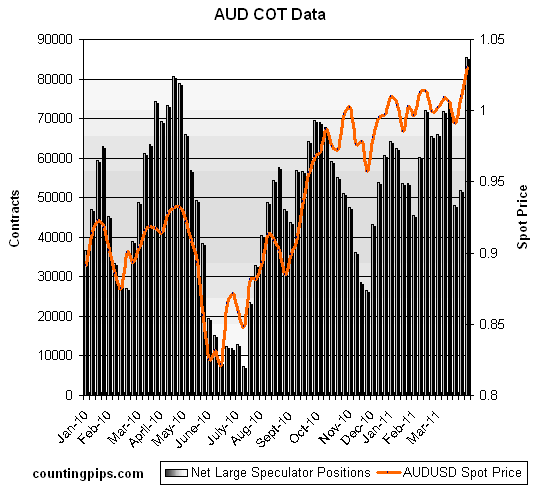
AUD: The Australian dollar long positions jumped sharply higher last week to the highest level in over a year. AUD contracts totaled a net amount of 85,565 long contracts as of March 29th after AUD positions had totaled 51,734 net long contracts on March 22nd.

AUDUSD, AUD COT Data

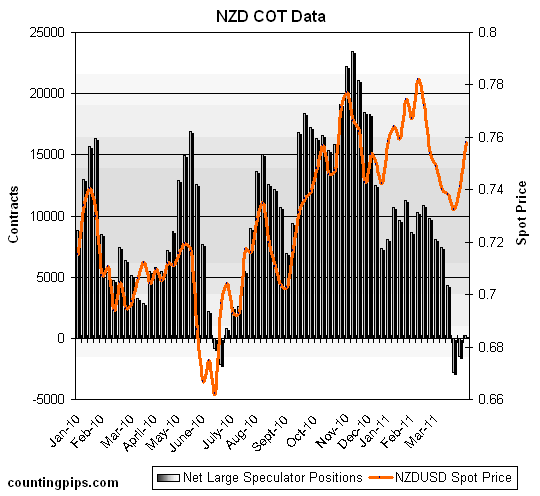
NZD: New Zealand dollar futures positions edged slightly higher for a second consecutive week. NZD contracts increased to a total of 239 long positions as of March 29th from a total of 1,482 short contracts on March 22nd. NZD contracts had fallen for five consecutive weeks through March 15th.

NZDUSD, NZD COT Data

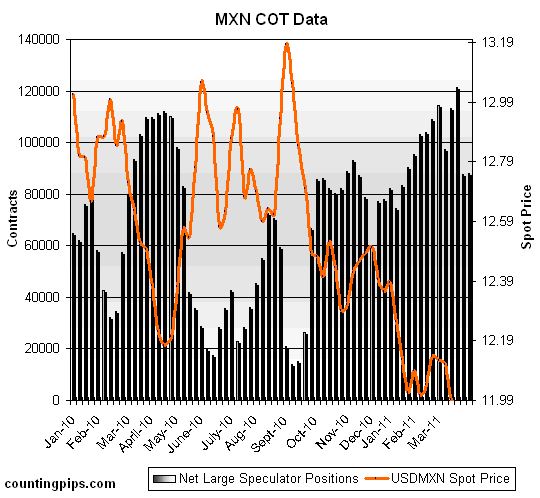
MXN: Mexican peso long contracts fell to almost unchanged from the previous week at a total of 88,075 net long contracts on March 29th. MXN positions had totaled 87,548 long contracts as of March 22nd. The MXN positions on March 15th had represented the highest level in over a year.

MXN, USDMXN COT Data

COT Data Summary as of March 29, 2011
Large Speculators Net Positions vs. the US Dollar

EUR: +56,630
GBP: +743
JPY: +7,052
CHF: +18,957
CAD: +51,245
AUD: +85,565
NZD: +239
MXN: +88,075

Further COT Resources from around the web:

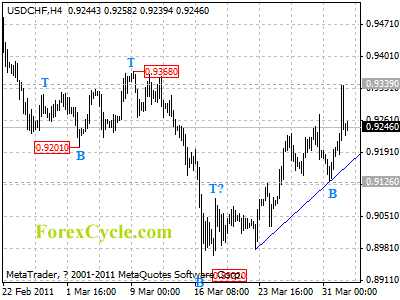
USDCHF’s upward move extended to 0.9339

USDCHF’s upward move from 0.8922 extended to as high as 0.9339. Support is at the rising trend line on 4-hour chart, as long as the trend line support holds, uptrend could be expected to continue and next target would be at 0.9400 zone. However, a clear break below the trend line will indicate that a cycle top is being formed, and the uptrend from 0.8922 is complete, then deeper decline towards 0.8922 previous low could be seen.

usdchf

Forex Signals

Forex Trading Calculator ‘ Just What You Need To Target Profits

By Cedric Welsch

If you invest on the Forex market to earn a steady stream of income it is important to invest in a quality Forex trading income calculator to monitor your investment. Many investors set income goals each year in hopes of not only meeting these goals, but exceeding them. If you set annual income goals you must be practical. Most investors with experience in the Forex market will base their goal on the current condition of the market. Know how to set your monthly and annual goals and why an income calculator is beneficial and step up your investment portfolio.

The primary purpose of the calculator is to calculate how many PIPS you must make on a daily basis to achieve the amount you set as your annual goal. Most advanced calculators will factor in casual losses and a quality calculator should not assume you will make the same amount of PIPs on a daily basis. Allowing some wiggle room in the calculations is extremely important.

The basic calculation tool will ask your annual goal amount and will simply calculate the number of PIPs you need per day. More advanced calculators will ask how many weeks you trade on average per year, how many days per week you dedicate to trading, dollars per pip, and lots per trade. With the advanced features of a calculation tool you can come to a more accurate calculation based on your own trading schedule and trading portfolio. Failing to tailor the calculations to your portfolio could cause you to miss your goal by thousands even if you are averaging the pip per day figure.

There are several different calculators available on the Internet. Some of these computer tools are available for free download while others will charge you for use. Be aware that free calculators can be developed and distributed by anyone who knows how to computer program. If you choose to use a free tool be sure to do your research to ensure accuracy. There should be a number of reviews are pretty much every calculator on the Internet. Figure out the general consensus of the tool and see if it is accurate and reliable.

Forex trading can be a wonderful opportunity to earn extra income. If you have been trading full-time or part-time and you are ready to set goals sit down and review your trading trends. Set a realistic goal and access a Forex trading income calculator to help you achieve your goal.

About the Author

Better and reliable fx news is irreplaceable to forex success.
Including broker forex review with that news reading should be wise.

Don’t Just Trade Anytime You Want, Know About Forex Trading Hours

By Cedric Welsch

If you want to trade Forex, one thing you need to be clear about is the world Forex trading hours. The Forex market is the foreign exchange trading market, and Forex traders are trading foreign currencies for profit. The market is run entirely electronically, within a network of banks, and runs continuously over a 24-hour period. When you make a trade on Forex you are simultaneously selling one country’s currency and buying the currency of a different country.

In Forex the major markets are London, New York and Tokyo, and the US and UK markets account for more than 50 percent of turnover. The continuous 24-hour market begins on Sunday 5 p.m. Sydney, Australia, time and goes through to 4 p.m. EST, rollover time being 5 p.m. EST. The foreign exchange trading day virtually never ceases apart from a few short periods during weekends, so at any given time somebody, somewhere, is buying and selling currencies.

So if you want to know when you can trade Forex, the answer is that you can trade when you want to. The 24-hour market, combined with the massive liquidity of Forex, means you have the freedom and independence to decide when you want to trade. However, some times are better than others. In order to find the best chance of trading opportunities, you need to look for the times when Forex volume is highest.

Overall Forex volume is determined by what markets are open and the times these markets overlap one another. Forex volume peaks when two of the three major markets have their open or exchange-traded markets open at the same time the exchange-traded markets are the markets in instruments such as futures, stocks and bonds, which adhere to traditional opening times. There are two periods in the 24 hours when two major markets overlap. Between 2 and 4 a.m. EST is when the Asian (including Australian and New Zealand) and European markets overlap, and between 8 a.m. and 12 noon EST is the time when European and North American markets overlap. The markets tend to make their biggest moves during these overlaps, and these are thus the best times to trade.

It has been said that the Forex market never sleeps. Unfortunately, this means that, in some parts of the world, the Forex trader will also get very little sleep. The world Forex trading hours are virtually continuous, but if you can stay awake at the peak times, you have the best chance of profitable trades.

About the Author

The habit of forex news online reading is an investor’s asset.
Many forex trading reviews are read by successful investors.

E-Mini Trading: Should You Trade Inside the Channel or Outside the Channel?

By David Adams

On any given day, a chart of any e-mini contract will display a number of price action formations. According to statistics (and statisticians vary on their assessment of the frequency of trending patterns and consolidating patterns), the market will spend about 30% to 40% of the time in a trending pattern and about 60% to 70% in a consolidating pattern. The general line of thinking is to avoid trading the consolidating patterns and focus on the trending patterns, and I certainly agree with this assessment.

Trading with the trend has long been a maxim in the e-mini trading vernacular, with good reason. Quite simply, if the market is moving upward it behooves a trader to trade in the direction the market is moving. Of course, the same holds true if the market is moving to the downside. I have taken some rather unfortunate e-mini trading entries with the trend and have been saved by virtue of trading with the trend. In short, these entries were poorly timed but the trend saved the trade from a disastrous result. Such is the nature of the trend.

After a trend reaches its apex it usually retraces a bit and then retests the previous high. It is not unusual for the final stages of a trend to begin a sideways direction and form a consolidation pattern, or channel. These channels can be very difficult to trade and many a small trader as deposited sizable portions of their trading account trying to trade in the channel. The general rule of thumb is to avoid trading and inside the channel and look for potential breakouts or breakdowns.

But there is a problem here, the percentage of successful breakouts versus unsuccessful breakouts is fairly high when trading out of the channel. Why? When the market is in a channel formation the buyer and seller counts are fairly even, or the market can be described as being in equilibrium. Logically, the market is likely to pull a certain portion of breakouts or breakdowns back into the channel or equilibrium. This can be fairly frustrating.

On the other hand, I love to trade certain kinds of channel formations;

• If the channel is at least three ES points wide, there exist some interesting trading possibilities. Though I would caution that this type of trading can be tricky and you need not walk away from your computer for any period of time.
• It is important to shorten their profit targets to six ticks and be happy with that smaller profit objective. Inside the channel, long protracted moves are rare.
• Only take trades when the price action has hit the resistance line or support line of the channel, and you must take a trade in the opposite direction of the price action moving towards the support or resistance line. To say the least, this is a leap of faith.
• You must be aware that at any point the market may, in fact, breakout or breakdown. To be sure, you can count on the market breaking out or breaking down at some point during your channel trading. A quick hand on the flatten button will avert disaster.
• This is high-risk trading and probably best avoided by brand new traders.
• In I often trade this way between 11 AM CST and 12:30 PM CST when the market is not moving very fast and dominated by smaller traders.

Not all the trading public will agree with this trading methodology, but I can attest to the fact that it can be very effective if the channel is wide enough and the price action is bouncing between support and resistance. It’s important to reduce your profit targets as you can generally only capture six ticks in each move. It’s worth considering, and you might even give it a shot sometimes. Under the right conditions, it can be an effective trading method.

In summary, we have discussed a method for trading inside the channel and listed some criterion that will facilitate channel trading. The channel ought to be at least three ES points wide and it’s important only take trades at the extremes, or at support and resistance. These traits should be in the opposite direction of the price action. Good luck with channel trading and trade smart.

About the Author

Real Live Trading Doesn’t Lie. Spend several days in my trading room and see if you can benefit from a fresh and unique view on trading e-mini contracts. Sign up for your free trading experience by clicking here

ES E-Mini: Profit from What the Market Offers, Not Your Expectations

By David Adams

I am having an ongoing discussion with one of my traders who is struggling with proper exit strategies on both winning and losing trades. It has been a frustrating battle, but has been beneficial for my own education. The market offers, at times, some handsome profits and can deal out devastating losses. The question becomes when to exit a bad trade and when to take profits on a good trade.

A good number of trading education books suggest that letting your profits run is a great idea. I can’t say I disagree with this notion, but in practice it is less than easy to implement. Say you are trading an ES contract with a three-point target (12 ticks) and the market begins to stall or reverse at 10 ticks. What do you? Do you let your profits retrace past your breakeven point? Do you immediately take the money and run?

As a scalper, this is a very difficult question to answer. I know what my answer would be. I would take my profit at 10 ticks and look for another profitable trade. One of the axioms I try to implement in all my trading is: Never let a winning trade become a losing trade. Of course, you might move your stop loss up to plus five and settle for small gain, and that is not necessarily a bad strategy. But for me, I would take the 10 ticks. Good trades come and go throughout the course of the day and my job is to find another quality trade, not wring every last tick out of my current trade. Then again, I don’t feel great about myself when the market careens in my direction another three points; this is money I could’ve had. When I was at 10 ticks though, I didn’t know that the market was going to continue in my direction. What I did know was that I had banked a solid gain, and in my mind that’s good enough.

Stop losses, on the other hand, are even more difficult to handle. When executing the trade most traders believe that it will be profitable. Unfortunately, some trades do not move in the proper direction and the trader must decide how much he is willing to lose, or risk. I have had many trades go with than one or two ticks of my stop loss and come back to be solid gainers. On the other hand, just as many have exploded through my stop loss target with little regret. Here is the point, it is not necessary to hit your stop loss to exit a trade. When a trade starts to go horribly wrong, why not just exit and look for a better trade?

It sounds very easy to exit a trade; unless you initiated the trade expecting it to be profitable, which is where the problem is rooted. It can be difficult, and for some even humiliating, to exit a trade early because the market has changed. I don’t have a hard and fast rule on when to exit a trade. In my mind, when I enter a trade I have an expectation of what is going to happen. If that event does not occur within two or three bars, I am generally looking for a way out of the trade. The longer you stay in a trade that has not met your initial expectation the more likely your chances of winning or losing becomes a matter of luck. Why? Well, after your initial expectation failed the market is developing new internals that may or may not be beneficial to your trade. If you’re lucky, the market moves your way, and vice versa. It’s not a good way to trade.

Oddly enough, I have watched many traders get far out of the money only to have the price retrace back to within one or two ticks of their breakeven price. Instead of flattening with a $25 loss, I have seen, time and time again, a trader let the price reverse direction and they hit their stop loss. What in the world? At an intellectual level it makes sense to accept a small loss and move on to another trade. At the emotional level, I believe some traders want to at least break even. This is a confusing situation, yet I see it very often. The problem lies in the trader’s emotions and his or her unwillingness to accept even a small loss. It’s a common problem; traders become emotionally invested in their trade and make illogical decisions.

In summary, we have discussed exiting trades on both the profit and loss sides of the trading equation. This is an area where emotions play a huge role. I have stated I prefer to take my profits and run, while I have noted many traders tend to hang on to their trade till the bitter end. It all boils down to emotions and emotional attachment to your trade. Your trade may not do what you expect it to do, but you can make the best of what the market offers by thinking clearly.

About the Author

Real Live Trading Doesn’t Lie. Spend several days in my trading room and see if you can benefit from a fresh and unique view on trading e-mini contracts. Sign up for your free trading experience by clicking here

Libya Continues to Go Back and Forth, USD Hurting

By James McKee

Unlike Iraq or Afghanistan US involvement in Libya has been kept as minimal as possible and despite the financial expenditure the operation has been fairly effective. Libyan forces still remain powerful but the Rebels have been able to push back and resist the attacks of government forces. If US involvement continues and this conflict escalates the USD will be falling against other majors on the online forex exchange, stay on top of what is occurring and be sure to look for other indicators as well. Libya’s future remains very much unclear and Gaddafi aims to repel all foreign “aggressors” at any cost.

The fact that Gaddafi also has the support of a large number of Libya’s citizens is not a good sign for the Rebels. This means that in all likelihood Libya will experience a civil war that will rock it to its foundation, the likelihood of genocide is incredibly high since Gaddafi has pledged to go “from house to house” killing anyone who has opposed him. Already there have been sniper attacks against civilians and military personnel alike as Gaddafi struggles to quell this revolution and regain control of Libya. If the crimes against humanity continue Gaddafi will likely see a dramatic increase in US involvement to the point of a possible ground war.

The United States has repeatedly insisted that they have no intention of invading Libya, the same goes for other members of the UN, however the continued condemnation of Libyan conduct continues. This condemnation could eventually result in further intervention by UN forces if need be, the murder of people for their political beliefs is a crime which is not tolerated in the international community. China and Russia continue to abstain from any interference and say that the United States and other members of the UN have over stepped their authority.

About the Author

Author is a Forex trader and financial analyst residing in Denver, Colorado. To stay up to date on all the latest developments in the financial world and beyond be sure to check out the online forex trading regularly.

Basic Types Of Currencies You Can Trade In The Forex Market

By Cedric Welsch

If you are looking for forex trading basics, there are a number of websites and books that you can turn to for assistance. This article will explain the basic concept of forex trading and then it will offer you a link to help you get started.

Forex is a shortened version of the terms “foreign exchange”, and it refers to the process of making money through the strategic trading of foreign currency from one currency to another. The currencies used are not of particular importance, and the advice in this article can be used regardless of which types of currencies you are trading.

There are several types of forex trades. The most common one is usually referred to as a SPOT trade. This is when money is traded on the spot as in when you draw money from an American checking account out out of a foreign ATM (automatic teller machine). The bank immediately converts the US dollars into the currency that you are drawing out of the machine. They may also add a surcharge. Another example of SPOT trading is when you trade one country’s money for another country’s money at a currency exchange office at a airport or in a train station. Perhaps the only way to make money with this sort of trade is by sticking the currency in a shoe box under your bed, waiting for the currency values to change, and then, trading the money back to the original currency.

However, that example will not yield a lot of profits so the primary way that investors attempt to make money from forex trades is through options. Basically, options means that you make a projection about a certain currency relationship. You project a trade and a date. For instance, you may project that a United Kingdom pound will be worth two United States dollars on a certain date. You will also commit to an amount of pounds that you are willing to trade on that date. When the date arrives, if the exchange rate is actually one pound equals one dollar and sixty cents, you will make your trade and you will profit forty cents for each pound that you agreed to trade.

For more information, you should visit the finance section of your favorite search engine. On Google, for instance, the webpage is http://www.google.com/finance. Once on that page, you may search for forex. Then, they will link you to a page that will give you forex trading basics including tutorials and videos.

About the Author

How many forex trading news are you regularly reading?
Make sure to include forex trading review sources on your list.