Gold Aiming For $1,650 Per Ounce!

gold, XAUUSD, commodities, commodities market, commodities trading, inverted head and shoulders continuation, ron acoba

Bling! Bling! Who wants to join the global gold rush? Just recently the price of gold set a new all-time high at $1,476.22 per ounce. Despite trading at this level, it appears that is some more upside on gold. 

As you can see from its daily chart, XAUUSD or gold has recently broken out from an inverted head and shoulders continuation pattern. Now, if you project the height of the pattern from the point of breakout, an upside target of $1,650.00 could be determined. Presently, though, it is already trading at an overbought condition. Given this, it could move sideways for awhile or retrace a bit back at the neckline of the pattern before it aims for $1,650.00. The previous neckline resistance should now play as a support that could launch it towards the said target. A break, however, of this support could bring it back to around $1,400.00. Nonetheless, its overall bias remains bullish given its present trend.

More on LaidTrades.com

Crude Oil Sets A 2-Year High!

Last April 1, I mentioned that WTI Crude Oil, as for my technical analysis, could be forming a n ascending triangle pattern (kindly check here) and upon break out, it could reach an upside target of 115.00 USD. Shortly after I posted it, the triangle’s resistance was cleared out as the buying pressure strengthened. From the $106.94 breakout point, crude oil closed at a 2-year high of $113.07 last Friday which means people will now be paying additional 5% for their automobile’s gasoline. I may be wrong but based on the bullish triangle pattern and the strong price closing, it could still hit $115.00. I prefer not. On the downside, in case the crude oil price drops, the current support is the 2-month uptrend. If that breaks, the next support could be the triangle’s resistance.

More on LaidTrades.com

Red Flag On Alliance Global Group, Inc.

alliance global group inc., AGI philippine stocks, symmetrical triangle, bearish breakaway gap, andrew tan, ron acoba, daily stock picks, stock market trading

Warning! The shares of Andrew Tan-led Alliance Global Group, Inc. or AGI in the Philippine Stock Exchange could slide further given their recent price action. Let me show you how. 

Well, AGI had been consolidating within a symmetrical triangle for a little four months. All along I thought that it was setting up for another bullish because of its run-up during the previous year. It was even one of the few issues, along with San Miguel Corporation (SMC), which held their ground when the general market made a correction following 2010′s stellar performance. However, it appears that AGI’s luck has changed when it broke down from the said symmetrical triangle pattern. In fact, its breakdown was more pronounced when it made a bearish breakaway gap. Given this and the fact that AGI has failed to fill the gap within three days suggests that it would continue to fall further. If it does, it could fall down to its downside target of around PHP 9.80 (computed by projecting the height of the triangle from the point of breakout.

On the fundamental side, AGI sold some of its treasury shares and secondary shares that were owned by its subsidiary, Megaworld Corporation. All in all, it raised PHP 9.73 billion at PHP 11.16 per share which will be mainly infused in the development of new projects for the newly acquired Fil-Estate Land (GERI). Majority of those which bought AGI at a discount quickly took profits since at that time it was still trading at around PHP 12.00. At present, AGI is still trading slightly higher than the discounted price at PHP 11.16. Therefore, some of the institutions that got it at that price could still make a quick buck by selling it. This in turn would weigh on the price of the stock at least in the near term.

More on LaidTrades.com

Buying Opportunity On Ayala Land, Inc. (ALI)

ayala land inc., ALI philippine stocks, cup and handle, ron acoba, jaime zobel de ayala, daily stock picks, stock market trading

“Float like a butterfly, sting like a bee.” Just Like what happened in the Thrilla In Manila, Ayala Land, Inc. or ‘the ALI’ of the Philippine Stock Exchange appears to have found its second wind after faltering for about seven months now.

You see, ALI had been trading on a downward slope since it peaked at PHP 18.70 back on September 9, 2010. It gradually fell and even marked a low of PHP 13.70 this February. Luck, however, turned to its favor when it rebounded from the said low and eventually broke free from its seven-month downtrend line. All along, it was in fact bottoming into a bullish complex cup and handle pattern.

Three trading days ago, ALI broke out from the mentioned cup and handle formation. Now, if we project the height of the cup from the point of breakout, we would get a target price of just above PHP 18.00. With the RSI, though, in the overbought territory already, ALI could lay off for awhile before it continues its ascent. Therefore, any dip in its prices as long as it stays above PHP 16.00 could be taken as a buying opportunity.

More on LaidTrades.com …

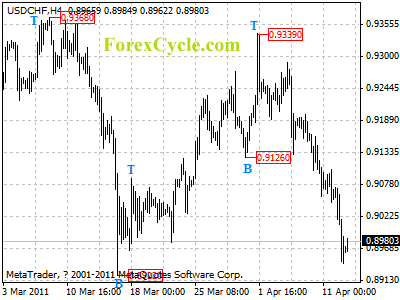
USDCHF’s fall extended to 0.8942

USDCHF’s fall from 0.9339 extended to as low as 0.8942. The pair is now facing 0.8922 previous low support, a breakdown below this level will confirm that the long term downtrend from 1.1730 (Jun 1, 2010 high) has resumed, then the following downward move could bring price to 0.8500 area. Resistance is at 0.9050, only break above this level could indicate that lengthier consolidation of long term downtrend is underway, then further rise could be seen to 0.9200 zone.

usdchf

Daily Forex Forecast

US Balance of Trade Deficit decreases in February as Imports slide. Deficit with China declines

By CountingPips.com

The United States trade deficit decreased in February as a result of lower import levels, according to a release by the Commerce Department today. The U.S. trade deficit declined by $1.2 billion in February to a total shortfall of $45.8 billion following a revised deficit of $47.0 billion in January.

The trade data was higher than the market forecasts that were expecting a deficit of approximately $44.0 billion for the month.

The lower deficit was the result of a bigger decrease in imports than in exports. Imports of goods and services fell by $3.6 billion for the month to a total of $210.9 billion. Imports had registered a total of $214.5 billion in January.

The US exported a total of $165.1 billion worth of goods and services in February which was an decrease of $2.4 billion from January’s total exports of $167.5 billion.

The politically sensitive U.S. trade deficit with China declined in February to a $18.8 billion shortfall following a deficit of $23.3 billion in January. Other notable U.S. trade deficits were with OPEC at $9.4 billion, the European Union at $6.9 billion, Mexico at $5.3 billion, Japan at $5.2 billion and Germany at $3.3 billion.

The U.S. trade surpluses with other countries for February included Hong Kong at $2.5 billion, Singapore at $0.8 billion, Australia at $1.4 billion and Egypt at $0.5 billion.

IMF Projects 2011 U.S. Deficit As Largest Among Developed Nations

The U.S. fiscal deficit is set to be the largest among major developed economies this year, beating out Japan and the U.K., with a shortfall representing 10.8% of GDP, the IMF said in a report released today. President Barack Obama will unveil long-term proposals for reducing the deficit to sustainable levels and getting the national debt under control on Wednesday. He will have to cut the deficit by at least 5% of GDP to attain his pledge of halving the deficit by the end of his four-year term. The IMF wrote in its Fiscal Monitor report, “Market concerns about sustainability remain subdued in the U.S., but a further delay of action could be fiscally costly, with deficit increases exacerbated by rising yields,” The IMF said most advanced economies are taking steps to reign in budget shortfalls, while two of the world’s three largest economies, Japan and the United States, have delayed such measures. The IMF expressed concern that upcoming elections in Japan and the United States, as well as France, could complicate policy efforts needed to reduce deficit spending.