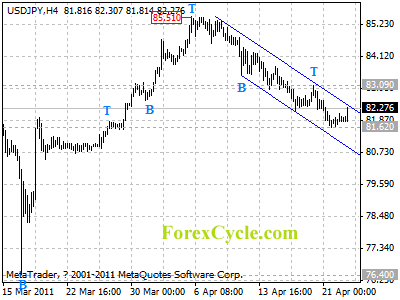
USDJPY remains in downtrend from 85.51

USDJPY remains in downtrend from 85.51, the price action from 81.62 is treated as consolidation of downtrend. Resistance is at the upper border of the price channel on 4-hour chart, downtrend could be expected to resume after touching the channel resistance. However, a clear break above the upper border of the channel will indicate that a cycle bottom has been formed, and the fall from 85.51 has completed at 81.62 already, then the following upward movement could bring price back to 83.50 area.

usdjpy

Daily Forex Forecast

Doing Market Analysis Through The Use Of Forex Trading Hour Charts

By Cedric Welsch

If you are in that place where you are wondering if you should use a Forex trading hours chart or a daily one, you should first understand that when it comes to Forex trading, everything is resumed to pretty much the same thing, which is determining which way the trend is going. This is because it is impossible to trade with the trend if you have no idea where it is going. And when trying to find out the direction of the trend, deciding for a trade frame is the next big concern that most beginners have.

There are many different methods of doing single and multiple time frame market analysis. However, this article will cover a specific one using the Forex trading hour charts that you may find useful and compatible with your trading style. Specialists suggest newcomers in this field to choose their trend chart as the first thing they do. Now, some people choose a monthly, weekly, daily or even an hourly diagram. The next step is to select an entry graphic representation. The entry chart should be more dynamic, so it could very well be the 5 minute time frame. Lastly, the timing chart should be even more dynamic.

To better understand the principle, we should have a look at an example. Let us assume that you are utilizing a daily chart as your trend-chart. Therefore, you will be using Fibonacci ratios, price bars, trend tools or other types of analysis methods in order to determine the trend of the foreign exchange market. In this case you should be using a 4-hours chart as your entry graph, as this would best help you see if there are any patterns in the market fluctuation. If you thus conclude that both the trend and entry chart are showing signs of a downward trend, you should be looking at the 5-minutes graph to determine the best time for an entry. This is nothing else than the moment you actually place an order on a particular currency pair.

A good trader must have a strict plan on when to enter and when to exit a trade, and this plan is recommended to be based on at least two different time frames. This allows you to see the wider picture of what is happening on the market and what is the best time to enter it with a selling or buying order. In conclusion, ensure you make good use of the Forex trading hours chart and of the other time frame charts to not get fooled by the market’s fluctuations.

About the Author

Many sites offering trading news are often good for your intake.
But beware with forex brokers review sites that are biased.

Traders Should Practice Using Forex Trading Demo Acccounts

By Cedric Welsch

There are many Forex brokers who allow their clients to use a Forex trading demo account where they can play on the market in real time, but with fake money only. Since most of the people entering this specific market come with the expectation to make big bucks, a demo account is the ideal way for them to test their trading skills and determine if they are actually ready to start investing real money. When opening a practice account, you get a certain amount of virtual money you can trade in real market conditions.

A Forex trading demo accounts is very helpful for a new investor to decide what broker or what platform he or she is most comfortable with. While some of the platforms are very simple and easy to use even for those people who never trade foreign exchange currencies before, others are more complex and difficult to learn and use. Most brokers include a lot of useful features in their platforms such as technical indicators, live news, daily market comments and even rumors about important and relevant rumors that can influence the foreign exchange market. While some brokers only allow you to trade using standard lots, others will offer you mini-lots as well or even separate units, such as a single dollar.

Learning to trade Forex without losing a dime is a great opportunity that you should not miss. That is the whole idea of the demo accounts: you may risk and risk again without losing your hard earned money. There is no doubt that this kind of investment is extremely risky even for the experienced traders, and it can cause you significant loss of capital and a lot of stress if you cannot manage to do it right. All of these can be avoided if you choose to play on a Forex trading demo account until you are certain that your trading strategy is safe and you can apply it on a real account with real money.

Lastly, another important benefit of the demo accounts is that they allow you to test many trading systems, included the automated ones. There are many people who have no intention to trade currencies on their own, but they only want to let a robot or a piece of software to do that for them. The internet if overwhelmed with a plethora of different trading robots and automated systems that claim to trade on your behalf and bring good profits, without you having to do anything. Whether these work or not, you do not have to lose any money as you can test them using a Forex trading demo account.

About the Author

Accumulating currency news trading info is a must for every trader.
Acquiring forex broker review opinions is one good example to this.

FOREX: Currency Specs trim Euro long positions. Yen futures sentiment lower for 4th week

By CountingPips.com

The latest Commitments of Traders (COT) report, released on Friday by the Commodity Futures Trading Commission (CFTC), showed that large futures speculators trimmed their long positions of the Euro against the US dollar while continuing to raise bets against the Japanese yen. Non-commercial futures positions, those taken by hedge funds and large speculators, added to their long positions for the British pound sterling, Swiss franc, Canadian dollar, New Zealand dollar and the Mexican peso while decreasing bets in the favor of the euro, Japanese yen and the Australian dollar as of April 19th.

This week’s notable changes were Japanese yen positions declining a bit lower for a fourth straight week to the lowest level in just about a year while Mexican peso positions rose for a fourth straight week and to their highest level in over a year.

EuroFx: Currency speculators decreased their net long positions for the euro against the U.S. dollar very slightly after increases for four consecutive weeks. Futures positions in the euro dipped to a net total of 62,195 long positions as of April 19th following a total of 64,985 long positions on April 12th.


The COT report is published every Friday by the Commodity Futures Trading Commission (CFTC) and shows futures positions as of the previous Tuesday. It can be a useful tool for traders to gauge investor sentiment and to look for potential changes in the direction of a currency or commodity. Each currency contract is a quote for that currency directly against the U.S. dollar, where as a net short amount of contracts means that more speculators are betting that currency to fall against the dollar and net long position expect that currency to rise versus the dollar. The graphs overlay the forex spot closing price of each Tuesday when COT trader positions are reported for each corresponding spot currency pair.

GBP: British pound sterling bets increased as of April 19th to a total of 30,175 net long positions after falling the week before to a total of 26,671 long contracts on April 12th.


JPY: The Japanese yen net contracts edged lower for a fourth straight week. Yen contracts decreased to a total of 52,983 short contracts following a total of 52,877 net short contracts reported on April 12th. This is the lowest level for yen contracts since May 4,2010 when short contracts totaled 65,612.


CHF: Swiss franc long positions rose higher for a second consecutive week. Franc positions increased to a total of 17,374 net long contracts following a net of 14,657 long contracts on April 12th.


CAD: The Canadian dollar positions edged higher to a total of 65,035 contracts as of April 19th after CAD net contracts had declined to a total of 63,741 net long contracts on April 12th.


AUD: The Australian dollar long positions edged lower for a second consecutive week. AUD contracts totaled a net amount of 84,961 long contracts as of April 19th after AUD positions had totaled 90,651 net long contracts on April 12th.


NZD: New Zealand dollar futures positions increased higher for a fifth consecutive week. NZD contracts increased to a total of 9,339 long positions as of April 19th from a total of 6,336 long contracts on April 12th.


MXN: Mexican peso long contracts continued to increase to a new high for the year at a total of 134,129 net long contracts on April 19th. MXN positions had increased the week before to a total of 124,846 long contracts as of April 12th.

COT Data Summary as of April 19, 2011
Large Speculators Net Positions vs. the US Dollar

EUR: +62,195
GBP: +30,175
JPY: -52,983
CHF: +17,374
CAD: +65,035
AUD: +84,961
NZD: +9,339
MXN: +134,129

Further COT Resources from around the web:
As A Trader, Are You Aware Of The Various Forex Trading Fees?

Forex trading fees are the costs that stem from trading based on a commission. There are numerous costs associated with exchanges on the Forex market, so investors will need to keep track of these costs in order to handle their finances properly. The two most common fees are “rollover”, which involves holding trades overnight, and “spread”, which comes from direct commissions.

Spread Fees

A bid/ask spread is the popular method that Forex brokers use to generate profits. With this technique, the broker will provide an array of currency pairs, and investors can use their own currency to buy into the other currencies that the broker is holding, as long as it is relative to the current spread. If you are interested in a specific currency, the broker will sell it for a much higher price than he/she would buy it back. This method insures profit for the broker, although it is fairly expensive for investors. Spread will allow brokers to sell high and buy low. As an investor, you should find a broker who has small spreads.

Rollover Fees

Amateur traders often get confused with rollover fees because it works differently than most other costs. Instead of having to pay a certain amount of money, the cost is simply credited to the investors. Rollover fees are used when all the main markets have closed and a Forex position is used. The investor usually has to wait for a few hours for the transaction to complete, so he usually loses the interest that he otherwise could have profited from by putting it in his bank account.

Rollover fees define the difference for the interest rates of sold and bought currency. If investors buy into a certain currency with a higher-than-normal interest rate, they will be paid the proper rollover reimbursement at the beginning of the next trading session. Conversely, if they buy into a currency at a lower-than-normal interest rate, they will be charged for the next trading session.

Margins

Margin trading is another prevalent cost in the Forex market. Forex trading generally requires a high leverage fee, so traders who do not have enough money must trade on credit. Most Forex brokers are allowed a 100:1 ratio for leverage, which means that investors only have to own 1 dollar for every 100 dollars that they invest. Margin trading is very risky, since losing the money can lead to significant debt. Smart traders should avoid margin Forex trading fees and methods unless the trade is guaranteed to succeed.

About the Author

Accumulating currency news trading info is a must for every trader.
Acquiring forex broker review opinions is one good example to this.

E-Mini Trading: Learn to Read Charts and Confirm with Indicators

By David Adams

It’s not unusual to see advertisements for trading education and see a wall of monitors with dozens of indicators and charts adorning the background. This may be understandable if the individual is a professional trader and following half a dozen different markets. This is generally not the case though; it’s been my experience that many retail traders may have up to six monitors with a battery of a dozen indicators following every imaginable market variable. My problem with this approach is a simple one; most of the information you really need is on the price action portion of the chart.

In my trading my primary focus is on the chart itself, support and resistance on the chart, and the chart price action. My primary indicator is always volume, and volume analysis. So I think it would be safe to say that I am not a system trader, and with good reason. The stock market and the futures markets are ever evolving and go through a variety of price patterns. Sometimes the price patterns are well-suited for systems type trading, and other times systems trading is woefully inadequate. By observing several different factors on the chart I am trading I can make some determinations about how I plan to trade during that particular trading session. Some of the factors I consider are:

• Is the market in a consolidation mode, or a channel?
• Are the price breakouts successful? Or do the price breakouts fail?
• Is the price action confined solely to the channel? Or is the price action outside the channel?
• Is the market trending in a straight line?
• Is the market trending with periodic retracements?

By observing the price movement on my daily chart I can make determinations about all these questions. Further, during the morning session the market may exhibit certain price behaviors and then in the afternoon session exhibit different price behaviors. As a trader, it is essential that you adjust your thinking as the market changes in personality. The characteristics I enumerated above are but a few of the many nuances the market displays throughout the course of the year, and it is my opinion that the best system is to observe market behavior and gauge your trading activity accordingly.

I am particularly fond of trading breakouts and breakdowns in the market because they are often very profitable and made indicate the beginning of a longer-term trend, which I can trade very effectively. However, there are many days that the market will begin a breakout or breakdown and then fail. After a couple of these failed breakouts, I can come to the conclusion that trading in a style that is meant to take advantage of breakouts and breakdowns is not going to be in any effective strategy. Further, I will also conclude that most of the price action is going to be within a defined range and can utilize a set of strategies that best utilizes techniques for range bound trading.

Indicators use information generated through past price action. Some of the time periods examined may be as short as five one minute periods, or as long as 200 ten minute periods. The key component and most important concept when utilizing indicators is that they lag the market. There are some indicators that claim to be forward-looking in nature, or leading indicators. I have used these indicators extensively and found them to be of limited value as leading indicators. After all, they use historical information in their algorithms and invariably lag the market, no matter how they are billed.

My point is a simple one; your best information will come from the chart and price action itself and indicators are an excellent way to reinforce the ideas or formulations that you have developed about the market behavior. On the other hand, straight indicator trading is a tough way to make a living and I have watched many traders fail because they relied on indicators as primary information sources and instead of the chart in front of them.

In summary, I have pointed out that the market is a creature of many moods and your intellectual abilities are the most effective method to ascertain the day the behavior of both the stock and futures markets. I have discouraged traders from using indicators as a primary tool to initiate trades or identified trade setups; instead, I have presented the idea that indicators are an excellent way to reinforce market action and trade setups you glean from chart reading.


About the Author

Real Live Trading Doesn’t Lie. Spend several days in my trading room and see if you can benefit from a fresh and unique view on trading e-mini contracts. Sign up for your free trading experience by clicking here

E-Mini Trading Versus Forex Trading: A Shocking Lack of Transparency

By David Adams

Forex trading has gained a large following in recent years as a popular day trading vehicle. It’s not unusual to observe a barrage of Forex firms touting their services on just about any financial news publication. As a longtime institutional stock trader and commodities trader I am often shocked at some of the outrageous claims and advertising techniques this industry utilizes. This type of advertising and verbiage is simply not allowed by the SEC or the CFTC. The Forex industry, on the other hand, is lightly regulated and offers no centralized exchanges like the securities industry in the United States and has virtually no regulation on advertising technique and claims.

From the onset I want to point out that the United States stock and futures exchanges have their share of hucksters and fraudulent activity. You need only peruse the current SEC and CFTC enforcement actions to get an idea of the amount of illegal activities that occur in our highly regulated exchange based trading structure.

On the other hand, the lightly regulated Forex industry has been in recent years the target of both the SEC and the CFTC, with good reason. Exchange traded securities provide potential traders with a high level of transparency and information in regards to the equity product or series they intend to trade. Variables like a leverage, registration of broker-dealers, and capital adequacy requirements are just a few necessary requirements that would go a long way toward establishing much-needed transparency in the Forex industry. Further, and from a personal standpoint, I believe a centralized exchange for Forex trading would be optimal for the industry.

By means of comparison, the futures industry and stock trading exchanges have rigid leverage, registration and capital adequacy requirements. In addition, e-mini trading is all conducted through well-regulated and orderly exchanges that feature reliable data feeds that provide real-time information on volume, trading entities, and pricing to all participants. This transparency in the futures industry is a sharp contrast to the murky Forex industry which is dominated by individual banking interests. Quite simply, there is a shocking lack of transparency in the Forex industry. In an orderly market, all participants ought to have access to accurate real-time information and standardized trading contracts.

Another concern of the SEC and CFTC is the leverage requirements in the Forex industry. The current United States industry standard for leverage and a Forex industry is 100:1. The most recent regulation proposes lowering the leverage standard to 10:1, which is a departure from the current leverage standard that is a quantum leap in scope. For a variety of reasons, Forex traders have been, by and large, fiercely critical of these regulations. Since the CFTC can only regulate firms in the United States, offshore firms would still be able to offer the absurdly high leverage requirements the Forex industry has enjoyed. The obvious result of this new regulation would be a mass migration of Forex traders from United States based firms to offshore firms that would not fall under the proposed US Forex reforms. There is, however, regulation under consideration that is very similar to offshore betting operations; in short, it is unlawful for US citizens to patronize offshore betting firms in order to circumvent current US law regarding betting. The proposed regulation for patronizing offshore Forex trading operations is very similar to the limitations of US citizens circumventing United States Forex regulation. In short, Forex traders based in the United States would be required to trade through domestic Forex trading operations.

In short, I don’t trade Forex because of the lack of transparency and a centralized exchange. In my opinion, there is simply too much potential for manipulation of bid/ask quotes, front running, and outright fraud. Currently the Forex industry leads security related scams by a wide margin, even though it is a small portion of the total day trading aggregate.

To summarize, the Forex industry has great potential to become a legitimate and profitable day trading option. In my opinion, the industry must institute strict regulation before its legitimacy can be truly realized. I think that in time all of the above addressed the problems will be rectified, but until there is true transparency in the Forex industry I believe I will abstain from participating. We have identified problems like over leverage, lack of registration, and the absence of a centralized exchange as problem areas in the Forex industry. Until these problems are addressed, I don’t think the Forex industry will reach its full potential.


About the Author

Real Live Trading Doesn’t Lie. Spend several days in my trading room and see if you can benefit from a fresh and unique view on trading e-mini contracts. Sign up for your free trading experience by clicking here

Read These Important Tips If You Are Just Starting In Fx Trading

By Cedric Welsch

The potential of earning money on forex is huge and there are many ways to be successful, but only those who are patient enough to learn more about the trading systems and who follow simple principles and rules will succeed. The following are five essential tips that any forex trading beginner should take into consideration:

1) Learn the basics before starting to trade. Forex is like any other career or job where you have to learn a lot and acquire experience. The more you know about the system and the market the better. Find a good, trustworthy source of information and follow it. Do not assume you know everything. There is always something new you can find out that can help you. First, learn what the basics pairs are, what a spread is, what leverage is and what a PIP is. Until you know the basics and how to read a chart, you have no business trading on the market.

2) Be careful what money you invest. Preferably, it should be the capital you do not need for day-to-day living. This is only advisable because you will feel more relaxed about using them as leverage to make even more money.

3) Use a demo account. You need practice, lots of it. You can only learn to take proper actions if you actually trade and it is much easier to learn when your money is not involved, at least in the beginning. New trading systems should be tested only in the demo account at least for a couple of days.

4) Choose a good broker. Find one that suits your needs. The broker should be able to give you advice and react fast. It is very important to have a good relationship with your broker, especially in the beginning.

5) Take it seriously. Treat it like a business and start trading with a single currency pair until you are familiar with it. Maybe the best pair to start with is EUR/USD. After you feel comfortable with it, you can start trading with other pairs too.

Every forex trading beginner has many information providers to choose from. While it is advisable to check multiple opinions and trading systems, choosing one system and sticking with it for a while almost always proves to be the right approach. You have to remember that success in this field is directly related to how much passion and time you put into it.

About the Author

Important currency news trading releases are always included in traders’ daily menu.
Exert effort in discovering forex broker review quality opinions to keep you safe.

Fx Trading For Starters ‘ Read This If You Are A Beginner

By Cedric Welsch

Forex trading for beginners will teach investors the basics of the Forex market and will give investors the tools needed for practice and improvement. Trading in the Forex market is much different than trading on the stock market. Even a seasoned NASDAQ professional can benefit from referencing a beginners strategy guide just to learn the basics of the Foreign Exchange market. If you have been told that making money in the Foreign Exchange platform is simple and risk-free, think again. Just like any type of financial investment, there are risks associated with the market and you are not guaranteed income. If you build your knowledge and learn how to trade Forex than your chances for success are much higher.

Rookie currency investors should start off by researching what exactly Forex is. The Foreign Exchange market involves the trade of currency and is technically the oldest and largest financial trade platform in the world. During times of economic crisis investors turn to Forex to hedge against the risk of investing in stocks and bonds. Recognized as the most liquid market in existence, the Forex market averages a daily turnover of approximately 1.9 trillion dollars. While these figures may seem enticing it is important to have realistic expectations. Where there are gains there are also losses.

When you trade currencies you are technically buying one currency and trading another. Because currencies are very liquid trades can be made any time of the day or any day of the week. Currencies are always traded in pairs. During uncertain times investors choose to invest in currency rather than stocks because currencies are constantly turning over. The reason for the fluctuating values of currencies is because companies and governments export goods and make a profit ultimately affected the value of the country’s currency. When a country is known for focusing on exports to industrial powers their currency is more valuable than the currency of say, a third world country. When you are learning the basics of currency trading you should be advised to do your research on world events. If nations are at war or are advancing significantly in technology you can make your trades accordingly.

Trading of currencies is not centralized on a specific exchange. Because of this trading moves can be made sun up and sun down. If you are interested in learning more on Forex for beginners reference a reliable guide and trading trends and start building your investment portfolio.

About the Author

Many crippling forex news are scattered everywhere often times.
That’s why many are vigilant with forex scams all the time.

Euro Dollar Weekly Analysis 23rd April

EURUSD Weekly Analysis

The EURUSD currency pair has given a close and subsequent upside move above the previous consolidation range highs.  As expected, fiber was rangebound on low liquidity during the UK bank holiday session on Friday but still remains on top of the 1.4500 level, which is a key area, and also inside the ascending channel.

Looking at the recent bullish price action – the upside looks to be the most probable direction towards the 1.4800 level, this level is is a resistance turned support zone.  Any subsequent move higher, going forwards, will have to contend 1.5000 which is a major psychological number followed by the 1.5143 level which is the  2009 swing high point.

Nick can be found writing at this Forex trading blog


eurusd chart