As A Trader, Are You Well Familiar Already With Forex Trading Hours?

By Cedric Welsch

The wide availability of forex trading hours is one of the things that make the industry so compelling to so many people. The forex trading hours begin on Sunday evening at 5 PM Eastern Standard Time and continue until Friday at 5 PM Eastern Standard Time. That allows people to work any time of the day or night except for Friday evenings, Saturdays, and Sunday mornings.

The reason that the markets are open so long is because they mimic the opening times of the world’s major trading markets. As a general rule, most of the markets are open from 8 AM to 5 PM local time. London, for instance, opens at 8 AM Greenwich Mean Time and closes at 5 PM GMT. These times correspond to 3 AM EST to 12 PM EST. When the markets from Tokyo, Hong Kong, Sydney and other cities are added to the schedule it results in forex trading hours that are almost constantly open.

However, simply because the markets are open does not mean that it is a lucrative time to work. Forex traders will generally make the most money when other trades are happening. Therefore, if you are sitting in front of your laptop between midnight and two in the morning EST when only the Asian and Pacific markets are open, trading may seem slow. On the other hand, if you try to work between 8:00 AM and noon EST, trading will be fast paced and more likely to be profitable because both Europe and the United States are open.

Forex investing and trading is a fun and easy way for a beginning investor to work from home. Although the hours referenced above may be optimal, you should not be afraid to get your feet wet at other times of day. If you have a day job and would like to try this on the side, you can attempt it in the middle of the night and focus on trades between the Australian dollar and the Yen or other trades involving Asian currencies.

As you can see forex trading hours offer many people the most flexible job hours that they have ever had. Whether you want to attempt forex trades as a hobby, a part-time job, or a full-time career, you will certainly be able to find hours that work for you. Once you start, make sure that you devote a bit of time each day to reading about forex trades. Any additional knowledge that you have will be an asset to you.


About the Author

The very systematic publishing of relevant forex news trading is a lifeline for traders. Do not deny that you need forex scam opinions from other traders so you can avoid scam.
How to Use the Darvis Box Method in E-Mini Trading

By David Adams

It’s not often that a ballroom dancer becomes a famous investing author and end develops a trading system that has lasted more than 50 years; but this is the case with Nicolas Darvis. It would be an understatement to say that the Darvis box remains popular and effective in the current investment world. Many of today’s finest investors in investment educators espouse the Darvis box method is one of the most effective methodologies for trading e-mini contracts.

Darvis originally only traded the Darvis box method for long trades; but today, his methodology has been refined for both short and long trading. Further, Darvis used is methodology for long-term trading, usually a year or more. Adapting his series to short-term trading, especially day trading the e-mini contracts, has not lessened the effectiveness of his original investing thesis; which is to say that the ideas he developed in the early 1950s are effective when trading intraday e-mini contracts in present times. On a side note, it is often claimed that Darvis was able to invest $36,000 into $2 million over a three-year period. That claim alone makes this somewhat obscure trading methodology worthy of study.

There was a time when it was essential to hand draw the boxes on daily investment graphs, but the world of computers has changed all that; most investing platforms include the Darvis box as one of the indicators that an investor can include on his or her chart.

So what is a Darvis box?

This methodology combines aspects of technical trading and fundamental trading. As much as anything, Darvis was interested in a volume and price in his assessment of potential profitable stocks in which to invest. The boxes that are formed through observed highs and lows and a specified trading cycle identified the methodology is a trend following system, though I much prefer classifying the Darvis system is a momentum system as this definition more clearly defines the exact methodology, in a definitional context, than a simple trend following system. Darvis himself identified a series of “states” in a normal stock growth trend, and identifying and exploiting those “states” is better suited for an entire book rather than a short article, Darvis identified highs, lows and consolidating patterns on a stock chart and integrated the highs and lows to form a square box. And typically, these boxes can be observed to be rising or falling in accordance with the current movement of the equity under study. Each box serves an important purpose, as the bottom portion of the box (in a long trade) or top portion of the box space (in a short trade) form specific stop-loss targets traders can utilize to minimize their losses and maximize their gains.

Most modern day traders use Darvis boxes as they are formed in a manner that is very similar to support and resistance theory. A close with confirmation above or below the top of an existing box can indicate a breakout or breakdown and hence, the potential for a profitable trade. I especially like the Darvis box method because I am quite partial to breakout and breakdown trades as they are often among the most powerful and profitable trades available to intraday investors. Darvis boxes provide an excellent methodology to identify breakdowns and breakdowns in trending markets. Conversely, Darvis boxes are also very effective at identifying consolidating markets where breakouts and breakdowns often form then fail. One of my favorite trades is to fade a failed breakout or breakdown as it returns to the original channel, or centerline of a Darvis box. To fully understand Nicolas Darvis and his trading methodology I highly recommend further study before trying to implement it into your trading. There is little doubt that this training method has great merit and is used by many influential investors.

In summary, we have identified Nicolas Darvis, a well-known ballroom dancer, is the inventor of Darvis box theory and briefly describe how Darvis boxes are formed, along with some of the practical applications, especially in setting stop – loss targets and identifying breakouts and breakdowns. I think it’s important to spend time with this older investment theory and become acquainted with its many possibilities.

About the Author

Real Live Trading Doesn’t Lie. Spend several days in my trading room and see if you can benefit from a fresh and unique view on trading e-mini contracts. Sign up for your free trading experience by clicking here

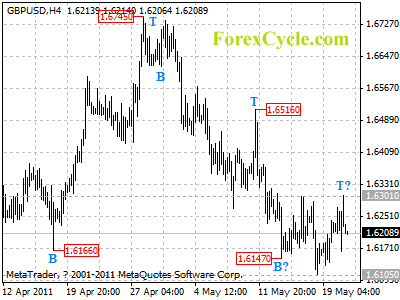
GBPUSD stays in a trading range

GBPUSD stays in a trading range between 1.6105 and 1.6302. As long as 1.6302 resistance holds, the price action in the range is treated as consolidation of downtrend from 1.6745, and another fall towards 1.6000 is still possible. On the other side, a break above 1.6302 will indicate that the fall from 1.6745 had completed at 1.6105 already, then the upward movement could bring price back to 1.6400-1.6500 area.

gbpusd

Daily Forex Analysis

Forex: Large Currency Speculators add bets in favor of US Dollar, Japanese Yen

By CountingPips.com

The latest Commitments of Traders (COT) report, released on Friday by the Commodity Futures Trading Commission (CFTC), showed that large futures speculators trimmed their long positions of the Euro against the US dollar for a second straight week while continuing to raise bets for the Japanese yen. Non-commercial futures positions, those taken by hedge funds and large speculators, added to their long positions for the Japanese yen while decreasing their bets for the euro, British pound sterling, Swiss franc, Canadian dollar, Australian dollar, New Zealand dollar and the Mexican peso, according to data on May 17th.

This week’s notable changes were British pound sterling positions fell over to the short side for the first time since March while Australian dollar positions fell for a sixth straight week.

EuroFx: Currency speculators decreased their net long positions for the euro against the U.S. dollar for a second consecutive week as of May 17th. Euro futures positions declined to a total of 41,645 long contracts following a total of 61,447 long positions on May 10th. Euro positions had marked the highest level since July 2007 on May 11th with 99,516.

The COT report is published every Friday by the Commodity Futures Trading Commission (CFTC) and shows futures positions as of the previous Tuesday. It can be a useful tool for traders to gauge investor sentiment and to look for potential changes in the direction of a currency or commodity. Each currency contract is a quote for that currency directly against the U.S. dollar, where as a net short amount of contracts means that more speculators are betting that currency to fall against the dollar and net long position expect that currency to rise versus the dollar. The graphs overlay the forex spot closing price of each Tuesday when COT trader positions are reported for each corresponding spot currency pair.

GBP: British pound sterling positions edged lower for a third straight week as of May 17th and fell over to the short side for the first time since March 15th. Pound contracts fell to a total of 928 net short positions. This follows a decline the week before to a total of 18,118 long contracts on May 10.


JPY: The Japanese yen net contracts improved for the fourth consecutive week as yen positions increased to a total of 15,373 net long contracts reported on May 17th following a total of 13,054 net long contracts on May 10th.


CHF: Swiss franc long positions edged lower for a second consecutive week. Franc positions fell to a total of 15,661 net long contracts following a net of 16,336 long contracts on May 10.


CAD: The Canadian dollar positions declined lower for a fourth consecutive week to a total of 26,291 contracts as of May 17th. CAD net contracts had fallen to a total of 37,203 net long contracts on May 10.


AUD: The Australian dollar long positions declined for the sixth straight week to a total net amount of 50,919 long contracts as of May 17th. AUD positions had totaled 60,321 net long contracts on May 10th.


NZD: New Zealand dollar futures positions declined after eight straight weeks of increases. NZD contracts decreased to a total of 12,624 long positions as of May 17th from a total of 13,714 long contracts on May 10.


MXN: Mexican peso long contracts dipped for a fourth week after reaching the highest level in at least a year on April 19th. MXN contracts fell to 104,912 net long contracts as of May 17th from a total of 118,065 long contracts as of May 10th.

COT Data Summary as of May 17, 2011
Large Speculators Net Positions vs. the US Dollar

EUR: +41,645
GBP: -928
JPY: +15,373
CHF: +15,661
CAD: +26,291
AUD: +50,919
NZD: +12,624
MXN: +104,912


EUR/USD Bears Eclipse Weekly Upside Gains On Friday

EUR/USD – Weekly Analysis 22/5/11

Last week the EUR/USD bulls pushed price higher until a decisive 214 pip drop came on Friday and eclipsed most of the week’s gains.

Fridays drop has formed a BEB (bearish engulfing bar) which would typically have my attention, with a view to trading short, but the proximity with the highlighted swing low does not give any trade enough space to run before support is encountered.

There is a reasonable posibility of price moving below this BEB, in this instance, and subsequently breaking through the swing low but selling into range lows is not a favoured long term strategy.

Any bounce off the 1.4000 area back up to 1.4500 would potentially be seen by the investing masses as a preferred short zone for Euro bears with more room to run before support was hit.


Follow the post author and see further Forex chart analysis


Before You Trade Currencies Seriously, Try A Demo Account First

By Cedric Welsch

Before jumping into actual forex trading, it is essential to practice first with a forex trading demo account. Currency trading is a huge risk for a beginner who does not know what he is doing. In every type of trading, knowledge and skills are highly important. Without developing quality trading skills, you risk losing a big amount of money doing trades.

The forex market offers a huge potential to make money, but it also provides a huge risk of losing money for people who are not skilled or knowledgeable enough about trading. With the growing popularity of online trading, anyone can participate in selling or buying currencies anywhere around the world. In fact, you do not need a broker to do the trading for you. All you need is to create an account and use a forex trading platform.

Luckily, FX trading websites provide free information on how to use their platform and how to trade successfully. Most trading websites also provide a free demo account especially made for beginners. The demo account does not require any initial deposit. You will be trading with a practice account that uses Internet money that does not have any real value. Before practicing with the account, it is essential to learn about forex in-depth. Learn how the platform works, how the currencies are traded, and how the graphs and charts can be analyzed to your advantage.

Buying and selling currencies are always done in currency pairs. The value of each currency in the pair is used to determine whether it is time to either buy or sell. Essentially, a currency is bought while its value is low. After a certain period of time, the value of the selected currency either goes up or down. If the value goes lower than the buying price, you can stop the loss or leave it be until it goes up again. If the value goes higher than the buying price, it provides a potential to make profit.

If the value of the currency is high, it provides an opportunity to gain profit by selling it. Keep in mind that profit can be made by buying a currency at a low price and selling it at a high price. Nevertheless, understand that you will not win every time so you have to be careful in analyzing currency charts. After you have enough practice with the forex trading demo account, you can switch to a real account and make money.


About the Author

The explosive popularity of the forex trading game has captivated millions of investors.
A number of these forex trading investors are earning millions of dollars in investments.

E-Mini Trading: Low Probability Trading Setups Are the Bane of Effective Trading

By David Adams

A search on any of the popular search engines will provide a trader with a plethora of high probability e-mini trading setups. Oddly enough, I was unable to locate any specific article concerning low probability e-mini trading setups. Yet the problem of most e-mini traders is avoiding low probability setups, which are generally unprofitable. Considering the astounding number of new traders who fall victim to low probability e-mini trading, I found it odd that so little has been written on this particular topic.

Obviously, some trading setups are better than others. That is to say that an e-mini trader who regularly takes high probability setups succeeds at a higher rate than in e-mini trader who takes low probability setups. That being said, the rate of failure of first-year e-mini traders is in the 80% to 90% range. Obviously, an awful lot of new traders are taking low probability setups and failing.

Why, then, are we reluctant to talk about low probability trading setups?

In my world, it is very important to be able to identify high probability e-mini trading setups; but it is just as important to be able to identify low probability trading setups. Perhaps e-mini educators are loathe to discuss the negative aspects of trading as it may discourage potential students from entering the business; for whatever reason, I am baffled at the lack of discussion of low probability trading. Obviously, the failure rate for new traders would indicate that an awful lot of traders are taking an awful lot of lousy trades.

I think unproductive trades fall into three particular categories, which are: (in no particular order)

• Trading against the trend
• Trading when there is no trend
• Trading without a solid understanding of support and resistance

One of the most overused clichés and trading is “the trend is your friend.” It is my opinion however, that every new trader should repeat this mantra 25 times every night because it is truly one of the most important keys to successful trading. Yet, I observe traders initiate trades against the trend with such startling regularity that it becomes both frustrating and astounding. I’ve given this concept much thought, and realize that very enticing setups occur against the trend, especially among traders who rely heavily upon indicators and oscillators to select e-mini trading setups. Depending upon which author you care to quote, the market resumes in the direction of the trend at a rate of 70 to 80% of the time following a retracement. Yet traders find themselves in a near constant battle to avoid trading retracements because they often made very enticing setups in oscillator and indicator-based trading. Regardless of the strength of an indicator-based trade set up, if it is against the trend I simply ignore it. Unless you are an extremely experienced countertrend is trader, stay with the trend and profit.

There are many times when the market is in a period of consolidation and confined to an identifiable range. When this consolidation period lasts longer than 8 or 10 bars it often stays in this channel for an extended period of time. Generally speaking, channel based trading is random in nature and very difficult to predict. That being said, the level of trading that occurs in a consolidation channel is surprising. Quite simply, if the price action is trading in a defined range it will tend to stay in that range for surprising periods of time. It is difficult, if not impossible, to effectively trade in these channels as the action can be quite unpredictable and is definitely random in nature. Yet the level of trading that occurs in channels is startling; especially when it is obvious that a pre-established range is apparent in the chances for anything beyond a small gain are unlikely. Yet new traders pound away in these channels with gusto, hoping that they will catch a breakout or breakdown. As a side note, breakouts and breakdowns from prolonged consolidation channels are generally fail, but not before they snare a good number of traders who pour into the false breakout or breakdown with unbridled hope. Simply stated, breakouts and breakdowns from channel based trading are a low probability trade. Granted, at some point one of the breakouts are breakdowns will succeed, but not before numerous failed attempts at breaking out or breaking down fail.

Of all the factors involved in e-mini trading, one of the most important is to have a firm understanding of where her current support and resistance lie. At any given time there may be 4 to 6 support/resistance lines in a trading range. Taking a long trade directly into a point of resistance is similar to running headlong into a brick wall, especially if the line of resistance has been tested several times and held strong. Yet a casual analysis of a daily trading chart will show a sizable number of traders trading directly into support and resistance. Being aware of the exact points of support and resistance is essential knowledge for every trader. On the other hand, it seems obvious to me that many traders are only vaguely aware of support and resistance, else they would not trade headlong into these powerful price action stoppers.

In summary, this short article serves to point out three trading options that are undesirable. No matter how tempting it may seem, it is seldom a good idea to trade against the trend; nor is it wise to trade consolidation patterns. Consolidation patterns, or consolidation channels are usually confined to an identifiable range which precludes any dramatic price movement. Finally, it is essential for every trader to know and understand where support and resistance lie on a trading chart. It is never a good idea to take a trade directly into support or resistance as these lines are often a stopping point for any potential price action. Trade with the trend, avoid trading consolidation channels, and be aware of the location of support/resistance and you will greatly enhance your chances of trading profitably.

About the Author

Real Live Trading Doesn’t Lie. Spend several days in my trading room and see if you can benefit from a fresh and unique view on trading e-mini contracts. Sign up for your free trading experience by clicking here

EUR/USD Goes Bullish Again

By James McKee

On the heels of various policy decisions that have caused fear the world over many are doubting the dollar, and while this is no surprise the fact that they Euro almost reached a high of 1.5 against the dollar is staggering. The USD has not done this poorly on the online forex exchange in quite some time, and while there are many who speculate as to why this is occurring no one can know for certain. The United States has experienced an irregularly large amount of turbulence in recent months, and state governments have begun instituting heavy cutbacks to their budgets.

The Federal government has also begun to spend a good deal of time instituting their own cutbacks; however, until the United States becomes serious enough to make cuts to Social Security and the military change is unlikely. The US and its citizens must become much more serious about paying off the debt it has accrued in order to accommodate real change in the country. Once the United States has paid back its debts to large countries such as China chances are that things will go much better for the country in the long run. There has to be a point at everyone pays their bills, otherwise there is a good chance that it will be necessary to declare bankruptcy.

The Euro is looking good for the time being, but as agreements to institute much more serious austerity measures become known to European citizens there is a good chance of riots. Riots have already rocked France and England in recent months and there is a very good chance that if austerity measures instituted shut down schools that there could a serious backlash. Such a backlash would mean certain doom for a good deal of Europe with regard to its stability, these demonstrations have already been experienced throughout the continent.

The state of California has already begun to witness serious backlash from its citizens in response to educational budget cuts. These responses have been everything from teachers protesting at the capitol to students chaining the doors of college buildings shut. While this has caused a certain degree of media attention it has also brought about a good deal discontent among citizens in the state. Little to no resolution has been achieved through budget cuts so far because it is not enough, there have to be much deeper cuts and a clear timeline for when we will be out of debt.

About the Author

Author is a Forex trader and financial analyst residing in Denver, Colorado. To stay up to date on all the latest developments in the financial world and beyond be sure to check out the online forex trading regularly.

What You Must Learn About Fx Trading Platforms And Options

By Cedric Welsch

The Foreign Exchange market, known as Forex, is an alternative to investing in the traditional stock market. This market deals exclusively with currencies from all over the world. Forex is the largest market in the world, and is one of the most liquid options, since it is dealing directly with money. There are many ways that one can get involved in this unique market. A variety of Forex trading platforms are available to global investors.

Forex trading platforms can often be downloaded directly from a company website. Which one an investor chooses will be based on their needs and personal preferences. These programs may come with certain features that make their use more streamlined. Features may include tutorials to help beginners learn both the program and the exchange system. If one wants additional guidance, they can find a program that comes with links to trading coaches. The software might have scenarios that one can play and manipulate to “practice” before investing their actual cash. Some software comes with automatic transaction choices that one can use based on guidelines that they set for themselves.

Some programs may be limited in that they include trading with only certain currencies. Others may have a minimum in how much money the individual must invest initially. It is important to understand and analyze the pros and cons of the different programs that they are considering. One might want to consider talking to current or past users that are familiar with the different program options. The Internet is a great resource for customers to use for comparison. Many websites are devoted solely to comparing different Forex trading platforms. These can be a quick way to compare features and read reviews from people who have used the platforms.

One might want to consider using a software trading tool along with advice from a “real live” professional. Brokers and other financial experts can help with the Forex market. Some individuals may even be specialists in this area. One should be sure that they trust their financial professional and understand their terms of service. It is a good idea to use someone associated with a reputable company, or someone that has a good community reputation.

Foreign Exchange market trading is an option that may offer a change of pace to traditional investing. This global market offers an array of trading platforms for individual investors to choose from and consider adding to their financial toolbox.

About the Author

To achieve high level currency trading profitability, you need good forex research.
And don’t ignore flipping through forex scam review pages on the web.