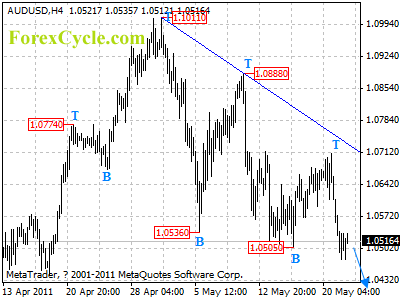
USDCHF stays in a trading range between 0.8747 and 0.8945

USDCHF stays in a trading range between 0.8747 and 0.8945. Another rise to test 0.8945 resistance would likely be seen later today, a break above this level will indicate that the uptrend from 0.8553 has resumed, then next target would be at 0.9100 zone. Support is at 0.8747, only break below this level will indicate that lengthier consolidation of uptrend is underway, then pullback to 0.8650 could be seen.

usdchf

Daily Forex Reports

The Youth Revolution Spreads to Europe

These are momentous times. By some measure, there is as much potential for change and upheaval now as at any time in the past 50 years.

Add in the prospect of war, and the time frame extends back 100 years or more…

The sweep of uncertainty and chaos is evident everywhere you look: America. The Middle East. China. Japan. Europe. Even Africa.

Major trends, both positive and negative, are clashing like titans in multiple “hot spots” all around the globe. And anyone who says smugly that “it’s all under control” is only fooling themselves.

Very little is under control right now — and the answer to “what’s next” is far from obvious.

If the 21st century had an animal mascot, it might well be a “black swan” — the rare bird popularized by Nassim Taleb as a symbol of unexpected fat-tail events.

Except, truth be told, most of the events unfolding now are actually “gray swans” — surprising in their power and ferocity, but not actually unexpected. Many of today’s developments were foreseen in rough shape, only the specific details and calendar timing left out.

These thoughts were brought to my mind by another “gray swan” revelation last week: The youth revolution is spreading to Europe.

In the Middle East it is known as the “Arab Spring.” This is appropriate, as the age demographics for the MENA (Middle East/North Africa) region skew extremely young.

So what will they call it when the same thing happens in gray-headed Europe? The below image, gleefully posted anonymously to the Internet, captures the spirit of the latest uprising.


As the U.K.’s The Guardian reported on Friday:

A youth-led rebellion is spreading across southern Europe as a new generation of protesters takes possession of squares and parks in cities around Spain, united by a rejection of mainstream politicians and fury over spending cuts.

Protests are also planned in Italy, where the tag #italianrevolution is a trend on Twitter. Plans have been announced for a piazza occupation in Florenceon Thursday night, and for further protests in Italian cities, including Rome and Milan, on Friday.

In Madrid demonstrators have refused to budge from the central Puerta del Sol despite a police charge that dislodged them temporarily on Tuesday night.

Now they have occupied a quarter of the square, covering it with tarpaulins and tents, setting up kitchens, tapping at laptops and settling down to sleep on sofas and armchairs.

Similar scenes were being played out in Barcelona, where protesters held a midday Argentinian-style pan-bashing protest in the Plaza de Catalunya, and in numerous other cities where protesters raised the banner of what they call “the Spanish revolution”.

Notice the “Twitter tactics” — creating a tag called #italianrevolution — which was also very evident in the Middle East protests.

So-called “social media” is now being used as a tool to facilitate uprising. From “flash mobs” and “crowd sourcing” to serious gatherings in which citizens challenge governments, communication technology is changing the face of the planet.

Nor is the “revolution” the sole province of youth. They are just the ones who are most comfortable using mediums like Twitter and Facebook as highly efficient mobilization devices.

The adults of Europe — taxpayers, business owners, despairing workers — have just as much incentive to revolt as the youth do, if not more.

As we have described in these pages, the basic plan of Europe is to rescue the banks at the cost of screwing Europe’s taxpayers — signing up the citizens for decades of indentured servitude. And not just taxpayers, but all European citizens exposed to the burden of deeply unfavorable economic conditions.

The idea that Greece, Portugal or Ireland can move forward without restructuring their debts — a move the bankers so want to avoid — is dependent on the notion of forcing those countries to accept deep, deep recession, or even depression-like economic conditions, for years if not decades to come. And all to save reckless banks and bondholders in the same ilk as Goldman Sachs.

As far as the European sovereign debt crisis goes, Spain is the great white whale of Europe. Notice that Spain has not been in the news as of late — though that may be changing even as this note is written. It has been all “periphery” — Ireland, Portugal, Greece.

That silence is partly because Spain is just too big to wave off. If the contagion fears truly grip Spain — and there is every reason to think they will — then all of hades truly breaks loose.

Look, here’s the thing. The wonks at the Federal Reserve are masters of denial. Those who run the European Central Bank (ECB) are also masters of denial, as are Europe’s leading politicians.

But all that vigorous denial doesn’t solve a damn thing. It only postpones the desperate need to find a true solution to the problems at hand… and in so doing makes those problems worse.

For years now your editor has steadfastly maintained, and still maintains, that the eurozone is in a disaster situation, a giant train wreck waiting to happen. It has only been the human miracle of persistent denial and suspended disbelief that has kept that train wreck from happening.

None of this is to deny the problems of the U.S., which we have written about extensively. All the major currencies are bad houses in a bad neighborhood. It happens to be the euro in the major line of fire just now, as a false solution comes close to being outright rejected by angry youth all across Europe. And adults joining in too.

Look for more crisis, more drama, more catastrophe ahead. And deflation too. The dreaded “D” word will return in a big way. Possibly soon…

Article brought to you by Taipan Publishing Group. Additional valuable content can be syndicated via our News RSS feed. Republish without charge. Required: Author attribution, links back to original content or www.taipanpublishinggroup.com.
Markets Rebound with NZD/USD Rallying

printprofile

Equity markets have recovered tepidly from yesterday’s global sell-off while the euro has come off of its low and the kiwi has rallied.

Global bourses came out of the basement following yesterday’s sharp move into the red. The Nikkei is up slightly 0.17% while the FTSE is trading higher by 0.50%. US stock futures are also trading up.

The euro reached as high as 1.4115 before pulling back after the Greek political opposition declared their obstruction to an increase in austerity measures. However, the opposition party did note they were open to an increase in state asset sales. An uptick in market sentiment could help erase some of yesterday’s losses. EUR/USD resistance is seen at 1.4120 followed by 1.4185 and 1.4240 from the trend line off of the early May high. Support comes in at 1.4030.

The European debt crisis has taken a firm grip on the euro’s trajectory. Today comments from ECB Governing Council member Chrisitan Noyer highlight the opposition to a Greek debt restructuring as Noyer compared the idea of restructuring to, “a horror story.”

European data this morning was weaker than expected as industrial orders for the month of March fell -1.8% on consensus expectations for a decline of only -1.2%.

Recently Spain’s name has been included in the same conversations as the peripheral nations due to this past weekend’s elections. Today Spain successfully auctioned off new bills at somewhat lower yields than at previous level. This may have helped ease pressure on the euro. However the peripheral bonds of Greece, Portugal and Ireland continue to trade at substantially higher yields.

The kiwi was trading higher today after New Zealand inflation expectations rose 3.0% from the Q1 reading of 2.6%. Yesterday the NZD/USD fell as low as 0.7857, a level that coincides with the upper line of a falling wedge pattern. Today after the inflation report the pair broke above the 0.8000 level. The next resistance level for the pair rests at the May high of 0.8120.

Read more forex trading news on our forex blog.

US Dollar Rally Shadows Euro Declines

Source: ForexYard

The euro paired its sharp losses versus the US dollar yesterday but judging from the recent price action momentum has shifted against the 17-nation currency.

Economic News

USD – Dollar Gains on Euro Losses

Yesterday’s gains in the US dollar were not so much a product of dollar strength but rather the result of anti-euro anything and the “risk-off” trade. Boosting appeal for the dollar was weaker than expected Chinese PMI numbers to start this week’s trading on a negative tone. Following the report Asian equities quickly sank into the red as did the Aussie and New Zealand dollar.

The “risk-off” environment carried over from the previous week multiple sovereign debt rating downgrades. On Friday Greece’s sovereign credit rating was cut multiple levels. Saturday saw Italy being moved to a negative watch from stable, and yesterday Belgium’s credit outlook was also moved to negative from stable.

USD fundamentals have not changed over the past month as the US still maintains an extremely loose monetary policy and is not expected to raise interest rates well into 2012. Given the current anti-euro sentiment and poor Chinese economic data the dollar was the natural benefactor from this type of trading environment and may continue to trade higher on the back of further rating downgrades in Europe.

The dollar gained as the euro sold off across the board with the EUR/USD moving as low as 1.3969, a level that coincides with the 100-day moving average. The pair has since come off its lows to trade at 1.4080 but momentum remains to the downside. The next major levels that come into play are between 1.3910 and 1.3860. The former is the 50% retracement level from the January to May move. The latter is a previous support level from mid-March.

EUR – Contagion Effect of Spain

A combination of events has driven the declines in the euro, ranging from slower than expected interest rate tightening to a renewal of the European debt crisis. Early in the month the euro saw sharp declines, coming off a 16-month high following the delay in raising European rates. The most recent declines have been a product of geopolitical events, a renewed flair up of the Greek debt crisis and possible contagion effects of Spain.

The debate continues to rage over how to handle the Greek debt crisis and no consensus has emerged. Reportedly Greece only has enough cash on hand to prevent a default until mid-July. This makes it the utmost importance that the indebted nation receives additional funding from previously negotiated agreements with the EU/IMF. The alternative is a restructuring/extension of Greek debt maturities. The objection to this idea by the ECB has been very vocal as the ECB holds roughly 50B euros of Greek debt.

Market focus has now shifted to Spain. Following the weekend losses in municipal Spanish elections by the incumbent Socialist Party the euro began to drop sharply versus the majors. The change in the power structure at the municipal level may cause regional Spanish governments to declare previously unknown financial obligations at the municipal level, thereby bringing the Spanish sovereign credit rating under further scrutiny and the threat of a downgrade.

Previously European regulators have succeeded in creating a fence around Spain as investors chose to focus on the debts of Greece, Ireland, and Portugal. However, yesterday Fitch revised Belgium’s rating outlook to negative from stable. This is one of the first non-peripheral nations to be put on watch by the rating agencies. The timing of the report coincided with the low for the day. Should Spain’s outlook be adjusted the euro will likely come under additional selling pressure.

JPY – Yen Continues to Ease

Despite yesterday’s “risk-off” trading environment the yen failed to make significant gains on the back of safe haven inflows. As tensions escalated in the forex markets and equities declined with the flair up in the European debt crisis the Japanese yen typically sees strong buying pressure as a result of safe have bids. However, yesterday the yen failed to hold a majority of its gains. This highlights the shifting trend in the yen as market forces focus more on Japanese fundamentals.

The USD/JPY fell to a low of 81.32 after beginning the day near the 82 level before closing down slightly at 81.79.

The failure of the yen to keep its safe haven gains shows a shift in the trend of the strengthening yen following deteriorating economic fundamentals. Yesterday the BoJ issued a negative economic assessment. The report for the month of May shows production has fallen and domestic private demand continues to weaken following the earthquake and tsunami on March 11. The Japanese economy contracted by 3.7% on an annualized basis in Q1.

As traders continue to focus on Japanese economic fundamentals and not safe haven inflows the yen could continue to weaken from its early May high. Further USD/JPY targets may be retracement levels from the April to May move at 82.50 followed by 83.25.

Oil – Crude Oil Lower On Chinese Economic Data

The price of spot crude oil fell after weaker than expected Chinese PMI data and a flair up in the European debt crisis. Both events had the same effect of switching to a “risk-off” mode as higher yielding assets such as equities and the Australian dollar traded lower on the day. Spot crude oil traded as low as $96.35 before settling at $98.22.

The HSBC China Manufacturing Purchasing Managers Index dropped to a 10-month low at 51.1 in May from 51.8 in April. The weaker than expected data combined with the increased tensions in Europe helped to drag crude oil prices below the psychological $100 price level.

Crude oil prices have slid from their May highs near $115 but have consolidated in a range between $95 and $104.50. A break below $95 could trigger declines to $93.00 followed by $83. A move higher would test $110 followed by the May high.

Technical News

EUR/USD

Momentum continues to shift to the downside with weekly stochastics falling sharply. Initial support was found at the 100-day moving average and the next major levels that come into play are between 1.3910 and 1.3860. The former is the 50% retracement level from the January to May move. The latter is a previous support level from mid-March. A breach here would target 1.3675 where the 200-day moving average and the 61.8% retracement levels coincide. Resistance comes in at Monday’s high of 1.4150 followed by the 50-day moving average at 1.4340.

GBP/USD

Cable continues to slide lower from its April high. Monthly stochastics have turned lower signaling further potential declines in the pair. Yesterday cable moved below the 100-day moving average and could target the 200-day moving average at 1.5935 which coincides with the March low. Initial resistance is found at 1.6300 followed by 1.6515.

USD/JPY

The yen has continued to weaken since the pair put in a low in early May. Weekly stochastics are turning higher, indicating future appreciation in the pair. A move higher would targets the retracement levels from the April to May move at 82.50 followed by 83.25. Support comes in at 81.30 and the May low at 79.50

USD/CHF

Yesterday’s high at 0.8890 coincided with the trend line falling off the February high. Traders may want to be cautious at this level as both momentum and stochastics on the daily chart indicate further potential gains. The pair could find resistance near the 50-day moving average at 0.8930. The last time the USD/CHF traded at this level was the beginning of the year. Support is found at 0.8745.

The Wild Card

Oil

Crude oil prices have slid from their May highs near $115 but have consolidated in a range between $95 and $104.50. Forex traders may wait for a break below $95 which could trigger declines to $93 followed by $83. A move higher outside the consolidation pattern would test $110 followed by the May high.

Forex Market Analysis provided by ForexYard.

© 2006 by FxYard Ltd

Disclaimer: Trading Foreign Exchange carries a high level of risk and may not be suitable for all investors. There is a possibility that you could sustain a loss of all of your investment and therefore you should not invest money that you cannot afford to lose. You should be aware of all the risks associated with Foreign Exchange trading.

Two Factors Drive the Euro

printprofile

There are two major factors driving the value of the euro; interest rate differentials and the European debt crisis. At this stage, only the debt crisis is having an impact on forex trading.

Since January gains in the euro have largely been driven by interest rate differentials between Europe and the US with Europe in the process of moving European rates higher. At the same time the US was in the process of easing monetary policy via its second quantitative easing program. As markets increased expectations of higher ECB rates the value of the euro increased accordingly. With US monetary policy forecasted to remain in a state of providing the market with high levels of liquidity the EUR/USD reached a 16-month high. After the ECB signaled it will not raise interest rates as quickly as markets expected the EUR/USD came off of this high.

One way to view the different interest rate differentials is to track the yield difference between the 2-year German Bund and the 2-year US Treasury. At one point the Bund was trading at a difference of 130 bps. As of this morning the difference has shrunk to 118 bps. This data point drives home the previous factor that was supporting the euro since January, interest rate differentials.

A new, yet familiar theme is now the leading factor in the movement of the EUR/USD; the European debt crisis. Tensions are building as Greece’s sovereign credit rating was cut multiple levels by Fitch. Greece looks to be unable to reach its proposed budget deficit target of 7.5% of GDP. Reportedly Greece only has enough cash on hand to prevent a default until mid-July. This makes it the utmost importance that the indebted nation receives additional funding from previously negotiated agreements with the EU/IMF.

Speaking last week, ECB executive board member Jürgen Stark said the ECB would cease to accept Greek bonds as collateral for loans to Greek banks should Greece choose to restructure its sovereign debt. Stark was quoted as saying, “Sovereign-debt restructuring would undermine the eligibility of Greek government bonds.” Earlier comments last week from EU officials warned a restructuring would be detrimental to the Greek banking system. The ECB is rumored to have 40-50B euros worth of Greek debentures on its books. Recently Junker proposed a re-profiling of Greek debt that would extend Greek maturities based on a mutually agreed extension.

Concurrently Italy and Belgium were hit with a series of ratings downgrades, adding a string of negative sentiment to the euro zone. Elections in Spain have also brought the market’s attention back towards one of the larger European economies.

The risk for the euro is a failure of EU authorities to contain the Greek debt crisis while avoiding a contagion effect and a downturn in investor sentiment. Such a scenario would bring a sell-off of the euro in forex trading as well as European fixed income instruments.

Read more forex trading news on our forex blog.

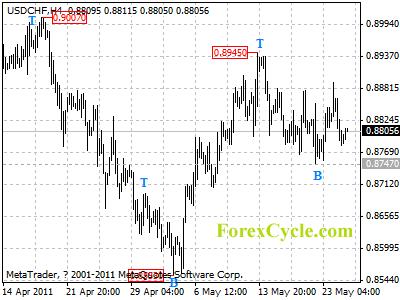
AUDUSD broke below 1.0505 support

AUDUSD broke below 1.0505 support and reached as low as 1.0478, suggesting that the downtrend from 1.1011 has resumed. Further fall could be seen in next several days, and next target would be at 1.0300 area. Resistance remains at the downtrend line from 1.1011 to 1.0888, only break above the trend line resistance could indicate that the fall from 1.1011 is complete.

audusd

Forex Signals

Forex Trading Help – Just What You Need As A Trader

By Cedric Welsch

With the forex market being the largest in the world, many people participate in forex trading in an effort to increase their income. Foreign exchange trading is not easy, nor is it a way to get rich quick. However, there is money to be made if you know what you are doing. This forex trading help will get you started in the right direction.

The first thing an individual should do when considering getting into the forex market is educate yourself with all of the terms, strategies and trends. Knowing what the market actually is and how it works before you begin is vital. It is easy to educate yourself simply be reading articles online, and there are courses that you can take to further your education.

Also of great importance is choosing the right broker. Reading reviews of specific brokers online is a great place to start. Look for a broker that offers availability, and does not charge large fees. No, cheapest is not always best, but there are good brokers that are quite affordable.

Practice doesn’t always make perfect, but it certainly does help. Open a practice account and see how you do. This is a no cost way to see if what you have learned is working. This allows you the chance to tweak your strategies before any real money changes hands.

When you are ready to move on, open a mini account. Most brokerages offer these. This will allow you to trade in units of as small as 1,000. Use these smaller amounts to see how your trades are performing before moving on to larger amounts.

Once you are ready to increase your trading amount, it is best to stick to only one or two open positions at any given time. Trying to do more will set you up for loss, as it is too difficult to monitor and manage more than that.

While it is perfectly normal to be elated when you profit, and dejected when you lose money, try to keep emotion out of the equation. Emotion can cause you to make rash decisions that are not in your best interest. If you find yourself becoming too emotional, walk away for as long as it takes to get your bearings before making any other moves.

Forex trading help is available at any time. No matter if you are a novice or consider yourself an expert, do not be afraid to use it, as it will help get you where you want to be.

About the Author

Enormous investment profits are being gained each hour through the forex marketplace.
Wildly enthused currency trading business individuals are glued at their computers for hours.