USD: The U.s. Dollar Has Not Been So Attractive To Investors

In the early hours earlier had been a day that is active in the financial markets with the EUR/USD moves in and out of negative territory. At the beginning of trading session New York, the dollar traded higher against most major currencies but at the end of the session, the greenback eventually gave up most of the profit rise was caused by the company. 

The restoration of its visible on all major currency pairs with the exception of USD/CHF, and USD/JPY remains unchanged for almost all day. UPS and downs of prices on the forex market shows that traders are still very worried about the problem in Greece. 

The situation in Europe continued to make investors anxious but at the same time, the prospects for the US economy is not too bright, that explains why investors aren’t rushing to move into u.s. dollars. 

Secretary of the Treasury Geithner shows, the u.s. economy is in a very difficult position and need a few more years before the restoration of full disektor housing. 

The unemployment rate will also be down too slow for the assessment of most people which is another way to say that the recovery might be sluggish speed continues for some time. 

The President of the Fed’s Kocherlakota, which is the owner of the voice on the FOMC seems to agree. He reduced his estimate for growth in the us for about 3 percent from 3-3.5 percent and he predicted the unemployment rate remained close to 8.5 percent, up from previous estimates. 

However, despite the revision down to growth, he still believes that the central bank to raise interest rates until the end of the year because 50bp inflation core. This view was not shared by other Fed officials or market that expect an increase in interest rates by the Federal Reserve to do in the first quarter of 2011. 

Part of the reason is because u.s. economic data continues to be vulnerable to pressure, describe how weak recovery AS fact. 

Orders for durable goods down 3.6 percent in April, the worst in six months. Excluding transportation orders, demand for the goods in the last 3 years down 1.5 percent. Durable goods orders increased significantly in the month of March and the latest data reflected a decrease in kembalai. 

Supply chain disruptions from Japan also contributed to the decline in demand, it is the speed of slow recovery of the US that has made consumers and businesses are reluctant to pull out of the budget. 

The US dollar barely reacted to the durable goods report shows that investors have been immune to the weaker U.S. data. Report of the second GDP Q1 today will be released and growth is expected to be revised upward 1.8-2.2 percent due to stronger consumer spending. Unfortunately even with the upward revision, growth in the first quarter is expected to slow down from growth of 3.1 per cent experienced in the fourth quarter of last year.

For more Please See www.ForexTradingEVO.com

EUR/USD Analysis-May 26,2011

Yesterday: Open 1.4103 High 1.4118 Low 1.4013 Close 1.4083 : Testing to 1.4201, Potential Amendments Sharply 

Since trading began yesterday’s Asian session, the euro has decreased by about 90 pips. But before the early European session, re-Euro try to rebound to the highest level of daily yesterday at 1.4118. On the whole movement of Euro yesterday still within normal limits in the range of 100 pips. 

Currently, the Euro looks bullish. 

The focus of today’s economic data for the EUR / USD is:

1. EUR Germany Import Prices m/m  
2. EUR ECB President Trichet Speaks

20110526_eur 

If the price continues to increase opportunities towards 1.4256 and 1.4201 resistance level. 

Conversely if the decline continues, the price opened up opportunities leading to the level of 1.4000 and 1.4058. 

Prices shown on the graph H1 line MA05 and MA10 strong bullish conditions. 

While the Stochastic indicator indicates there are still bullish opportunities are limited.


More Analysis please see www.ForexTradingEVO.com


Forex Economic Calendar: May 26, 2011

By CountingPips.com

Economic News Releases –  GMT Time

00:30 Australia House Affordability
06:00 Switzerland Trade Balance
06:00 Switzerland Imports / Exports
09:20 Europe Trichet Speech
12:30 United States GDP Report
12:30 United States Personal Consumption
12:30 United States Jobless Claims
13:45 United States Consumer Comfort Index
23:01 United Kingdom GfK Consumer Confidence
23:00 Japan Consumer Price Index
23:50 Japan Retail Trade

Economic Calendar

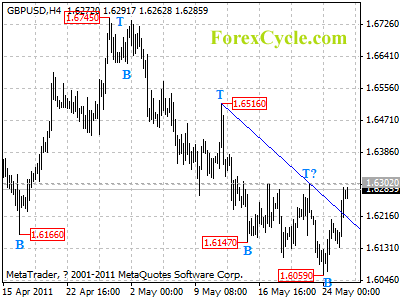
GBPUSD broke above trend line

GBPUSD broke above the trend line from 1.6516 to 1.6302, suggesting that a cycle bottom had been formed at 1.6059 on 4-hour chart. Now the pair is facing 1.6302 resistance, a break above this level will confirm that the downward move from 1.6745 had completed at 1.6059 already, then the following upward movement could bring price back to 1.6400-1.6500 area. However, as long as 1.6302 resistance holds, the bounce from 1.6059 is treated as consolidation of downtrend, and another fall to 1.6000 is still possible.

gbpusd

Daily Forex Forecast

Are You Making Money From Soaring Global Energy Demand?

Energy is a topic that dominates the news.

We’re constantly hearing about rising prices at the gasoline pumps… the ongoing global war for oil… and the push for cleaner, greener technologies.

Thanks to the soaring demand for new energy sources – fueled by growth in emerging markets – we’re entering a historic era for energy investments.

Now with all of that said… let me ask you a simple question:

Without visiting wind farms or getting a degree in geology, how is it possible for an individual investor to make money from this extraordinary trend?

After all – if you’re like me, I’m sure you know plenty of people who have lost money by “gambling” on individual energy stocks.

Several years ago, I worked with someone – an incredibly bright guy, Paul K. – who lost thousands of dollars on speculative energy investments back in the early ’90s. It wasn’t so much that Paul was a bad investor… he just kept chasing the next big oil discovery.

It used to be that making big money in energy was a bit like playing the lottery.

You’d hear about an exploration company that had a good story… you’d plunk down your hard-earned cash… and you’d hope they struck oil.

Every once in a while – at a cocktail party, most likely – you might hear a story from someone who made a killing from an oil strike.

Of course, it was much more common to hear stories about investments that lost money.

But those days are over.

Thanks to a relatively new investment vehicle, you can harness the power of energy investing and make “speculator-sized profits” without visiting a single drilling site.

Let me show you what I mean.

Thanks to the combination of two fundamental shifts, it’s possible for individual investors to take enormous stakes in very targeted, specific energy investments… while at the same time limiting their risk.

The first of these fundamental shifts is in the global demand for energy.

Thanks to the explosion in energy demand from countries like Brazil, Russia, India, and China, our global energy resources are being quickly depleted.

And concern over the geopolitical dangers associated with Middle Eastern oil – and the push for clean energy technologies – has helped change the energy landscape in a huge way.

Couple this explosion in energy demand with the second fundamental shift – the change in how investors can profit from specific “pockets” of the market – and you have a true game-changer.

Not that long ago, institutional investors had a clear advantage over the little guy when it came to making money in the markets.

That’s because – when their research showed that a particular sector was about to “pop” – they could simply gobble up every stock in that sector.

Individuals like you and me didn’t have the resources to do something like that. So we were left to grab a handful of companies and hope for the best.

But that’s all changed, thanks to the invention of the ultimate investor’s “power tool”: Exchange Traded Funds (ETFs).

**** Advertisement ****

After 2 years, our breakthrough is finally online

We recently planted a “spyware” program in the stock market.

Along the way, we spent $500,000 and hired 15 Russian programmers and a Ph.D. mathematician to help us. What this means for you is a chance to make a fortune right now.

To see what we’ve done, click here for our full presentation.

Now… you might think of an ETF as simply a way to invest in a particular index, like the NASDAQ or the S&P 500.

But the explosion in growth of ETFs over the last five years has created a world of new opportunities… though only a small number of individual investors have figured out how to take full advantage.

What’s more – ETFs are the perfect vehicle to help individual investors capitalize on the fundamental shift in our energy landscape.

Now the easiest thing an investor could do would be to invest in a broad-based ETF – like the Energy Select Sector ETF (NYSE: XLE) – that will provide solid returns as the energy sector heats up.

But – if you know where to look – greater profits are possible.

As you know, investing in exploration companies can be a real crapshoot.

Even the successful companies tend to come up empty more often than not… and that can be devastating to an individual investor.

But with carefully selected ETFs, you can take advantage of specific pockets of the energy market.

So long as you’re plugged in to the most important trends, this can be an exceptionally powerful tool.

If, for example, the supply-demand picture for natural gas presents an opportunity… you can invest in an ETF that focuses on the natural gas markets.

If you see that soaring demand for alternative energy will translate into life-altering profits for some companies – but you’re not sure which company will “pop” first – you can invest in ETFs that are devoted to specific niches of the alternative energy market.

In the last six months alone, you could have made 54% profits from a global energy ETF… 59.1% profits from a Canada-based natural gas ETF… and 31.4% profits from a solar energy ETF.

And I’m sure it’s possible that you could have made more by investing in specific companies that struck it rich during that time.

But I also know that I wouldn’t want the risk associated with the old “needle-in-a-haystack” approach to energy investing.

That approach didn’t work for my friend, Paul K. – and the truth is, it’s an approach that works for only a very small number of individuals.

But thanks to the power of ETFs – in particular, the explosion in energy-focused ETFs – it’s now possible for you to exploit the unprecedented global demand for energy without the risk of lottery-style investing.

Now it’s worth remembering that energy, like all investments, is subject to short-term pullbacks from time to time.

But those pullbacks are very small bumps in the road, as global demand for energy continues to soar. And the liquidity and diversification that ETFs provide help minimize your exposure.

In my new advisory service – ETF Energy Trader – I show you how you can take advantage of where the energy market will “pop” next by putting carefully-selected ETFs to work for you.

When used properly, ETFs allow you to actively trade the historic global shift in energy demand while, at the same time, carefully managing your downside risk.

[Ed. Note: R.J. Sterling is a writer and financial publisher with more than two decades of experience bringing new ideas to investors. To learn more about his ETF Energy Trader service, click here now.]

About the Author

This article appears courtesy of Early To Rise, a free newsletter dedicated to creating wealth and success through inspiration and practical, proven advice. For a complimentary subscription, visit http://www.earlytorise.com.

How to Put the Wave Principle to Work

How to Put the Wave Principle to Work

In the video below, EWI Senior Commodity Analyst Jeffrey Kennedy walks you
through a basic checklist of how to put the Wave Principle to work. This clip
was taken from The Wave Principle Applied webinar, originally recorded for Futures
Junctures
subscribers.

Get 45 pages of FREE practical lessons in Elliott Wave International’s Best
of Trader’s Classroom eBook

Would you like to learn more about trading with the Wave Principle? Get 45
pages of FREE practical lessons in Elliott Wave International’s Best of Trader’s
Classroom eBook
.

Taken from Jeffrey Kennedy’s renowned Trader’s Classroom series, this
FREE 45-page collection offers 14 actionable lessons that will help you determine
entry points, stop levels and price targets for the markets you trade.

Download The Best of Trader’s Classroom now

About the Publisher, Elliott Wave International
Founded in 1979 by Robert R. Prechter Jr., Elliott Wave International (EWI) is the world’s largest market forecasting firm. Its staff of full-time analysts provides 24-hour-a-day market analysis to institutional and private investors around the world.

Two Factors Drive the Euro

By Russel Glaser

There are two major factors driving the value of the euro; interest rate differentials and the European debt crisis. At this stage, only the debt crisis is having an impact on forex trading.

Since January gains in the euro have largely been driven by interest rate differentials between Europe and the US with Europe in the process of moving European rates higher. At the same time the US was in the process of easing monetary policy via its second quantitative easing program. As markets increased expectations of higher ECB rates the value of the euro increased accordingly. With US monetary policy forecasted to remain in a state of providing the market with high levels of liquidity the EUR/USD reached a 16-month high. After the ECB signaled it will not raise interest rates as quickly as markets expected the EUR/USD came off of this high.

One way to view the different interest rate differentials is to track the yield difference between the 2-year German Bund and the 2-year US Treasury. At one point the Bund was trading at a difference of 130 bps. As of this morning the difference has shrunk to 118 bps. This data point drives home the previous factor that was supporting the euro since January, interest rate differentials.

A new, yet familiar theme is now the leading factor in the movement of the EUR/USD; the European debt crisis. Tensions are building as Greece’s sovereign credit rating was cut multiple levels by Fitch. Greece looks to be unable to reach its proposed budget deficit target of 7.5% of GDP. Reportedly Greece only has enough cash on hand to prevent a default until mid-July. This makes it the utmost importance that the indebted nation receives additional funding from previously negotiated agreements with the EU/IMF.

Speaking last week, ECB executive board member Jürgen Stark said the ECB would cease to accept Greek bonds as collateral for loans to Greek banks should Greece choose to restructure its sovereign debt. Stark was quoted as saying, “Sovereign-debt restructuring would undermine the eligibility of Greek government bonds.” Earlier comments last week from EU officials warned a restructuring would be detrimental to the Greek banking system. The ECB is rumored to have 40-50B euros worth of Greek debentures on its books. Recently Junker proposed a re-profiling of Greek debt that would extend Greek maturities based on a mutually agreed extension.

Concurrently Italy and Belgium were hit with a series of ratings downgrades, adding a string of negative sentiment to the euro zone. Elections in Spain have also brought the market’s attention back towards one of the larger European economies.

The risk for the euro is a failure of EU authorities to contain the Greek debt crisis while avoiding a contagion effect and a downturn in investor sentiment. Such a scenario would bring a sell-off of the euro in forex trading as well as European fixed income instruments.

Read more forex trading news on our forex blog.

Forex Market Analysis provided by ForexYard.

© 2006 by FxYard Ltd

Disclaimer: Trading Foreign Exchange carries a high level of risk and may not be suitable for all investors. There is a possibility that you could sustain a loss of all of your investment and therefore you should not invest money that you cannot afford to lose. You should be aware of all the risks associated with Foreign Exchange trading.

How One Editor Is Still Taking Gains on Commodities

michael robinsonA Note from Editor Sara Nunnally: Commodities are a special niche I’ve always had an interest in. Much of the way commodity prices move is pretty straightforward. Supply and demand are the biggest factors that move prices… But now, demand growth is coming from huge investment firms.

That’s why I like to turn to someone who has an even better grasp of what’s moving commodities like gold and silver and other metals.

That is American Wealth Underground editor Michael Robinson.

He’s been riding the ups and downs in precious metals and rare earth metals for well over a year now in his portfolio. And even with the major pullback we’ve seen in silver prices, Michael is making gains for his subscribers.

We’ve featured guest articles from Michael on this topic before, and you’ve been asking for more. Here’s the latest commentary from last Wednesday.

Protect Sizzling Rare Earth Gains With Trailing Stop-Losses

After several punishing days it looks like the Great Resource Correction has finally subsided — at least temporarily.

So, I want to thank you for sticking it out during this difficult time. In the past three weeks I’ve received very few notes from readers anxious about either giving up gains or actually incurring losses with our natural resources picks.

In one sense, I was glad to see the correction. No doubt we gave up some short-term gains on existing positions. But I see lots of buying opportunities in stocks that had simply gone up too quickly.

So, I bargain-hunted. Against this backdrop, next week I will be recommending a new rare-earth exploration stock. This company owns the most strategically important mine of its kind in Europe, a region in a near-panic to acquire more rare earth metals.

In that regard, the recent resource correction has given us the chance to acquire this exciting company at sharply reduced prices. And today’s rally allows us to lock in some gains on the Rare Earth Giants of North America I recommended almost a year ago.

In a moment I’ll tell you how to protect those sizzling gains on half the positions. First, however, I want to remind you once again that resource stocks remain subject to corrections during what I believe will be a long bull market for energy, precious metals and rare earth metals.

That’s why we recently took gains of more than 60% on half our silver positions. You may recall at the time I said we might see gains evaporate even further before a recovery would occur.

It’s too soon to know if silver stocks will maintain the strong momentum we saw in early trading today. At deadline, [CENSORED] was up more than 5% as [CENSORED] gained 4.5%.

As of today we’re up about 65% on the half we are still holding. With [CENSORED] that figure stands at 48%.

We’ve owned [CENSORED] for about six months, which is usually the minimum I like to hold a position. So, if the market turns dramatically against us in the next few weeks we may need to close out the remaining portion and buy it all back later at more favorable prices.

With so much volatility in the markets today it’s hard to predict how long the natural resources rally will last. These days the slightest bit of bad news seems to cause tidal waves of panic selling.

But as of now the rally remains broad based. In fact, every natural resources stock in the portfolio showed gains today.

For [CENSORED], that was welcome news. It was up 2% in early trading today for cumulative profits of just under 9%. After the company recently announced new financing, we saw half our earlier gains evaporate in just a few days.

This performance got me to thinking we really ought to protect profits on the rare-earth-exploration stocks I recommended in May 2010. All were in a special report titled “The Rare Earth Giants of North America.”

They’ve all shown terrific returns with our “weakest” position yielding nearly 200% profits. Though I’m bullish for the long haul I think we need to protect ourselves against volatility while remaining open to a renewed rally.

(Sign up for Smart Investing Daily and let regular editors Sara Nunnally and Jared Levy simplify the market for you with their easy-to-understand articles.)

Here’s what I recommend you do: Lock in gains on half of each position with trailing stop-losses.

You can do this yourself online if you have an Internet brokerage account.

This approach is designed to remove the guesswork on when to take gains. The market will decide for us so we can relax and go about our business of looking for new investment opportunities on the road to creating wealth.

Editor’s Note: This article had specific stock recommendations that have been censored because they are still open positions in the American Wealth Underground portfolio. But these names, and those in Michael’s report, “The Rare Earth Giants of North America,” are available online to all subscribers.

You can learn more about these companies by joining American Wealth Underground, and if you hurry, you might even be able to catch the alert that releases the name of that strategic mining company in Europe.

Article brought to you by Taipan Publishing Group. Additional valuable content can be syndicated via our News RSS feed. Republish without charge. Required: Author attribution, links back to original content or www.taipanpublishinggroup.com.

{jtagstpg} {authorstpg}

Other Related Sources:

  • Learn Which Four North American Companies Are Prepared to Smash a Monopoly…
  • Michael Robinson Hits Home Run With Rare Earths
  • More Signs of a Top in the Rare Earth Stock Bubble
  • Why America’s Problems Could be Bad News for the Aussie Dollar

    Why America’s Problems Could be Bad News for the Aussie Dollar

    “California unemployment edges below 12%”

    In a moment, we’ll explain why that headline from the Los Angeles Times points to more trouble for the U.S. economy, but good news for the U.S. dollar…

    With an unemployment number of 12%, you’d think most folks would be happy to take any job they can.

    But not the four picketers we ran into outside our hotel in San Francisco.

    They weren’t the only ones protesting.  Two former employees of CVS Pharmacy picketed the store on Market Street.

    And further along two picketers handed out leaflets outside the entrance to Bristol Farms grocery store at Westfield’s San Francisco Centre.

    A downward spiral

    These events – while small – help confirm our view of the U.S. economy: it’s on a downward spiral.

    Don’t get us wrong.  We’re a fan of the U.S.A.  We’re sure throughout history there’s no better example of the downtrodden being granted the liberty and opportunity to succeed.

    That’s what happens when individuals are free to make their own decisions and mistakes.

    The only problem is the country is suffocating from Progressives and statists.

    Those who want the government to do more, not less.

    They want more money going to government.  And less in the pockets of individuals and private enterprise.

    That’s what makes us sceptical about the so-called U.S. economic recovery.  We don’t believe trillion dollar debts and deficits add up to a recovering economy.

    In that case, you’d expect us to sell the U.S. dollar.

    Wrong.

    In fact, we believe you should do the opposite…

    Why you should buy the U.S. dollar

    Like it or not, the U.S. dollar is still the global reserve currency.

    And with the Euro and Japanese Yen on the nose right now, we’re not convinced investors will abandon the Greenback yet.

    Don’t forget, the U.S. economy still accounts for one-quarter of global Gross Domestic Product (GDP).  That’s on a par with U.S. economic share in the 1980s and 1990s.

    That all suggests when the proverbial hits the fan again, you could see another knee-jerk rally of U.S. dollar buying.  It’s hard to see big investors breaking old habits.

    Not because America has the best economy.  But simply because investors are used to buying the dollar.  Despite all that’s happened, most investors still see the U.S. dollar as a safe investment.

    Emerging nation currencies such as China and Brazil still rely on the U.S.

    And when markets take another hit, we’re not convinced big investors in Europe will hold most of their cash in Chinese Yuan or Brazilian Reals.

    We’re not the only ones to think this.

    The fact the Aussie dollar has failed to go tells you investors are cautious about further gains.  That could mean the Aussie’s glory run is over.

    And the same goes for other currencies.  Here’s the U.S. dollar index chart:

    One-Year Chart for DOLLAR INDEX SPOT (DXY:IND)

    The U.S. dollar has bounced after plunging from 88 to 73 in less than a year… even if it’s just a small bounce.

    Make no mistake, it could have a big impact on your investments if the Aussie dollar drops and the U.S. dollar gains.

    While it’s not something we’ve addressed in Australian Small-Cap Investigator, our old pal, Australian Wealth Gameplan editor, Dan Denning has.

    And that makes sense to us.

    The fact is, Aussie investors have a lot of money invested in commodities stocks.  Commodity prices have a big impact on the value of the Aussie dollar.  So any swift and long-term decline in industrial commodity prices – iron ore, copper, etc. – spells trouble for the Aussie dollar and your investments.

    We can’t tell you exactly how Dan has suggested investors reduce their Aussie dollar exposure – that’s for subscribers only.

    But we can say that with the Aussie dollar near a record high, it makes sense to manage your exposure to the commodity-focused Aussie.

    Cheers.

    Kris Sayce
    Money Morning Australia

    P.S. The Aussie dollar is still trading near a multi-decade high.  The Aussie dollar is one of the most popularly traded currencies on the market, due to the commodities exposure.  That means it’s possible the Aussie dollar is in the middle of a huge currency price bubble.  And when it re-values lower it will have a big impact on Aussie share prices.  In our opinion, that’s something you should prepare for.  To check out what Dan Denning has told his Australian Wealth Gameplan readers, click here…


    Why America’s Problems Could be Bad News for the Aussie Dollar