ForexCT’s Afternoon Market Thoughts for 10 June 2011

Video courtesy of ForexCT – A leading Australian forex broker, liscensed by the Australian Securities & Investments Commission, offers the MetaTrader4 and PROfit Platform to retail traders. Other services include Segregated Accounts, Trading workshops, Tutorials, and Commodities trading.


Hints at Rate Increase So Far Fail to Bolster Euro

Source: ForexYard

With the US economy releasing a series of soft data reports, and President Obama falling in public opinion polls, the euro zone should be set to make a major jump against its Atlantic rival should it be capable of harping on yesterday’s hawkish rate announcement and potentially impending rate hike.

Economic News

USD – US Dollar Moderately Bullish as Euro Zone Rate Hints Underwhelm

The US dollar largely experienced mixed results yesterday but with moderately bullish sentiment against the EUR as hints at a future rate hike in the euro zone largely underwhelmed investors. The results so far have been for the value of the USD to increase and then hold versus its currency counterparts; albeit weakly.

The issue of interest rate differentials has generated market tension over the past several weeks and yesterday’s semi-hawkish statement from ECB President Trichet was expected to push the EUR much higher, but the USD ended the day stronger with investors betting on a higher probability for a Greece default. Soft global economic data has led many investors to focus more on debt concerns than future growth potential, which is helping the greenback make strides.

As for today, with the week coming to a close, traders will be focusing their attention on the manufacturing and industrial production figures out of Europe, Britain and the United States. The Chinese trade balance may also come into play, but with less significance for the other major currencies. The Canadian economy will also be publishing several significant reports, which could make today’s trading interesting. Traders should expect an added level of volatility today as investors try to gauge direction ahead of market closing.

EUR – Euro Zone Rate Statement Fails to Excite Traders

The euro felt pressure versus the US dollar this morning, with the pair’s price dropping sharply from its one-month high near 1.4650, reaching as low as 1.4520. Yesterday’s rate statement by the European Central Bank (ECB) was strongly hinting at an impending rate statement which should have shifted some momentum back into the 17-nation common currency. Forex traders appeared underwhelmed by the statement, however, as concerns over a potential Greece default outweighed the hawkish sentiment.

However, with the US economy releasing a series of soft data reports, and President Obama falling in public opinion polls, the euro zone is set to take a major jump against its Atlantic rival should it be capable of harping on yesterday’s hawkish rate announcement.

As for today, the euro zone will be publishing a handful of industrial production and manufacturing data alongside Britain. Most investors appear keen to push bearish on the region considering the damage a Greek default would wreak for the already-present debt woes. The US dollar doesn’t appear poised to capture significant gains against its Atlantic rivals, but a failure by Europe to capitalize on a potential rate increase in the near future could have regional values pushed lower by a resurgent dollar.

JPY – Investors Consider Risk Appetite Following ECB Rate Statement

The USD/JPY was seen trading somewhat higher this morning, holding steady near 80.40 at today’s opening Asian sessions. Market news released out of Europe today will likely be the driving force behind forex market values and traders would be wise to watch the repercussions of yesterday’s rate statement by the European Central Bank (ECB). The semi-hawkish statement by the ECB hinted at an imminent rate increase, but investors appeared underwhelmed and largely moving towards the safety of the US dollar.

The Japanese yen has been trading recently with largely positive results since Friday as investors turn their focus towards news out of the euro zone. After a week of ups and downs, the Japanese yen appears set to make gains today as investors largely flee risk after yesterday’s rate statements in Europe and Britain.

Oil – Saudi Arabia in Focus after OPEC’s Failure to Lift Production Targets

The price of Crude Oil ended yesterday much higher as traders largely began to anticipate a shortfall in supply in the coming months. A breakdown in talks between OPEC members in Vienna this week generated tension among oil speculators who were anticipating a rapid response to rising oil prices and global demand. The result has been a sudden climb in oil prices since Tuesday, reaching upwards of $102 a barrel as of this morning.

The sudden jump in the value of the US dollar yesterday should have helped halt this sudden rise in oil prices, but the force of global markets speculating a shortfall in production superceded this pressure. The OPEC spat, however, has made the investment environment around oil even less clear. Without some sign of production output agreement by OPEC, many are turning to Saudi Arabia for hints at a unilateral increase to sate global appetite. All eyes are on the Arabian oil giant ahead of this week’s close.

Technical News

EUR/USD

The current rally has helped the pair climb above the 61.8% Fibonacci retracement level from the May downtrend at 1.4570. While monthly stochastics are beginning to roll over, both the weekly and the daily stochastics are moving sharply higher. The pair could continue to rise where it may encounter resistance off of the previous trend line from the January to May rally which comes in at 1.4750. This level has additional significance as it coincides with the late April/early May lows. Further strength would test the May high at 1.4940. Initial support is found at 1.4550 while any pullback could find support at 1.4420, the 38% retracement from the May to June move higher. The 50-day moving average also hovers in this area. A deeper move could extend to 1.4330-00.

GBP/USD

Sterling is showing a few signs of weakness versus the dollar as daily stochastics are declining and a failed attempt to close the previous week above the 1.6515 resistance level. The pair is trading in a triangle consolidation pattern with resistance at 1.644. A move higher would then test the April high at 1.6745. To the downside support from the consolidation pattern is located at 1.6360. The 20-day moving average may prove to be supportive at 1.6320 as well as the trend line rising from the May 2010 low which comes in at 1.6180. A breach here would expose the May 2011 low at 1.6055.

USD/JPY

Yen strength has reemerged and the pair looks to test its post-intervention lows from early May at 79.56. A break of this level exposes the pre-intervention low at 76.11 as the charts are absent of any significant support levels. To the upside, 81.75 should see some resistance followed by the May high at 82.15.

USD/CHF

A new week and a new high for the Swiss franc as the USD/CHF traded as low as 0.8326. Falling stochastics on the weekly chart point to further potential declines in the pair. Traders may find opportunities to enter into the downtrend on a pullback in the pair. Support is located at the May low of 0.8550 followed by the falling trend line off of the February high at 0.8750.

The Wild Card

Oil

Spot crude oil prices are testing the upper boundary of a triangle consolidation pattern and today’s resistance comes in at $102.80. Measured from the chart pattern, a breakout higher could be worth an additional $10 a barrel. forex traders will want to eye key resistance levels at $105.25 and $110.75. To the downside support is found at the lower boundary of the triangle pattern at $97.30.

Forex Market Analysis provided by ForexYard.

© 2006 by FxYard Ltd

Disclaimer: Trading Foreign Exchange carries a high level of risk and may not be suitable for all investors. There is a possibility that you could sustain a loss of all of your investment and therefore you should not invest money that you cannot afford to lose. You should be aware of all the risks associated with Foreign Exchange trading.

Sterling Beginning to Weaken

printprofile

The British pound is showing signs of weakness as market players focus on interest rate differentials and expectations for the Bank of England Monetary Policy Committee to remain on hold in the near term. A recent string of negative news flow has been seen for sterling. A number of academics have called for the British government to scale back its belt tightening program, disappointing Halifax HPI numbers, followed by rigid comments from Moody’s earlier this week that were quickly retracted. The stream of discouraging reports is occurring as the GBP/USD is inching closer to its long term trend line from the May 2010 low. Technical traders will be eyeing a break of this level which today comes in at 1.6175. It is possible that the next move for cable could be to the downside.

Today’s Economic Data Releases:

GBP – Manufacturing Production m/m – 08:30 GMT
Expectations: 0.0%. Previous: 0.2%.
Previous PMI data releases point to a disappointing quarter for the British manufacturing sector. This could lead to further selling of the GBP/USD. A break of 1.6280 may take the pair lower to the rising trend line from the May 2010 low which comes in today at 1.6175.

GBP – PPI Input m/m – 08:30 GMT
Expectations: -1.2%. Previous: 2.6%.
A surprise jump in the inflationary reading could give traders an opportunity to sell into any gains the pound may reap from such a result.

CAD – Employment Change – 11:00 GMT
Expectations: 21.8K. Previous: 58.3K.
Declines in the USD/CAD appear to be capped by a rising trend line from the April low which comes in today at 0.9720. With a stop below this level and a target the 200-day moving average at 0.9940, this gives traders a potential opportunity to go long with a good profit to risk ratio of more than 4:1.

Read more forex trading news on our forex blog.

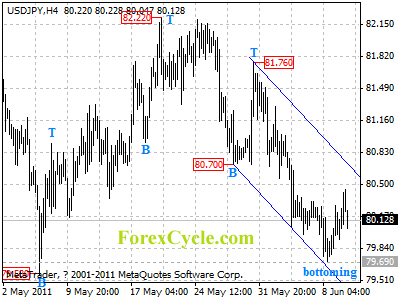
USDJPY rebounded from 79.69

Being contained by 79.58 support, USDJPY rebounded from 79.69, suggesting that a cycle bottom is being formed on 4-hour chart. Further rally would likely be seen later today, and target would be at the upper border of the price channel. As long as the channel resistance holds, downtrend could be expected to resume, and another fall towards 78.00 is possible. Only a clear break above the channel resistance could indicate that the fall from 82.22 had completed at 79.69 already, then the following upward move could bring price back to 81.50-82.00 area.

usdjpy

Daily Forex Forecast

Money in the Bank: Does It Still Mean “Safe and Sound?”

Elliott Wave International’s free report “Discover the Top 100 Safest U.S. Banks” explains the true risk that you may face when a bank fails.

By Elliott Wave International

Bank failures still dominate headlines as the number of failing banks continues at an alarming pace in 2011. The odds are that you’ve seen at least one bank failure in your community since the financial crisis hit in 2008. Some economists claim we’re in a recovery, yet hundreds of smaller financial institutions still suffer from the debt crisis that began a few years back.

Consider this May 25 post from author Kalyan Nandy, on the popular Atlanta real estate site CityBiz:

“Bank failures continue with no end in sight. Last Friday, U.S. regulators closed down three more banks, taking the total number to 43 so far in 2011…Looking back, there were 157 bank failures in 2010, 140 in 2009 and 25 in 2008.

“Issues like rock-bottom home prices, still-high loan defaults and deplorable unemployment levels are nagging troubles for such institutions…

“The number of banks on FDIC’s list of problem institutions shot up to 884 in the fourth quarter of 2010 from 860 in the previous quarter. This is the highest number since the savings and loan crisis in the early 1990s.”

The following excerpt from Elliott Wave International’s free report, Discover the Top 100 Safest U.S. Banks, explains the true risk that you may face when a bank fails.

Why do banks fail? For nearly 200 years, the courts have sanctioned an interpretation of the term “deposits” to mean not funds that you deliver for safekeeping but a loan to your bank. Your bank balance, then, is an IOU from the bank to you, even though there is no loan contract and no required interest payment. Thus, legally speaking, you have a claim on your money deposited in a bank, but practically speaking, you have a claim only on the loans that the bank makes with your money. If a large portion of those loans is tied up or becomes worthless, your money claim is compromised.

A bank failure simply means that the bank has reneged on its promise to pay you back. The bottom line is that your money is only as safe as the bank’s loans. In boom times, banks become imprudent and lend to almost anyone. In busts, they can’t get much of that money back due to widespread defaults. If the bank’s portfolio collapses in value, say, like those of the Savings & Loan institutions in the U.S. in the late 1980s and early 1990s, the bank is broke, and its depositors’ savings are gone…

The U.S. government’s Federal Deposit Insurance Corporation guarantee just makes things far worse, for two reasons. First, it removes a major motivation for banks to be conservative with your money. Depositors feel safe, so who cares what’s going on behind closed doors? Second, did you know that most of the FDIC’s money comes from other banks? This funding scheme makes prudent banks pay to save the imprudent ones, imparting weak banks’ frailty to the strong ones. When the FDIC rescues weak banks by charging healthier ones higher “premiums,” overall bank deposits are depleted, causing the net loan-to-deposit ratio to rise. This result, in turn, means that in times of bank stress, it will take a progressively smaller percentage of depositors to cause unmanageable bank runs.

If banks collapse in great enough quantity, the FDIC will be unable to rescue them all, and the more it charges surviving banks in “premiums,” the more banks it will endanger. Thus, this form of insurance compromises the entire system. Ultimately, the federal government guarantees the FDIC’s deposit insurance, which sounds like a sure thing. But if tax receipts fall, the government will be hard pressed to save a large number of banks with its own diminishing supply of capital. The FDIC calls its sticker “a symbol of confidence,” and that’s exactly what it is.

So what is the best course of action to safeguard your money?Read our free 10-page report, Discover the Top 100 Safest U.S. Banks, to learn:

• The 5 major conditions at many banks that pose a danger to your money.
• The top two safest banks in your state.
• Bob Prechter’s recommendations for finding a safe bank.
• And more!

Download your free report, Discover the Top 100 Safest U.S. Banks, now.

This article was syndicated by Elliott Wave International and was originally published under the headline Money in the Bank: Does It Still Mean “Safe and Sound?”. EWI is the world’s largest market forecasting firm. Its staff of full-time analysts led by Chartered Market Technician Robert Prechter provides 24-hour-a-day market analysis to institutional and private investors around the world.

With iCloud, Apple Once Again Opens Up New Market

With iCloud, Apple Once Again Opens Up New Market

by Ryan Cole, Investment U Research
Thursday, June 9, 2011

Apple is doing it again…

The company has a rich history of getting to a new sector, not first, but best. And when it does, everything changes. That’s not ad-man hyperbole – that’s just simple fact…

  • When Apple released the first iPod, personal MP3 players weren’t new – but they weren’t mainstream, either. That all changed when consumers experienced the ease of use of Apple’s then-revolutionary click-wheel.
  • When Apple started selling music via iTunes, many pundits wondered whether digital music could compete with physical media. Today, iTunes is the number one music seller in the world, with Amazon not far behind. Brick-and-mortar stores dedicated to music are just about extinct.
  • Last year, Apple released one of the first – but not the first – tablet computer. Now, Apple owns over 70 percent of the tablet market (and over 90 percent according to some calculations that consider sold-versus-shipped numbers).

Of course, none of this is counting Apple’s previous innovations… like icon-based operating systems, mouse-based interface systems, or advances in battery life that have helped the company dominate the high-end laptop market.

In short – what Apple does, it does well, and when it enters a new market, it tends to dominate it – at least for a time.

Competitors may swoop in to steal Apple’s early lead – as Microsoft did with the personal computer, and as Google may do with the tablet. But there’s no doubt – where Apple goes, the market follows.

That’s why Apple’s newest service – dubbed iCloud – is a bigger deal than many investors might realize.

Welcome to Tomorrow, Today: The Cloud Gets Real

Let’s be clear: Apple is far from the first to this space. Both Amazon and Google have been aggressively moving to the cloud.

But, as usual, Apple is doing it differently – and in a more user-friendly way. So, let’s take a look at what iCloud is offering:

  • File sharing that equals – or beats – Google docs.On Apple machines, you can start working on a document on one device, pick up exactly where you left off on another and make edits on a third (or fourth or ninth). This is much like other cloud services – but it’s more seamless with the Apple interface, and does a tremendous job of picking up exactly where you left off.

    That goes for pretty much every program – pick it up on any device, and you’ll open to the exact view you left on your previous device. In other words – you aren’t just storing data on the cloud – this is more like working off the cloud.

  • Photos and videos taken on one device are automatically and immediately available on every other synced device. True – after 30 days, they disappear. Unless you want it elsewhere – and then you just mark it for a more permanent place.
  • Music bought on iTunes is immediately available on all devices. And, for $25 a year, any music in your library is available to every device in your ecosystem.

That’s a big differentiation with other services. Amazon charges twice as much, and requires time- and data-consuming uploads, while Apple just allows your device to download previous copies already on Apple’s servers. Google music doesn’t have a price yet – but is already outclassed by the services Apple is offering.

This is far from the last salvo – and this war is far from over. The gap between what Apple’s offering and competitors is small. There’s no saying yet who will dominate the cloud.

But that hardly matters. Apple has thrown its hat into the ring, with its usual slick user interface and huge horde of dedicated customers.

What counts is this: With Apple’s entry, the cloud is virtually guaranteed to now take off. No more promises for the future – the cloud is today.

Good investing,

Ryan Cole

Captain Obvious (Ben Bernanke) Finally Gets It…

federal reserveWelcome to the party, Federal Reserve Chairman Ben Bernanke… In a speech to international bankers on Wednesday, the Fed Chief said, “Monetary policy cannot be a panacea.”

This phrase has been painfully obvious to us here at Smart Investing Daily. Heck, the unstable economy and the U.S. dollar make this phrase crystal clear. And remember when all of those countries holding hundreds of billions in U.S. debt started talking about ditching the dollar?

But it felt like the Federal Reserve — and even the markets themselves — ignored this idea for years.

Now, Bernanke finally gets it.

We have two questions… Is it too late? And will the markets like Bernanke’s newfound enlightenment?

We can hazard a guess for the first question. In short, yes. It’s too late.

It’s too late, and too little. Here’s what I mean. That life preserver MarketWatch.com was talking about is the easy monetary policy that’s been in place since the financial crisis. Absurdly low interest rates are considered part of the Federal Reserve’s “accommodative monetary policy.”

In the Fed’s mind the economy needs access to cheap money in order to start growing again. And Bernanke said, “Accommodative monetary policies are still needed. Until we see a sustained period of stronger job creation, we cannot consider the recovery to be truly established.”

This means we won’t see a hike in interest rates.

Here Comes Inflation

It also means that we’ll be paying more for gas and bread by the end of the year. Inflation, folks. I don’t see a way around it.

And, we know the answer to the second question.

A MarketWatch.com article reports:

Federal Reserve Board Chairman Ben Bernanke threw financial markets a life preserver, but the markets have thrown it back, disappointed that the U.S. central bank was not preparing another quantitative easing ocean liner to come to its rescue, Fed watchers said Wednesday.

The Dow Jones Industrial Average ended down for the sixth day in a row. Same for the Nasdaq and S&P 500 (barring the 0.02 point green day for the S&P on Tuesday).

But does the market really understand what’s happening?

I want to share with you an excerpt from Jared’s service WaveStrength Options Weekly. This article went out to his readers on Tuesday.

Jared wrote:

If you were to put the news and economic data from this past week in a time machine and send it back to just about any period in time, you probably would have created a market crash. No news was good last week, but the market didn’t crash.

One of the reasons why the market hasn’t completely rolled over and died, ironically, is because of the U.S. dollar. The weaker the dollar, the higher the price of things bought with dollars — like gold, oil and yes, markets.

It should be said, then, that you can still make money. For example, Jared’s WaveStrength Options Weekly subscribers recently made back-to-back gains… around 20% each in about a day.

(If you want to learn more about Jared’s service and these kinds of gains, click here.)

There will be a tipping point, however, where the weak U.S. dollar undercuts gains. Inflation is like an infestation of termites, eating small chunks of your savings and retirement fund until your gains are riddled with holes.

Remember that retirement stress test we told you about back on May 9? Try working those numbers with 5% or 6% inflation, and see how long your nest egg lasts.

It’s time to get into survival mode.

Get Your Kit Ready

I told you on Wednesday that we’re preparing for our annual summit meeting. I gave you a link to a special Webinar. This Webinar is designed to help you weather the coming “money crisis.” It should be the first thing you put into your survival kit.

This year’s summit meeting will equip you with other tools for your survival kit, but as with any kit, you need to make sure you’re fully supplied.

This free Webinar comes with an exclusive report that only Webinar attendees will get. It’s a vital tool you’ll want in your “Money Crisis Survival Kit.”

If you haven’t signed up for this event, make sure to reserve your spot today. I’ll be there, listening in to make sure we’re all well-equipped, but I can’t give away the exclusive report.

You’re on your own to get that, so follow this link to get access to the report.

Editor’s Note: No need to get a second job, go back to school or work extra hours to potentially collect weekly income tips. This secret could consistently earn you extra money. Read on for the full details…

Article brought to you by Taipan Publishing Group. Additional valuable content can be syndicated via our News RSS feed. Republish without charge. Required: Author attribution, links back to original content or www.taipanpublishinggroup.com.

{jtagstpg} {authorstpg}

Other Related Sources:

  • How Long Will Your Retirement Nest Egg Last?
  • How to Get the U.S. Dollar to Stop Stealing Your Commodity Profits
  • This Is How the Dollar Dies
  • Trichet Signals Rate Increase but Euro Declines

    printprofile

    The euro was down one cent versus the dollar and lower in the crosses at the conclusion of the ECB press conference. Despite Trichet’s signal of an impending rate increase in July the euro fell across the board in what looks like a “buy the rumor, sell the fact” type scenario.

    To say that the euro sold off because the peripheral nations will struggle to grow in an environment of higher interest rates is to discount the price action of the last three weeks. The ECB expects euro zone growth to increase this year between 1.5% and 2.3%.

    Looking at the price action of the EUR/USD the pair has risen 5% from its low in May to a high reached on Tuesday. While much of the bids for the euro came on the hopes of a solution to the European debt crisis, much of the buying is on the back of increasing interest rate expectations. As the July interest rate was predominantly priced by the market, the euro sold off following Trichet’s confirmation.

    Read more forex trading news on our forex blog.

    Are You ready for a Market bounce? Key Support & Resistence Levels

    By Chris Vermeulen, thegoldandoilguy.com

    During the past 4 months we have seen the financial sector (banks) under selling pressure. With real estate prices continuing to fall and foreclosures picking up speed again investors have not been that interested in holding bank stocks. And we all know that without the financial sector moving higher we cannot expect the broad market to make any significant moves higher either.

    If you take a look at the financial sector ETF XLF you will notice that it’s now trading near a major support level (fair value) where most shares changed hands in the past. With this sector sliding 13% from the highs in February and the fact that it’s making a parabolic drop into a support zone I can’t help but think a bounce is very likely to form soon.

    XLF Financial Sector ETF – Daily Chart

    SP500 Futures – 10 Minute Chart
    With the financial sector nearing major support and the SP500 staring to show signs of a bottom forming I will admit my heart is starting to pound in excitement for an entry point. I am really hoping that this week we see another sharp drop in the stocks which should spikes the volatility index up (VIX) to 21 or higher. If we can see this take place, then I will be taking a long position to catch a 2-15 days bounce in the broad market.

    The chart of the past 10 trading sessions below shows a price and volume pattern which typically leads market bottoms. I’m keeping a close on things these days…

    Silver 2 Hour Chart
    Silver took a big hair cut last month falling from $50 down to $33 per ounce. Ever since then it has been trying to form a base which will act as the next launch pad for higher prices. So far it is looking good but there is a key resistance level to breakthrough before fireworks. Keep your eye on the silver bullet.


    Gold 2 Hour Chart

    Gold is back trading up near its high but is starting to struggle with resistance (sellers). We could easily see gold pullback to the $1520 area before taking another run at resistance.

    Mid-Week Update Conclusion:
    In short, I feel investors are getting very nervous because of the 6 week sell off in stocks. There have been some technical support levels broken on the SP500 and other indexes and its these broken levels which have investors running for the door. The thing is, this type of selling happens every year and generally 2 -3 times. During a bull market I like to see fear in the eyes of investors. Until we are proven wrong about buying extreme oversold dips, they continue to be my focus.

    Also if the financial sector can find a bottom and start to rally, then we will see higher stock prices across the board in the coming weeks. I am currently neutral on metals, oil and the dollar. But am getting bullish on financials and the SP500 as they move lower.

    Get these trading reports free each week here: http://www.thegoldandoilguy.com/trade-money-emotions.php

    Chris Vermeulen