Yields Favor Gains for Swedish Krona

printprofile

Fundamentals appear in favor of the Swedish krona according to interest rates and bond yields.

One of the major driving factors in the valuation of a currency is interest rates and Sweden enjoys higher yields versus both its European and US counterparts. The Riksbank is forecasted to continue to raise interest rates over the mid-term which should be supportive of the Swedish krona. Currently the repo rate maintained by the Riksbank is 1.75%. The EU interest rate currently stands at 1.25% and is expected to rise 25 bps in the next ECB meeting in July. The US maintains an interest rate below 0.25% and is forecasted to continue its ultra-loose monetary policy.

Strong yield differentials between the Swedish 2-year bond and the 2-year German bund are in Sweden’s favor by 81 bps while Sweden enjoys a 197 bps spread between the equivalent US 2-year Treasury. Currently the Swedish 2-year yields 2.41%.

However, traders should be aware that the 2-year US Treasury note has plummeted since April (bond prices and yields have an inverse relationship) as the yield has risen to 0.44%. As such, traders may look to play the euro versus the Swedish krona rather than the USD.

Read more forex trading news on our forex blog.

Euro Under Pressure Once Again

printprofile

The euro fell in early European trading following a Bloomberg report that yesterday’s meeting of Europe’s finance ministers in Brussels failed to resolve the differences between the ECB and Germany. After two days of euro gains this puts the pressure on the 17-nation currency once again and may be the driving factor in today’s trading. Yesterday’s high at 1.4500 stands as short term resistance for the EUR/USD while a clear breach below 1.4320 could open the door to test the 1.4000 level for the second time in as many months.

Today’s Economic Data Releases:

GBP – Claimant Count Change – 08:30 GMT
Expectations: 7.1K. Previous: 12.4K.
Cable looks weak based on yesterday’s doji candlestick and the pair’s failure to rise above the recent falling resistance line from the May 31st high. Resistance is located at 1.6425 while the trend line off of the May 2010 low comes in today at 1.6200. A break here and the pair could test the neckline of a potential head and shoulders pattern at 1.6110.

USD – Core CPI m/m – 12:30 GMT
Expectations: 0.2%. Previous: 0.2%.
There are those calling for QE3 to support the tepid economic recovery and struggling US equities, many market pundits and those in the blogosphere forget that QE I and II were implemented to drive down interest rates and avoid a potentially damaging deflationary environment. Yesterday’s PPI reading showed an increase of 0.2% on consensus expectations for only 0.1%. With rising inflation data the Fed would be hesitant to further loosen US monetary policy, a potential dollar catalyst in the medium term.

Read more forex trading news on our forex blog.

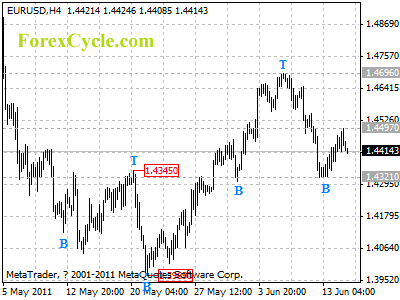
EURUSD’s rise extended to 1.4497

EURUSD’s bounce from 1.4321 extended to as high as 1.4497, suggesting that a cycle bottom had been formed at 1.4321 on 4-hour chart. Lengthier consolidation of downtrend from 1.4696 is possible in a couple of days, and range trading between 1.4321 and 1.4497 is expected. Support is at 1.4321, a breakdown below this level will indicate that the downtrend from 1.4696 has resumed, then another fall towards 1.3969 could be seen.

eurusd

Forex Signals

Six Straight Weeks of Decline Take DJIA Below 12,000: What Now?

Before blaming falling stocks on the most recent weak economic reports, let’s check some dates

By Elliott Wave International

As of June 10, the Dow has suffered the “longest losing streak since the fall of 2002. The market’s last seven-week stretch of losses began in May 2001, as the dot-com bubble deflated,” reports The Associated Press.

As for why stocks are falling, most observers agree: Blame “weaker hiring, industrial output, and a moribund housing market.” The economic reports from the past two weeks made that clear.

But wait a minute. The DJIA didn’t top in the past two weeks — it topped on April 29. At the time:

  • U.S. unemployment benefit applications had been trending down/flattening. In fact, “The unemployment rate fell last month in more than 80% of the nation’s largest metro areas,” said an April 27 AP report.
  • U.S. industrial output was up. In fact, “both the Philly and N.Y. Fed reports show[ed] improving manufacturing and business conditions.” (Reuters, April 15)
  • As for the U.S. housing market, it officially entered the “double-dip recession” zone only on May 31, a month after the Dow’s April 29 peak.

This is not to say that unemployment, manufacturing and real estate were peachy in April. But the worst of the reports from those areas of the economy only came after the stock market had already entered the decline. The most recent weak economic reports hardly explain why stocks topped when they did.

If you’re looking for a better explanation, consider an Elliott wave perspective: The economy doesn’t lead the stock market — it’s the stock market that leads the economy.

Skeptical? Then think back to 2007. “Goldilocks economy,” strong corporate earnings, unemployment at 4.4% — nothing but blue skies ahead. The Dow rallies to an all-time high above 14,000 in October 2007 — and over the next 18 months goes on its biggest losing streak in 70+ years, falling 54% and ushering in “the Great Recession.”

Now fast forward to March 2009. The Dow has crashed below 6,500; unemployment has more than doubled; the desperate Fed has dropped interest rates to 0%; foreclosures; bailouts; consumer confidence at an all-time low; general state of near-panic. The Dow bottoms on March 6, 2009, and stages a powerful two-year rally above 12,000.

By conventional logic, you’d have to agree that, paradoxically, “the good economy” of 2007 prompted the deflationary crash, while “the bad economy” of 2009 sent stocks flying.

But here’s an explanation that actually makes sense: Broad market trends are not created by the economic conditions — social mood is what creates them. Social mood doesn’t depend on what Ben Bernanke had for breakfast — it changes for endogenous reasons, and those changes follow the Elliott wave model. Stocks lead the economy because they are quicker to register changes in social mood.

Before you make investment decisions based on the latest economic report, be sure to read the 2011 edition of The Independent Investor eBook by Elliott Wave International. You will see example after example of the fallacy to the belief that economic conditions direct the moves in the stock market.  Download your free 50-page Independent Investor eBook now.

This article was syndicated by Elliott Wave International and was originally published under the headline Six Straight Weeks of Decline Take DJIA Below 12,000: What Now?. EWI is the world’s largest market forecasting firm. Its staff of full-time analysts led by Chartered Market Technician Robert Prechter provides 24-hour-a-day market analysis to institutional and private investors around the world.

Fighting Arab Nations Are Costing You Hundreds at the Gas Pump

You know, gasoline prices are supposed to climb as we head into summer, but things are getting a bit ridiculous!

Gasoline prices are up nearly $1.06 a gallon from last year, and it’s not even summer yet.

Why is this happening? Well, the Arab nations of OPEC are fighting…

OPEC decided not to produce more crude oil. Or rather, Iran and its cohorts blocked Saudi Arabia’s efforts to try to boost production.

Aside from the crummy effect this had on crude oil prices just after the meeting last Wednesday, there are some bigger issues coming to the surface.

The Wall Street Journal reported:

An acrimonious OPEC meeting failed to produce an agreement to increase oil production despite tight supplies and rising prices, bringing to the fore long-simmering divisions between key cartel players Saudi Arabia and Iran and calling into question the group’s ability to influence oil prices.

And the Boston Herald said:

OPEC’s stunning admission of major dissent within its ranks has left it reeling and its status as the world’s oil power-broker weakened — perhaps beyond repair.

OPEC has already lost a lot of clout as crude oil production outside of its group has grown in the past decade or so. Places like Russia and Brazil have brought a lot of crude oil to the table. These countries aren’t under the thumb of OPEC’s production rules.

That said, OPEC’s influence with global powers, however, shouldn’t be forgotten.

I’m talking about the crude oil embargo in the mid-1970s that nearly brought the U.S. to its economic knees, and quadrupled the price of crude oil in less than half a year.

Saudi Arabia and other Arab OPEC members turned off the tap by 15% back in 1973, and markets went bananas… The “oil weapon” will always be a threat. But ill will between major OPEC producers has even bigger consequences.

That they are fighting now should be a warning to everyone. Saudi Arabia and Iran — who are ranked as the top two Arab countries in terms of oil reserves — are vying for power… and they have very different global views. Mainly, they deal differently with the West. Saudi Arabia works closely with the U.S., while the U.S. still has strict sanctions against Iran.

Now, these two countries are dealing with more than one crisis. Even though Saudi Arabia and its OPEC allies are calling for increased demand in the second half of this year, the world is using less crude oil because of the global financial crisis. Crude oil inventories in the U.S. are 7.5 million barrels higher than they were last year.

You could say the call to increase production would solely be a bid to lower prices. This rubbed some OPEC members the wrong way because some of them can’t produce more crude oil quickly or cheaply. Iran is one of those countries.

Indeed, only Saudi Arabia and three other Gulf countries that are more allied with the West than other Arab OPEC members favored an increase in production.

Most of these countries don’t want lower crude oil prices. This is because of the second crisis. The Middle East and North Africa are under siege from their angry citizens. When Tunisia and Egypt were successful in overthrowing their governments, other countries jumped on the uprising bandwagon. Yemen, Bahrain and Libya have all seen huge protests.

Of course, Libya is still in the midst of a global military intervention. Its oil production is still offline.

These countries need high crude oil prices if only to throw money at the masses, hoping they’ll stop their protests.

Because of these two crises, OPEC is on the edge of a cliff. Some analysts are even saying that OPEC is dead.

But what — if anything — will this do to crude oil markets?

Immediately after the announcement, crude oil prices climbed nearly 3%. This pressure means higher gasoline prices heading into summer. As I told you, gasoline prices are nearly $1.06 per gallon higher than last year… And unlike oil inventories, gasoline inventories are down 4.5 million barrels from last year.

Translate this pain at the gas pump to other market investments, and you’ve got possible bearish outlooks for retail companies.

On the other hand, domestic energy could get a lot of attention. Even companies doing business in friendlier countries like Canada could benefit.

Check out Apache Corp. (APA:NYSE) and Suncor Energy Inc. (SU:NYSE), up about 26% and 19% in the past year. These guys are heavy hitters without being 800-pound gorillas. They are outperforming their competitors and are a much better value than their industries as a whole.

Of course, these aren’t the only opportunities to pop up in the wake of the nasty OPEC meeting. In fact, this first OPEC fracture could be the start of an even bigger crisis. Justice Litle, editor of Macro Trader just sent me a letter about the coming crisis saying:

I can tell you right now, we have never… EVER… seen this level of chaos on U.S. shores. This will put the financial crisis of 2008 to shame…

I don’t have room to tell you what the rest of his letter said, but we’re quickly working on a way to let you read it in its entirety. One thing I can tell you, though, is that Justice believes that the bigger the crisis, the bigger the opportunity.

As soon as this letter is available, I’ll be sending you a link to it, so keep an eye out in your inbox.

Article brought to you by Taipan Publishing Group. Additional valuable content can be syndicated via our News RSS feed. Republish without charge. Required: Author attribution, links back to original content or www.taipanpublishinggroup.com.

Backdoor IPOs and Reverse Mergers: A Chinese Recipe for Scandal

Backdoor IPOs and Reverse Mergers: A Chinese Recipe for Scandal

by Tony D’Altorio, Investment U Research
Tuesday, June 14, 2011

Since 2007, more than 150 Chinese companies have been listed in the United States through reverse mergers or backdoor IPO listings.

These types of listings happen when Chinese firms merge with a U.S. publicly traded shell company. Many of these listings are found on less regulated stock exchanges such as the Pink Sheets, the OTC Bulletin Board and NYSE AMEX.

These reverse mergers and backdoor procedures allow Chinese companies to become public without the regulatory rigors involved in a traditional initial public offering (IPO).

In recent months, short sellers have attacked a large number of these types of Chinese companies – accusing them of fraud or other wrongdoings. This has caused shares of these companies to tumble and have inflicted huge losses on unlucky investors…

Investing in China Becomes Unsettling…

With so many of these reverse merger and backdoor Chinese companies now under a cloud of scandal, investors in China are getting increasingly unsettled.

Especially since the United States is at the center of this storm. In the past six months alone, more than 25 New York-listed Chinese companies disclosed accounting discrepancies or saw their auditors resign.

Most of these firms are small and slipped onto the exchanges in the past few years through the reverse merger process described above.

Regulators are now reversing that process.

  • Nasdaq and NYSE Euronext halted trading in the shares of at least 21 small- and micro-cap Chinese companies in the past year. Five such companies were altogether kicked off of the exchanges.
  • Facing investors’ ire, the SEC is investigating many of these companies as well as the network of U.S. auditors and public relations firms who marketed such companies to the U.S. investing public.

Some U.S. investors are worried whether they can take the financial statements of any Chinese company at face value.

For instance, look at software firm Longtop Financial Technologies (NYSE: LFT). It listed in New York in 2007 via an IPO, not through a reverse merger. Last month the company’s auditor, Deloitte, accused Longtop of “very serious defects,” including faking its bank statements. Longtop said it is conducting its own internal investigation.

As the scandals mount, many investors are dumping U.S.-listed Chinese stocks. They’re fearful of further price declines or perhaps not being able to sell their shares due to trading halts.

Protecting Against Fraudulent Chinese Stock Listings

So what should investors do? How can they protect themselves against fraudulent Chinese companies?

One way recommended by my colleague, Carl Delfeld, is to avoid the smaller companies. He pointed to a study showing that 60 percent of China backdoor listings reported less than $50 million in annual revenue or assets.

There’s another logical way investors can avoid most of these fraudulent companies…

  • Do a little bit of homework and look to see if these companies are listed either on mainland Chinese stock exchanges or in Hong Kong.
  • Not surprisingly, you’ll find that the vast majority of these companies aren’t listed in their home market.
  • The fraudsters running these companies know they can’t dupe local investors, who would be well aware if they are or are not legitimate companies in China.

One former executive at one of these firms was even quoted as saying that American investors will buy anything “as long as it has ‘technology’ in its name.”

He may be on to something. Many of the recent “hot” Chinese IPOs listed in the United States are technology companies that are not listed in China.

Investors need to keep in mind that investing in Chinese companies should be no different than investing in other companies. Do your homework and your due diligence. Caveat emptor.

Good investing,

Tony D’Altorio

America’s New Inflation Hedge is Real Estate

mortgageI guess you could call me a “grassroots” investor when it comes to my longer-term ideas. I look out my window, talk to friends and read the back pages of just about every local publication I can get my hands on. I want to find out what’s really happening out there, to find trends that could explode onto the national scene.

Most of the headlines of tomorrow are being hidden by the big headlines of today. They are often talked about in local papers, but can be hard to spot if you don’t look beyond Page 1.

I want to share with you an idea that’s a little unconventional… at least when it comes to inflation. Let me give you a little background.

America’s Struggle Against Inflation

The average American has little or no defense against inflation. For most of us, our home is the ONLY asset we have that keeps up with inflation and thus gives us some protection. You need to own hard assets like real estate and/or precious metals if you want to keep up!

For most Americans, the dream of owning a home is NOT getting any closer.

Impossible loan requirements make mortgages hard to come by. This is exacerbated by the fact that many have had their credit bruised in the recession. Many were perhaps even forced to change jobs or go to work for themselves, which also makes it harder to obtain financing.

If you couple that with the fact that most Americans are still scared to buy anyway, you have a housing market that is ripe for the savvy investor to step in and find deals.

Five to seven years from now, when the economy has stabilized and these issues disappear off of people’s credit reports, you will have a much healthier housing market out there. 

If you have the means, you can profit in these tough times!

U.S. Real Estate: Housing, Housing Everywhere, but Not That Much for Rent

There is no doubt that the regular housing market is still suffering and banks are keeping their hands in their pockets when it comes to offering mortgages to prospective homebuyers.

Fannie Mae is the only agency that is helping buyers with less-than-stellar credit and less than 20% to put down on a home. You can expect lending to remain tight and housing to continue to struggle.

But rents are a different story altogether…

Rent rates are up and have been for some time now. In fact, according to the Bureau of Labor Statistics, primary residence rent rates are up over 1.3% over the past year. In this same period the average home value dropped about 5%.

I have been noticing this trend for some time now and finally the mass media seems to be catching on.

After looking at investments in Dallas, I wrote about rental property a year ago. I also warned of a housing market double dip back in December 2010. I wanted to revisit this topic and offer a few more tactics if you want to allocate some funds to rental properties.

Why Own Real Estate Property?

If you do a little homework and take your time you can find some great long-term real estate investments. The drop in home values has shaved off almost 10 years of appreciation. That’s good for the long-term investor.

As new homebuilders scale back on construction (as they have been for some time) and older homes are demolished for other uses or natural decay takes the old inventory off the market, supply goes down.

That means there could be some pent-up demand for homes when the economy improves.

This simple equation should lead to home price appreciation. But in the meantime, an investment can still make you money. In fact, there is a plethora of homes out there that are generating positive rental cash flow.

To Landlord or Not to Landlord

Being a landlord is not always a picnic. But not every tenant is going to be the next Michael Keaton in Pacific Heights. (Don’t watch the movie if you plan on buying an investment property.)

There are some tips that you should know before even considering it:

Location — You will want to buy a home in a stable, dense neighborhood preferably close to a military base, college or large commercial/industrial office park where there will be a huge pool of possible tenants to draw from.

Inman News recently wrote a piece about the 10 best markets for real estate investors; here are their top 10 picks:

  1. Indianapolis — Carmel, Ind.
  2. Winchester, Va.
  3. Gainesville, Fla.
  4. Tucson, Ariz.
  5. Tallahassee, Fla.
  6. Hagerstown, Md.– Martinsburg, W.Va.
  7. Salt Lake City, Utah
  8. Richmond, Va.
  9. Gainesville, Ga.
  10. Winston-Salem, N.C.

Price — Everything is relative when it comes to price and value. Do your homework and look at average rent rates in the area and average sale prices, and check out sites like Craigslist.com to see what people are offering and how it compares to your perspective property in terms of cost, condition, amenities, etc.

Management Company? — There are management companies that can help you, but they will cost money and it might be better to do it yourself, as they don’t have your investment as their No. 1 priority. Take your time finding the right tenant and make sure you do proper checks on credit history and criminal background.

I have always looked to friends to find tenants and have never used a management company, but if your property is far from home, it might be your best bet.

If you are on Facebook, sometimes just posting that you have a place for rent might bring a friend (or friend of a friend) to your door!

Of course, renting out a property isn’t your only investment choice…

Don’t Want to Be a Landlord?

There are several public rental property companies to invest in. They won’t give you the same inflation hedge or real equity that a home would, but investing in a company might save you a couple headaches. Here are two that I think are worth looking at:

Essex Property Trust (ESS:NYSE) This real estate investment trust (REIT) manages properties along the West Coast. As an REIT, they must distribute a large amount of their earnings through a dividend. The current yield is about 3%.

Camden Property Trust (CPT:NYSE) is also an REIT with 187 properties all across the U.S. They offer a well-diversified portfolio of communities in terms of geography and also are currently yielding a dividend of about 3%.

There is no such thing as a free lunch, my friends. The wealthiest people in the world usually had to work for what they have. Diversification of your investments and taking action when others are too scared or too slow can lead you to wealth if done with tact.

And that means being open to alternative investment ideas like the inflation hedge we’ve talked about today. It’s a perspective that we at Smart Investing Daily are always willing to share.

Do you like the unique investment tactics I talk about? As a trader, I truly enjoy discussing strategy, trading ideas and market events with fellow traders. My guess is that you’re the same way. It’s amazing what you can learn from sharing trading experiences with colleagues and friends.

In September, you’re going to have just this kind of opportunity. Mark your calendar for Sept. 17-19 when we will hold our annual conference in Las Vegas. This is your chance to hear trading ideas from all of our editors, ask questions during our panel presentations, and chat about trading over breakfast, lunch or dinner.

I am looking forward to the event. We uncovered some great opportunities last year and had a blast doing it.

To kick things off this year, we are hosting a FREE online event next week — the “Money Crisis Survival Webinar.” Not only will you hear about the trouble we see brewing, but you will get solutions… including a free report that details how to take advantage of Washington’s unending greed.

Technically, registration is closed. But we’ve had such demand for this one-of-a-kind event, we found a way to increase our bandwidth and let more viewers in. Don’t miss this last chance. Reserve your spot now… All we need is your email address.

Article brought to you by Taipan Publishing Group. Additional valuable content can be syndicated via our News RSS feed. Republish without charge. Required: Author attribution, links back to original content or www.taipanpublishinggroup.com.

{jtagstpg} {authorstpg}

Other Related Sources:

  • How to Fix the U.S. Housing Market
  • How to Earn 18% Without Buying a Single Stock
  • The Housing Market is Still NOT Safe
  • The 8 Rules I Use to Earn $112.77 in Dividends Per Day

    Article by DividendOpportunities.com

    The 8 Rules I Use to Earn $112.77 in Dividends Per Day

    Note: The following is a guest article from Dividend Opportunities co-founder Paul Tracy.

    I counted twice, just to be sure…

    $41,161.63.

    That’s the amount in “daily paychecks” — more commonly known as dividends — I received from my investment portfolio in 2010. That total comes to $112.77 for each day of the year. Cash.

    Why am I telling you this?

    It’s not to brag. I was born and raised in Wisconsin. The typical Midwestern mentality is so ingrained in me, I very rarely talk about money. And I’m not one to show off, either. I drive a Nissan I bought six years ago. I get my hair cut at Supercuts.

    No, I’m telling you this because I honestly think what I’ve discovered is the single best way to invest, hands down.

    I’m talking, of course, about the “Daily Paycheck” strategy. If you’ve read Dividend Opportunities for even a couple of weeks, you’re likely familiar with Amy Calistri and this strategy.

    Amy is the Chief Strategist behind our premium Daily Paycheck newsletter. Her goal is to build a portfolio that pays at least one dividend every day of the year. The idea for her advisory came from my personal “Daily Paycheck” experiment.

    I’ve been following the strategy personally for a few years now. In that time, I’ve not only been able to build an investment portfolio that pays me more than 30 times a month, but the checks are getting bigger and bigger as time passes.

    What I like best is that it’s the easiest way to invest you can imagine. Once you get started, it runs on autopilot. Of course, you’ll make a few portfolio adjustments now and then, but you won’t have to anxiously watch your holdings every day.

    Now it’s time to come clean. If you start this strategy tomorrow, it’s unlikely you’ll be earning $112 a day by the weekend.

    I’ve been fortunate to start with a healthy-sized portfolio. And as I said, I’ve enjoyed the benefits of implementing the “Daily Paycheck” strategy for a few years now, so my payments have grown much larger than when I started.

    But here’s the good news… it doesn’t matter. Whether you have $20,000 or $2 million, you can start your own Daily Paycheck portfolio today. The results are fully scaleable, and anyone can have success, as long as you follow eight simple rules Amy and I created to not only build our portfolios, but also manage risks…

    1. Dividend payers beat non-dividend payers.
    According to Ned Davis Research, firms in the S&P 500 that raised dividends gained an average of +8.8% per year between 1972 and 2008. Those that cut dividends or never paid them produced zero return over this entire time span. 

    2. Higher yields beat lower yields.
    This is such a “no-brainer” that it doesn’t require explanation. Clearly, a bigger dividend puts more cash in your pocket.

    3. Reinvesting your checks beats cashing them.
    This buys you more shares, which leads to larger dividend checks, which buy you even more shares, and so on (this is how my dividend checks have grown).

    4. Small caps beat large caps.
    A 70-year study of different equity classes showed that $1,000 invested in small-cap stocks grew to $3,425,250. In large-cap stocks it grew to only $973,850.

    5. International beats domestic.
    The average U.S. stock pays just 2.0%. That’s peanuts compared to yields overseas. Stocks in New Zealand yield 5.4%… stocks in Portugal yield 4.1%… in Spain 5.3%… and in the Czech Republic 4.8%.

    6. Emerging markets beat developed.
    It’s much easier for a small economy to post fast growth than a large one. And investors who know this benefit. Since 1994, Vanguard’s Emerging Markets Stock Index Fund is up +268%. Stocks throughout the developed world, as measured by Morgan Stanley’s EAFE index, are up just +55%.

    7. Tax-free beats taxable.
    Tax-free securities often put more cash in your pocket at the end of the day — especially if you’re in a high tax bracket. A muni fund yielding 6.0% pays you a tax-equivalent yield of 9.2% if you’re in the 35% tax bracket.

    8. Monthly payouts beat annual payout.
    Getting paid monthly is not only more convenient — you actually earn more. Thanks to compounding, a stock paying out 1% monthly yields far more than 12% — it can actually pay you 12.68% if you reinvest.


    It’s these eight rules I’ve followed to build a portfolio that not only paid me $112 a day in 2010, but that is also seeing rising payments. In December, I earned 59 checks, at an average daily amount of $214.18. (December’s payouts were higher than normal thanks to year-end dividends, but there’s no doubt the payments are increasing.)

    I’ve been investing for the better part of two decades. During that time, I’ve tried just about every strategy and style you can imagine. And don’t get me wrong — you can make money any number of ways in the market.

    But earning thousands of dollars each month consistently? I never experienced that until I implemented the Daily Paycheck strategy.

    Good Investing!

    Paul Tracy
    Co-Founder — StreetAuthority, Dividend Opportunities

    P.S. — My ultimate goal is to build a portfolio that pays me $10,000 a month. In December I pocketed $6,639, so I’m well on my way. To learn how easy it is to set up your own “Daily Paycheck” portfolio, be sure to read this memo. It has all the details on how to get started yourself.

    Let NFC Smartphone Technology Give Your Wallet the Boot

    Let NFC Smartphone Technology Give Your Wallet the Boot

    by David Fessler, Investment U’s Senior Analyst
    Tuesday, June 14, 2011: Issue #1534

    How often have you left home and forgotten your wallet? Or had to get a credit card replaced because a stranger lifted your number at a restaurant? As a frequent traveler, I’ve had both happen to me on numerous occasions.

    With plastic credit cards fast becoming as obsolete as paper money – Visa, the giant credit card issuer, has created an amazing new technology it calls “payWave” that enables you to leave your wallet, cash and credit cards home. Easily allowing consumers to turn their smartphones into electronic wallets.

    PayWave uses something called near field communication (NFC). NFC is a short-range, wireless technology that allows secure communications between two proximate devices. You simply bring your smartphone within a couple of inches of the transaction terminal, and voila, a transaction is complete.

    Despite the obvious benefits, the e-wallet industry has had a slow, rocky start.

    • One one side, the mobilephone users saw no need to incorporate NFC into their devices.
    • On the other side, retailers wouldn’t install mobile payment readers if consumers didn’t own phones that could use the technology.

    It’s been a bit of a chicken-and-egg thing…

    GSMA Issues Call to Arms to Encourage NFC Devices

    Back in 2008, GSMA challenged device manufacturers to begin embedding NFC technology into their devices. Fast-forward to 2011, and the next generation smartphones (still a year or two away) will all have NFC capability.

    But Visa didn’t wait. It provided a way to use today’s smartphones to take advantage of NFC-enabled vendors. It involves inserting a special micro-SD (secure digital) card into the slots on some phones. For the iPhone 3 and 4, Apple developed a special plastic skin to hold the chip.

    Now, users simply download Visa’s special app, and they can begin NFC transactions. So far, 11 banks, including Wells Fargo, Bank of America, Chase and U.S. Bank, all offer the payWave technology.

    MasterCard’s PayPass and Amex’s Express Pay are similar e-wallet systems using NFC technology, and all three are compatible with the terminal readers.

    Bill Gajda, global head of Visa Mobile, spoke to CNET at the Mobile World Congress earlier this year in Barcelona, Spain. He believes the transition to cardless transactions is well underway. “NFC technology will take off in 2011,” said Gajda. “The move from leather wallets to mobile wallets will come this year.”

    So far, vendors include CVS stores, McDonalds and 10,000 taxicabs in New York City. In San Francisco, you can use your e-wallet to buy your groceries at Whole Foods, and pay for public transit in Los Angeles and New York.

    (If you’ve already plugged into this technology, or want to see merchants who are participating in your area, you can visit Visa’s payWave merchant locator.)

    The 800-Pound Apple in the Room…

    Gajda said customers are already installing the chips and skins in their existing smartphones: “People don’t want to wait two years for new NFC-enabled phones to come out or to switch phones. You can make payments today on the iPhone 3 and 4.”

    So far, iPhones, certain Blackberry models and Samsung’s Android-based Galaxy S II are sure bets for NFC-based payments.

    According to an EE Times article, that appeared back in January, Apple, Inc. (Nasdaq: AAPL) has been in discussions with both retailers and its contract manufacturers about supporting mobile payments.

    Quoted in the article, Richard Doherty, Principal at consulting firm Envisioneering, says NFC could be a game-changer for both Apple and retailers.

    “Apple could significantly lower the costs credit card companies charge retailers to verify and complete transactions, a major source of irritation for retailers. Tens of billions of dollars [would] flow through Apple in the next several years.”

    While no one knows Apple’s plans for sure, it’s a safe bet that the iPhone 5 will be NFC-enabled.

    Taking a little piece of every transaction would represent a huge, new incremental revenue stream for Apple. And one thing’s for sure… As the company has with just about everything else, Apple will set the NFC mobile payment device standard that all other manufacturers will be scrambling to copy.

    • With its tightly integrated handsets, operating systems and online payment systems already in place, Apple’s in an envious position to be able to leapfrog the competition in the mobile payment space.
    • It owns several key patents that have to do with implementing NFC, and it hired an NFC specialist over a year ago.
    • Analysts expect most other manufacturers will soon follow, as NFC becomes a standard feature on new phones.

    This isn’t just a U.S. phenomenon, either. Consumers in Japan and Korea are adopting NFC-enabled mobile payment systems, with Brazil, India and other countries hot on their heels. Visa has been developing its payWave system for its European customers, as well as Turkish iPhone users.

    So how easy is it to use? You simply open the app, unlock it with a swipe of your finger and place your phone near the terminal to complete the purchase.

    The payment is immediately charged to your credit card or debited from your bank account depending on your preference. Banks and retailers can also present the user with discounts, specials and coupons through the payWave system.

    That’s Great, But How Safe is NFC Technology?

    That was my question when I first heard of NFC technology. Criminals can clone existing plastic cards with ease. Cards can also be easily swiped a second time on a separate reader connected to a computer that lifts all of your card information that can later be sold.

    With all the cyber criminals out there, are we just one hack away from having our credit cards stolen electronically?

    In actuality, it’s virtually impossible for someone to steal a credit card number with the new systems.

    • First, the phone has to be two to four centimeters away from the transaction device to work, making it extremely difficult for someone else to intercept the transaction.
    • Second, NFC software generates a new authentication code for each transaction. That differs from current credit card technology where the security code is always the same. Once thieves have the credit card code, they’re off to the races (or in my case, they were off to JCPenney’s).
    • Third, most phones have the capability of being password-protected by the user, adding another level of security.

    Visa’s payWave system monitors credit card use in real time, and can instantly alert a customer within minutes of a suspicious transaction. Compare that to current credit card technology, which can take days to notify you of a bogus purchase.

    In a paper written three years ago, mobile security expert Collin Mulliner performed a detailed study on ways to attack mobile phones equipped with NFC technology.

    After talking to Visa, he admitted their system was safe from the types of attacks he envisioned. He plans further tests on a payWave-enabled phone, but for now, his feeling is that it’s a far more secure system than plastic.

    Deepak Jain, CEO of Visa technology partner DeviceFidelity, said attacks would be nearly impossible. Multiple electronic barriers are in place to prevent them.

    Digital keys, the heart of the authentication process, are encrypted on the chip itself. The Visa app is the only app recognized by the device, and the digital keys aren’t stored locally. They all come from the Visa network.

    NFC transactions will eventually become the norm rather than the exception. By the end of this year, Apple could be driving a completely new NFC-enabled bus… all the way to the bank. Its competition will once again be scrambling to catch up, and fighting over 10 to 15 percent of the market that Apple leave for them.

    Good investing,

    Dave Fessler

    After Solid Inflationary Data, Traders Await Tomorrow’s Investment News

    printprofile

    Today’s publication by the Great Britain and the United States regarding their level of consumer and producer inflation (CPI and PPI, respectively), and US-based retail sales, had many investors seeking higher yielding assets. The news spurned calls for growth, especially as consumer spending in the US shrank less than forecast.

    After digesting the bullish inflation reports, investors now appear to be anticipating tomorrow’s CPI and TIC Long-Term Purchases data out of the US. The inflationary figure is expected to highlight the same solid growth patterns as today’s news, but the long-term purchases investment data is forecast to show a near-doubling of foreign investment in US-based long-term securities.

    The report could be highlighting a downturn in US investments overseas, or a shift into US securities by foreigners. Either way, more capital is flowing (or staying) in the US, which should help the USD in the short- to mid-terms.

    Read more forex trading news on our forex blog.