One Of The Riskiest Investment You Could Make Yet Possibly The Most Profitable Is The Forex Market

By Cedric Welsch

Recently, there has been a lot of publicity surrounding the foreign exchange market, also known as the Forex or FX market. With the instability of the stock market in these volatile times, investors are looking for new opportunities to make money. Before one jumps in with both feet, it is important to learn how this market works and what the pitfalls can be.

Many people have never heard of this form of trading that is being touted as the latest, greatest thing in investments. However, banks, multinational corporations and institutions have recognized this as a superior opportunity for many years. It has only been in the past few years that an individual has been able to do what previously was restricted to large companies.

This is primarily due to the increasingly widespread use of computers and the availability of the internet to nearly everyone. The ready access to technology, charting tools and other resources which was once limited to professionals has now become available to the general public.

One of the simplest ways to define this market is to say that it is the practice of trading world currencies. A set of two currencies is called a pair. A trade consists of selling one country’s currency to buy that of another one. The common terminology is “trading pairs”.

In contrast to the stock market, the Forex averages a volume of over one and a half trillion dollars per day. The New York Stock Exchange only averages about twenty-five billion. Also different from stocks, there is no one exchange or location at which one can trade. Investors only need a telephone or a computer with online access.

Because trades in this market are made by investors in all parts of the civilized world, it does not operate on the same limited schedule as the stock exchanges. It is open 24 hours a day, five days a week. For someone living in the eastern time zone of the United States, a week for this type of trading typically starts on Sunday afternoon and continues without pause until Friday afternoon.

Many companies offer free classes in how to trade currencies. Some even offer practice trading accounts to allow a person to become familiar with how this market works before spending any real money. Anyone wishing to trade in the foreign exchange market would be well advised to investigate this form of investment and learn its intricacies.

About the Author

Do not be incompetent when it comes to trading updates, get your daily dose of forex news online. There may be irreconcilable differences between forex trading reviews that you read at times.

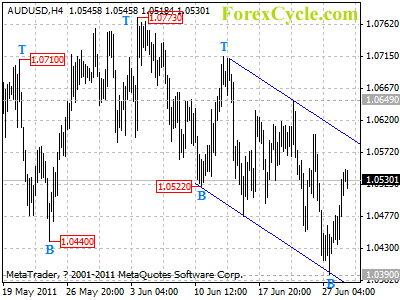
AUDUSD had formed a cycle bottom at 1.0390

AUDUSD had formed a cycle bottom at 1.0390 on 4-hour chart. Further rise towards the upper border of the price channel is expected later today. As long as the channel resistance holds, the bounce from 1.0390 is treated as consolidation of downtrend from 1.0773, and one more fall towards 1.0250 is still possible. Only a clear break above the channel could indicate that the fall from 1.0773 had completed at 1.0390 already, then another rise towards 1.1011 previous high could be seen.

audusd

Daily Forex Forecast

How to find an Investment Advisor

By Ulli G. Niemann

Do you think you need an Investment Advisor? Hold on before you answer because this is sort of a trick question. Also, I am definitely biased because I am an Investment Advisor. Nonetheless, I think I can assist you in looking at this issue in a way that will serve you.

Working with a fair number of investors over the last nearly 20 years, I have observed that while most are intelligent people, and many are fairly knowledgeable about the market, they are, as a group, not terribly successful with their investing.

Why should they be? More likely than not they have made their living doing something other than investing, so why would they think they can do what a professional does better than a professional? (After all, they go to professionals for health care or for car repairs when needed!)

Most investors-even some professionals-tend to be “off” in their timing: they buy things when they are hot, not when they are cold. But for the greatest benefit, it should be the opposite. The media doesn’t help much when it comes to this buying approach, and let’s face it; greed and fear play a large part in most peoples’ investment decisions.

I truly believe the majority of people would be better of (that is, they would end up with more money at the end of the day) if they used professional money managers to advise them on their investing. Specifically I am referring to Registered Investment Advisors with proven track records of performance in investing in stocks, bonds, mutual funds

Let me burst one myth right off the bat: You don’t have to be a millionaire to engage the services of a topnotch advisor. Some people think you need to start an account with $50,000 or more to get a really good advisor. Well, you may have more choices if you’re at that level, however you can find very successful Investment Advisors who will accept opening accounts for as little as $5000.

There are literally thousands of Registered Investment Advisors in the US. Just what do they do-what service do they provide you? They do the legwork; the research and analysis. Maybe more importantly, they keep their primary focus on the markets, and specifically on their specialty area like individual stocks, mutual funds, or bonds.

Because they spend the bulk of their time and energy researching, considering, and analyzing, they naturally have a greater sense of the market and its movements than those of us who don’t put this kind of attention into it. So, with the right advisor, you can keep your focus on what you want-like your business or your retirement or whatever-and still get the information you want and need to invest wisely.

How Do You Find The Advisor for You?

Since there are good Investment Advisors and bad ones, how do you find the former and avoid the latter? Good question, and there are some keys. Most large brokerage firms list the Investment Advisors they work with and maintain information about their past performance. This is not a foolproof resource, though, since they tend to recommend the Investment Advisors who invest in their products or clear their business with the firm. So if you pursue this avenue, you need to watch for conflict of interest issues.

You can always subscribe to one of the numerous database services that include information, and sometimes rankings, on Investment Advisors. These services tend to be fairly pricey, though, so they may not be your best choice. Another option is to find articles (yes, like this one) or free newsletters written by Investment Advisors. If you find one or several that make sense to you, check out the IA and see if there’s chemistry between you.

When checking out advisors, here are some things to keep in mind:

1. Verify their record — look over their past performance;

2. Consider their system. Will it work in different market environments?;

3. As best you can, check out their operation and

4. See if they’ve had regulatory problems.

5. Equally important as doing your due diligence is making sure there is good communication between you and your advisor and that you trust this person with your money choices.

Another quick free way to scan through a select database and find a wide variety of candidates is with www.wiseradvisor.com. I’m registered there myself as an advisor and know that the company did a background check regarding registrations and regulatory issues.

An important question to ask is the how the advisor gets compensated. You want to stay away from commission junkies or salesmen disguised as advisors. I believe that you will get the best unbiased advice from someone who is paid a management fee based on the value of the assets that you entrust them with.

To take it one step further, ask if the advisor invests his own money in the same methodology that he recommends for his clients. If he doesn’t, ask why. If you don’t like the answer, close your check book and run as fast as you can.

Choosing an Investment Advisor can yield long-term high profit benefits. I encourage you to consider it if you haven’t before. However, as with any relationship, make sure there’s a fit before you jump into it.

© Ulli G. Niemann


Ulli Niemann is an investment advisor and has been writing about objective, methodical approaches to investing for over 10 years. He eluded the bear market of 2000 and has helped countless people make better investment decisions. To find out more about his approach and his FREE Newsletter, please visit: www.successful-investment.com.

EU Bank Stress Tests Due Mid-July

The European Banking Authority (EBA) continues to court controversy with the way it is administering the recent round of bank “stress” tests. The testing process has been in progress since March and is designed to restore confidence in the European banking system awash in questionable sovereign debt.

As part of the evaluation, the banks have been provided with a formula that will “address inconsistencies and excessive optimism” when it comes to assessing risk of these sovereign exposures. Based on the risk assumption, the banks can then determine the extent of the “haircut” to which they could face and then determine how much they need in reserves to cover the potential losses.

What the EBA is not doing, however, is to force the banks to simulate the impact of an actual default or debt restructuring. If the EBA is hoping to restore confidence with this approach, it leave much to be desired. Especially given the track record of the previous round of stress testing.

Last year’s stress test results were called into question from the very beginning simply because so few banks were deemed at risk. Indeed, the Irish banks were given a clean bill of health just months before the Irish government was forced to provide emergency funding to keep them afloat.

Nevertheless, the EBA claims that owing to the improvements introduced this year, the results will provide a truer picture of the state of the financial system. Still, they are not addressing the greatest fear of all investors – an out-and-out default by a sovereign nation.

Testing Results Leaked

A story carried by several news agencies Tuesday morning quoted an anonymous Eurozone insider as saying that potentially one in six of the ninety-one banks tested will fail the testing process. This means up to fifteen banks are deemed at risk based on the criteria imposed by the EBA.

On the surface this appears to be a dreadful result but according to the EBA source, this is exactly what the banking authority wants as it feels this will prove that the EBA is serious in its assessment.

“In order to demonstrate that it is credible, the EBA would need to show that the number of bank failures is significant, without being substantial,” the source was quoted as saying. “A number in the teens is about right.”

The process still has the appearance of being manipulated given the nature of the comments, but in light of last year’s fiasco, there could be a degree of method in the madness. Besides, no one is buying the old “the banks are all right line” line any how, so by finding a significant number as being at risk – but not too many – this may actually show investors that authorities are indeed serious this time.

Final results are due in a couple of weeks at which point we’ll see once and for all how the EBA intends to deal with the bank solvency question.

Scott Boyd is a currency analyst and a regular contributor to the OANDA MarketPulse FX blog

Bubble Theory and the Madding Crowd

By EarlyToRise

In the investing world, we talk about bubbles. A bubble happens when stocks in a particular sector are over-hyped, and greed starts driving the market.

In a stock market bubble, investors stop thinking about what they’re buying and start looking around them to see who else is buying it.

Joe Investor sees a sizable group of other investors piling into a stock or sector, driving the price higher. He figures they’ve thought things through, so he’ll go along for the ride.

Jill takes Joe’s lead, figuring he knows what he’s doing. Jerry follows Jill. Julie follows Jerry. The blind are leading the blind.

Well guess what?

There are marketing bubbles too…

Some marketing tactic or strategy is hyped beyond all reasonable expectation… newbies who don’t know any better jump in… and a bubble is born. As the hype grows, it creates a kind of vortex that sucks in more and more people. The number of dupes and the number of promoters both skyrocket.

Some investment analysts are calling the recent LinkedIn IPO a warning sign that a new tech bubble might be upon us. The stock debuted at $45 and immediately started gyrating between $80 and $120, hundreds of times 2010 earnings. In plain English, there was no justification for these prices.

Groupon and Facebook are planning IPOs as well, and they will most certainly garner the same kind of senseless, nosebleed valuations. The bubble will balloon and burst. And overnight, billions of dollars will change hands, just as they did during the dot-bomb bust of the late nineties. Foolish investors holding these stocks will get the shirts ripped from their backs.

With marketing bubbles, the damage is subtler…

Each day, a new crush of wild-eyed marketing neophytes rush in, lured by the promise of easy money, like ants to a Twinkie. Hungry for knowledge, they buy up info-products right and left. And do they learn?

Bubble stuff. All about Facebook and Twitter and mobile marketing and Groupon and other so called “game changers.” Now I’m not saying there is no value in these things. It’s just that they are hyped into the ozone… out of all proportion… beyond anything even remotely real.

And that hype drowns out the importance of learning the basic, bread and butter stuff, without which these neophytes are going to get their heads handed to them.

**** Advertisement ****

New Video Presentation: 11 Breakthrough Cures From Around the World

What if there was a simple method that could use your body’s hormones to root out and separate cancer cells from healthy cells so they could be easily targeted and killed?

What if a biopharmaceutical company had actually discovered a way to reverse aging on a genetic level?

What if there was a simple, 3-step process that uses a volcanic mineral to eliminate the underlying causes of heart disease (and has never yet failed to work)?

These aren’t just theoretical cures of the future… in this video presentation you’ll discover these amazing cures and more from around the world.

View this special video presentation now…

In the world of investing, the basics are things like earnings growth, return on equity, and profit margins. The boring, common sense stuff that allows you to rationally compare one stock to another. In the marketing world, it’s return on resources invested (RORI). Is marketing this way worth my investment? Is it the best use of my resources?

The fact that there are umpteen million users with a Facebook account makes for great hype. Heck, if it were a country it would be the third-biggest. But what does that mean in terms of the RORI for your particular business?

Most people who market with social media haven’t a clue. Their behavior is driven purely by peer pressure.

They’re going gaga for likes and friends and fans and followers and the rest of it. But they have no idea how many new subscribers or customers or dollars all that exertion is netting them.

Worse, many of them are paying zero attention to the fundamentals of online marketing – like copy and conversion. They don’t even know these things exist. Bubbleheads.

I read somewhere that for many people Facebook IS the Internet…

Pretty strong hype, isn’t it?

I suppose there are people quaking in their cyber-boots at the thought of venturing into the savage outer reaches of the Web… that bastion of evil lurking beyond the safe, mediated womb-world of Facebook. But do you really want those people as YOUR customers? Maybe you do. Depends on what you’re selling.

For the kind of fierce individualists who make good customers for me, Facebook-addicted prospects are about as attractive as a bag of chicken giblets.

And then there’s the whole Groupon thing…

We’re seeing Groupon copycats popping up everywhere, like Whac-a-Mole. They’re hyping the slashing and burning of prices to blue blazes. There are even Groupon wannabes for information products. I’m willing to bet that if it hasn’t happened already, you’re about to get pitched by one of them.

“Let us expose your company to the multitudes,” they say. “You’ll gain hundreds, perhaps thousands, of brand-new customers. All you have to do is let us sell your $1,000 info-product digitally for $17 bucks and pay us a commission.” Come again?

What should you do when they come knocking? If you’ve got a stale old info-product that few are buying and you can still sell it with a conscience, think of it as lead generation.

But to sell a genuine $1,000 product that offers real commensurate value for $17… get serious. Do you really want to pimp your brand and the perceived value of your products in exchange for a bunch of bottom feeding bargain hunters who will probably never even open your files on their computer?

Let your decision on all things bubbly be based on good old-fashioned RORI, not peer pressure.

[Ed. Note: Daniel Levis is a top marketing consultant, direct-response copywriter, and publisher of the highly acclaimed marketing periodical Persuasion Mastery Club. Get a full month of Persuasion Mastery Club (a $78 value) FREE! No credit card required. Just sign up here.

Listen in while Daniel grills one of the masterminds behind what is arguably the biggest info-product success story in the history of direct marketing – The Doctor’s Book of Home Remedies for Rodale Press. Michael Fishman spills his most cherished secrets on everything from envisioning an info-product idea… to developing it through systematic research… to validating it with small-scale tests… and, ultimately, to rolling it out for juicy profits!

Click here for free access to the mp3 and transcript of this priceless interview and a bonus edition of Daniel’s Persuasion Mastery Club premium e-letter.]

About the Author

This article appears courtesy of Early To Rise, a free newsletter dedicated to creating wealth and success through inspiration and practical, proven advice. For a complimentary subscription, visit http://www.earlytorise.com.
The Currency Exchange Market: Learning How The Forex Business Works

By Cedric Welsch

The currency exchange business is a global financial market where financial centers located in different parts of the globe function as trading places between sellers and buyers. Forex also known as foreign exchange aids in trade and investment by making it possible for businesses or individuals to convert one currency to another. This helps facilitate companies from different parts of the globe to import goods from other countries by paying in the currency of the country they are buying from. It makes it possible for a European company for example to import goods from the United Kingdom by paying in sterling even if the income of the European company is in Euros.

For those thinking about giving the currency exchange market a try, subscribing to trading news or what’s better called as forex news is a must. This will help an investor or an importer to keep himself or herself updated with the goings on in the financial industry. Although the latest news about the currency exchange industry is vital in this line of business, it is still important for traders to study the market extensively to make sure that they make money instead of losing capital.

Foreign exchange began in the 70s and has been deemed as the perfect venue for businesses around the world to interact with each other without being hampered by currency intervention.

It is important to note however that dealing with foreign exchange is not easy. One has to learn about the political climate in a country along with other factors before making a transaction.

A lot of businessmen and start-up investors have tried dealing with currencies by practicing with play money in different websites. When they started making profit in these websites, they figured they should try the real deal. The real transaction is more complicated than a game though because this is not a game of chance.

It is important to keep in mind that one is not relying on pure luck in this type of market but on intelligent decisions that involves a lot of factors. This involves studying the market, the trends, and the different currencies one is contemplating to trade in. A vital part of this industry are companies who seek currency exchange to buy goods or services. Banks and central banks also play crucial roles in this business. Central banks are there to control inflation, interest rates and money supply. More often than not, the central banks have target rates for their own currencies.

About the Author

Some incomprehensible numbers and stats may arise as you hear forex news trading from different sources. The more heavy the gravity of a certain forex scam, the more you need to be aware of it too.

U.S. Coal Production: What Investors Need to Know

U.S. Coal Production: What Investors Need to Know

by David Fessler, Investment U Senior Analyst
Tuesday, June 28, 2011: Issue #1544

Last week, I wrote about Indonesia’s booming thermal coal export business. It’s the largest exporter of thermal coal in the world, and business is booming, primarily due to demand from India and China.

It turns out the coal export business is just as good for another country, half a world away from Indonesia. I’m talking about the good ol’ U.S.A.

That’s right, coal exports are booming here, too. As you can see from the graph below, published by the EIA, coal export shipments are now at levels not seen in nearly two decades.

us  coal exports

This past year, they’ve been on an absolute tear, up 49 percent for the first quarter of 2011 compared to a year ago…

The two-year statistics are just as good: The 26.6 million short tons exported in the first quarter were double the amount shipped in the same quarter of 2009.

Coking or metallurgical coal makes up 64 percent of U.S. exports. But that’s rapidly changing. Like Indonesia, the United States has experienced a tremendous increase in thermal or steam coal.

As you can see from the EIA graph below, in the first quarter of 2011 steam coal exports were up a whopping 160 percent compared to 2010. Coking coal was up a respectable 21 percent for the same period.

us coal exports chart

What’s going on here? As I’ve said countless times, with commodities, it’s all about supply and demand. In the case of coal, this year’s gains in the United States and elsewhere have come largely at the expense of Australia.

Flooding and typhoons that occurred between last November and this February shut down most of the coal mines in Queensland. The multiple disasters also disrupted rail service and damaged seaport coal-handling facilities.

That translated into an estimated 30-million-ton export shortfall from down under, and that was just from the first quarter. Dewatering the mines, and repairing the railroads and port facilities is ongoing.

Golden Opportunity for Two Big U.S. Coal Producers

Full mine production isn’t expected to resume until sometime in the third quarter of 2011. That means U.S. coal producers are stepping in to fill the gap. This is happening in the face of increasing coal demand from China and India. They’ll be burning coal for the next 100 years, and they can’t get enough of it.

As a result, U.S. producers can ship all they can mine. That’s been a boon to U.S. steam coal producer Arch Coal, Inc. (NYSE: ACI).

Here’s why I like Arch: The location of its mines and its easy access to port loading facilities give it a big advantage over some of its domestic competitors. It ships coal domestically and to customers on four continents globally.

Alpha Natural Resources, Inc. (NYSE: ANR) is another big U.S. coal producer that’s substantially ramped up its production and exports in response to Australia’s woes. Why do I like it? Simple: It has more export terminal capacity than any other U.S. producer.

It also happens to be the nation’s leading exporter of metallurgical coal, and the number three supplier in the world.

If you want to be invested in commodities, and you can get past the environmental guilt, you should definitely consider both of the above suppliers, particularly for the balance of 2011.

Good investing,

David Fessler

Ford Reaches a Crossroads

Ford Reaches a Crossroads

by Justin Dove, Investment U Research
Tuesday, June 28, 2011

People who follow Ford (NYSE: F) were dealt a big surprise last week by some negative press.

Ford fell 18 spots to 23rd in this year’s J.D. Power and Associates 2011 Initial Quality Study.

Ford was ranked fifth last year and was the mainstream brand with fewest defects. Ford had exceeded industry averages in quality each year since 2006.

There’s no coincidence that it was also President and CEO Alan Mullaly’s first year with the company…

Mullaly’s Reputation with Boeing and Ford

Mullaly built his own strong reputation as the CEO at Boeing. Then he added to this reputation with the way he handled Ford through the recession. Ford was the only company of the “Big Three” that didn’t take federal aid and still made a profit in 2009.

Ford’s stock fell sharply in the financial crisis to as low as $1.58 per share. Since then, it’s peaked at $18.65 per share this past January, much higher than its pre-recession value that hovered around $6 per share.

So how did Ford fall so far in quality?

It appears there is an array of problems with the MyFord Touch and MyLincoln Touch systems Ford has recently rolled out. While Ford Sync helped sales and revenue, these new touchscreen systems have become a burden for the automaker over the past year.

Consumer Reports blasted the systems last December and reiterated the sentiment this month, calling the systems “cumbersome and distracting.”

Despite Touchscreen Tech Hiccups, Ford Continues Consumer Innovation

Despite the hiccups with new technology, some appear to be high on Ford over the long term:

  • According to this International Business Times article, “Responding to increasing consumer demand for mobile app use in vehicles, Ford is hiring top tech execs and engineers.” While rolling new technology too quickly hurt Ford with MyFord Touch, the company is showing strong innovation and seems to be carving out a niche for tech-savvy customers.
  • Earlier this month Ford announced it was going to vamp up its efforts overseas, especially in Asia. They claim to expect overseas sales to increase by 50 percent over the next five years. The global market has been an issue for Ford as competitors like General Motors have overtaken them in Asia and other markets.

It appears that Ford is at a crossroads. Growth has been strong, but quality slipped this year. It could be a case of Ford spreading itself too thin. Trying to innovate in technology and increase efforts abroad may have been too aggressive over the past year.

Mulally has a rock-solid track record though, and this situation will likely serve as a wake-up call to the giant auto manufacturer. Ford could continue to have a very strong decade if it can improve the implementation of new technology and reach the lofty expectations for Asia and abroad.

Good investing,

Justin Dove

Can the Fed and Economists Forecast the Future? See This Startling Chart.

Elliott Wave Financial Forecast Editors Kendall and Hochberg on economists, the Fed and forecasting
By Elliott Wave International

Business Talk Radio host Gabriel Wisdom recently spoke with Pete Kendall, Co-Editor of EWI’s Elliott Wave Financial Forecast. Their discussion included a crucial but rarely asked question about economists and the Federal Reserve. Here’s the relevant excerpt:

Gabriel Wisdom: “Ben Bernanke, the chairman of the Federal Reserve, says the economy is slowing but there’s faster growth ahead. Is he wrong?”

Pete Kendall: “Economists are extrapolationists. They tend to look at what’s happening in the economy and extrapolate that forward. So here we have a situation where not just Bernanke but economists in general are looking at… what they call the ‘soft patch’ and somehow contorting that into growth later in the year.

Pete’s startling reply flatly contradicts conventional wisdom. Most people believe that the Fed really is able to anticipate the economic future. After all, they’re the most “qualified.” But what do the facts say?

Pete’s Elliott Wave Financial Forecast Co-Editor Steve Hochberg recently included this eye-opening chart (from Societe Generale Equity Research) in his new subscriber-exclusive video, “Buy and Hold, or Sell and Fold: Where Are The Markets Headed in 2011?

Analysts Lag Reality. From 'Buy and Hold, or Sell and Fold: Where Are the Markets Headed in 2011?'

The red line in the chart is the S&P earnings, and the black line shows economists’ forecasts relative to those earnings. Here’s what James Montier, head of equity research for Societe Generale, said about it:

“The chart makes it transparently obvious that analysts lag reality. They only change their minds when there is irrefutable proof they were wrong, and then only change their minds very slowly.” (emphasis added)

That comment is spot-on. In 2002-2003, as you can see, earnings turned up despite economists’ forecasts for earning declines. It took them a while to “turn the ship around” and play catch-up with the trend.

Yet in 2007-2008, earnings turned down — despite the forecast by economists for continued increases. The devastating truth is that earnings did more than fall in the first quarter of 2008: they had their first negative quarter in the history of the S&P. As Steve said in his subscriber video, “Economists were wrong to a record degree” — and investors felt the pain.

So what’s the point? Economists do extrapolate the trend. That approach works fine, until it doesn’t­ — and you’re on the hook.

Elliott wave analysis never extrapolates trends — it anticipates them. The Wave Principle recognizes that markets must rise and fall — and that they unfold according to changes in investor psychology, in a way that is patterned and recognizable.

—–

Most people believe that the Fed really is able to anticipate the economic future. Now you know the facts. Uncover other important myths and misconceptions about the economy and the markets by reading Market Myths Exposed.

EWI’s free Market Myths Exposed 33-page eBook takes the 10 most dangerous investment myths head on and exposes the truth about each in a way every investor can understand. Download your free copy now.

This article was syndicated by Elliott Wave International and was originally published under the headline Can the Fed and Economists Forecast the Future? See This Startling Chart.. EWI is the world’s largest market forecasting firm. Its staff of full-time analysts led by Chartered Market Technician Robert Prechter provides 24-hour-a-day market analysis to institutional and private investors around the world.