AUD Reluctant to Rise as China Hints at Rate Hike

By ForexYard

The steady, and dovish, monetary policy of the Reserve Bank of Australia (RBA) served the Aussie with little support in this week’s market as most participants await news from China and New Zealand to determine the direction of the AUD relative to its Pacific neighbors. It appears any negative news in Australia, or a rate hike by either China or New Zealand, will push the Aussie into a tailspin as risk aversion takes hold.

Economic News

USD – USD Bullish as China Rate Hike Weighs on Risk Appetite

The US dollar was seen increasing late yesterday as traders began to seek shelter following speculation that China may pursue a more hawkish monetary policy due to rampant inflation. The EUR/USD was seen moving towards 1.4380 yesterday while the GBP/USD was inching towards 1.6030.

The news so far has sent several traders into a risk aversion shift, helping to lift the value of the USD as riskier currencies like the EUR took a dive. Assisting this shift was a dismal retail sales report out of the euro zone arriving five hours prior to US data which revealed sluggishness in US factory orders and as commodity values dipped on a decline in demand outlook.

With another heavy news day expected today, traders are sure to see heightened volatility. Most significantly, the US economy will be publishing its ISM Non-Manufacturing PMI inflationary report. Should today’s news disappoint, there is a possibility that more investment will get pushed towards the safety of the greenback, driving USD values higher.

GBP – British Housing Data on Tap

The British pound (GBP) was seen trading only mildly lower yesterday following news of stable growth in the island economy’s service sector. Against the US dollar (USD) the pound was seen trading somewhat bearish in late trading as shifts into safe-haven investments pulled money out of the Cable and into other stores of value. The EUR/GBP, however, was more mixed as news affecting both currencies was centered on uncertainty.

While the pound was seen flattening out against the EUR yesterday, it appears to have moved mildly lower against the greenback and continues to see sideways price action versus the Japanese yen. Today’s housing data will not likely affect currency values in Britain significantly enough to warrant interest, but traders will want to keep track of how such sectors grow or contract considering their longer-term implications.

The report published earlier this week on British housing highlighted expectations for a continued rise in home purchases and construction spending through the summer months. Should today’s Halifax HPI come in as expected, or better, the joint data releases may prove positive for the pound as investors find reason to go long on the UK’s real estate market.

AUD – Aussie Trading Hesitantly on Possible China, NZ Rate Hikes

The Australian dollar (AUD) was seen trading hesitantly versus most other currencies yesterday after news began to shift many traders back into risk averse assets. The Aussie has been a top performer these past several months considering many traders bank on a strengthening of the AUD due to a rise in Chinese demand for Australian raw materials.

However, yesterday’s news appears to have moved many investors towards safe-haven assets, which tends to result in a weaker Aussie. The steady, and dovish, monetary policy of the Reserve Bank of Australia (RBA) served the Aussie with little support in this week’s market as most participants await news from China and New Zealand to determine the direction of the AUD relative to its Pacific neighbors. It appears any negative news in Australia, or a rate hike by either China or New Zealand, will push the Aussie into a tailspin as risk aversion takes hold.

Oil – Fears of Reduced Fuel Demand Drops Oil Prices

Crude Oil prices dropped sharply towards $93.60 a barrel Tuesday as sentiment appeared to favor a downturn in global industry alongside a slump in demand for the black gold. Data releases out of Britain and China yesterday were driving many investors back into safe haven assets as most reports suggested a surprise downtick in growth among global industrial output and consumer spending; with dismal consumer confidence reading these past few days from the major economies of the West.

As investors sought safety, the value of crude oil, which has been seen plummeting all week, fell to a monthly low of $93.50 a barrel. A sudden jump in dollar values due to this week’s risk averse environment has helped many investors ram up their short-taking positions on physical assets. Should Crude Oil sentiment hold steady this week, oil prices may continue to fail to find support near current prices.

Technical News

EUR/USD

A bullish engulfing pattern on the weekly chart does not bode well for further declines in the pair. Combined with rising weekly and daily stochastics, a case can be made for additional gains in the EUR/USD. The first resistance level the pair should face is 1.4700 off of the June high and a move above here and the pair would encounter selling pressure at the May high of 1.4940. Should the pair fail to move outside the upper line of the triangle consolidation pattern at 1.4515 the EUR/USD would encounter support at 1.4440 and the lower leg of the triangle which comes in at 1.4130.

GBP/USD

The monthly chart shows potential declines for sterling. Falling stochastics point to additional losses in the pair. Traders could be looking for the GBP/USD to decline to 1.5650, a level that offers long term support. Both the 20-month moving average comes in near this area but more importantly this is where the falling trend line from the 2007/2008 highs comes in and sterling could see a technical bounce in this area. This level has further significance as it coincides with the October 2010 lows on the daily. To the upside resistance is found at 1.6150, the top of the current consolidation pattern as well as the previous trend line from the May 2010 low at 1.6280.

USD/JPY

A triangle consolidation pattern has formed on the daily chart with the legs forming from the May high and the June low. Judging from the long term trend the USD/JPY would be expected to break lower where support comes in at 80.25. A break here would likely test 79.70 and 79.55. However, a move higher may also be in the cards and a break above the initial 81.10 resistance would target 81.75.

USD/CHF

After forming a base near the 0.8300, the pair has risen to test its falling trend line from the February high which comes in at 0.8535, not far from the resistance level at 0.8550. Further resistance awaits the pair as the 50-day moving average. A breach here and the pair could unravel to the mid-May low at 0.8750.

The Wild Card

EUR/CHF

Regular readers of this article may have noted the recent focus on the EUR/CHF. Following a 4% rebound from its all-time low the pair retraced 38% of its April to June move before turning sharply lower at this key technical level. As such, forex traders may want to be short on the pair with stops above 1.2350.

Forex Market Analysis provided by ForexYard.

© 2006 by FxYard Ltd

Disclaimer: Trading Foreign Exchange carries a high level of risk and may not be suitable for all investors. There is a possibility that you could sustain a loss of all of your investment and therefore you should not invest money that you cannot afford to lose. You should be aware of all the risks associated with Foreign Exchange trading.

“Risk-Off” with Euro Falling and Chinese Interest Rate Increase

printprofile

The euro is down after Europe woke up to news that Moody’s cut Portugal’s credit rating by four levels to junk status below investment grade, capping last week’s rally in risky assets. An interest rate increase by China fueled the euro selling environment.

Euro zone Q1 GDP came in as expected at 0.8% and German factory orders handily beat expectations but markets were firmly focused on yesterday’s downgrade by Moody’s, the first major rating agency to label Portugal’s credit rating below investment grade. The euro quickly fell and retraced 50% of its move that began with last Monday’s low. Worries of contagion into Ireland and Spain have also dragged down European equities with the DAX down -0.30% and the FTSE 100 lower by -0.78%. The pressure is on the euro a day before the ECB is expected to hike interest rates by 25 bps tomorrow as the ECB once again attempts to prove its inflation fighting reputation. But now growth is lagging in the euro zone and yesterday’s PMI data showed a slowing services sector, a negative for the euro. EUR/USD initial support is 1.4340 with the next test at the rising support line from the May 23rd low which comes in today at 1.4140.

The other story this morning was the 25 bps interest rate increase by the People’s Bank of China, the central bank’s third rate hike this year. The one-year deposit rate now stands at 3.50% and the one-year lending rate was also lifted 25 bps to 6.56%. Talk of a hard landing in China is possible as inflation pressures continue to rise. In May inflation registered 5.5% though China has made it a goal to take inflation back down to 4%. The interest rate hike could weigh on the dollar block currencies (AUD, NZD) that rely on China for much of its growth.

Read more forex trading news on our forex blog.

Portugal Rating Downgrade Sparks USD Buying

printprofile

The rebound in the “risk-on” trade ended yesterday with a resumption of the European debt crisis. Moody’s was the spoiler in both the morning hours and the North American session after it downgraded Portugal’s government bond rating to junk, snapping a 5-day wins streak for US equities and sending the euro lower. Today’s US services PMI is the headline event and a disappointing number may help to shift market sentiment in favor of the USD.

Today’s Economic Data Events:

GBP – Halifax HPI m/m – 07:00 GMT
Actual: 1.2%. Expectations: 0.1%. Previous: 0.1%.
Yesterday’s UK services PMI data provided some short term relief for cable but the warm fuzzy feeling did not last long. This morning’s surprise jump in UK housing prices was largely ignored by market participants with USD strength the winner in early European trading as the GBP/USD is testing yesterday’s low at 1.5990. A break here will target the March low at 1.5930.

EUR – German Factory Orders – 10:00 GMT
Expectations: 0.7%. Previous: -0.6%.
The euro has been pressured after Moody’s warned of impairment charges for banks rolling over Greek debt and the selling of the euro intensified following the downgrade of Portugal’s bond rating to junk status. Weak euro zone growth is anticipated in the near-term and is expected to slow after additional interest rate increases by the ECB which will likely come tomorrow. EUR/USD support is 1.4340 followed by the rising support line from the May 23rd low which comes in today at 1.4140. Resistance is this week’s high at 1.4580.

USD – ISM Services PMI – 14:00 GMT
Expectations: 53.9. Previous: 54.6.
A disappointing PMI will likely support USD buying and threaten last week’s rally in US equity markets that is already beginning to show signs of weakness. Yesterday the S&P 500 snapped a 5-session win streak with a -0.13% decline.

JPY – Core Machinery Orders m/m – 23:50 GMT
Expectations: 3.1%. Previous: -3.3%.
The dollar has been firming versus the yen but the pair maintains its current range. This is despite improving Japanese data releases that show the economy may be rebounding from the earthquake and tsunami faster than previously expected. The 81.25 level looks to cap any USD/JPY appreciation while the rising support line off of the June low will likely contain any declines at 80.40.

Read more forex trading news on our forex blog.

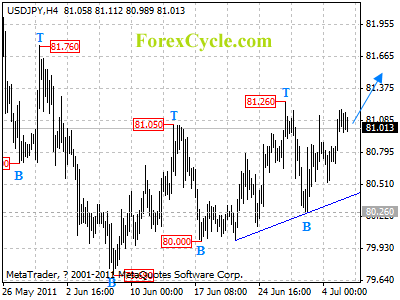
USDJPY is facing 81.26 resistance

USDJPY is facing 81.26 resistance. Further rise would likely be seen after a minor consolidation, and next target would be at 81.60-81.80 area. Key support is at the uptrend line on 4-hour chart, as long as the trend line support holds, uptrend from 79.69 will continue. Only a clear break below the trend line could indicate that the rise from 79.69 is complete, then another fall towards 78.00 could be seen.

usdjpy

Daily Forex Analysis

Greek Loan Disbursement Keeps Risk Appetite Elevated; RBA to Hold its Rate Meeting Tonight

Greek Loan Disbursement Keeps Risk Appetite Elevated; RBA to Hold its Rate Meeting Tonight
by Richard Cox
Last Saturday, finance ministers from the Eurozone met to complete the quarterly transfer of loan funds to Greece.  The IMF will hold a similar meeting later this week (most likely on Friday).  For the most part, this was not a surprise, since we did see the Greek parliament successfully pass its austerity vote last week but the Euro and equities have remained supported so far this week.  The end of last week saw the S & P 500 close 1.44% higher on Friday, following the daily close in the Nikkei 225 above the key psychological 10000 level (the first time this has happened in two months).

In addition to the positives seen in the Greek story, there were also strong expectations for June’s US ISM data, which rose to 55.3 (against expectations of 52.0).  The EUR/USD is currently seen at 1.4510-1.4580 while the USD/JPY is ranging at 80.70-80.90.  Today will see no major US macro data today, as the markets are closed for the Independence Day holiday.

During the meeting between Eurozone finance ministers decided not to design a new Greek aid plan for the long term.  Most expect this to take shape at some point, and will take precedence the initial agreement from May 2010.  The role of the private sector continues to be a point of contention, and markets will remain attentive to any news relating to this aspect of the agreement.  There is a high probability that there will be headlines explaining greater detail in the next few weeks.

The Greek Finance Minister (Venizelos) made statements, describing the length of time that will be required to reach a decision, and gave the middle of September as a current target.  The German Finance Minister (Schaeuble) announced that …

Read the original post here along with explanation about ig index

Russian Ruble’s Climb Jolted as Oil Depreciates

printprofile

The value of Russia’s ruble (RUB) against the US dollar (USD) felt its first decline in over a week this morning as oil prices came tumbling yesterday. With oil being the leading export-driven revenue in Russia, its value tends to have significant effect on the nation’s currency values; which is why traders saw the USD/RUB and EUR/RUB move upwards by about 0.2% after a jolting downturn in oil values was witnessed Monday evening.

A mild decline, granted, but the suddenness of the move had forex traders eyeing commodity pricing data ahead of a turbulent news week. Bloomberg analysts highlighted China’s central bank statement that it would maintain a “prudent” monetary policy to address its inflationary concerns as a key driver in the decline of oil prices yesterday.

Read more forex trading news on our forex blog.

The move is expected to dampen oil demand in the US and China, which speculators have taken as a cue to sell the black gold. Russian currency values were not the only thing affected, moreover. Russian government bonds also fell, dropping the ruble Eurobond yield by approximately one basis point. Should oil prices continue to falter, ruble traders may continue to see some bearishness.

Australia Holds Rates Steady, Trade Surplus Rises

printprofile

The Reserve Bank of Australia (RBA) held their short-term interest rates steady at 4.75% this morning, meeting analyst expectations. The value of the Australian dollar (AUD) was largely affected in a bizarre neutral fashion. The currency appears to be holding off on significant shifts as news from its neighbors comes in over the next few days.

Analysts are speculating that a fall in Chinese yuan (CNY) values may drop the Aussie, as could a hike in New Zealand’s interest rates. But for now the Aussie seems to be holding its recent losses in anticipation of a further decline. Forex traders looking for a gamble may see this as an opportunity to jump into a new trend before it really takes off.

Read more forex trading news on our forex blog.

Swiss Economy Slowing Domestically

printprofile

Economic data released out of the local economy in Switzerland lately has shown a rising sluggishness affecting several sectors. Monday’s publication of retail sales data showed a sharp downturn in consumer spending, as well as domestic demand for retail goods.

Expectations for Thursday’s inflationary CPI data are also set to reveal a 0.1% decline in growth. The news has done little to affect the value of the Swiss franc (CHF), however, as traders continue to flock to the Swissie as a store of value during the choppy trading sessions of these past several days.

Sweden Central Bank Increases Interest Rate 25bps to 2.00%

Sweden's Riksbank raised its benchmark repo rate by 25 basis points to 2.00% from 1.75% previously.  The Bank said: “The Swedish economy is growing at a good rate, although international developments are marked by uncertainty,”.  On inflation, the Bank noted: “Consumer price inflation is high at present as a result of rising mortgage rates.  Underlying inflationary pressures remain low, but are expected to increase as economic activity strengthens.”  


The Riksbank last increased the benchmark repo rate by 25 basis points to 1.75% at its April meeting this year.  Sweden reported annual inflation of 3.3% in May, the same as April, and up slightly from 2.9% in March; while also above the Riksbank's inflation target of 2.0%.  Market expectations are for further interest rate increases from the Bank, with the repo rate expected to be 2.3% in Q4 2011, and 2.9% in Q3 2012.  The Swedish Krona last traded around 6.26 against the US dollar.

www.CentralBankNews.info

The Secrets of the Investment ‘System’

stock wavesLast week proved to be an enigma for many professional traders. Many of us believed that a rally of that magnitude, in that period of time, with little positive economic or fundamental data, made about as much sense as running into a brick wall head first and not expecting to injure yourself.

The movements of the financial market last week tested most of our instincts and experience as professionals; I know that’s how I felt.

And after I talked with a good many friends over the weekend, I have to address what I see as the core problem that most investors face.

Psychological Control

You may think the average investor fails because he doesn’t have the inside knowledge or experience that professionals do. But that’s not true. In fact, most average investors have all the tools — more than most of us professional traders.

The fundamental difference between the average investor and the professional trader is how you think about an investment.

For many investors, fear and greed cause frustration and panic. Once these emotions take control, investment plans tend to break down, and investors become a detriment to their own investment portfolios.

Having an “insider” like one of us at Taipan to guide you can certainly help, but you also need to learn who YOU are as an investor and where your sensitivities lie…

Are You Aware of Yourself?

My good friend Mark Douglas, who is highly regarded on Wall Street and was kind enough to write the forward to my book, Your Options Handbook, has written two exceptional works on the mental aspects of trading. This past week, I thought a lot about his most recent work, Trading in the Zone.

The book is extremely detailed and takes you through a series of scenarios that focus on our belief systems. The goal is to be aware of your thought processes and conquer your hidden mental roadblocks to success. (He also explores the many paradoxes in the marketplace — and there are plenty of them!)

Through our friendship, experiences and projects together, I believe we both share this fundamental core belief about investing:

Even though the market can be extremely random in its outcomes, having an edge (which comes from a system, tool or method) combined with a sound and consistent mental approach will ultimately lead to success if executed with continuity and repetition over time.

Basically, if you follow a set of rules or an investment system that has made other people successful, you too should be able to succeed if you “don’t let your brain get in the way.” Be aware and have control over your belief systems. Keep following the rules of your system over and over again.

In his book, Mark makes several compelling statements. Here are two to think about:

  • “Learning how to identify an opportunity to buy or sell does NOT mean that you have learned to think like a trader.”

Many investors develop a system to find opportunities and see some success through testing. But once they put it to use in the real market, they fail. Why? Because the system is only half of what makes you a good trader. Perhaps they jumped out of the trade in fear, because the pain of potentially losing all that money scared them.

The solution here is to look back on the trades you made and record your emotions. Why did you exit the trade? Was it your system? Tools (charts)? Did your reasoning change? Or were you “spooked” out of the trade?

Last week, many short sellers (investors going against the market) were spooked in this same way. Maybe they could have benefited from another of Mark’s ideas:

  • “If you want to create consistency, you have to start from the premise that no matter what the outcome, you are completely responsible.”

Whatever your plan or system is, you must follow it without fail and realize that deviations from your plan or system creates another layer of randomness in your success. Let me explain what that means. The more you make decisions outside of your plan, method or system, the less you know why a trade was a success or a failure.

First You Need a System

Each of our trading services follows a system, incorporates a method and has a plan that we execute as consistently as possible. If a stock or option meets our criteria, we act. When that stock or option no longer fits our criteria, hits our stop-loss, or if we attain our profit target, we exit.

Just like the greatest teams in sports, there will sometimes be strings of many winning trades and even losing trades, but you cannot let the emotions of trading take you away from your method or belief system.

My colleagues and I strive for consistency. We will teach you that when the market throws a curveball, you must act as though you are the best hitter in baseball and simply execute what you have been trained to do: connect!

Success in the markets is a long-term goal. Don’t panic or make dramatic adjustments in your strategy if you are hitting a dry patch. Adjust one variable at a time and measure your results.

To help develop your system, I encourage you to learn more about what we do at Taipan. Here is a link to our different services.

Editor’s Note: Jared’s WaveStrength Options Weekly service has a system that consistently banks 15%, 20%, even 50% gains for his readers.

It is not a shady get-rich-quick program either. Jared’s faithful subscribers are getting rich with safe, reliable profits. To get his latest advice, click here.

Article brought to you by Taipan Publishing Group. Additional valuable content can be syndicated via our News RSS feed. Republish without charge. Required: Author attribution, links back to original content or www.taipanpublishinggroup.com.

{loadposition sidarticles}

{jtagstpg} {authorstpg}

Other Related Sources:

  • How Do You Time a Trade?
  • How I Navigate Trades In a Tricky Financial Market
  • Investment Systems and Speculation Style