Bank Negara Malaysia Holds Rate at 3.00%, Lifts Reserve Requirements

The Bank Negara Malaysia maintained the Overnight Policy Rate (OPR) unchanged at 3.00%, and held the floor and ceiling rates of the corridor for the OPR at 2.75 percent and 3.25 percent respectively.  However the Bank increased the Statutory Reserve Requirement (SRR) ratio by 100 basis points to 4.00% from 3.00%, effective from 16 July 2011.  The Bank said: “The decision to raise the SRR is undertaken as a measure to manage the significant build-up of liquidity, which may result in financial imbalances and create risks to financial stability.”

The Bank Negara Malaysia last increased the OPR by 25 basis points to 3.00% in May this year, it also increased the SRR by 100bps to 3.00% at that meeting.  Malaysia saw inflation of 3.3% in May, up from 3.2% in April, and 3.0% March, bringing the average to 2.8% for the first quarter of 2011.  The Malaysian economy contracted -3.2% in the March quarter (+1.5% in Q4 2010), while growing 4.6% on an annual basis (4.8% in Q4 2010), according to Trading Economics.

Reasons Why Most Forex Trading Systems Fail to Show Attractive Results

Forex Systems Evaluation – The Basic Rules

Why do they fail?

There is an old saying about Forex Trading Systems. It is that the systems themselves never fail. It is always the users that fail. And the users fail because they did not make the system their own. That is, they have not built up enough confidence in it to follow the rules without questioning them. The only way to build confidence in a system is to test it until the point one is convinced by the results. The degree of conviction is very important. Traders need to be convinced to a level such that they will intuitively take a signal the very second it manifests itself.

Traders usually say, sometimes in jest and sometimes seriously, that a system will fail five times in a row. The sixth time, when the signal has been ignored, is when it kicks in and makes more than it had lost on the first five occasions. Whether stories like this are true or not, it only serves to underline the point. And the point is that the only way to know confidently that the sixth trade is the trade that is going to make the money is not only to test the system but to know and understand the result of the test. Forex Trading Systems do not work forever. The reason for this is a simple one.

Customization through trial and error

System are based around fixed rules and Forex Trading Strategies, but the Forex market is dynamic. So users have to periodically, if not continuously, test their systems to check whether or not changes in the market over time have degraded its usefulness. Over time conscientious users should develop a sixth sense. They ought to know instinctively that their forex trading system is out of kilter. For example, if a system in the past has only ever had three consecutive losses but now experiences four consecutive losses, something is probably going wrong. This is a warning signal to be heeded. Users can then do some tests and tweak their system to bring it back in line.

Tweaking a system to adjust its performance to adapt to current market conditions is not the same as curve-fitting. This is where an unproven system is tweaked to make it fit with recent historical data. Most forex software designers and traders are scrupulous about avoiding curve-fitting, which can be disastrous for trading results. But most accept that systems do need changing from time to time to reflect changes in the way the market is working. An alternative is to find another system that works better in the current type of market.

Andre J Young

Forex Trading For Beginners

The Amazing Dividend Chart You Have to See

Article courstey of DividendOpportunities.com

I have a chart that I want to show you. It’s nothing complex or hard to understand. In fact, I take pride in how simple it is to read.

You’ll be surprised that the information shown in this chart is the result of just a year of work; you’d never know it at first glance. I’m betting you’ll think it took years or decades to cultivate.

You might also think that replicating what my chart shows takes a fortune to pull off. I’ve done it with $200,000. That’s nothing to sneeze at, but it’s far from an extraordinary amount of money.

The results are also fully scalable. If you only have half that amount to invest, you’ll receive half of what my chart shows — still a considerable amount of money. If you have a $400,000 at work, just double my numbers. Anyone — and any dollar amount — can replicate my performance.

But the best news is that what this chart shows is the result of a strategy you can start today. It doesn’t take a Ph.D. to follow (I only have a lowly master’s degree, anyway). You don’t have to track the market every day — or every week for that matter. The beauty of this strategy is that it takes care of itself.

In fact, the primary investing “skill” you need is patience. If you can allow yourself to build a portfolio without having to constantly fuss over it, make unnecessary trades, or live and die by daily fluctuations, you can achieve these results.

My chart below shows what I’m talking about. Listed are the total amounts of the “paychecks” I’ve received since the implementation of the Daily Paycheck strategy. As you can imagine, I’ve been pretty happy:

The strategy is simple — I’m trying to build an income machine that pays me each and every day.

In January, I received 25 “paychecks” (that’s my nickname for dividend and interest payments from my holdings) worth over $1,600. That’s a little under my goal of one check for every day of the month.

Imagine if you’re a retiree — that’s a nice stream of cash from your investments to supplement any other income you might have.

But there’s another step if you really want to see your income stream accelerate over time… it’s why patience is key.

It’s tempting to take the cash. Who wouldn’t want an extra $1,600 per month in the bank? But I strongly recommend reinvesting your paychecks. By using your dividends to purchase more shares, compounding takes over. Your next payment will be larger, even if the dividend payment doesn’t increase.

I won’t lie, reinvesting does take a little time to see a major impact — that’s why patience is so important. (And before you start, give your broker a ring to make sure they offer reinvestment at no extra commission.)

But I think you can see from the performance so far that the Daily Paycheck strategy is one of the most promising ways to capture the most income from the market.

Always searching for your next paycheck,


Amy Calistri
Chief Investment Strategist — The Daily Paycheck

P.S. — What’s the best thing about the Daily Paycheck strategy? I love that it’s fully scaleable to any dollar amount. For instance, I’ve had subscribers start their daily income stream with $20,000 or less. My boss, StreetAuthority co-founder Paul Tracy, earned more than $6,000 in dividends in December using the strategy and a bit larger bankroll.

To learn more how you can start your own Daily Paycheck portfolio today, read this memo.

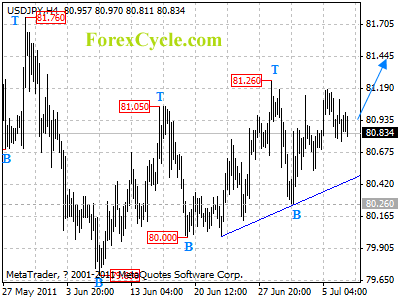
USDJPY remains in uptrend from 79.69

USDJPY remains in uptrend from 79.69, the price action from 81.26 is treated as consolidation of uptrend. Support is at the uptrend line on 4-hour chart, as long as the trend line support holds, we’d expect uptrend to resume, and one more rise to 81.60-81.80 area is still possible. However, a clear break below the trend line will indicate that the rise from 79.69 had completed at 81.26 already, then the following downward move could bring price to 78.00 zone.

usdjpy

Daily Forex Forecast

How to beat the Mutual Fund Companies at their own game

By Ulli G. Niemann

You’d have had to be living on a desert island with no TV, newspaper or internet connection to have missed hearing about the great mutual fund scandal of 2003.

The issue was that some mutual fund companies allowed certain hedge funds to engage in after-hours trading, sometimes incorrectly referred to as market timing. Unfortunately, some companies have used the confusion about the term “market timing” to further their own cause. How?

They have used this issue to pretty much ban all forms of trading their funds, and some companies are imposing hefty short-term redemption fees-penalties for all intents and purposes-in the name of avoiding impropriety. But the real idea behind it all is: Buy our fund and never sell it!

These companies advocate a stubborn Buy & Hold philosophy despite the devastating effects that approach had on investors’ portfolios during the recent bear market. Performance is immaterial to them-they want your money in their fund whether it’s going up or down.

With all of the negative press over the months you’d think that mutual fund companies would have cleaned up their act and started giving more consideration to the individual investor. Not so.

This was brought home to me when a fund manager of an $800 million mutual fund called me to see what my plans were in respect to holding our positions with his fund (about $2 million).

I explained my trend tracking methodology and he got very angry when he heard I would protect my clients’ accumulated profits by selling his fund if it were to drop 7% off its highs.

His blustering made it quite clear that he did not like anyone managing for the benefit of their clients; he only cared about what was best for him and his company.

So, what can you do to prevent being taken advantage of? For one thing, do what your mutual fund company does – not what they tell you to do. Adopt a strategy for following trends, such as I do, and use the mutual fund manger’s superior stock picking ability to your advantage by buying and holding only as long as the fund is performing well.

Remember, the fund manager has one big disadvantage over you: He always “has to” be invested so that the public can purchase shares in his fund. You don’t!

If market conditions dictate that you are better off in the safety of a money market account because we are in a severe downtrend, then you can take your money and run for cover. He can’t. He is constantly trying to adjust his portfolio to ever-changing economic conditions so that his potential losses are minimized. At the same time you are being told that his fund is the investment for all seasons. Don’t fall for it!

You as an individual investor are really in the driver’s seat. Unfortunately, you have probably been conditioned to think that Buy & Hope is a good investment strategy, when in fact it is a losing proposition.

Bottom line is, use a well performing mutual fund during strong up trends and get over to the sidelines during trend reversals. (That’s exactly what I did for my clients in October, 2001, and we retained the lion’s share of their profits while Buy & Holders kept insisting the emperor was wearing new clothes.) Pretty soon you will feel that you are in charge of your financial destiny and any chosen mutual fund is merely a tool to bring you closer to your goals of maximizing your gain and minimizing your losses.

© Ulli G. Niemann


Ulli Niemann is an investment advisor and has been writing about objective, methodical approaches to investing for over 10 years. He eluded the bear market of 2000 and has helped countless people make better investment decisions. To find out more about his approach and his FREE Newsletter, please visit: www.successful-investment.com.

Bank of Uganda Sets New Interest Rate at 13.00%

The Bank of Uganda set its new monetary policy interest rate (the central bank rate) at 13.00%.  Bank of Uganda Governor, Emmanuel Tumusiime Mutebile, said: “To tighten monetary policy, the Central Bank Rate will be set at 13% for the month of July. The interest rate will be used to guide the 7–day interbank interest rates,”.

The move represents the Bank’s first interest rate decision as it begins using the 7-day interbank rate to influence inflation, and begins explicitly targeting inflation. Uganda reported annual headline inflation of 16% in May this year, up from 14.1% in April, while core inflation was 11.3% in May and 9.7% in April.

Bank of Ghana Cuts Lending Rate 50bps to 12.50%

The Bank of Ghana cut its key lending rate by 50 basis points to 12.50% in order to help boost lending as inflationary pressures reduce.  Bank of Ghana Governor, Kwesi Amissah-Arthur, said: "Inflation is going down and we don't see the banks responding (to lower interest rates)" and further noted that "the bank is confident that the annual inflation target of 9 percent is achievable".


The Bank of Ghana also reduced its lending rate by 50 basis points to 13.00% at its May meeting this year.  Ghana reported inflation of 8.9% in May, compared to 9.0% in April, and 9.1% in the previous month.  Ghana's economy grew 23% in the March quarter, compared to 9.5% in the previous three months, as Africa's newest oil exporter saw export earnings boosted by oil sales, as well as a high gold price and cocoa volumes.

www.CentralBankNews.info

Poland Central Bank Holds Interest Rate at 4.50%

The Narodowy Bank Polski's Monetary Policy Council maintained its benchmark 7-day interest rate unchanged at 4.50%.  The Bank said: "In the coming months, the annual CPI inflation rate will continue at an elevated level, mainly due to the strong growth in global commodity prices observed prior to the inflation increase."  The Bank also noted that it would "not rule out a further adjustment of monetary policy, should the outlook fro inflation's return to the target deteriorate".


The Bank also held unchanged the following rates: the rediscount rate at 4.75%, the Lombard rate at 6.00%, and the deposit rate at 3.00%.  The Bank last raised the interest rate by 25 basis points to 4.50% in June this year.  Poland reported inflation of 5% in May, up from 4.5% in April, 4.3% in March, and higher than the Bank's official inflation target of 2.5% +/- 1%. 

Why You Shouldn’t Invest Like Warren Buffett

buy and hold investingNote from Managing Editor Sara Nunnally: Everybody knows who Warren Buffett is… The Oracle of Omaha has amassed billions of dollars by buying up stocks at great prices. Sometimes he holds them for years before seeing a big profit.

As a billionaire, he’s got the means to do this. He can afford to have a huge chunk of money stay in the market for years at a time. Today’s investor, like you and me, has to be more nimble. We have to be able to take profits at a much faster pace.

In this environment, as our guest editor Zachary Scheidt says, “buy and hold” investing is dead. In this environment, we need to be traders…

Zach is the editor of Velocity Trader, and his service just saw a gain of 44% in a single day. Perhaps this is evidence that you should be investing like Zach, and not like Warren Buffett.

Read on! (And don’t forget to sign up for Smart Investing Daily and let me and fellow editor Jared Levy simplify the market for you with our easy-to-understand articles.)


Buy and Hold Investing Is Dead

In my previous position as a hedge fund manager, I had one particular client that I will always remember fondly. George was a retired oil driller who had been lucky enough to make some great energy investments, and smart enough to take some profits off the table.

George had a few million dollars invested in one of our funds, and a large position in a single drilling company that he had fallen in love with. What I really liked (most of the time) about George was his predictability.

You see, every Friday afternoon — without fail — George would call the office to count his money. A typical conversation would go something like this (keep in mind, George has a thick “Bahstahn” accent):

George: Hi, Zach! How’d we do this week?

Zach: Hi, George… Well, the fund is up about 1.8% for the week and we’re looking at a deal that…

George: ONLY ONE POINT EIGHT? C’mon Zach, you ghatta do bettah than that!

Zach: You’re right; we’ll try to do better next week. We’re tracking two different companies that have plans to…

George: What about Atlas (referring to his favorite drilling stock)?

Zach: Well, Atlas is down about 37 cents on the day.

George: What happened??

Zach: Not too much — the board authorized the second-quarter dividend and…

George: Can you print that out and fax it to me?

Zach: Sure, George. Have a great weekend.

George: (click)

It got to be almost humorous (except for the interruption to my research every Friday). George wanted to know everything about the company — down to the press releases for each well that was initiated. But he never actually traded the stock. He simply took his lumps when times were bad, and rejoiced when times were good.

The Difference Between Market Environments

During bull market periods, buy and hold works beautifully. Simply pick a successful company (it almost doesn’t matter which company) and enjoy the profits as the stock trades higher. The game is easy — nearly every stock rallies.

If you want better returns, pick more aggressive companies or use leverage (borrowing money to buy more shares). During a bull market, risk doesn’t matter. That’s because prices continue to tick higher and every pullback is just an opportunity to buy more.

But today’s environment is much different. As you should already know, our economy is facing serious risks from a number of different angles:

  • Unemployment has been above “acceptable” levels for more than three years now.
  • Housing values continue to plummet.
  • Food and energy inflation is cutting into consumer as well as corporate spending.
  • Emerging market growth is in danger of stalling.
  • European debt could sink the global financial system.

And the list goes on… This is certainly NOT a long-term bull market, and the benefits of a buy-and-hold strategy are slim to none!

Trading Is the Answer

So what is an investor to do with this market full of risk?

In order to be truly successful in today’s market, investors need to adapt a more nimble approach. They need to become traders!

I’m not saying you need to fire up a high-powered computer and begin entering orders each and every day. You probably don’t have time for that. As a professional investor even I don’t have time for all that action…

Trading is much less about the amount of activity, and much more about the profit opportunity. To survive in our turbulent economic environment, you need to be able to capture the opportunity that markets present — and sit on the sidelines when the opportunities aren’t good.

For me, this means watching the price action and taking a few key positions each week. And it means trading in sync with the market, whether prices are rising or falling. I’m just as comfortable making money off a falling retail stock as I am buying a precious metal miner. I’m also just as comfortable holding a position for a few days as I am holding for a few months.

It all depends on the opportunity!

Take Sears Holdings (SHLD:NASDAQ) for instance. On June 22, I recommended readers of my Velocity Trader service take a short (bearish) position on Sears. The retail company has been under pressure and was primed for another wave of selling.

To our delight, the very next day Sears dropped sharply and our bearish bet was up 44%. As a trader, when I have an overnight gain of 44%, I like to take some of the profits off the table. It just makes sense to ring the register when the market gives you that much of an advantage.

But at the same time, I still believe Sears has much farther to fall. The company’s challenges are still in play, and investors are still likely to sell their shares and push the stock lower. So we only sold half of our position and let the rest run for much larger profits.

Volatility Means Opportunity

That’s how the trading game is played. You isolate opportunities, and then you execute. When you have profits, you capture them. You manage your losses and continually monitor the markets for new setups.

Being a trader gives me a distinct edge over “buy and hold” investors. You see, volatility is my friend. When stocks begin to make wild moves, that’s when I am able to step in and make a buy or sell transaction and see my profits begin to accumulate.

Buy-and-hold investors simply have to ride out the roller coaster. And watching your net worth bob up and down like a yo-yo is no fun at all… Just ask George.

You see, it does very little good to monitor every tick and tack of a company that you like — unless you are going to act on the information. As a trader, I continually monitor a watch list of about 85 to 100 stocks, and rotate which stocks are on my list based on what type of opportunities the market is giving.

Your Stocks, Your Decision

Would you indulge me in a quick exercise?

Write down the ticker symbol of the three largest positions in your account. (If you’re not holding any stocks, write down three trades you are interested in.) Now next to the ticker, briefly summarize why you like this stock and what you expect the stock to do.

Now keep that sheet next to your computer or in your top desk drawer. Look at it each day. Ask yourself if your reasoning for holding this stock is still valid. Ask yourself if it is still the best opportunity for your money. Ask yourself if it has already accomplished what you expect it to.

If you find that your stock has already served its purpose, or that your original investment thesis is no longer valid, then it’s time to move on. Sell that position and look for the next opportunity.

And voilà! You’re a now trader!

Editor’s Note: Zach is right. Buy-and-hold investing is dead. But it is not bad news, at least for Zach and his Velocity Trader subscribers. As a former hedge fund manager, Zach knows the tricks and techniques it takes to get ahead of the market.

He just released his latest report to his readers. The green light is flashing on a set of potentially huge trades. To read the details, follow the link.

Article brought to you by Taipan Publishing Group. Additional valuable content can be syndicated via our News RSS feed. Republish without charge. Required: Author attribution, links back to original content or www.taipanpublishinggroup.com.

{loadposition sidarticles}

{jtagstpg} {authorstpg}

Other Related Sources:

  • Believe It or Not, Warren Buffett Might Not Be Right
  • Why Civil Unrest Is Sweeping the Globe
  • The Buy and Hold Apocalypse