Strong Data Supports Short-Term Risk Taking in Forex Market

By ForexYard

A short series of data released yesterday painted a relatively stronger picture for the US economy’s growth. Weekly unemployment claims saw a better than forecast rise, hitting 398,000 for the past week. A home sales report also showed a solid uptick, significantly beating expectations. So far the news has helped drive the USD lower as traders seek out small amounts of risk ahead of the week’s conclusion.

Economic News

USD – US Dollar under Pressure from Solid Jobs Data

The US dollar was seen trading mildly lower yesterday as traders began to reevaluate the recent jump in USD values. The EUR/USD was seen meeting resistance near 1.4500 yesterday and plummeted towards 1.4430 in late trading. The greenback saw similar movements against most other currency pairs as well.

A short series of data released yesterday painted a relatively stronger picture for the US economy’s growth. Weekly unemployment claims saw a better than forecast rise, hitting 398,000 for the past week. A home sales report also showed a solid uptick, significantly beating expectations. So far the news has helped drive the USD lower as traders seek out small amounts of risk ahead of the week’s conclusion.

With a heavy news day expected Friday, dollar traders should be anticipating some exciting currency movements brought about by heightened liquidity. The economic calendar, though, will be focused on Japan and the US with several reports on inflation and GDP, respectively. The greenback is in focus as the week concludes considering the intense rollercoaster it experienced these past few trading days, also considering the deadline for lifting the debt limit will be reached next Tuesday.

EUR – EUR Mixed as Italian Bond Auction Flops

The euro was seen trading lower yesterday in light of data releases suggesting stagnation in the German employment sector. Moreover, an auction of Italian bonds this week produced fear that debt contagion was coming back into view. The lackluster performance of the auction drove many regional investors away from the EUR despite the relative potential is has for making gains should the US falter on its debt ceiling talks.

While growth variances between the US and Europe came into view this past week, the higher yielding assets like the GBP and EUR appeared positioned to lose as traders turned away from risk, despite the uptick in risk taking seen by mid-week. The growth in risk aversion may have many investors choosing to store their value in lower yielding currencies, like the USD and JPY as the week comes to a close.

As for Friday, the euro looks to be anticipating an evaluation of its recent downturn against the other major currencies with mild bias further leaning to the downside. The euro zone will be publishing a few economic events on today’s calendar. Traders should try and follow the significant publication emanating from the Japanese, US, and Canadian economies today, however, as a heavy string of reports are expected throughout the day.

JPY – JPY Seen in Ascent as Traders Seek Store of Value

The Japanese yen (JPY) was seen trading higher versus most other currencies this week after news began to shift many traders back into safe-haven assets. The yen has been a top performer these past several months considering many traders bank on the Japanese carry trade during times of intense risk appetite and move towards the JPY in times of risk aversion, making it an appealing currency in these recent times of ominous debt talks.

The JPY was in a position to make solid gains yesterday after debt auctions in Italy moved many investors away from the euro zone and into safer assets. Moves toward riskier currencies halted as pessimism took hold and drove much of yesterday’s trading liquidity towards traditional stores of value. As such, traders appear to be anticipating an uptick in the JPY prior to this week’s close.

Oil – Oil Price Floats near $98 a Barrel

Crude Oil prices sunk yesterday, reaching near $97.50 in late trading. Growth differentials between the Atlantic states have risen into view this week while manufacturing output and service data revealed mild weakness in Europe. This has so far led several large investors and analysts to consider a shift away from the EUR and other risky assets in exchange for the safety of the USD and JPY.

As investors sought safety, the value of crude oil, which has been seen holding steady most of the week, also fell slightly towards $97.50 a barrel. A sudden jump in dollar values due to this week’s risk sensitive environment has helped many investors move hesitantly away from assets like gold and silver, but crude oil appears untouched by this sentiment. Should Crude Oil prices hold steady this week, we could see some gains going into the week’s final hours.

Technical News

EUR/USD

The EUR/USD has taken a step away from the edge after failing to get a close below its 200-day moving average and the price is testing the falling trend line from the May and July highs at 1.4450. Short term momentum is currently rising and break above this resistance line may find resistance at the peaks from July, June, and May at 1.4580, 1.4700, and 1.4940 respectively. However, a bearish tweezer candlestick pattern has formed on the daily chart from last week’s highs on Thursday and Friday, strengthening the argument for the 3-month old resistance line to hold. Support is found at 1.4015, 1.3835, and 1.3780 from the rising trend line off of the June 2010 low.

GBP/USD

After dipping as low as 1.5780 which is the 38% Fibonacci retracement level from the May 2010 to April 2011 move, Cable has broken above both the neckline from the head and shoulders pattern and the resistance line falling from the April and May highs. The pair has now found resistance at the previously broken trend line from the May 2010 low and now serves as initial resistance at 1.6360. A move above this line will likely go on to test the May high at 1.6545 though sterling bears may make a stand before the April high of 1.6745. To the downside support may come in where the neckline and the previous resistance line off the April and May highs intercept at 1.6190. Additional support is located at 1.6000 and the July low at 1.5780.

USD/JPY

The reemergence of yen strength has taken the USD/JPY one step closer to its all-time low at 76.11. Falling stochastics on the monthly, weekly, and daily charts all point to additional declines in the pair. Initial support is found at 78.20 followed by the lower line from the falling wedge pattern from December 2008 which comes in at 77.50. A move higher may find resistance at 79.60 and 81.50.

USD/CHF

An attempt to push the USD/CHF higher ran into resistance at 0.8270. Since failing to hold any gains the pair looks to test the most recent all-time low at 0.8080. Any attempt to move the pair higher will likely encounter resistance at 0.8270 and 0.8385 from the falling trend line off the February high. Relative value sellers of the pair may also be lurking at 0.8550.

The Wild Card

EUR/JPY

A combination of euro weakness and a resurgence of yen strength have taken the EUR/JPY abruptly lower. The pair has broken out from a bearish flag pattern and has support at 110.80 from yesterday’s low followed by 109.55. A break here would expose the mid-March low at 106.30. Forex traders will find resistance at 111.50 though move higher could find its way to 113.00 without jeopardizing the bearish chart pattern.

Forex Market Analysis provided by ForexYard.

© 2006 by FxYard Ltd

Disclaimer: Trading Foreign Exchange carries a high level of risk and may not be suitable for all investors. There is a possibility that you could sustain a loss of all of your investment and therefore you should not invest money that you cannot afford to lose. You should be aware of all the risks associated with Foreign Exchange trading.

Philippine Central Bank Raises Reserve Requirements 100bps

The Bangko Sentral ng Pilipinas held its overnight borrowing rate unchanged at 4.50% and the overnight lending rate at 6.50%, and increased the reserve requirement 100bps to 21% effective 5 August 2011.  The Bank said: “bank lending has been growing at double-digit rates since January 2011, supported by the strong momentum of domestic economic activity and stable financial conditions…  The Monetary Board is of the view that sustained foreign exchange inflows, driven by upbeat market sentiment over the brighter prospects for the Philippine economy, could fuel a further acceleration of domestic liquidity growth which could pose risks to future inflation.”


The Philippine central bank last raised its interest rate in May this year by 25 basis points to 4.50%.  The Philippines reported annual consumer price inflation of 4.6% in June, up from 4.5% in May and 4.3% in April, while core inflation was measured as 4% compared to 3.7% in May.  Inflation is currently tracking inside the Bank’s inflation target range of 3%-5%.  The Bank also increased the required reserve ratio during its June meeting; the latest increase is estimated to remove around P30 billion of liquidity from the system.

Central Bank of Kenya Holds Interest Rate at 6.25%

The Central Bank of Kenya held its benchmark lending rate unchanged at 6.25%.  The central bank Governor, Njuguna Ndung’u, said: “the tight monetary policy stance would not achieve the desired results at the moment if the supply sides of food, fuel and energy were not effectively being managed to signal relief to the constraints guiding inflationary expectations.  It was noted that the growth of broad money supply has been below its target since September 2010 which rules out demand pull inflation.”


Recently the Bank increased, and subsequently decreased the discount window rate by 75 basis points to 6.25%.  The Kenyan central bank last increased the benchmark lending rate by 25 basis points in May this year.  Kenya experienced inflation of 14.49% in June, up from 12.95% in May, compared to 12.05% in April and 9.19% in March, according to inflation data from the Kenya National Bureau of Statistics.  The Central Bank of Kenya has an inflation target of 5 percent.


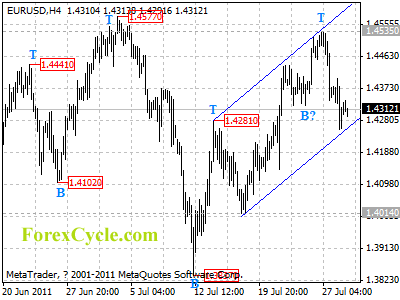
EURUSD is facing channel support

EURUSD is facing the support of the lower border of the price channel on 4-hour chart. As long as the channel support holds, uptrend could be expected to resume, and rebound would likely be seen after touching the channel. However, a clear break below the channel will indicate that the rise from 1.3837 had completed at 1.4535 already, then the following downward move could bring price back to 1.4000 area.

eurusd

Forex Signals

Reserve Bank of New Zealand Holds OCR at 2.50%

The Reserve Bank of New Zealand held the Official Cash Rate (OCR) unchanged at 2.50%, but signaled plans to increase the rate.  The Bank Said: “Provided current global financial risks recede and the economy continues to recover, the Bank sees little need for the March 2011 ‘insurance’ cut to remain in place much longer.  The current very high value of the New Zealand dollar is acting as a drag on the New Zealand economy.  If this persists, it is likely to reduce the need for further OCR increases in the short term.”


Previously the Bank also held the OCR steady at 2.50%, the Bank cut the rate by 50 basis points in March this year, following the Canterbury earthquake.  New Zealand reported consumer price inflation of 5.3% in Q2 this year, up from 4.5% in Q1, and 4.0% in Q4 of 2010, and above the official inflation target of 1-3% as short term factors such as tax increases caused a spike in prices.  The New Zealand dollar (NZD) has surged 20% over the past year; trading just beyond a record high of 0.87 against the US dollar.

www.CentralBankNews.info

BSkyB Drawn Into Spotlight by News Corp. Hacking Scandal

July 28 (Bloomberg) — Bloomberg’s Poppy Trowbridge reports on the outlook for British Sky Broadcasting Group Plc. amid the phone-hacking scandal at News Corp. which has a controlling 39 percent stake in BSkyB. Owen Thomas also speaks on Bloomberg Television’s “On the Move.” (Source: Bloomberg)

Prior-Wandesforde Says India Faces `Sticky’ Inflation

July 28 (Bloomberg) — Robert Prior-Wandesforde, an economist at Credit Suisse Group AG in Singapore, talks about India’s economy and central bank monetary policy. India’s central bank on July 26 raised it benchmark interest rate more than forecast to quell the fastest inflation among major economies. Prior-Wandesforde speaks with Rishaad Salamat on Bloomberg Television’s “On the Move Asia.” (Source: Bloomberg)

One Easy Way To Protect Your Money

Our economy and our money have reached a turning point. The only sure way to survive unscathed is to seek shelter.

When I wrote about the economic disaster, I cited the government’s own numbers to support the case we are already in a depression worse than the great one.

I don’t write that to scare anyone.

My single purpose is to alert you to the real conditions in which we must operate. I am quite optimistic that you’ll be able to profit in the times ahead.

When I ask family members who lived through the last depression to describe it, they said that if a person had a job, they made out fine. They also talked about how no one would ever think of accepting welfare, or get on the government “dole,” as they called it.

How times have changed.

In the last depression, there was massive deflation, so their comments about having a job make a lot of sense. If each dollar in your wages earned buys more than the last pay period, even if you are not making quite as much, you will sustain.

The savers were rewarded.

The opposite is true when it comes to rising prices. As long as your income increases at the same pace as inflation, the pain is minimal.

Today is different.

It is critical for you to understand this. Our current depression has higher prices and lower wages — a double whammy, coupled with unemployment at 28%.

We’ve argued that we may see deflation, followed by inflation (or even hyperinflation) as a result of our government’s incessant meddling in the market.

Again, everything points to a remarkable implosion of the U.S. economy. But we’re not alone. The EU looks determined to sink itself.

I was speaking with a seasoned debt trader today and his comment was, “It looks like two sinking ships and the captains are arguing over what to serve on the buffet.”

He’s right. Our leaders are more worried about re-election than the destruction of their nations. It borders on treason.

Now I recognize that nothing I’ve said sounds optimistic.

However, I know from experience (professional and personal) that from every disaster, some opportunity of equal significance, and most times greater, will present itself.

We need only look for it.

I’ll ask you to trust me on this; if you’ve not experienced it yourself, it seems very Pollyanna-ish, but it’s true.

We’ve talked about a number of different scenarios to find the profit in disaster situations, and now we’ll examine one of the simplest strategies you can implement to protect your wealth.

We’ve talked about it before, but this is important enough that it bears repeating. It not only can help you sidestep our currency devaluation, but can help make you a tidy sum.

EverBank (with which Taipan has a relationship — the legal team makes me say that) is an FDIC-insured U.S. bank. It is one of the very few U.S. banks that allow you to hold your savings account in currencies other than dollars.

More than a year ago, we recommended you open an account as an easy way to own the Chinese yuan. We knew this Communist government would bow to U.S. pressure and allow their currency to appreciate, which it did within weeks of our recommendation. We also noted that it’s pegged to the U.S. dollar, and that any gain would be reflected in our holdings.

We were right on both and scored a two-for-one return.

For the ultra-conservative, I strongly suggest, again, opening an account with EverBank. I’ve had an account there longer than I’ve been writing for Taipan and can attest to the ease of use and excellent customer service (legal doesn’t make me say that).

This is a savings account, nothing more, and nothing less. However, it has the added advantage of being able to switch to a different currency with a phone call.

In these precarious times, having that flexibility to move from one currency to the next could make all the difference in the world. It costs almost nothing and if the dollar really begins to unravel, you have an option that most will not.

I have Swiss franc in my account (not enough). It wasn’t because six years ago I was planning for the fall of our dollar or the franc’s recent rise or because Michael Sankowski’s followers have been making money hand over fist thanks to the Swiss franc.

It was because the Swiss have had their economic act together for a century. The appreciation was nothing more than dumb luck.

In the first few years I owned the currency, its value moved in a very tight trading range. There was nothing of major significance, but it held its value and that was its purpose. Of course this has all changed and we’ve seen a major increase in its value.

Again, this was luck. But, as they say, luck favors the prepared.

Are you in the least bit prepared for the continued destruction of the dollar by QE3?

For the not-so risk-averse, there are a great many exchange-traded funds (ETFs). These tools trade like equities, and attempt to move in tandem with the currency markets.

There are some added expenses with them, and during the last market meltdown, we saw some blow up. However, for those who are looking for ease of use, and equity-like action, these may be the perfect solution.

I like ETFs, but found that I buy and sell them as if I were trading the currency market. In other words, I was in and out of them several times over a few days. At the end of the day, commissions (even discounted) ate into my profits.

When examining my results, I found that I would have been better off trading my own currency account than using the ETFs. I discovered had I followed the same strategies, and because of the leverage allowed in the Forex markets, my small returns would have been greatly magnified.

Last year I closed my account that allowed me to trade currencies. I thought I had enough exposure with an EverBank account, ETFs and an offshore account.

However, I believe it may be time to position myself back into Forex. It’s easy to see that there is a strong possibility of major moves in the dollar and euro.

I am, again, preparing to be very lucky.

Written by Joseph McBrennan for Taipan Publishing Group. Additional valuable content can be syndicated via our News RSS feed. Republish without charge. Required: Author attribution, links back to original content or www.taipanpublishinggroup.com.

Finding True Wealth (in ANY Economy)

By John Carlton

I just spent a week with family – mostly my sister’s boys and their wives and kids.

I was sitting in my sister’s living room, watching the grandnieces and grandnephew play (ages 2, 4, and 6) with rambunctious glee… and I realized that all the adults were reading books.

No TV blaring. No radio jangling.

In fact, we’d just finished playing some guitars together and having an intense discussion about world affairs. You know… like really intelligent people enjoy doing.

Not everyone was reading great literature, of course. There were volumes of happy trash being devoured, along with some really good stuff. But I was kinda stunned, just the same.

This was a room full of very educated people. Three are teachers, one is a school shrink, another runs a program for troubled youth. All were involved with written stories. All deeply involved, too.

No one wanted to talk about marketing B.S. Or ways to get rich. Or systems to get ahead. These were family-oriented people, content with doing their jobs well and living their lives as fully as possible within their means.

I felt a little… humbled.

I don’t apologize for my entrepreneurial DNA. Unlike most of the rest of my family, I chafed at authority, and desperately needed to find my own path.

However, as I hang out with more and more of the elite “winners” in the online marketing world… I am becoming acutely aware of how little I am driven by the desire for money.

Not that there’s anything wrong with making money. But throughout my career, I’ve felt out of place among the guys for whom business success was the ONLY thing that mattered.

I honestly do not “get” people who need piles of cash to justify their existence. And I am often offended by gratuitous displays of wealth. The path I took veered away from the glistening skyline of power and fame that most of my colleagues were attracted to.

I like having lots of dough, don’t get me wrong. But long ago, I figured out what “enough” was, and I’ve not sacrificed my other lifelong interests to build my pile bigger than my humble little self can handle.

We used to call it “F*** You Money,” to be honest.

True independence comes when you are no longer desperate for whatever your current client is offering you. You can walk away and not worry about the consequences if he turns out to be an ass. Or if the deal seems squirrelly.

You don’t need his money… because you’ve got enough stashed away.

It’s a stash you put aside and never touch unless you absolutely need to. If you die without ever dipping into it, you’ve won.

The psychological juice behind knowing you don’t “need” anyone’s money is staggering.

The size of your FYM stash, of course, is dependent on what you feel you “need” – in cold, hard, liquid cash – to be confident you’ve got enough to tide you over until circumstances change.

For me, it’s not a huge amount. Enough moolah to survive for a year or so with no other income. Being frugal, I could stretch it out for much longer. And still have fun, and still indulge in things I love.

But the key thing is… it’s your support system. It’s not an investment.

However… once you get a taste of business success, it’s easy to be lured into living each day FOR that business. You put off other pursuits, you start to obsess on projects, you become… boring.

You’ve suddenly got 20 times your basic FYM, and yet still get up each day focused on bringing in more.

I’ve been lucky. I don’t need lots of money to have a great time. So much of life’s best adventures are actually dirt-cheap.

I’m seeing a group of old college buddies this weekend, for example. None are “successful,” according to any measure a businessman would use. And yet, all are happy. All are good friends, and I cherish the time we get to spend together.

They don’t envy my success. And they don’t treat me differently. (To them, I’m still the nutcase I was 30 years ago at the university. And I embrace that character with gusto.)

All this gets me thinking about what “true” wealth is.

Being broke sucks. No getting around that. But somewhere between being broke and being stupid-rich, with 12 cars and three homes and more boats than you can count… is a sweet spot where many people live in near-bliss. Minus the expensive toys.

I think, by now, you know what I’m getting at.

It’s sappy, yes. It’s all about love and living well with what you have.

Ambition can be a curse. I’m very lucky to be ambitious… but also to be lazily moderate about pursuing what I want. I’ve done most of what I set out to do at this point in life. The goals remaining on my master-list are good ones, and I hope I’m around for another half-century to knock them off, too.

But, more urgently, I am reminded of how amazingly “rich” my family and friends are who sink their teeth into life without driving ambitions.

Sometimes, playing with your grandniece on the old swing set at the park is enough wealth to last an eternity.

There’s been a big shake-up in the economy. As with any shake-up, there are lots of opportunities to profit. If you have ambitions, this could be your year to break out. When you do, though… keep a little Zen awareness in your brain about what truly counts in life.

You can’t take your FYM with you when you die. But you can’t tell me that the love you generate and receive doesn’t travel to the Other Side.

[Ed. Note: If making more money this year is your top objective, that’s great. ETR can help you grow your wealth every step of the way. But keep John Carlton’s words in mind – and remember that amassing money isn’t the only type of wealth you want to find this year. Whatever you’re looking to achieve – business success, personal fulfillment, becoming a better parent or friend – our Success Mentor can help you find it. Learn more about how to get everything you want out of life right here.

John Carlton is an expert copywriter, a pioneer in online marketing, and a teacher of killer sales copy. He knows marketing inside and out. Discover how to get your hands on the kick-ass secrets of the world’s smartest, happiest, and wealthiest marketers.]


This article appears courtesy of Early To Rise, a free newsletter dedicated to creating wealth and success through inspiration and practical, proven advice. For a complimentary subscription, visit http://www.earlytorise.com.

India Could Be the Best Growth Opportunity on the Planet

Yesterday I was sitting in my favorite Indian restaurant. I don’t get to go there often since we’ve moved all the way out to the farm. They have the best paneer masala…

Now, I haven’t had the chance to try it in India, mind you. Taipan has not sent me there yet. But I’ve been watching as stories about India pop up all over the place.

I might have to talk our executive publisher into letting me take one more trip…

It was actually a census update published on Time.com that grabbed my interest. The article said, “India will be the most populous nation [in 2050], surpassing China sometime around 2025.”

I see an interesting investment trend… one that can be exploited for the next 20 years.

India’s population could soar to 1.656 billion by the year 2050.

Those people will need a lot more food and energy. Commodities are one of the best places to look for an investment opportunity in India.

Last Wednesday, Russia’s Gazprom signed a 25-year agreement to provide liquefied natural gas (LNG) to Indian Oil Corporation, Ltd. It’s the fourth agreement Gazprom signed with Indian companies this year.

These deals could be worth more than $90 billion, and that’s just for starters.

There’s talk of a sovereign wealth fund (SWF) to help finance energy deals. Folks are worried India is falling behind China as it builds its foreign energy supplies, particularly in places like Africa.

Not everyone in the Indian government wants an SWF. That’s why the idea is still in the proposal stages. It’s a real possibility, though.

We can take advantage of the idea India needs energy supplies.

One of the most profitable areas of the energy sector will be nuclear power. According to BBC News, India’s nuclear power market is estimated to be around $150 billion.

That market is now open to investors. India’s lower house of parliament passed a law last year that opens the door for private investments in the nuclear market.

India’s going to need all the help it can get. It has an ambitious plan to build 30 nuclear plants in the next 30 years. Nine countries signed deals with India to help build its nuclear power market.

This is going to be a big area of investment, and a long-term trend to keep coming back to.

(Don’t forget to sign up for Smart Investing Daily and let me and fellow editor Jared Levy simplify the market for you with our easy-to-understand articles.)

Another area we should look at is consumer spending.

India’s middle class is growing, and they like to spend their money.

Ford (F:NYSE) has a second Indian production plant in the works. The plant will cost $1 billion and create 5,000 jobs. Production could start in 2014. Ford sold more than 95,000 cars in India between April 1, 2010, and May 31, 2011.

Not bad for one plant…

Unilever, plc (UL:NYSE) makes consumer goods. It is already a powerful company in India. Now it’s looking to media and technology. Almost half of India’s citizens are under 25 years old. There is huge potential in India’s youth population.

Unilever could make big investments in things like information technology and brand promotion.

India’s population isn’t supposed to jump ahead of China’s until 2025, but companies are already getting a head start in this growing country.

The BBC’s Soutik Biswas says that India has more than 800 million telephone subscribers and produces more than 3 million passenger cars. Domestic air travel is six times higher now than 20 years ago.

I see India as a kind of safety bunker against the U.S.’s crushing money crisis… And I’m not the only one.

An interesting report from India’s Table Tennis Federation (via Reuters):

Table Tennis Federation of India (TTFI) officials were rather bemused when the Swedish coach they recently approached demanded payment in Indian currency and not in American dollars.

Anders Johansson’s argument was the dollar had been losing steadily to the Swedish crown and the steadier Indian rupee was a better option.

This reminds us of when that Brazilian supermodel wanted to be paid in euros back in 2007.

The U.S. dollar has fallen almost 10% against Sweden’s krona in the past year. India’s rupee has lost less than 7% against the krona.

This is just another example of how shaky the U.S. economy is. When Swedish ping-pong coaches won’t take dollars, we know we’re in trouble.

India is just one of the safety bunkers I’m researching for this year’s conference in Las Vegas. Taipan Publishing Group’s Money Crisis Survival Summit will show you how to protect yourself during the biggest shift of wealth the world has ever seen.

The money crisis won’t wipe out trillions of dollars. The money will just change hands. And that means you can be ready to take advantage of this transfer of wealth…

If you know where it’s headed.

P.S. Understanding what lies ahead and knowing how to take advantage of it is what our Money Crisis Survival Summit is all about. I want to show you more about this conference, and how important it is for you to attend. I’m attaching a short video for you. Take a few minutes and watch it — it isn’t long.

If you’re determined to protect your wealth from the coming money crisis, you need to start planning for your survival now.

Article brought to you by Taipan Publishing Group. Additional valuable content can be syndicated via our News RSS feed. Republish without charge. Required: Author attribution, links back to original content or www.taipanpublishinggroup.com.

{loadposition sidarticles}

{jtagstpg} {authorstpg}

Other Related Sources: