EUR Plummets as Greek Debt Woes Return

By ForexYard

The EUR dropped to a 10 year low versus the Japanese Yen as fears Greece will default materialized. The common currency also dropped below $1.33 versus the USD as investors turned to the safety of the HPY and greenback.

Economic News

USD – USD Surges as Uncertainty Hits Markets

Euro-Zone concerns overshadowed the upbeat economic data from the release of the better than expected the ISM Manufacturing report, bringing down market sentiment and pushing the safe haven currencies USD and JPY higher. Global stocks also dropped Monday as bearish sentiment ruled markets.

The dollar slipped 0.7% to 76.65 Japanese yen after the Bank of Japan’s tankan survey showed business sentiment turned positive in the July-through-September period

Markets are looking forward to Friday’s U.S. data on nonfarm payrolls for September, with the expectation of another lackluster job growth report. This dampens market sentiment further and provides greater support for the greenback.

Today’ traders should follow the speeches of Fed Chairman Bernanke and ECB President Trichet as they are expected to shed light on current market condition and guide market sentiment short term.

EUR – Euro Hits 10-Year Low versus Yen

The EUR reached its lowest point against the yen since June 2001on Monday, touching ¥101.54. The EUR also fell below $1.33 for the first time since Jan. 18.

The common currency plummeted despite positive economic data from the US as concerns of Greek default overshadowed markets and pushed investors to safety. With all eyes on Greece this coming week, traders should follow today’s speeches by Fed Chairman Bernanke and ECB President Trichet as they are expected to shed light on current market condition and guide market sentiment short term.

JPY – JPY Gains versus Major Counterparts

The Yen climbed against the Dollar Monday after the Bank of Japan its quarterly Tankan index of sentiment increased to 2 in September from minus 9 in June, encouraging investors to take refuge in Japan’s currency.

Further boosting the Japanese currency were concerns from the Euro-Zone about an imminent Greek default and uncertainties about global growth prospects. Better than expected economic data from the US was unable to mollify the bearish market sentiment.

A continuation of dampened global sentiment will likely push the Japanese currency even further.

Crude Oil – Crude Trades below $77 a Barrel

Oil fell to the lowest level in more than a year Monday on concerns that a Greek default will lead to a decrease in global fuel consumption.

Light, sweet crude for November delivery settled down $1.59, or 2%, to $77.61 a barrel on the New York Mercantile Exchange, their weakest finish since Sept. 28, 2010.

Crude futures briefly turned higher after a better-than-expected U.S. manufacturing report pushed global equities higher, however, the report was not enough to maintain positive mood in the markets and crude returned to losses.

A continuation of bearish sentiment will likely push Oil towards $75 a barrel.

Technical News

EUR / USD

The EUR/USD pair continues to slide and has fallen below the 1.3300 level for the first time in nine months. The next significant support level appears to be at the located at the 1.3200 level. If the pair will fall below the support level it may signal that the bearish trend has potential to further extend, and reach as low as the 1.3050 level.

GBP / USD

After seeing a mild bullish correction and reaching as high as the 1.5664 level, the cable has once again resumed the bearish trend. Currently, both the MACD and the Slow Stochastic on the 4-hour chart are providing bearish signals, suggesting that the bearish trend has more room to go, with a key-target level of 1.5350.

USD / JPY

The USD/JPY pair continues with the flat trading and keeps on trading within the 76.00-77.80 range. The pair currently seems to be on its way towards the 76.00 support level. If falls underneath it, the pair might extend its general bearish trend and reach as low as the 74.50 level. Otherwise, the pair is likely to bounce back up once again towards the 77.00 level.

USD / CHF

After failing to breach the 0.7050 support level the USD/CHF pair resumed the bullish trend at full steam and is now testing the 0.9200 resistance level. If the pair manages to cross the resistance level it has potential to go further upwards until the next resistance level, which is located at the 0.9340 rate. Going long with tight stops looks to be the right strategy today.

The Wild Card

Gold

Following several days of falling prices, gold is one again seeing bullish signals. Gold has managed to recover from its 10-weeks low of $1,532 an ounce, and has reached this week above the $1,660 level. In addition, as the Slow Stochastic on the daily chart is providing a bullish signal, it seems that gold bullish correction has potential to extend. This might be a great opportunity for forex traders to join the correction at its beginning.

Forex Market Analysis provided by ForexYard.

© 2006 by FxYard Ltd

Disclaimer: Trading Foreign Exchange carries a high level of risk and may not be suitable for all investors. There is a possibility that you could sustain a loss of all of your investment and therefore you should not invest money that you cannot afford to lose. You should be aware of all the risks associated with Foreign Exchange trading.

Greek Debt the Main Focus at EU Meeting

Source: ForexYard

printprofile

Following Tuesday’s meeting with top European Union finance ministers, there remains much doubt regarding the ability of the Greek government to meet its debt obligations. While there were several other topics discussed, such as shoring up other euro zone economies, the Greek debt crisis was the main issue addressed.

EU ministers are being forced to review the most recent bailout package handed out to Greece as it is becoming clear that the Greek government is not hitting its target budget for reducing deficit. In order to protect other EU countries, the union’s finance ministers have decided to take various measures in order to build up weaker economies in the euro zone.

Some ministers are aiming to make Greece’s debt woes an issue for private bondholders and creditors to help solve. This idea did gain favor as this would relieve many other struggling economies in the EU from having to further exhaust funds in order to aid the faltering Greek economy.

Still, the EU remains in hot water and addressing its myriad problems is not an easy fix by any measure.

Forex Market Analysis provided by ForexYard.

© 2006 by FxYard Ltd

Disclaimer: Trading Foreign Exchange carries a high level of risk and may not be suitable for all investors. There is a possibility that you could sustain a loss of all of your investment and therefore you should not invest money that you cannot afford to lose. You should be aware of all the risks associated with Foreign Exchange trading.

Reserve Bank of Australia Keeps Rate at 4.75%

The Reserve Bank of Australia (RBA) kept the cash rate unchanged at 4.75%.  The RBA said: “Taking into account all the recent information, the path for inflation may now be more consistent with the 2–3 per cent target in 2012 and 2013, abstracting from the impact of the carbon pricing scheme. This assessment will be reviewed on receipt of further data on prices ahead of the Board’s next meeting. An improved inflation outlook would increase the scope for monetary policy to provide some support to demand, should that prove necessary.”

The Bank also held the cash rate unchanged at 4.75% during its previous meeting in September this year, the RBA last increased the interest rate by 25 basis points in November last year.  Australia reported annual consumer price inflation of 3.6% in Q2 this year, up from 3.3% in Q1, and 2.7% in the December quarter of 2010, and just outside the Bank’s inflation target of 2-3%.  

The Australian economy expanded 1.2% in the June quarter, after contracting -0.9% during the March quarter due to the impact of natural disasters; placing year on year GDP growth at 1.1% in the June quarter, and 1.2% in the March quarter.

The RBA next meets on the 4th of November, and will release its October meeting minutes on the 18th of October.  The Australian dollar (AUD) had weakened about 6% against the US dollar so far this year, after reaching parity and climbing as high as 1.10 this year; the AUDUSD exchange rate last traded around 0.95

Too Big to Bail

By MoneyMorning.com.au

I am just back from a family reunion in country NSW. I needed to take two days off work for the drive up and back. 16 hours driving in total. Not exactly my idea of a holiday.

I thought I could turn my back on this market for two days without the world ending but I was wrong. Since I left on Friday the ASX 200 is down 3.5% at 3868 having negated the whole short squeeze from the previous week.


We are now flirting with the lows from last Monday of 3862. Below there you can expect to see a quick move to the lows we visited briefly last month at 3762.

I won’t go into the technical reasons here why I continue to see further downside in the markets because it is far too confusing for all concerned to explain charts with the written word. I go into great detail in my free weekly video updates. So if you are interested in a detailed explanation of my technical reasoning, you should have a look at them here.

Last week on Wednesday 28 September I predicted that the S+P 500 would fall to 1100 if it closed below the Point of Control at 1155. Last night’s price action has reached my target in only three days trading.

From here the situation gets very interesting. Keep an eye out here for my new update in the next few days.

Instead of explaining the technicals, I thought I would spend today responding to a question I received on my YouTube channel, which asked:

‘Hi Murray, enjoy your analysis however why exactly are you so bearish? You always see the market going down and down but never really substantiate why… I think we’re way oversold. Where do you see the bottom?’

The first thing I would have to say is that the term ‘oversold’ would have to be one of the most overused terms in trading. When a market is in long-term downtrend, as we are now, it can remain ‘oversold’ for a very long time and can keep going lower and lower. To buy the market on this reason alone is a recipe for disaster.

To answer the query on why I am so bearish, I will have to go into some detail about the underlying macroeconomic forces driving this market.

A good starting point is a chart I found on ZeroHedge the other day:

Determining the short term liquidity robustness of large cap European banks
Click here to enlarge

Source: ZeroHedge


The area of the chart that we are interested in is the red section. The red section shows you the European banks that have a weak liquidity coverage ratio and a high dependence on short-term wholesale funding.
These are the banks that are most at risk from the recent drying up of the wholesale funding markets for European banks.

There was plenty of talk recently about Dexia – the Belgian retail and commercial banking service – being in a lot of trouble (read: insolvent), a quick look at the chart shows you that Soc Gen and BNP Paribas (the big French banks) are also skating on very thin ice.

The news flow over the past few months has seen the American money market funds pulling out of short-term funding for European banks. Lloyds of London has lowered its exposure to Europe and Siemens recently pulled $500 million euro out of the banking system and deposited it with the European Central Bank (ECB).

This lack of trust in the European banking system has led to the major central banks of the world (UK, Europe, Japan, US) announcing they would supply unlimited US dollars in short-term financing to the European banks to fill the gap left by the private sector.

This may solve the European banks’ short-term liquidity issues but it doesn’t solve their long-term insolvency issues. Even the US Federal Reserve has balked in the last few days at supplying unlimited dollars without getting more detail from the European banks about the state of their balance sheets.

If the US Fed is worried about getting its money back, then you and I should be very worried indeed.

This situation is on the back of the losses that would be inflicted on the banking system from a Greek default. If the Greeks (with a population of only 11 million) have borrowed enough money to bring the European banking system to its knees if it doesn’t pay its debts… how do you think the banks are going to look if the dominoes start to fall in Portugal, Ireland, Spain, Belgium and, god forbid, Italy, with the second biggest government bond market in the world?

The losses that may be coming are staggering. And are, quite frankly, too big to bail.

The political situation in Brussels is to keep the Euro alive at all costs. The constant bailouts for Greece are not due to European solidarity. They are a desperate attempt to keep the leaky ship afloat in the knowledge that if Greece goes the ship may sink.

The politicians need to keep picking the pockets of their citizens if they are to continue kicking the can down the road. The current bailout money trail goes from taxpayers to Greece and back to European/US banks that hold the debt.

The bulk of the money needs to come from the only remaining place where there is any, i.e. Germany.

The whole of Europe is trying to stare down Germany in an attempt to open the purse strings of the German citizens further to keep bailing the banks out of trouble.

The Germans are finally waking up to this game and are fighting back.

The head of the German constitutional court came out last week and said that the European Financial Stability Facility (i.e the European bailout fund) cannot be expanded further – in any way – without a change to the constitution via a referendum. 60% of Germans are already sick of the continuing bailouts. How do you think that referendum will go?

The Germans have also kyboshed the ‘Eurobond’ farce, which is just another attempt by those in debt to get the rich nations to bail them out and guarantee all of their debt into perpetuity.

I think the chance of Germany pulling up stumps and leaving the Euro to return to the Deutsche Mark is increasing by the day. The political situation at the moment makes that unlikely right now, but Merkel’s days are numbered as are the political careers of many other European nations.

The people are going to start fighting back as they should.

The only thing that makes our markets rally is the constant rumours of the coming massive bailout by Europe of their banks. When you understand what I have stated above it becomes clear that any massive bailout is going to have to jump over many hurdles before it can get over the line. My feeling is that it will hit a brick wall with the citizens of Germany.

The banks use scare tactics to get bailed out. ‘You’d better give us a trillion dollars otherwise the world will end and you will all lose your jobs!’ This worked in 2008 when the government had the money and the power to do so.

Now governments are bankrupt and the people are wising up to the game.

The European banking system is basically insolvent but no one wants to admit the fact. Those in the know are running for the hills while the Government officials try to calm the market with soothing words about their power to fix everything with the wave of a wand.

In answer to the question about ‘substantiating’ my bearish view I would have to say that watching the European banking system crumble is more than enough reason for me to continue selling this market short.

There will be plenty of rallies along the way on the back of government intervention, but ultimately the markets will continue to sell off as people realise that there really is no money tree to fix the mess.

I will cover the technical situation in my next weekly update, which should be out in a day or two.

Murray Dawes
Money Morning Australia


Too Big to Bail

What’s The Biggest Mistake Most Investors Make?

By MoneyMorning.com.au

You might be one of those investors who have been wondering whether now is a good time to look for cheap stocks. At a time like this – with the stock market breaking below 3840 this morning – it’s important to understand the difference between the intrinsic value and the price of a company.

This is something most investors simply can’t do.


When you estimate intrinsic value you’re estimating what a company’s really worth. It’s different to its share price, which is based on Mr Market’s emotional judgement – not rooted in sound knowledge of a company’s financial position or business fundamentals.

But that’s not to say the share price isn’t useful. It is. Because it gives you the chance to buy a company when it’s trading below its real value and sell it when it’s trading at a premium.

Put simply, price is what you pay and value is what you receive.

A stock’s price is based on the market’s assessment of its value. More often than not, this assessment is distorted by the prevailing sentiment – either too much optimism or pessimism. This means price and value often differ wildly.

And when you’re under the influence of sentiment, it can lead you to either buy a company well in excess of its value, or sell below its value. That is, fear and greed can lead you into making the wrong decisions at exactly the wrong time.

One tool I use in Sound Money. Sound Investments to help you see past the sentiment and assess whether a company is undervalued by the market is the price-to-book (P/B) ratio.

This is simply a way of calculating the value of the company’s assets against its share price.

For example, Lynas Corporation [ASX: LYC] is a rare earths miner. Today it’s trading at 93 cents. But back in April it was selling for $2.60 a share – the stock price has dropped 61%! What happened?
The volatility in the market hasn’t helped. But JP Morgan’s downgrade of fellow rare earths miner Molycorp [NYSE: MCP] was the real catalyst for the price fall. It started a big ball of negative sentiment rolling. Bankers, traders and retail investors began bailing out of rare earths stocks. They short sold the sector. All on the back of negative sentiment – the fundamentals for the rare earths market hadn’t changed. China still controls more than 95% of the rare earths market. Making matters worse, China is expected to offer a paltry 30% of its 93,800 tonnes of rare earths to the export market. And rare earth demand is tipped to reach 185,000 tonnes in four years.

But the power of this negative sentiment sparked by JP Morgan’s re-rating of Molycorp pushed the share price of Lynas deeper into the red. Even though the average price for Lynas’s assets – its rare earths – was up 31% in the third quarter!

Here’s the thing. Using the price-to-book value, you can see through the market sentiment and get a clearer picture of the company’s asset value.
Lynas has a P/B value of 2.98.

Now, for the value investor, a company with a P/B of less than one tells you one of two things. Firstly, it could be that the market feels the asset value is inflated. Or secondly, the company has a lousy return on its assets.

The higher a company’s profitability, the higher the P/B value will be. And at 2.98 Lynas is sitting pretty.

This is why I focus on profitable companies.

Over time, it’s a much lower risk way of building wealth than trying to chase the market up or bail out on the way down.

A company’s true value has nothing to do with sentiment. If you understand this and have the right temperament, you’re well on the way to becoming a very successful investor.

Greg Canavan
Money Morning Australia


What’s The Biggest Mistake Most Investors Make?

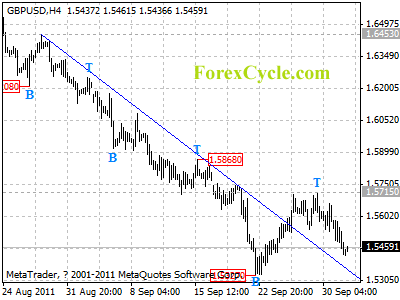
GBPUSD formed a cycle top at 1.5715

GBPUSD formed a cycle top at 1.5715 on 4-hour chart. Deeper decline towards 1.5327 previous low would likely be seen later today, as long as this level holds, the price action from 1.5327 is treated as consolidation of downtrend from 1.6617, and one more rise towards 1.5800 is still possible. On the other side, a breakdown below 1.5327 will signal resumption of downtrend, then another fall towards 1.5000 could be seen.

gbpusd

Daily Forex Forecast

Daily Dividend Report: October 3, 2011

American Financial Group (AFG) announced its quarterly dividend of 17.5 cents per share, an increase of about 7% over its prior dividend in July of 16.3 cents. The company is an insurance holding company, based in Cincinnati, Ohio with assets in excess of $30 billion.