Enjoy the Rally, It Won’t Last For Long.

By MoneyMorning.com.au

– If you like catching up with Murray Dawes on YouTube, head over there now. He’s just recorded this week’s market update video – and he says he’s feeling bullish

–He reckons there could be a market rally in the offing… and if he’s right about that, he has an idea where the ASX could be headed. He also has an idea about what to do if it gets there… and that involves some pretty major selling. But Murray’s musings come with a caveat: “If Soc Gen or BNP fall over then all bets are off…” To watch Murray’s brand new market update video now – go here.

– Today’s comedic relief is brought to you, once again, by Europe. We weren’t going to write about the other side of the world today. But in this type of market you need an occasional good laugh, even if it threatens your wealth at the same time.

– After realising the plan to leverage the European Financial Stability Facility (EFSF) was idiotic, the lemmings in Europe are running over to a new ‘solution’ – bank recapitalisations. Like most things bureaucrats dream up, it’s good in theory. How it plays out in practice will be entirely different.

– That’s not the funny bit though. Check this out: Apparently European finance ministers have asked the European Banking Authority (EBA), Europe’s top (we use the word loosely) banking regulator, to stress test Europe’s banks – again.

– You may remember the same incompetent organisation conducted stress tests in 2010 and 2011. The latest one, completed in July this year, found European banks to have a capital deficiency of just €2.5bn. At the same time as Athens was burning, these pompous fools didn’t even model a sovereign default. Now, just a few months later we’re talking about a need for €200 billion in fresh bank equity.

– But instead of all being sacked and the organisation shut down – as would happen in the private sector – these imbeciles get another go. We can only conclude the EBA is a corrupt organisation in the palm of the bankers. And it’s supposed to be their regulator?

– Look, the bank recapitalisation plan is on the right track. We don’t dispute that. But it’s a plan being put together by a bunch of squabbling politicians who put their own re-election prospects ahead of anything else. So the chances of it actually being done properly are remote.

– As we wrote in our Sound Money. Sound Investments email update yesterday – bank recapitalisations will be beneficial as long as they are accompanied by bad debt write-downs. The main problem with the global economy today is the amount of bad debt festering on bank balance sheets. This impedes the creation of new, productive debt.

– It also affects confidence. Banking is – and has always been – a business based on confidence. Without it, banks are exposed as the highly leveraged and fragile institutions that they are.

– So to improve confidence you need to purge the bad debt out of the system. This requires bank recapitalisations to absorb the coming write-downs. Before we go any further, just what do we mean by ‘bank recapitalisation’?

– The process is best explained with reference to a bank’s balance sheet. In balance sheet land, a company’s assets are equal to its liabilities and equity. The ‘equity’ value of a company is traded on the stock market. It is this portion usually referred to as ‘bank capital’.

– If you’re still with us, we’ll show you French basket case Société Générale’s balance sheet.

Assets €1.158 trillion
Liabilities €1.106 trillion
Equity €52.1 billion

– Here’s how it works. A write down in the value of its assets must be matched by a write down in the value of the equity. If the value of the banks assets fell by just 5 per cent, all the equity would be wiped out and the bank would be insolvent. This just goes to show how highly leveraged European banks are.

– Actually the bank’s assets have probably already fallen by 5 per cent. Luckily, it’s not required to ‘mark its assets to market’. Banks aren’t allowed to fail remember?

– Société Générale’s current market capitalisation is just €14 billion. This is what investors think the bank’s equity value is worth. It will probably prove optimistic.

– This is where a recapitalisation comes in. The Euro bailout fund, the EFSF, will contribute funds to banks in need of new equity capital. This should take the form of ‘preferred equity’, which will rank above existing equity when it comes to absorbing write-downs. That way anyone punting on European bank shares will take a hit before new taxpayer funds do.

– If all the bad sovereign debt in the system is really purged (which it won’t be, but bear with us) most of the existing equity holders will be wiped out. The pie-in-the-sky plan would then be for the preferred equity to convert to ordinary equity. Once this whole debt crisis thing blows over, say by Christmas*, the taxpayers would sell out for a profit, proving the eurocrats’ plan to be pure genius.

– There’s no harm in dreaming of course, but it won’t work out that way. There will be squabbling about which banks receive capital and how much is actually needed. If estimates of €200 billion are correct, the recapitalisation plan will leave the EFSF just about empty, with no more funds to buy other struggling sovereign debt.

– And don’t forget, bad sovereign debt is the cause of the crisis. Insufficient bank capital is just a symptom of the problem. A Greek default still awaits.

– The Europeans are only just beginning to realise how big their problems are. So enjoy the rally, it won’t last for long.

* Remember in World War One the conventional European wisdom was the ‘it would be over by Christmas’. Christmas 1914 that is.

Publisher’s note: Greg Canavan is the foremost authority for retail investors on value investing in Australia. He’s the former head of Australasian Research for a major asset-management group and a regular guest on CNBC, Sky Business’s ‘The Perrett Report’ and Lateline Business. Greg shares his insight, ideas and investment recommendations with readers of his Sound Money. Sound Investments newsletter… to find out more information on Greg’s letter, go here.


Enjoy the Rally, It Won’t Last For Long.

Why Chinese Monetary Planning Means More Volatility For You

By MoneyMorning.com.au

There are plenty of risks out there to keep markets nervous right now. Two of the most visible are Europe in the short term. And China over the next 6-12 months…

China’s unsound monetary policy is causing problems.

Sure the economy is booming – it grew 9.5 per cent in the second quarter, which was better than expected. But with such low interest rates and banks still willing to lend, it should be booming.

The problem is the country’s foreign exchange (FX) reserves, which continue to soar.

China Monthly Foreign Exchange Reserves

They increased US$153bn in the second quarter after jumping nearly US$200bn in the first quarter. China’s total FX reserves now stand at $3.2 trillion, equivalent to around 50 per cent of GDP.

This is not a sign of strength, but of severe economic distortions. As the Financial Times says:

China must print renminbi to buy all the foreign exchange streaming into the country. To blunt the inflationary impact, it issues bonds and orders banks to set aside a chunk of their deposits as required reserves, but economists say that room for such sterilisation operations is increasingly limited. That could put currency appreciation back to the forefront of efforts to damp down on inflation.

China has an inflation problem.

This is because of its extraordinarily loose monetary policy. But it has been reluctant to do what’s necessary to control inflation. Instead, it increases reserve requirements and slowly increases interest rates. As you can see from this chart, these moves have little impact on the problem.

China Inflation Rate

China’s inflation is primarily a result of it wanting to maintain a cheap currency.

In order for China to maintain a fixed exchange rate, it must print money to buy the foreign exchange flowing into the country. The more FX reserves that flow in each month, the more money printing must take place. This in turn makes it increasingly difficult to control inflation.

Back in July, I wrote in Sound Money. Sound Investments that China’s inflation problem and its policy proscriptions will come under greater scrutiny in the second half of this year. Yesterday the US Senate voted ‘to move ahead with a bill that would punish China for keeping the value of its currency low,’ reported the Wall Street Journal.

The undervalued Yuan makes imported products cheaper for American consumers, but politicians, like Republican presidential candidate Mitt Romney, are claiming this hurts American jobs.

Yet the response from the People’s Bank of China said ‘…factoring in inflation, the Yuan has appreciated greatly and is close to a balanced level.’

Exchange Rate vs. US Dollars

China Exchange Rate

Source: Tradingeconomics.com


In September this year, Prime Minister Wen said ‘China will continue to follow the strategy of expanding domestic demand, with a focus on improving the structure of demand and increasing consumer demand to drive economic growth.’

But this will only happen with a stronger Chinese currency.

The People’s Daily Online, a Chinese newspaper, has reported analysts asking for an increase in the Yuan to ease the inflationary pressures and drive consumer demand.

Maintaining a low Yuan discourages consumption. And consumption growth is slowing to pre-GFC levels.

Chinese Consumption – Fallen to a Seven-year Low

Chinese Consumption - Fallen to a Seven-year Low

Source: World Bank – China


China’s cheap Yuan policy is punishing the household sector.

Simply put, the weak Yuan benefits only those companies in the export sector and those with fixed-asset investments. The country’s high household saving rate is effectively subsidising these sectors.

Keeping the Yuan undervalued will make a transition to a consumer-based economy near impossible.

So for those in the Chinese government who expect its citizens to rise and become a major source of global consumer demand, think again.

China is a distorted economy reliant on fixed-asset investment and exports. Adjusting from such a model won’t be the end of the world, but it will be painful. And I suspect it will mean the Aussie market remains volatile for some time.

Greg Canavan
Money Morning Australia


Why Chinese Monetary Planning Means More Volatility For You

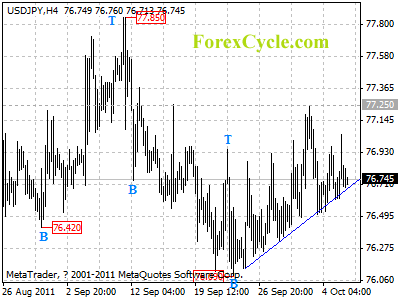
USDJPY is facing the trend line support

USDJPY is facing that support of the uptrend line on 4-hour chart, as long as the trend line support holds, the fall from 77.25 is treated as consolidation of uptrend, one more rise towards 77.85 is still possible. However, a clear break below the trend line will indicate that a cycle top has been formed at 77.25, and the rise from 76.09 has completed, then deeper decline towards 75.96 key support could be seen.

usdjpy

Provided by ForexCycle.com

Tan Seeks `Screaming Buys’ Amid Asia Market Downturn

Oct. 5 (Bloomberg) — Tan Teng Boo, managing director of Capital Dynamics Asset Management Sdn. in Kuala Lumpur, talks about the global economy and financial markets. Tan speaks with Rishaad Salamat on Bloomberg Television’s “On the Move Asia.” (Source: Bloomberg)

Mitsubishi Electric May Buy Overseas Should Yen Advance

Oct. 5 (Bloomberg) — Mitsubishi Electric Corp., Japan’s second largest maker of machinery used to automate factories, may accelerate overseas procurement should the yen strengthen by as much as 10 percent from current levels, President Kenichiro Yamanishi said yesterday at the Cutting-Edge IT & Electronics Comprehensive Exhibition, or CEATEC, near Tokyo. Mike Firn reports on Bloomberg Television’s “First Up.” (Source: Bloomberg)

Central Bank of Kenya Ups Rate 400bps to 11.00%

The Central Bank of Kenya upped its benchmark lending rate by 400 basis points to 11.00% from 7.00% previously.  The central bank Governor, Njuguna Ndung’u, said: “The Committee decided to raise the CBR by 400 basis points to 11.0 percent. In addition, the MPC will be meeting every first week of the month until further notice,” and said the CBK “will revise the CBR further if inflation and exchange rate volatility do not abate.” also noting: “inflationary pressure has continued to increase and both the weakening of the shilling and its volatility poses additional threats.”

At its previous meeting the CBK increased the interest rate by 75bps to 7.00%, after having previously increased, and subsequently decreased the discount window rate by 75 basis points to 6.25%.  The Kenyan central bank last increased the benchmark lending rate by 25 basis points in May this year.  

Kenya experienced annual headline inflation of 17.3% in September, up from 16.7% in August, up from 15.5% in July, and up sharply from 9.19% in March this year, according to inflation data from the Kenya National Bureau of Statistics.  The Central Bank of Kenya has an inflation target of 5 percent.  


Kenya reported seasonally adjusted GDP growth of -4.6% in Q2, compared to +2% in Q1.  
A Kenyan Ministry of Finance official noted that Kenya is expected to record economic growth around 5-5.5% this year, and 6% next year.  

The Kenyan Shilling (KES) has weakened about 27% against the US dollar so far this year; the USDKES exchange rate last traded around 101.25.


National Bank of Poland Keeps Rate at 4.50%

The Narodowy Bank Polski‘s Monetary Policy Council kept the benchmark 7-day interest rate unchanged at 4.50%.  The Bank said: “In the medium term, inflation will be curbed  by the anticipated decline in domestic economic growth amidst fiscal tightening, including reduced public investment spending, and interest rate increases implemented in the first half of 2011, as well as a likely global economic slowdown. On the other hand, the impact of the situation in the global financial markets on the zloty exchange rate constitutes an upside risk factor to domestic price developments.”

The Bank also kept the following interest rates unchanged: the rediscount rate at 4.75%, the Lombard rate at 6.00%, and the deposit rate at 3.00%.  The Bank last raised the interest rate by 25 basis points to 4.50% in June this year, and held the interest rate unchanged at its previous meeting.  

Poland reported annual headline inflation of 4.3% in August, up slightly from 4.1% in July, with previous readings of 4.2% in June, 5% in May, 4.5% in April, 4.3% in March, and higher than the Bank’s official inflation target of 2.5% +/- 1%.  


The IMF recently reduced its forecast for Poland’s 2011 economic growth rate to 3.8% from 4% previously.  The Polish Zloty (PLN) has weakened by about 13% against the US dollar so far this year; the USDPLN exchange rate last traded around 3.30.

How to Invest Like a New York Yankee

How to (or Not to) Invest Like a New York Yankee

by Marc Lichtenfeld, Investment U Senior Analyst
Wednesday, October 5, 2011: Issue #1615

Joe DiMaggio once said, “I’d like to thank the good Lord for making me a Yankee.”

There are several members of the Bronx Bombers who likely feel the same way. Not only have Alex Rodriguez, Derek Jeter, Mark Teixeira and Mariano Rivera won the World Series, they’ve become fabulously rich doing so. A-Rod of course was rich before he joined the Yankees, but he’s certainly gotten richer during his time in pinstripes.

In 2011, Derek Jeter and Mariano Rivera each made just under $15 million, before endorsements, money from the playoffs, or other sources of income.

Mark Teixeira made $23.2 million.

Alex Rodriguez’s paychecks totaled $32 million.

If DiMaggio loved being a Yankee 70 years ago, imagine how much he would have enjoyed it today! And how exactly would he invest?

Though star athletes are known not just for physical prowess but also for their smart decision-making on the field, when it comes to managing their money, they don’t always perform like champions.

  • Lenny Dykstra, the former Mets and Phillies star, is famously sitting in a California jail after his life spun out of control in the aftermath of an eight-figure financial collapse.
  • Sixty percent of NBA players are broke five years after retirement.
  • Former heavyweight champion Mike Tyson declared bankruptcy in 2003 after earning more than $400 million in his career.

Investing Like a New York Yankee

With the baseball playoffs underway and the Yankees on the path to another World Series championship, let’s take a look at how several members of the team are investing their money and whether it makes sense to follow their footsteps.

Derek Jeter – Perhaps the most beloved Yankee since Mickey Mantle, Jeter recently built a $15-million, 31,000-square-foot mansion near Tampa, Florida. Real estate in Florida is not likely to recover in the near future, so his timing may be off.

But if you can build your dream home and it will only cost you your base salary for one year – go for it.

Alex Rodriguez – A-Rod has been sharpening his poker skills in some high stakes games in case this baseball thing doesn’t work out. Always smart to have a backup plan. Additionally, he appears to be good at hedging his bets.

Despite being a large investor in Zico Pure Coconut water, he recently signed an endorsement deal with competitor Vita Coco. Either way, he wins. It’s like buying a put on a stock. Although when you buy a put, you usually don’t infuriate your co-investors.

Mark Teixeira – According to the Baltimore Sun, the slugging first baseman is invested in The Geier Strategic Total Return Fund (GAMTX), a mutual fund that “offers a conservative mind set. One that seeks growth without unnecessary risk.”

Sounds like a plan. Except when you look at the portfolio and notice it’s 40 percent in cash, 52 percent bonds, including two other bond mutual funds with much-lower expense ratios than the Geier Fund. In fact, Geier charges a much-higher-than-average 2.11-percent expense ratio. You can park your cash in the bank for free. You don’t need to pay a mutual fund company 2.1 percent to hold it for you. Remember, very few mutual funds outperform the market. So when selecting a fund, keeping your expenses low is critical.

Mariano Rivera – The Yankees’ reliever invested in Sunovia Energy Technology (OTC: SUNV), a company that makes energy-efficient lighting systems.

The stock trades for just $0.02 per share. Mariano didn’t become baseball’s all time greatest closer by being reckless. Sunovia has yet to make a dime and has revenue of just $1.2 million in the first six months of the year, although its net loss has declined significantly from last year.

Rivera has made a lot of money in his career and if he wants to swing for the fences with a little bit of it, I’m not going to tell him he shouldn’t. But hopefully, it’s only a very little bit and the rest of it is invested with precision and control, like the way he throws his cut fastball.

Besides for their freaks of nature bodies, mind boggling salaries and glamorous lifestyles, star athletes aren’t that different from you and me.

Wealth Protection Strategies and Dividend-Paying Stocks

These guys should be looking for ways to protect their wealth and generate income for when their playing days are over. They’ve already hit the jackpot in terms of making money. Rather than trying to do it again in some hair-brained scheme that their cousin’s friend’s uncle is leading, they should find tax efficient strategies that will generate enough money for them to live on for the rest of their lives.

The two best strategies for preserving wealth:

  • Muni bonds – Although interest rates are quite low, you can still get quality muni bonds. For instance, you can buy a AA 20-year rated muni with a yield of 4.29 percent, which is equivalent to earning 6.6 percent if you live in a state with no income tax. In a state like California with high income tax, it’s the equivalent of 7.2 percent.

If you’re going to buy bonds you should be prepared to own them for the life of the bond. Yields are so low and prices so high that you may have to endure some pain in terms of the bond’s price while you own it. However, as long as you are holding it to maturity, you’ll get your money back.

Despite the tough economic times that we’re enduring, the fear of muni bond defaults is overblown. AA munis only default 0.03 percent of the time. That’s one in every 10,000.

  • Dividend stocks – Buy quality stocks that pay healthy dividends and that grow the dividend every year.

Currently, dividends are taxed at just 15 percent, making them more appealing from a tax perspective than ordinary income. That of course may change in the very near future.

There are plenty of quality companies paying dividends of four to six percent that raise their dividend every single year. That’s important because if you’re holding the stock for the long term and living off the income, you need the dividend to keep up with inflation.

Here are a few stocks you and members of the Yankees should consider:

  • Altria (NYSE: MO) – A lot of ballplayers use their smokeless tobacco products. They might as well get some money back from the company. It pays a hefty dividend yield of 6.1 percent and over the past ten years has grown the dividend by an average of 11.7 percent per year.
  • Northeast Utilities (NYSE: NU) provides electricity to customers in three states in New England and is in the process of acquiring NSTAR (NYSE: NST), whose customers are in Boston and the surrounding area.I’m sure Yankees players wouldn’t mind collecting the 3.3-percent dividend (growing at 10 percent each year), knowing that every time a Red Sox fan leaves the light on in the bathroom, they’ll get paid.
  • Eli Lilly (NYSE: LLY) – The next time a ballplayer is nailed for taking human growth hormone, it’s possible it came from Eli Lilly. The drug giant makes Humatrope, which is supposed to be used in children who are not growing properly. But it can also be used to hit 40 home runs in a contract year.Lilly’s stock yields a healthy 5.3 percent. It hasn’t raised the dividend in a few years but the company should have no problem continuing to pay the current dividend due to cash flow and a payout ratio of less than 33 percent.

Now, that I’ve got the Yankees’ finances figured out, let me get to work on getting A-Rod’s bat back in the groove during the playoffs.

Good investing,

Marc Lichtenfeld

Article by Investment U

Baer’s Gattiker Says ECB Rate Cut `Not Necessary Yet’

Oct. 5 (Bloomberg) — Christian Gattiker, head of research at Bank Julius Baer & Co., comments on Apple Inc.’s new iPhone 4S and the outlook for tomorrow’s European Central Bank interest-rate decision. He talks with Owen Thomas on Bloomberg Television’s “On the Move.” (Source: Bloomberg)