How to Pick the Right Small-Cap Explorer

By MoneyMorning.com.au

On Monday we wrote about Take-Over Targets and Treasure Hunters – and told you why we believe they’re your best chance to bag gains like 226% and 81% in resources stocks.

Today, we’ll show you some of the methods our editors use to track down these companies. It’s an easy formula to filter good stocks from bad stocks…

Finding Them

First, our editors will get their name on company mailing lists… or the mailing list of PR companies that run investor presentations. But they also know these guys are salesmen. They need to double- and triple-check the facts before they believe what they’re told.

Second, they go to mining conferences to hear about up-and-comers (Slipstream Trader, Murray Dawes and Diggers & Drillers editor, Dr. Alex Cowie are on their way back from the Sydney Mines and Money Conference today). Again, they’ll need to check any facts they’ve been told.

Many companies will tell you a project is only 18 months from production. But if you go back next year and hear them talk, they’ll tell you the same project is still ‘only 18 months from production’!

Another way is to painstakingly search the internet and company websites for under-reported stories. Most of the info they need is out there… it’s just a case of finding it.

So once they’ve found a company they like, and it’s exploring for a commodity they know is in demand…

How do they pick the right explorer?

There are a lot of stocks to choose from. And some of it comes down to luck – getting the right idea about the right industry and the right stock at the right time.

But there are five questions they ask that can help weed out the hopefuls from the hopeless…

1. Who’s in charge? Look for a team with a successful exploration record in the same field. If they’re looking at a small-cap potash explorer and the management team’s only experience is in producing iron ore, they’ll probably steer clear. There’s a big difference between exploring and producing. And an even bigger difference between mining iron ore and potash.

2. When will investors get their money? They ask the company to explain how its plans will increase the share price. If there’s no plan in place, it may be too early to buy. If the plan is too ambitious or things don’t add up, maybe the company isn’t being completely honest. Again, maybe that’s a sign to steer clear.

3. What about promotion? Without good promotion, most early stage explorers are as good as sunk. It costs a lot of money to sink holes in the ground and if the company can’t raise the capital it needs to explore, there’s a good chance it won’t make you any money either.

4. Where can it go wrong? If the management team can’t give our editors the downside of the project, they either haven’t thought it through or aren’t being straight with them. They need to make sure the company has a plan in place in case something goes wrong – a contingency plan.

5. How much is it worth? There are many ways to value a mining company. It can depend on how developed the company’s project is. And the potential size of the resource will have a big impact on the value. The less developed the project the riskier it is and therefore you’d expect a bigger return.

Most important, not every explorer hits pay dirt. It costs a fortune to pull commodities out of the ground. And many companies lose their investors’ stakes digging up a whole lot of nothing.

But the ones that do dig up a whole lot of something should make investors big returns. Sometimes it’s like looking for a needle in a haystack. But the reward for finding the right stock at the right time more than makes up for the effort of finding it.

Aaron Tyrrell
Editor, Money Morning

P.S. Looking for a small-cap explorer with the potential to make you big profits is fun but it’s tough. That’s why Diggers & Drillers Alex Cowie spends his days doing the hard work for you. To find out more, click here

Related Articles

A Bright Future for Destruction

Watch What the Rich Do, Not What They Say

Is Australia Killing its Entrepreneurs?

How to Profit from a Disruptive Market

How to Turn Pennies into Pounds With Australia’s Most Exciting Companies

From the Archives…

What Debt Crisis?
2011-10-07 – Greg Canavan

Enjoy the Rally, It Won’t Last for Long
2011-10-06 – Greg Canavan

Why the Fed’s Actions Make Perfect Sense
2011-10-05 – Murray Dawes

Too Big to Bail
2011-10-04 – Murray Dawes

What Can We Expect Next From Commodities?
2011-10-03 – Dr. Alex Cowie

For editorial enquiries and feedback, email [email protected]

How to Pick the Right Small-Cap Explorer

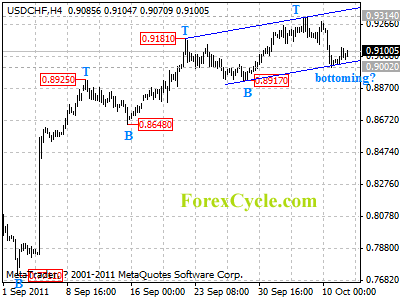
USDCHF rebounded from 0.9002

Being supported by the lower border of the price channel on 4-hour chart, USDCHF rebounded from 0.9002, suggesting that a cycle bottom is being formed. Further rally would likely be seen later today, and a break above 0.9150 could signal resumption of uptrend from 0.7711, then next target would be at 0.9500 area. Key support is at 0.8917, only breakdown below this level could indicate that the uptrend from 0.7711 had completed at 0.9314 already, then the following downward move could bring price back to 0.8500 zone.

usdchf

Lim Says Asia Recession Scenario `Still Awhile Away’

Oct. 11 (Bloomberg) — Su Sian Lim, a Singapore-based economist at Royal Bank of Scotland Group Plc., talks about the outlook for interest rates in Southeast Asia. Indonesia will probably leave interest rates unchanged for an eighth month today, after a tumble in the nation’s currency curbed scope for lower borrowing costs to bolster expansion as global economic growth weakens. Lim speaks with Rishaad Salamat on Bloomberg Television’s “On the Move Asia.” (Source: Bloomberg)

Minikin Says Yuan Policy Promotes Market Stability

Oct. 11 (Bloomberg) — Robert Minikin, a senior foreign-exchange strategist at Standard Chartered Plc in Hong Kong, talks about the outlook for China’s yuan, the euro and the U.S. dollar. Minikin speaks with Rishaad Salamat on Bloomberg Television’s “On the Move Asia.” (Source: Bloomberg)

Central Bank of Nigeria Hikes Rate 275bps to 12.00%

The Central Bank of Nigeria hiked its monetary policy interest rate by 275 basis points to 12.00% from 9.25%, after convening an emergency meeting as a result of heightened global uncertainty and a desire to preserve the value of its currency, the Naira.  The Bank also voted to raise the cash reserve ratio to 8% from 4% previously.  

Bank Governor, Lamido Sanusi, said: “
The global economic horizon remains highly uncertain, with the signs getting more ominous as policy makers find it increasingly difficult to take the necessary economic decisions that may avert a new wave of  recession.” 

“Three self-reinforcing negatives continue to define the global economy: the sovereign debt crisis in the Eurozone, significant undercapitalization of internationally-active banks, and negative market sentiment leading to continuing flight to cash as a safe haven and deleveraging. The first and second aspects intensify the third, and without confidence and some appetite for financial assets and credit, the debt crisis and financial solvency concerns in turn become deeper”


Previously the Nigerian central bank raised the the monetary policy rate by 50 basis points to 9.25%, after hiking the rate 75 basis points to 8.75% in July, and increasing it by 50 basis points to 8.00% at its May meeting this year.  Nigeria reported annual headline inflation of 9.3% in August, down from 9.4% in July, 10.2% in June, 12.4% in May, 11.3% in April, and 12.8% in March, but within the Bank’s inflation target of 10%.  

The Nigerian government doubled the minimum wage to 18,000 Naira recently.  Nigeria reported annual GDP growth of 7.72% in the June quarter, after growing 7.43% in the March quarter, while the Bank is forecasting 2011 growth of 7.8%.  


Nigeria’s currency, the naira (NGN), has weakened about 8% against the US dollar so far this year, with much of the weakness coming in the past few weeks.  The USDNGN exchange rate last traded around 164.25.

Shvets Expects `Bear Market’ for Stocks for 5-10 Years

Oct. 11 (Bloomberg) — Viktor Shvets, head of regional strategy at Samsung Securities Co., talks about the outlook for global equities. Shvets also discusses People’s Bank of China monetary policy and the nation’s banking system. He speaks with Susan Li on Bloomberg Television’s “First Up.” (Source: Bloomberg)

Marshall Says Weaker Countries Will Have to Leave Euro

Oct. 11 (Bloomberg) — Robin Marshall, director of fixed income at Smith & Williamson Investment Management, discusses the euro-zone crisis and prospects for closer fiscal integration among member states. He talks with Maryam Nemazee on Bloomberg Television’s “The Pulse.”

Netflix Reverses DVD, Streaming Split

Netflix Reverses DVD, Streaming Split

by Justin Dove, Investment U Research
Tuesday, October 11, 2011

The broad market sell-offs over the past few months were especially brutal on Netflix (Nasdaq: NFLX). That’s because, in July, Netflix announced that it was raising prices and splitting its streaming and DVD rental businesses.

The decisions led to a mass exodus of over one million customers and the stock falling 65 percent between mid July and late September. The stock even fell 19 percent in one day on September 15 after Netflix announced it was expecting to lose 600,000 customers for the quarter rather than adding the 400,000 it had forecast.

While it was obvious the company was headed for a rough patch due to insanely high valuation and the rapid emergence of competitors, not many saw this much of a dip coming. Although the broad market sell-offs due to global recession fears have certainly played a part, the market has definitely spoken in terms of Netflix.

Therefore the company announced on Monday that it has decided to rescind its previous decision to split its DVD and streaming services into two different product offerings.

Netflix (Nasdaq: NFLX) Stock Reversal

Netflix: Too Little, Too Late?

Jeff Reeves of MarketWatch.com feels that “this Netflix debacle is not so easily resolved by wishing it away.”

He gives three reasons as to why he feels Netflix won’t rebound from this debacle:

  • “Some subscribers are gone for good” – Reeves argues that the whole thing may have left a bad taste in the mouths of many subscribers. He also cites that Netflix doesn’t offer a good enough catalogue of new releases and that many “mildly dissatisfied customers sometimes stick around out of laziness or complacency. Once they’re gone, however, they need more than the status quo to return.” I can certainly see the validity to this point.
  • “DVD business publicly revealed as disposable” – This is probably Reeves’ biggest stretch. He argues that somehow former customers’ feelings will be hurt by feeling marginalized, and they’ll never return. I don’t buy this. I think most customers are simply worried about a price point in this industry and Netflix rose above that. First by raising its prices, and second by splitting options for its customers (effectively raising prices even more).
  • “Netflix’s poor leadership exposed” – This could be a valid point. Netflix did execute poor judgment with its decisions to raise prices and lower customer options. It’s also disheartening that it failed to come to terms with Starz and will lose that content in January. As Reeves points out, Starz’ content currently makes up eight percent of its streaming library. However, one good sign is that the company understands its mistakes and isn’t being stubborn. It would be much more disheartening to see Netflix act like the stubborn Co-CEOs over at Research in Motion (Nasdaq: RIMM).

The Future Success of Netflix

Although Reeves makes some good points about the future success of Netflix, his bearishness may be a bit overstated. Its current P/E ratio at roughly 30 is much more palatable than the highs in the 80s back in July. And at least management can own up to its mistake in judgment and try to fix it.

Losing the Starz relationship will definitely hurt, considering it likely means Netflix will lose the rights to stream films from Walt Disney Studios and Sony Pictures Entertainment. But it’s adding DreamWorks Pictures to the fold for 2013, which should offset some of the losses. It’s also beginning to generate its own content, which it hopes will separate it from similar services.

“House of Cards,” will be Netflix’s first original show, which is expected to premier in late 2012. According to The New York Times, it’s also in talks to distribute new episodes of the cancelled sitcoms “Arrested Development” and “Reno 911.”

It’s unlikely Netflix will see its highs of $300 a share again anytime soon. But it’s also probably a bit oversold due to the broad market sell-offs and overboard bearishness. Investors may want to keep an eye on Netflix, as this could be a low point for the stock.

Good investing,

Justin Dove

Article by Investment U