Dollar Losses Limited, Markets Expecting Heightened Volatility

By ForexYard

Liquidity will likely be higher in today’s early trading as several events are being published in rapid succession from Britain, Canada and the US. American liquidity will be heightened, and Great Britain will contribute to today’s movements with its retail sales figure.

Economic News

USD – US Dollar Bearish, but Downturn Limited

The US dollar (USD) was seen trading mildly bearish early Thursday as traders viewed comments by the Fed as a sign of potentially impending hawkish moves on the policy front. The sudden jolt to risk appetite generated by such movement pushed down on the greenback, but seems to have lifted following a string of reports out of the US today which could reverse much of the markets recently acquired short-term stability.

Data from the American housing market yesterday also signaled mixed messages between building permits and home sales, representing a possible lull in impending construction, but an increase in mortgage loans and other sales. The news has done little to the forex market, however, though it could ripple through longer-term analyses on US capital markets later in the year.

As for today, the US economic releases will focus mostly on housing and manufacturing. Liquidity will likely be higher in today’s early trading as several events are being published in rapid succession from Britain, Canada and the US. American liquidity will be heightened, and Great Britain will contribute to today’s movements with its retail sales report.

EUR – Euro Bullish from Sudden Growth in Risk Appetite

The euro (EUR) is expected to be seen trading with bullish results this morning ahead of a slew of reports from Great Britain, Canada and the United States. Against the US dollar (USD) the euro has been seen trading somewhat bearish as the greenback moves upward against its currency rivals.

Traders are looking for a way to balance a renewal of risk aversion with continued shakiness in global markets. A mildly pessimistic sentiment towards investing in the US dollar at the moment has many investors on edge. An embattled euro zone, fending off market bears amid turmoil in its peripheral nations, also looks to be losing ground in financial markets as safe haven assets such as the Swiss franc (CHF) and Japanese yen (JPY) make gains.

Sentiment across the euro zone has turned negative, with many analysts and economists expecting moves towards safety by traders this week. Any more bearishly-leaning news out of any major global economy will likely pull down on the EUR even further as investors flee risk. With a heavy news day ahead, many traders are anticipating significant data releases to move the market. If today’s data continues to reveal negative market directionality, the EUR is likely to remain bearish.

JPY – JPY Beginning to Feel Pressure

The Japanese yen (JPY) was seen trading mildly lower versus most other currencies this morning as its value as an international safe haven was being challenged by an air of diminished industrial activity and production. Being linked to international risk sentiment, the yen has experienced an expected uptick during a period when shifts away higher yielding assets became prominent. The JPY has been experiencing several long strides lately from the various shifts into riskier assets.

The latest moves of the yen are causing some concerns, however, as many speculators are anticipating some downturn following this week’s industrial activity releases. A strengthening yen has benefits for the buying power of the island economy, though its dependence on exports makes a strong yen unfavorable for longer-term growth in Japan’s current financial model. As industry slumps in Japan, this uptrend may meet resistance.

Crude Oil – Oil Prices Holding Steady amid Market Turmoil

Crude Oil prices held steady Wednesday as sentiment appeared to favor a mild uptick in global stocks following reports of monetary moves being made by several central banks. Data releases out of Europe and the US last week are beginning to generate some risk taking after statements by the Federal Reserve began to cause investors to seek out higher yields.

An expected dip in dollar values due to this week’s risk seeking environment has helped many investors ram up their long-taking positions on physical assets, but with the USD’s losses not materializing in large enough numbers, sentiment appears to have the price of crude oil holding steady. Should Crude Oil sentiment continue to flatten this week, oil prices may reach a decision point which forces a wide swing by mid-week.

Technical News

EUR/USD

The pair has traded within a wide 8 cent range since the beginning of the month and could continue its rebound. Initial resistance for the EUR/USD is found at the weekly high which coincides with the 50-day moving average at 1.3910 and a retracement target at 1.4015. A move above here would signal more than just a correction in the downtrend. The previously broken trend line from May 2010 beckons as resistance at 1.4175. Should any downside price action be seen in the EUR/USD pair then the 20-day moving average could come into play at 1.3550.

GBP/USD

Cable has received a significant bounce after the downtrend failed to follow through below the 1.5300-1.5270 range. Initial resistance can be found from last week’s high of 1.5850 with scope to the 1.6000-1.6100 range. Support is located at Tuesday’s low of 1.5630 followed by the September low of 1.5325.

USD/JPY

The range trading for the USD/JPY continues with the pair held in check between the levels of 77.50 and 76.30. A move higher would likely find willing sellers at the September high of 77.85 while a break here could test the post intervention high of 80.25.

USD/CHF

The USD/CHF is encroaching on its rising trend line from the August and September lows which comes in at 0.8900. A bounce here could retest the October high of 0.9310 while a break of the trend may have scope to the 0.8550 support.

The Wild Card

Gold

Spot gold prices failed to move above the $1702.50 resistance level, limiting the upside moment. Forex traders should note that a break below $1627 could open the door open for a retest of the September low of $1530.

Forex Market Analysis provided by ForexYard.

© 2006 by FxYard Ltd

Disclaimer: Trading Foreign Exchange carries a high level of risk and may not be suitable for all investors. There is a possibility that you could sustain a loss of all of your investment and therefore you should not invest money that you cannot afford to lose. You should be aware of all the risks associated with Foreign Exchange trading.

Impending US Construction Expected to Fall Shy of Forecasts

Source: ForexYard

printprofile

As reported early Wednesday afternoon, the building permits report from the United States’ economy revealed an impeding shortfall in construction, albeit mildly. Forecasts on housing tend to be more estimated than other figures, making them carry less significance for the forex market.

Market watchers and economists were anticipating a month-on-month rise of roughly 610,000 building permits issued in October. The actual result was only 590,000 permits, falling just shy of forecasts. The impact may be a muted rise in the greenback as more traders turn to safety.

Read more forex trading news on our forex blog.

Forex Market Analysis provided by ForexYard.

© 2006 by FxYard Ltd

Disclaimer: Trading Foreign Exchange carries a high level of risk and may not be suitable for all investors. There is a possibility that you could sustain a loss of all of your investment and therefore you should not invest money that you cannot afford to lose. You should be aware of all the risks associated with Foreign Exchange trading.

Japanese Industry Falling Behind

Source: ForexYard

printprofile

Coming in line with Monday’s statement on revised industrial production, this morning’s release on All Industry Activity in Japan revealed another sluggish month for the island economy. Expectations were for a mild downturn, making the report less surprising, however.

The results revealed a month-on-month contraction of approximately 0.4%. Following Monday’s release of industrial production, which fell short of market forecasts, makes this report more ominous for Japan. The yen may find itself coming under pressure as a result.

Read more forex trading news on our forex blog.

Forex Market Analysis provided by ForexYard.

© 2006 by FxYard Ltd

Disclaimer: Trading Foreign Exchange carries a high level of risk and may not be suitable for all investors. There is a possibility that you could sustain a loss of all of your investment and therefore you should not invest money that you cannot afford to lose. You should be aware of all the risks associated with Foreign Exchange trading.

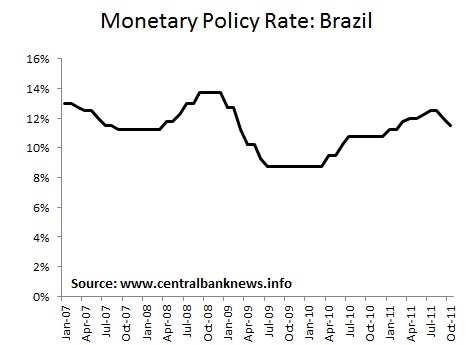
Brazil Central Bank Cuts Rate Another 50bps to 11.50%

Central Bank News - Brazil Monetary Policy RateThe Banco Central Do Brasil dropped the Selic interest rate by another 50 basis points to 11.50% from 12.00% previously.  In its statement, Brazil’s Central Bank Monetary Policy Committee (Copom) said [translated]: “Continuing the process of adjusting monetary conditions, the Committee decided unanimously to reduce the Selic rate to 11.50% pa, without bias.  The Monetary Policy Committee believes that the timely mitigate the effects coming from a more restrictive global environment, a moderate adjustment in the level of the base rate is consistent with the scenario of convergence of inflation to the target in 2012.”

Brazil’s central bank previously also cut the rate by 50 basis points, after raising the Selic rate by 25 basis points to 12.50% at the June Copom meeting this year, which at the time amounted to total tightening for the year of 175 basis points (now net tightening of 75bps).  Brazil reported an annual inflation rate of 7.31% in September, compared to 7.23% in August, 6.87% in July, 6.71% in June, and 6.55% in May, and just outside the official inflation target of 4.50% +/-2% (2.5-6.5%).  


The Brazilian government is forecasting economic growth this year of 4.5-5%, compared to GDP growth of 7.5% during 2010.  The “BRIC” emerging market economy grew 0.8% q/q in the June quarter (1.3% in March), placing annual growth at 3.1% (4.2% in Q1).  The Brazilian Real (BRL) has weakened about 6% against the US dollar so far this year, while the USDBRL exchange rate last traded around 1.77


Bank of Thailand Keeps Rate at 3.50%

Central Bank News - Thailand Monetary PolicyThe Bank of Thailand held its benchmark 1-day bond repurchase rate unchanged at 3.50%.  Bank of Thailand Assistant Governor, Mr. Paiboon Kittisrikangwan, said: “The MPC deemed that the current level of the policy rate is appropriate in addressing upcoming inflationary pressure  and supporting economic adjustments amidst heightened uncertainty in the global economy. Meanwhile, with the floods not yet over, their impact on the economy was not fully evident. The MPC therefore voted 6 to 1 to hold the policy interest rate at the current level of 3.50 per cent, with one vote in favour of a 0.25 per cent decrease. The MPC would remain vigilant in monitoring developments of risks and stand ready to take appropriate policy actions.”


The Bank of Thailand raised the rate to 3.50% at its previous meeting, and increased the interest rate in July this year by 25 basis points to 3.25%, continuing a string of monetary policy tightening measures, with the repo rate now 150 basis points higher than the start of the year.  Thailand reported core inflation of 2.92% in September, compared to 2.6% in June, 2.48% in May, and 2.07% in April, according to the Commerce Ministry.  Headline inflation was 4.29% in August, 4.08% in July, 4.1% in June, compared to 4.19% in May, and 4.04% in April.  The Bank of Thailand has an inflation target range of 0.5% to 3.0%.  

The Thai economy contracted -0.2% in the second quarter, after growing 2% in the March quarter, placing annual GDP growth at 2.6% (3.2% in the previous quarter).  The Thai baht (THB) has weakened about 2% against the US dollar this year, the USDTHB exchange rate last traded around 31


www.CentralBankNews.info

Norwegian Central Bank Holds Rate at 2.25%

Norway’s central bank, Norges Bank, held its key monetary policy rate steady at 2.25%, and signaled no changes.  The Bank’s Deputy Governor, Jan F. Qvigstad, said: “The Executive Board is of the view that the outlook and the balance of risks now suggest that the key policy rate should be kept at the current level for some time ahead. If the economic unrest abroad intensifies, money market premiums remain high and the outlook for growth and inflation weakens further, the key rate may be reduced. If financial market turbulence subsides and there are prospects of higher growth and inflation, the key rate may rise.” 

At its previous meeting the Bank held the key policy rate unchanged, after increasing the interest rate by 25 basis points to 2.25% in May.  The Bank expects inflation to remain relatively low, but to progress towards the 2.5 percent inflation target (but with due upside inflation risks); Norway reported annual inflation of 1.6% in September, 1.3% in August, 1.6% in July, 1.3% in June, 1.6% in May, and 1.3% in April this year.  


Norway‘s economy grew by 0.4% in the June quarter (-0.6% in Q1 this year), placing GDP growth at -0.4% on an annual basis (+0.9% in Q1). The Norwegian krone has gained about 4% against the US dollar this year, while the USDNOK exchange rate last traded around 5.64

China’s Hard Landing is Certain

By MoneyMorning.com.au

“China’s surging economy moderated to its slowest pace in more than two years in the third quarter, as it remains on track for a government-engineered ‘soft landing’ that has unsettled global investors.” – Financial Times

When we see the words “government-engineered”, it sends a shiver down our spine… hairs stand up on the back of our neck… and if it happens to be a full moon, we howl at it.

But that’s nothing compared to our reaction to the term “soft landing”. It’s one of the most dangerous words in the economic language.

Because shortly we’ll show how the U.S. Federal Reserve’s attempt at a “soft landing” in 2000 gives a clue to where the Chinese economy is heading next. And considering how crucial China is to the Aussie economy, understanding what’s happening in China is important to every Australian…

Good News for Banks is Bad News for the Market

But before we go on, don’t forget to check out Slipstream Trader, Murray’s Dawes’ latest free weekly update on YouTube.

In the video released yesterday, Murray revealed the next few weeks could be “one of the best selling opportunities of the year.” That’s great news for short-sellers. And it’s also good news for investors who want to get out of stocks before the market tanks… again.

This morning the Aussie market is down more than 1% in early trading – thanks to lower commodity prices and…

As it turns out, Europe’s banks may be in better shape than many thought (remember everything is relative, the banks are still stuffed, just not quite as stuffed).

That means the bailout and stimulus programs may not be as big as investors had hoped… which means less money printing and a smaller boost to asset prices.

In other words, good news is bad news!

But the banks aren’t on our radar today. Because right now, the banking story is just noise hiding the real story. Which brings us to Mark Twain…

A Lesson from History

He supposedly wrote:

“It is not worth while to try to keep history from repeating itself, for man’s character will always make the preventing of the repetitions impossible.”

What Mr. Twain was getting at is that history provides a good indication of what could happen in the future. And that it’s wishful thinking to believe people will learn from mistakes.

We’re sure you’ve heard how U.S. Federal Reserve chairman, Dr. Ben S. Bernanke is determined not to make the same mistakes as the Fed did during the Great Depression. Yet everything we’ve seen from the Fed tells us Dr. Bernanke is helping repeat history, rather than avoiding it.

The problem is those who gain positions of authority believe too much in their own abilities. They believe they’re the only ones who can solve the problem… because only they’ve learnt from history.

Only, humans are fallible. And no single person can possibly know enough information to predict all possible outcomes – if it was possible you wouldn’t get unintended consequences.

Yet as we’ve written many times, despite the evidence, most believe those in authority will succeed. They believe chaps like Dr. Bernanke knows what he’s doing. And those same people also believe China knows what it’s doing too… that China can engineer the fabled economic soft landing.

So, let’s briefly describe just what a “soft landing” is…

Is This the Kind of Soft Landing They Want?

In simple terms it’s the idea a central bank can gradually raise interest rates to slow down an economy. That rather than crashing to a halt, the economy will slow gradually to a more sustainable rate of economic growth.

Of course, as you can guess, the People’s Bank of China isn’t the first central bank to give it a go. For example, take this from the Philippine Daily Inquirer on 6 July 2000:

“The US economy is on track in the second half of this year to achieve the ‘soft landing’ desired by Federal Reserve policymakers, slowing just enough to hold inflation in check, according to economists surveyed by Bloomberg News.

“Growth will probably average a 3.7-percent annual rate in the final six months of the year… That’s down from a 5.5-percent first quarter growth pace and close to the consensus forecast of a 3.5-percent rate for the second quarter that ended Friday.”

The article continues with a comment from Paul Christopher, economist at financial services firm, AG Edwards & Sons:

“Whether the Fed closed their eyes and pushed the button or they have a remarkably good crystal ball, it seems like they are going to get the kind of slowdown they wanted.”

Turns out either the Fed did close its eyes… or the crystal ball was a dud. Because two years later the U.S. market had dropped 50%. And the economy was in recession:

market chart
Click here to enlarge

Source: Google Finance

If that was the “kind of slowdown they wanted”, we don’t recall the Fed mentioning it in advance.

No Pot of Gold

Let’s be honest, the idea that a central bank can engineer a soft landing is about as likely as you finding a pot of gold at the end of a rainbow.

Soft landings – if they happen at all – happen by luck, not design.

And right now, China is right out of luck. Because based on what we can see, the signs are that China is heading for a very, very hard landing… and for the most part, the market is blind to it.

Even so, the clues are obvious. Of course, there’s always a chance they’re too obvious and we’re wrong. But we don’t think so.

Our bet is the Chinese economic collapse will happen soon – perhaps very soon. And make no mistake, when it happens it will cause more damage to the world economy than anything the collapse of a few dodgy European banks could ever do.

So, what are the clues?

For that you’ll have to wait until tomorrow. We’ll fill you in on the details then…

Cheers.
Kris.


China’s Hard Landing is Certain

The Euro Zone’s Fire Breathing Monster

By MoneyMorning.com.au

Within the space of 18 months, the debt crisis has grown from a hatchling in Greece, consumed a few bloated PIIGS, and then gestated into a full-blown, fire-breathing monster with a wingspan the width of Europe.

Europe’s debt crisis has grown into a monster very rapidly.

Politicians can scurry around and have as many emergency meetings as they want, but they’re delusional if they reckon they can fix debt with debt.

And all this debt is eroding the value of your cash.

But there are alternatives instead of holding onto paper notes.

Like precious metals.

It’s best to think of precious metals as an alternative to holding cash in a portfolio.

The risk, of course, is that gold and silver prices fall significantly. But I don’t expect this to happen. As you’ll know if you read my articles earlier this week…

It’s best not to think of gold and silver metal as a way to make you rich though. Think of it as something that will work for you as a store of value.

Even though the spot price of gold has dropped from its earlier highs – investor demand for the metal is outpacing supply.

5 year gold chart

5 year silver price in USD

Source: kitco.com

The increase in popularity in bullion has left many investors new to the gold and silver market wondering which is the best way to get their hands on precious metals.

My favourite option is buying physical bullion.

Buying physical gold or silver is more expensive because dealers charge a premium. You then have the cost of delivery, storage and insurance. But the nice thing about it is you actually know you own it!

You can choose from coins, antique coins, nuggets and bullion bars.

Coins are pretty, but because of the detail they’re more costly to buy. Antique coins are a specialised market. And nuggets are great, but the price varies on purity and other factors.

If you’re investing for the long-term, in my opinion it’s best to do it with bullion.

You can buy the metal directly from a dealer’s office. Or put an order by phone or online. Delivery is easily arranged. But ask questions about the method used and whether it’s insured.

While there are plenty of bullion dealers in Australia, there’s another surprising way to get your hands on the shiny stuff.

Bizarrely, eBay has quite an active silver market! I’ve bought and sold successfully this way quite a few times.

This is much riskier than going through a registered dealer. And it’s essential to get the metal tested. This is as easy as going to a business that buys scrap gold and silver, and asking them nicely to scan it for you.

Importantly, stick with good sellers when you find them. And it’s a smart move to get the seller to send it recorded delivery and insure it.

Enjoy that bullion!

Alex Cowie
Editor, Diggers & Drillers

[Ed note: Alex gave subscribers a complete rundown on how to buy, hold and sell physical gold bullion in the May 2011 issue of Diggers & Drillers. If you’d like to know more about Alex’s investment advisory service and buying gold, click here…]

Related Articles

Why Chinese Monetary Planning Means More Volatility for You

Australia: The World’s Investing Casino

Why China’s Hidden Debt is Bad News for Aussie Stocks

The Great Indian Coal Rush

The Other Side of Short Selling

From the Archives…

Can You Beat Goldman Sachs?
2011-10-14 – Kris Sayce

Three Stocks to Sell Before China Slumps
2011-10-13 – Kris Sayce

Why Allocation Beats Diversification
2011-10-12 – Kris Sayce

Huge Rally – Is the Low In?
2011-10-11 – Murray Dawes

Queensland Housing’s 100-Year Slump
2011-10-10 – Kris Sayce

For editorial enquiries and feedback, email [email protected]


The Euro Zone’s Fire Breathing Monster

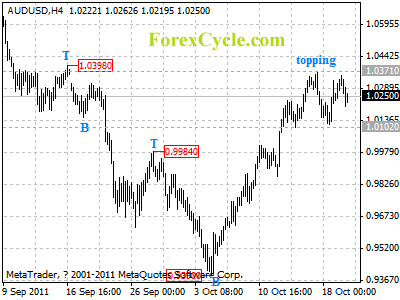
AUDUSD moved sideways in a range between 1.0102 and 1.0371

AUDUSD moved sideways in a range between 1.0102 and 1.0371. As long as 1.0102 key support holds, the price action in the range is treated as consolidation of uptrend from 0.9390, and one more rise to 1.0500 is still possible. On the other side, a breakdown below 1.0102 support will indicate that a cycle top has been formed at 1.0371 on 4-hour chart, and the rise from 0.9390 has completed, then the following downward move could bring price back to 0.9900 zone.

audusd

NZD/USD – Daily outlook 20 October

NZD/USD – Daily outlook 20 October

Three day’s ago on Monday we saw the Kiwi rejecting the 50% retracement level from its most recent down swing on the daily charts. Price action has not generated any bearish rejection signals until today where we’ve seen an inside bar forming on the daily charts and have almost completed a head and shoulders pattern on the 4hr charts.

In the chart below you can see resistance has been sitting strong at the 0.8020 area which in the summer months held as support for the pair. The 0.8020 area also ties in with the 50% retracement of the most recent down swing. Although recent weeks have seen the bulls taking charge of this market the 50% retracement & rejection suggest we could be in for further moves to the downside in the coming days.


nzdusd20octdailychart


To support the daily chart price action we can take notice of the head and shoulders pattern that has almost formed on the 4hr charts, again rejecting the same 0.8020 area mentioned above.  You can see the downwards sloping ‘neck line’ further supporting a push lower. At the present moment we are approximately half way to completing the final stage of the 2nd shoulder.


nzdusd20ocths

Should we see a break of the ‘neck line’ we could expect the kiwi to lose further ground against the Dollar in the coming days/weeks.

http://www.vantage-fx.com