Oct. 21 (Bloomberg) — Ron William, a technical strategist at MIG Bank, talks about his analysis of the gold price and euro. He speaks with Linzie Janis on Bloomberg Television’s “Countdown.” (Source: Bloomberg)
Looking Past the EU Economic Summit
Source: ForexYard

The upcoming weekend EU economic summit is the event that has captured the headlines but it may be a potential monetary policy move that is on the minds’ of FX market participants. At this time it is unclear what type of agreement France and Germany will come to though investors appear to be approaching the weekend with a bit of optimism given the gains European bourses have booked today.
With the German DAX up 2.80% and the French CAC up 1.80%, the hefty equity gains display a hint of optimism leading into the weekend. This weekend’s EU summit had quite the buildup but France and Germany have yet to come to an agreement and the scheduling of an additional summit this Wednesday to hash out the two nations’ differences regarding the legalities of the EFSF may just be delaying the theory that the two will eventually see eye to eye. Disagreements over the involvement of the ECB in any post July 21st agreement seem to be the largest gap. France is for the inclusion of the ECB while Germany counters with an insurance scheme that could cost France its AAA credit rating.
Despite the uncertainty and lack of an agreement between Europe’s two perennial powers investors are approaching the weekend with a glimmer of optimism. European equities are poised to finish the day with strong gains while the EUR/USD has moved above its recent consolidation pattern. At print time the USD is lower versus the majors. While European matters are getting a majority of the headlines, perhaps a WSJ article that discusses the next possible round of US monetary policy easing is having an impact on the USD?
Read more forex trading news on our forex blog.
Forex Market Analysis provided by ForexYard.
© 2006 by FxYard Ltd
Disclaimer: Trading Foreign Exchange carries a high level of risk and may not be suitable for all investors. There is a possibility that you could sustain a loss of all of your investment and therefore you should not invest money that you cannot afford to lose. You should be aware of all the risks associated with Foreign Exchange trading.
Gold Headed for Weekly Loss, Eurozone Plan “Lacks Concreteness” and could be “Ambitious with No Details”
London Gold Market Report
from Ben Traynor
BullionVault
Friday 21 October, 08:30 EDT
U.S. DOLLAR gold bullion prices climbed to $1637 an ounce Friday lunchtime in London – 2.0% up on this week’s low – while stocks and commodities also rallied despite ongoing uncertainty over plans to solve the Eurozone crisis.
“Gold is starting to garner some interest as some participants start to view current prices as good entry levels,” says Marc Ground, commodities strategist at Standard Bank.
“Is gold going to get back up to the highs?” asks Credit Agricole analyst Robin Bhar.
“That’s looking less certain now. It’s not on the agenda, although you can never say never.”
Despite Friday’s rally, gold bullion looked set for its first weekly loss of the month – 2.6% down as we headed into the weekend.
Silver bullion meantime rallied to $31.13 per ounce – though still a 3.4% drop for the week.
European leaders have scheduled a second meeting next week – in addition to this weekend’s European Union economic summit – stating that there is not enough time to finalize an agreement by Sunday.
German chancellor Angela Merkel also cancelled a speech she planned to give to the Bundestag Friday, which was to include details on proposals for the European Financial Stability Facility – the Eurozone’s ad hoc bailout fund set up last year.
“Without any concrete proposal for increasing the efficiency of the fund the chancellor can’t present a complete set of proposals,” explained Bundestag member Norbert Barthle, a member of Merkel’s Christian Democratic Union party.
European governments are set to allocate as much as €940 billion to fighting the crisis, news agency Bloomberg reported Friday.
“The market wants the Euro crisis solved yesterday,” says Chris Rupkey, chief financial economist at Bank of Tokyo-Mitsubishi in New York.
“Politicians and finance ministries seem to be saying “yes we can, but no we won’t”…Europe has the wealth…it is just that the process is incredibly complex.”
Reports suggest France favors turning the EFSF into a bank – which would allow it to access European Central Bank funds. German, in contrast, is said to prefer using EFSF money to insure a portion of ‘first losses’ on debt issued by troubled sovereigns.
“This clearly creates the prospect of a two-tier market with guaranteed debt trading at a premium to noninsured paper,” says Steve Barrow, research analyst at Standard Bank.
“[This] is not a way out of the crisis in our view.”
“[There is a] risk, ” adds Huw Pill, chief European economist at Goldman Sachs in London, “that the post- summit announcements will suggest an ambitious program at a high level but lack concrete detail on implementation…given previous experience, markets are unlikely to be very tolerant of such an outcome.”
“With this weekend’s meeting now apparently redundant,” adds one gold bullion dealer here in London, “and with the prospect of decisive action effectively postponed until the middle of next week, it seems likely that markets will tread water and play it cautiously as we enter the weekend.”
Elsewhere in Europe, the European Securities and Markets Authority is considering suspending sovereign credit ratings for countries that have been granted a bail out, the Financial Times reports.
“It is not the thermometer that causes the fever,” conceded Michel Barnier, European internal markets commissioner.
“But the thermometer has to work properly to ensure you do not exaggerate the fever.”
Barnier this week welcomed a European Parliament agreement to seek a ban on so-called naked positions in sovereign credit default swaps – whereby traders buy a CDS to profit from a sovereign default without owning the bonds issued by that government.
These regulatory proposals follow the ban on short selling of financial stocks imposed by France, Spain, Italy and Belgium in August – a ban that remains in place.
Rating agency Standard & Poor’s meantime has released the results of new stress tests it conducted for a number of Eurozone sovereigns. The stress tests looked at two scenarios: a double dip recession, and a double dip recession accompanied by a spike in interest rates.
“Sovereign ratings on France, Spain, Italy, Ireland, and Portugal likely would be lowered by one or two notches under both scenarios,” said an S&P statement.
Over in India – the world’s biggest market for gold bullion – gold dealers have stepped up their purchases of bullion ahead of next week’s festivals, including Diwali, news agency Reuters reports.
“Buying has started and come out in huge quantities,” says Haresh Acharya, head of the bullion desk at Parker Bullion in Ahmedabad.
“There are good buy orders close to $1,600,” adds a Mumbai-based dealer at a state-run bullion bank.
Gold value calculator | Buy gold online at live prices
Editor of Gold News, the analysis and investment research site from world-leading gold ownership service BullionVault, Ben Traynor was formerly editor of the Fleet Street Letter, the UK’s longest-running investment letter. A Cambridge economics graduate, he is a professional writer and editor with a specialist interest in monetary economics.
(c) BullionVault 2011
Please Note: This article is to inform your thinking, not lead it. Only you can decide the best place for your money, and any decision you make will put your money at risk. Information or data included here may have already been overtaken by events – and must be verified elsewhere – should you choose to act on it.
Bloxham Says RBA’s Next Move Likely to Be Rate Increase
Oct. 21 (Bloomberg) — Paul Bloxham, chief economist for HSBC Holdings Plc in Sydney and a former central bank official, talks about the outlook for Reserve Bank of Australia monetary policy and the nation’s economy. Australia’s export price index advanced 4 percent from the second quarter, the Bureau of Statistics said in a report in Sydney today. Import prices were unchanged. Bloxham speaks with Rishaad Salamat on Bloomberg Television’s “On the Move Asia.” (Source: Bloomberg)
British Economy Posting Strong Gains this Week
The Great Britain pound (GBP) is expected to be seen trading with mildly bullish results this week after reports on the country’s retail sales and inflation revealed a solid uptick this past month. Against the US dollar (USD) the pound has been trending strongly upwards as the greenback’s bearish moves help other currencies rise, particularly in Europe.
Economic News
CAD – Canadian Dollar Falls ahead of CPI Data
The Canadian dollar (CAD) was seen moving lightly bearish late Thursday as investors fled the higher yielding assets from speculation on a market downturn following recent releases on manufacturing. A worse-than-forecast uptick in US unemployment claims this week added to risk sensitivity for many investors, leading some to await today’s news before entering more strongly.
The Bank of Canada (BOC) also held rates steady in its latest decision, along with every other major economy announcing a rate decision, but talk was slightly more optimistic in the northern giant’s economy than elsewhere. The downtick seen in the Loonie was significantly milder than in other currencies. This may be partially due to the CAD’s disconnect from some of the market turmoil, but it could also be from some optimistic data emerging from the economy lately.
Most significant on today’s calendar will be the Canadian publication of its CPI and Core CPI data. Should today’s news foreshadow a modest growth in the Canadian economy’s consumer inflation, an assessment that does, however, seem less likely from data released these past few weeks, there is a possibility that more investment will get pushed towards the higher yielding abilities of the European currencies as investors seek to diversify their portfolios, which could also support the CAD in short-term trading.
GBP – GBP Rising on Retail Sales and Inflationary Growth
The Great Britain pound (GBP) is expected to be seen trading with mildly bullish results this week after reports on the country’s retail sales and inflation revealed a solid uptick this past month. Against the US dollar (USD) the pound has been trending strongly upwards as the greenback’s bearish moves help other currencies rise, particularly in Europe.
A mildly pessimistic sentiment towards investing in the euro at the moment has many investors on edge when considering regional investments. An embattled euro zone is sending financial ripples through its neighbors and some are concerned it could pull growth down across the entire continent. With yesterday’s retail sales data out of Britain, this doesn’t seem to be the case, at least for the island economy north of Western Europe. Inflationary data also seemed to support this solid growth with consumer prices growing at a healthy rate in the UK.
Sentiment across the region may have turned negative, with many analysts and economists expecting moves towards safety by traders this week, but the GBP could see a solid weathering of this financial storm so long as data remains bullish. Great Britain appears positioned for a relatively better quarter than its southerly neighbors. The pound could see some bullish movement at the end of this week as a result of this overall sentiment.
AUD – Australian Economy Dipping Mildly Below Expectations
The Australian dollar (AUD) is expected to be pushed down a bit at the close of this week as market reports showed mild hesitation across the boards. Piling atop recent reports on Australia’s slowly expanding housing sector, recent publications of Australian consumer and business confidence is starting to show a somewhat disturbing contraction striking several sectors of Australia’s economy, as well as its psyche.
Expectations for these recent reports have been for modest growth, and in some instance, at best, zero movement. The week’s reporting has so far led many investors to pull away from the Australian dollar (AUD) in recent trading, but many are expecting a rebound. National data on housing and employment has also driven many investors away from the once-burgeoning AUD. This data, combined with dismal housing starts figures and building approvals reports, has so far dragged the Aussie lower and looks to continue doing so this week.
Oil – Crude Oil Sees Downtick in Inventory Growth
Crude Oil prices gained mild support Thursday as sentiment appeared to favor an upward turn brought about by a strong downtick in US stockpiles. The weekly report revealed yesterday that the US has lost roughly 4.7 million barrels from its reserves. This news has so far countered the notion of a sinking price of oil brought about by higher USD values and pushed oil into a bullish posture from supply shortfall speculations.
An expected dip in oil values due to this week’s risk sensitive environment, which saw the greenback climbing sharply, has so far not affected the price of physical assets in any clearly visible way. The stockpile report out Wednesday surprised many investors who had priced in a far milder decline in reserves. With this sentiment grabbing hold among many traders, oil prices could see resurgence above $90 a barrel in the near future.
Technical News
EUR/USD
The pair has traded within a wide 8 cent range since the beginning of the month and could continue its rebound. Initial resistance for the EUR/USD is found at the weekly high which coincides with the 50-day moving average at 1.3910 and a retracement target at 1.4015. A move above here would signal more than just a correction in the downtrend. The previously broken trend line from May 2010 beckons as resistance at 1.4175. Should any downside price action be seen in the EUR/USD pair then the 20-day moving average could come into play at 1.3550.
GBP/USD
Cable has received a significant bounce after the downtrend failed to follow through below the 1.5300-1.5270 range. Initial resistance can be found from last week’s high of 1.5850 with scope to the 1.6000-1.6100 range. Support is located at Tuesday’s low of 1.5630 followed by the September low of 1.5325.
USD/JPY
The range trading for the USD/JPY continues with the pair held in check between the levels of 77.50 and 76.30. A move higher would likely find willing sellers at the September high of 77.85 while a break here could test the post intervention high of 80.25.
USD/CHF
The USD/CHF is encroaching on its rising trend line from the August and September lows which comes in at 0.8900. A bounce here could retest the October high of 0.9310 while a break of the trend may have scope to the 0.8550 support.
The Wild Card
EUR/JPY
The EUR/JPY is finding support, albeit weak support at 104.75. Forex traders should note that a break here and the charts lack support levels until the October low of 101.06. To the upside the EUR/JPY has resistance at 107.65 and 109.00.
Forex Market Analysis provided by ForexYard.
© 2006 by FxYard Ltd
Disclaimer: Trading Foreign Exchange carries a high level of risk and may not be suitable for all investors. There is a possibility that you could sustain a loss of all of your investment and therefore you should not invest money that you cannot afford to lose. You should be aware of all the risks associated with Foreign Exchange trading.
Trade Interceptor partners with Swissquote Bank
Trade Interceptor offers currency traders live trading with Swissquote Bank on iPad, iPhone, Android phones and tablets, as well as desktop (Windows, Mac and Linux).
21 October 2011 – Trade Interceptor, a multi-broker forex trading platform, has released live trading capabilities with Swissquote Bank – Switzerland’s largest online Bank. In 2010, Swissquote acquired ACM, one of the world’s leading Forex brokers for fair pricing and execution. Clients of Trade Interceptor will now be able to connect directly to Swissquote Bank’s FX and Metal liquidity.
Trade Interceptor, developed by Riflexo Jsc, has become a leading forex mobile trading solution for iOs and Android mobile phones and tablets, and is currently the number one Forex trading app on the Android Market as well as one of the most popular apps for iPad and iPhone. The mobile applications can be downloaded for free from theAppleiTunesStore, theAndroidMarket, and access to the forex desktop trading application is also free after registration on TradeInterceptor.com
“We are excited to give forex traders access to the largest Swiss online bank’s FX trading services, through Trade Interceptor advanced technology. The two technical teams have worked hard together to offer a low-latency and very stable trading connection”, explains Rodolfo Festa Bianchet, CEO of Riflexo. “Trade Interceptor is becoming the preferred mobile solution for forex traders, registering a growth of 11.000 new subscribers every month”, he continues.
“Riflexo has demonstrated excellent innovation when they created their Trade Interceptor phone and tablet trading applications and we are excited to be the bank chosen to provide FX and Metal pricing to their users,” states Ryan Nettles, Head of FX at Swissquote Bank. “We are looking forward to providing trade execution services to their users and having a successful strategic technical partnership with Riflexo.”
Swissquote Bank offers commission free forex and metal trade execution at some of the lowest spreads. Trade Interceptor provides clients with exclusive trading conditions.
Trade Interceptor is powered by Riflexo, a Sofia-based software company, which has been developing real-time trading solutions for financial institutions and professional traders for the last 11 years.
—
About Riflexo
Riflexo Jsc. is in the business of providing software solutions and services to clients around the world. The company developed software projects for various business sectors and has strong track records in the development of financial, real-time, and mobile applications. Riflexo also developed a JDO implementation for the management of persistent data, teaming-up with world technology leaders to create standard-based applications. The company’s objective is to offer high quality and cost-effective software solutions, based on standard technologies and delivered on time, which meet today’s most advanced development needs.
Turkey Central Bank Holds Repo Rate at 5.75%

The Central Bank of the Republic of Turkey held its benchmark 1-week repo rate at 5.75%. The Bank said: “Recent data releases suggest that there will be a notable reduction in economic growth in the second half of the year. External demand remains weak, and domestic demand continues to slow down. The deceleration in credit growth and domestic demand combined with the exchange rate movements have been contributing to the rebalancing of domestic and external demand. Accordingly, the Committee expects a significant improvement in the current account balance in the forthcoming period.”
The Turkish central bank cut the benchmark rate by 50 basis points when it held an emergency meeting in early August, the bank also cut its benchmark interest rate by 25 basis points to 6.25% in January this year. The Turkish central bank also adjusted required reserves in late July. Turkey reported annual consumer price inflation of 6.7% in August, compared to 6.3% in July, 6.2% in June, off from 7.2% in May, but up from 4.26% in April, and 3.99% in March, and above the Bank’s full year inflation target of 5.5%.
The Bank also increased the overnight lending rate by 350 basis points to 12.50% from 9.00%. The Turkish Lira (TRY) has weakened by about 20 percent against the USD so far this year, and last traded around 1.86 against the US dollar. Turkey’s central bank is scheduled to review monetary policy settings on the 23rd of November.

If Demand is High, Why Has the Price Dropped?
By MoneyMorning.com.au
Yesterday we signed off with:
“Our bet is the Chinese economic collapse will happen soon – perhaps very soon. And make no mistake, when it happens it will cause more damage to the world economy than anything the collapse of a few dodgy European banks could ever do.
“So, what are the clues?
“For that you’ll have to wait until tomorrow. We’ll fill you in on the details then…”
Your wait is over. Here’s your first clue…
Copper.
Copper is one of the most economically sensitive of all industrial metals. When the economic outlook is good, the copper price goes up. When it’s not so good, the copper price falls.
And right now, the falling copper price tells us – and most investors – the outlook is bad. Just this morning, the Australian newspaper reports:
“Copper settled at a 15-month low on escalating concerns about Europe’s debt… Copper for December delivery, the most actively traded contract, settled down US20.05 cents, or 6.2 per cent, at $US3.0575 a pound on the Comex division of the New York Mercantile Exchange.”
Over the past six months, the copper price has dropped 28%, as the chart below shows:

Most blame the falling copper price on economic uncertainty out of the U.S. and Europe. But that’s only half the story.
What if there’s more to it than that?
Prices Down, Stockpiles Up
We’ve looked at the latest quarterly copper production figures from Rio Tinto [ASX: BHP] and BHP Billiton [ASX: BHP]. Both companies reported a big drop in copper production.
Not surprisingly, neither talks about slowing demand. They pin the blame on a workers’ strike at Escondida (the world’s biggest copper mine) during July and August this year. And lower ore grades and mine maintenance. But we don’t buy it.
Because if the demand was strong, surely the copper price would soar as a result of the Escondida strike.
But no, the copper price continued to fall.
Not only that, there’s another clue. If there was still a strong demand for copper you’d expect copper inventories at places like the COMEX copper warehouse to report a drawdown in stock levels to make up for lost production.
Well, there’s been no drawdown according to the following 60-day chart…

…In fact, stock levels are up about 5%. Hardly a sign that copper buyers are rushing to top up their copper stock levels, is it?
Now, you could argue that industrial users of copper are drawing down on their own inventory. And maybe they are. Because as it turns out, China has one heck of a stockpile…
One-Third of Annual Usage in Stock
According to the Financial Times:
“Chinese copper inventories stood at 1.9m tonnes at the end of 2010, more than the US consumes in a year… The estimate is significantly higher than the 1.0m-1.5m tonnes range that foreign executives have assumed in the past.”
To put that in perspective, in 2010 Chinese industry used 6.8 million tonnes of copper. So by the end of 2010, China had a stockpile of almost one-third of its annual consumption.
We don’t care what anyone says, that’s a lot of inventory.
But it shows you what happens when governments and businesses have unrealistic hopes of future demand… They over-invest.
That’s partly why we believe China is set to suffer a bust on the same scale as that suffered by the U.S. economy in 2000 (refer to yesterday’s Money Morning).
Because as the boom ends and the bust begins, human instinct takes over… even in a centrally planned economy.
Businesses will start discounting stock to attract customers so they can quickly get rid of excess stock.
Naturally this will create a rush to the bottom as businesses out-discount each other. But at some point, the price drops so much that businesses sell at a loss. That just can’t last… even for a communist economy.
So, with one-third of annual usage sitting in warehouses… and consumer demand falling… the impact clearly flows through to Aussie mining companies.
Our bet is the slowing Chinese economy is the real reason BHP and Rio have seen copper production fall. Strikes and maintenance are just cover for slowing demand. And this is where it gets really tough for the Aussie miners…
High Costs and Low Grades a Disaster for Producers
Because copper prices have soared, miners could exploit lower-grade deposits. Even though costs were higher, the higher sales price made the deposits viable.
But check out the following chart from AQM Copper Inc.:

Source: AQM Copper
You can see just how much ore grades have fallen since the mid-1980s. In a market with rising commodity prices it’s not so bad. But in a market with falling commodity prices, it spells bad news for producers.
Because even if costs fall, it still won’t be enough to save the marginal deposits. Producers with better ore grades and higher margins will always be able to undercut the producer that has lower ore grades and margins.
In short, commodity prices – especially copper – are giving investors a clear sign that at the very least the growth in demand for raw materials is slowing. For a period this could cause investors to believe the fabled “soft landing” has worked.
But odds are what we’re seeing now is the early stages of a potentially ruinous “hard landing” that will send the Chinese economy crashing… along with the prices of big commodity stocks like BHP, Rio and Fortescue.
Cheers.
Kris.
Is There Any Upside Left for Gold Investors?
By MoneyMorning.com.au
Gold fell $32.50 in US dollars yesterday. (It’s still up 17% for the year. But down 14% from the $1895 high in August.) And the gold stocks followed it down.
We guess a question you might ask yourself now is: ‘What’s the upside for me as a gold investor?’
If the experts are calling for gold to get to US$2000… and gold is trading at US$1620… you’re looking at, what, a 23% gain? Is that enough to bring new gold buyers into the market? And if not, what does that mean for you? And what does it mean for gold stocks?
Most gold explorers had a terrible time in September. The junior gold miners ETF fell off a cliff on the 20th of September. This may be down to hedge fund activity in the sector.
Gold Explorers ETF (GDXJ)

Source: Yahoo Finance
In theory, a gold stock is worth the value of its future cashflow. So a stronger gold price should lift gold stocks (remember, gold is up 17% this year). That’s pretty much the pattern we’ve seen in the past.
But what has happened to gold stocks as gold made new highs every few months? Well… they fell…
Gold price goes up – Gold stock index drags lower

Source: Google finance
Gold stocks normally amplify the gains from gold. If gold goes up 10%, then a good gold stock should go up 20%. So traders look for this ‘leverage’ to the gold price in gold stocks.
But the gold price (red line) has hugely outperformed gold stocks (blue line).
So, what does this mean for gold stocks now?
For one thing, wherever the price goes, gold stocks are still worth the price of their future cash flows. And as the gold price rises further, so should the stock’s value.
And that means with the gold price still high and gold stocks at a low relative price, current prices are incredible value to new investors.
Dr. Alex Cowie
Editor, Diggers & Drillers
Related Articles
Why Chinese Monetary Planning Means More Volatility for You
Australia: The World’s Investing Casino
Why China’s Hidden Debt is Bad News for Aussie Stocks
The Other Side of Short Selling
From the Archives…
Can You Beat Goldman Sachs?
2011-10-14 – Kris Sayce
Three Stocks to Sell Before China Slumps
2011-10-13 – Kris Sayce
Why Allocation Beats Diversification
2011-10-12 – Kris Sayce
Huge Rally – Is the Low In?
2011-10-11 – Murray Dawes
Queensland Housing’s 100-Year Slump
2011-10-10 – Kris Sayce
For editorial enquiries and feedback, email [email protected]
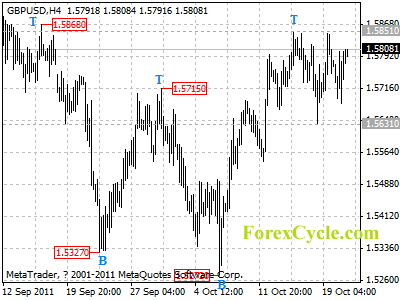
GBPUSD traded in a range between 1.5631 and 1.5851
GBPUSD traded in a range between 1.5631 and 1.5851 for several days. As long as 1.5631 support holds, the price action in the range could be treated as consolidation of uptrend from 1.5272, another rise to 1.6000 is still possible. On the other side, a breakdown below 1.5631 will indicate that lengthier correction of uptrend is underway, then deeper decline could be seen to 1.5500 area.