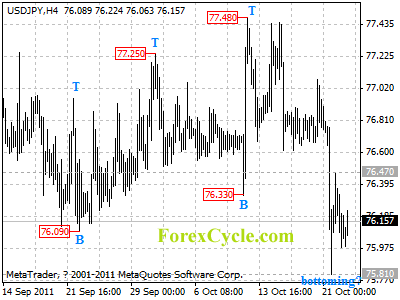
USDJPY bounced from 75.81

After breaking below 75.96 previous low, USDJPY bounced from 75.81. Key resistance is now at 76.47, as long as this level holds, the bounce is treated as consolidation of downtrend from 77.48, another fall towards 70.00 is possible after consolidation. However, a break above 76.47 will indicate that lengthier consolidation of the longer term downtrend from 85.51 (Apr 6 high) is underway, then another rise to test 77.85 resistance could be seen.

usdjpy

Google Bidding For Yahoo! – Is The Interest Real?

Google Bidding For Yahoo!: Is the Interest Real?

by Justin Dove, Investment U Research
Monday, October 24, 2011

Yahoo! (Nasdaq: YHOO) is a hot rumor in mergers and acquisition activity lately. First, there was news that the Chinese e-commerce company Alibaba (OTC: ALBIY.PK) was interested in a takeover.

Then Microsoft (Nasdaq: MSFT) was announced as a potential suitor three years after an unsuccessful attempt to take over the company.

Now the latest rumors tab search-engine giant Google (Nasdaq: GOOG) as a potential buyer. According to the reports, Google has talked to at least two private equity firms about potentially financing a deal.

While there are certainly some valuable parts of Yahoo!’s franchise that may interest Google, it doesn’t seem probable that the interest is genuine.

It sounds like Google is posing as a potential buyer in the hope of driving up the cost of the acquisition for its major rival, Microsoft.

“Fake” Interest As a Tactic

Although it may sound a bit like a conspiracy theory, it’s a tactic used in business all the time.

Baseball fans may remember that this past offseason the New York Yankees used “fake” interest in Carl Crawford to help drive up the bidding price and ultimately force the Boston Red Sox to pay an inflated $142 million for a seven-year contract. New York General Manager Brian Cashman later admitted that the team had no real interest, but wanted to drive up the price tag.

The rivalry between Google and Microsoft is somewhat comparable to that of the Yankees and Red Sox. The two companies battle for talent and have increasingly overlapped each other’s markets.

Just to name a few battlefields for the two companies:

  • Google introduced Google Docs to battle Microsoft Office.
  • Microsoft introduced Bing to challenge Google’s search engine supremacy.
  • Microsoft recently joined forces with its former enemy, Apple (Nasdaq: AAPL), and other companies to launch a patent war against Google’s Android mobile operating platform.
  • Now it appears Microsoft is gaining some steam to compete with Android in the tablet platform space with its Windows 8 product after failing to have much success with its previous endeavor into a mobile operating system.

The Bottom Line

Yahoo! stock is already benefiting from the Google rumors as it’s up close to three percent midday Monday. It’s unlikely Google would take on the antitrust attention and all of the problems Yahoo! is facing.

But Microsoft could see value in Yahoo! as a means to advance Bing in its competition with Google for search engine supremacy. Google may see this as a competitive move against them and be looking to drive up the price to make it harder on Microsoft.

Even though Google probably doesn’t have genuine interest, its potentially “fake” interest could still bring a higher premium in a possible takeover.

Good investing,

Justin Dove

Article by Investment U

Bank of Israel Keeps Interest Rate at 3.00%

The Bank of Israel held its benchmark interest unchanged at 3.00%.  The Bank said: “The decision to leave the interest rate for November unchanged after reducing it for October is in line with monetary policy aimed at stabilizing the rate of inflation within the price stability target range of 1–3 percent over the coming 12 months, and is intended to support growth while preserving financial stability. The path of the interest rate in the future depends on developments in the inflation environment, growth in Israel, the global economy, the monetary policies of major central banks, and developments in the exchange rate of the shekel.”

Previously the Bank cut its monetary policy interest rate, after leaving it unchanged at its June, July, and August meetings, and increasing the interest rate by 25 basis points to 3.25% at its May meeting this year.  Israel recorded annual inflation of 2.9% in September, 3.4% in August and July, 4.2% in June, 4.1% in May, and 4.0% in April and just inside the Bank’s inflation target range of 1-3%.

Israel reported GDP growth of 4.8% (annualised) in the March quarter, and 3.3% in the June quarter.  The Bank said: “GDP growth for 2011 is forecast to be 4.7 percent, and 3.2 percent in 2012”  The Israeli Shekel (ILS) has weakened about 2.5% against the US dollar this year, while the USDILS exchange rate last traded around 3.65

Euro/Dollar Daily Update 24/10/11

EUR/USD Analysis 

The Euro/Dollar currency pair gave a 6 week high earlier today prior to retracing under the 1.3900 level resistance.  The psycho level 1.4000 level is however seen as key in the near term with added confluence as follows:

  • 61.8% Fib ret of 1.4548 > 1.3144 is at 1.4009.
  • 150 EMA (Exponential Moving Average) is aligned with 1.4000.
  • Price structure support lows from the 2011-03 > 2011-09 period are likewise aligned.

A failure to hold the current highs now brings 1.3600 into play as a potential downside target.  This market has bought the eur since earlie in October and there’s no obvious sign of a reversal at present.  The 76.00 dollar index level has also held intra-day and can be monitored if trading the dollar versus any other currency.

Daily Chart

eurusdanalysisoctober24th thumb EURUSD Analysis October 24th

  • RSI 14 is neutral at 55.57
  • Stoch(9,6) neutral at 51.21

Article by forex-fx-4x.com

A Major New Threat to Your Stock Portfolio

A Major New Threat to Your Stock Portfolio

by Alexander Green, Investment U’s Chief Investment Strategist
Monday, October 24, 2011: Issue #1627

A number of readers have asked me to weigh in on the Occupy Wall Street movement and what it means for the financial markets.

Let me begin by saying I sympathize with the anger and frustration of these protesters.

It’s maddening when you can’t find a job, pay your bills, or plan for your retirement. It’s aggravating when your savings pay nothing. And I have no sympathy for the big wire houses. As I wrote in The Gone Fishin’ Portfolio, most Wall Street firms service their retail clients the way Bonnie and Clyde serviced banks.

Yet these demonstrators’ heads are leading them astray. If you want to examine who bears responsibility for the state of the economy, take a look at the facts, starting with the financial crisis of 2007 to 2009. Consider:

  • The Federal Reserve took interest rates too low for too long, making mortgage loans dirt-cheap and priming the real estate bubble.
  • Congress exempted the first $500,000 in capital gains on primary residences held for two years, creating a huge incentive for Americans to flip their homes.
  • In a misguided effort to promote home ownership for everyone, both Republican and Democrat legislators passed laws effectively criminalizing banks that failed to lend to subprime borrowers (and particularly minority subprime borrowers).
  • The federal government sponsored Fannie and Freddie – or (as I prefer) Phony and Fraudie – to warehouse these crummy loans and then put taxpayers on the hook to clean up the mess.
  • The $615-trillion market for credit default swaps accelerated the financial collapse. These should have been traded through central clearinghouses, on exchanges that provide transparency. Who decided against this? Congress in December of 2000 by passing the Commodity Futures Modernization Act and preventing any real oversight of the over-the-counter derivatives markets.
  • And who’s responsible for the regulation of banks, savings and loans, mortgage companies and rating agencies to make sure the mortgage market is fair and transparent? Why the federal government, of course.

The problem wasn’t corporate greed. It was government incompetence.

Sure, there’s plenty of blame to go around. For example, CEOs Jimmy Cayne of Bear Stearns, Dick Fuld of Lehman Brothers and Hank Greenberg of AIG all failed to understand the huge risk their own institutions were taking. Shareholders and employees of these firms suffered mightily as a result. There was plenty of collateral damage, too.

And let’s not forget the enemy in the mirror. After all, mortgage brokers don’t generally hogtie clients and force them to take out home loans at gunpoint. Plenty of Americans got caught up in the hoopla during the housing bubble and figured they could get rich in a hurry by flipping a house. That didn’t work out too well.

If there’s intense demand for home loans, however, the free market will provide them.

Understand that businesses compete for profits the way NFL teams compete for championships. If you attended a game where the referees let the players step out of bounds, spear, face mask, or commit personal fouls without blowing the whistle, all hell would break loose.

That’s what happened in the recent financial crisis. Politicians and bank regulators knew that financial institutions weren’t requiring down payments from borrowers. They knew they weren’t verifying income or assets or borrowers’ ability to repay the loans.

They were supposed to officiate the game. But they didn’t.

As Berkshire Hathaway Vice-Chairman Charlie Munger pointed out, when a lion escapes from the zoo and injures someone, you don’t blame the lion. You blame the lion keeper. Federal regulators had all the tools they needed to protect us – and failed to use them. Now they’re blaming it on investment banks and “millionaires and billionaires.” And the Occupy Wall Street crowd is buying it.

Aside from aiding and abetting the recent the financial crisis, Congressmen in both political parties have grossly mismanaged the nation’s finances, running up trillions in debt and tens of trillions more in unfunded liabilities. (The debt now amounts to more than $1 million per taxpayer.) For a better picture of this fiasco, click here to see the National Debt Clock.

In short, rich people and Wall Street firms aren’t responsible for this state of affairs. Free-spending Congressmen are. Someone should tell the Wall Street occupiers to pick up camp and move over to 1st St and East Capitol, the address of the Capitol Building.

Between protests they might also pick up a book by Adam Smith, Friedrich Hayek, or Milton Friedman. According to Douglas Shoen, a former pollster for Bill Clinton, surveys of the Occupy Wall Street protesters show they overwhelmingly favor “opposition to free market capitalism and support for radical redistribution of wealth, intense regulation of the private sector and protectionist policies to keep American jobs from going overseas.”

This didn’t work in the 1930s. And it won’t work today.

If voters, out of misguided populist anger, elect representatives who endorse these policies… well, at the very least it won’t be good for your stock portfolio.

Next year’s elections may well be the most important of your lifetime. Some Americans believe business is responsible for the country’s economic woes. Others believe it’s government.

I say, “Let’s vote.”

Good investing,

Alexander Green

Article by Investment U
New Zealand Dollar Expecting Volatile Move Monday Night

Source: ForexYard

printprofile

With New Zealand banks on holiday Monday in observance of Labour Day, many are anticipating a volatile jump in the New Zealand dollar’s (NZD) value come reopening later this evening. The New Zealand economy is releasing a highly important data release on consumer inflation (CPI).

As this report comes on the coattails of a bank holiday, it is expected to generate a wider swing than usual as bank liquidity comes back online simultaneously with an impactful report. The Kiwi has been consolidating lately and this evening’s data release could be what’s needed to shake it loose and send it reeling. Traders interested in trying to capture this volatility for profit would do well to watch this evening’s report.

Read more forex trading news on our forex blog.

Forex Market Analysis provided by ForexYard.

© 2006 by FxYard Ltd

Disclaimer: Trading Foreign Exchange carries a high level of risk and may not be suitable for all investors. There is a possibility that you could sustain a loss of all of your investment and therefore you should not invest money that you cannot afford to lose. You should be aware of all the risks associated with Foreign Exchange trading.

Decline in German Manufacturing Disconcerting

Source: ForexYard

printprofile

Flash reports on the euro zone regional economy have shown manufacturing to be in decline. France did report a positive bump in manufacturing, but Germany and the broader region are indicating a decline. The reports on Germany are perhaps the most disconcerting of the data considering its recent importance in stabilizing the region.

Germany reported a downtick in their flash manufacturing figure from last month’s 50.3 to this month’s 48.9. The indicator has begun to weigh somewhat on the value of the euro (EUR) as investors adjust their appetite for risk in a region which appears to be slowing on the manufacturing and industrial fronts.

Read more forex trading news on our forex blog.

Forex Market Analysis provided by ForexYard.

© 2006 by FxYard Ltd

Disclaimer: Trading Foreign Exchange carries a high level of risk and may not be suitable for all investors. There is a possibility that you could sustain a loss of all of your investment and therefore you should not invest money that you cannot afford to lose. You should be aware of all the risks associated with Foreign Exchange trading.

Inflationary Growth Slowing in Australia

Source: ForexYard

printprofile

The quarterly report on the Australian producer price index (PPI) revealed a slow-down in growth from an expected 0.8% to a reading of 0.6%. The indicator suggests that price increases related to increased demand for produced goods has diminished somewhat as the Australian economy turns mildly sluggish.

This report has so far dragged the Australian dollar (AUD) down mildly this morning, but speculators are turning their attention to the risk appetite of European nations this afternoon following the manufacturing and service reports out of the euro zone.

Read more forex trading news on our forex blog.

Forex Market Analysis provided by ForexYard.

© 2006 by FxYard Ltd

Disclaimer: Trading Foreign Exchange carries a high level of risk and may not be suitable for all investors. There is a possibility that you could sustain a loss of all of your investment and therefore you should not invest money that you cannot afford to lose. You should be aware of all the risks associated with Foreign Exchange trading.