Positioning for the ECB Press Conference/EU Economic Summit

Source: ForexYard

The most recent CFCT IMM data shows EUR non-commercial traders have their largest short position built in the futures market since June of last year. The one sided positioning could create a short squeeze if European leaders begin to instill a bit of investor confidence towards the end of the week.

Economic News

EUR – Positioning for the ECB Press Conference/Economic Summit

The EUR is shrugging off the recent negative headlines as investors begin to position themselves prior to the ECB policy meeting on Thursday and the 2-day EU economic summit. Market expectations are for at least a 25 bp interest rate cut and some are calling for a 50 bp reduction in ECB interest rate. The rate decision will come 45 minutes before the main event which is the ECB press conference. Investors will be looking for signs the ECB has softened its stance and want Draghi to hint that the ECB will take out its “bazooka” to support the financially struggling nations with additional bond purchase.

Last week Draghi suggested if there was a commitment by political leaders to stricter budget discipline that other elements might follow, “But the sequencing matters.” Given his prior statements the ECB may wait and see what comes from the 2-day EU summit before committing itself to a more aggressive policy of supporting the likes of Italy and Spain.

Market participants may be positioning themselves for a positive outcome from the EU summit. The most recent CFCT IMM data shows EUR non-commercial traders have their largest short position built in the futures market since June of last year. The one sided positioning could create a short squeeze if European leaders begin to instill a bit of investor confidence towards the end of the week. EUR/USD resistance is found at Monday’s high of 1.3490 and at Friday’s high of 1.3550. Support looks to be at the November 30th low of 1.3260 followed by the October low of 1.3145.

CHF – Swiss CPI Shows Deflation

Switzerland released CPI numbers yesterday and the data is worrisome. Consumer prices declined by -0.2% m/m and the yearly rate of inflation now stands at-0.5%. With deflation creeping into the Swiss economy there are increased discussions of a pending move by the SNB to raise the floor of the EUR/CHF to 1.25 or 1.30 from 1.20. So far the SNB has been successful as investors have been the ones to push the EUR/CHF closer to 1.25 after the SNB said they would not tolerate a rate below 1.20. The SNB has done with without intervention in the FX spot market. Thus we may not expect any additional action to weaken the CHF on the part of the SNB until the market attempts to push the exchange rate under the SNB’s line in the sand. The EUR/CHF has support at its 200-day moving average of 1.2220 and resistance at 1.2500.

AUD – RBA to go 3 for 3 on Interest Rate Cuts

As expected the Reserve Bank of Australia cut interest rates by 25 bp yesterday. This is the second consecutive reduction in the interest rate. The bank will next meet in February and there is the chance the RBA will go 3 for 3. Currently Australian interest rates stand at 4.25% and are still far above the rest of the major global economies, making the AUD an attractive currency. Traders should be concerned over slowing growth in China which is Australia’s largest trading partner. The most recent HSBC services PMI dropped to 52.5 in November from 54.1. This is the slowest rate of growth for the survey over the past 3-months. The manufacturing PMI came in at 49, below the 50 boom/bust level and the lowest November 2008. However, with last week’s cut in the Chinese reserve requirement it appears that Chinese officials are ahead of the policy curve and recognize the potential for lower economic growth. The AUD/USD maintains resistance at 1.0350 from the November 14th high where the 100-day moving average comes in.

Gold – Gold Uptrend Fails to Break Resistance

Spot gold prices failed to move above a significant short-term resistance level and have followed through with a move lower. The initial cause of the price decline can be linked to USD strength as the USD continues to move higher versus the G10 currencies. The price of spot gold topped out at $1,761 where the falling trend line off of the September and November highs comes in before the price moved lower to the initial support of $1,700. Additional support is located at the pivot from November 21 at $1,666.

Technical News

EUR/USD

The weekly chart shows the pair is trading in a symmetrical triangle pattern with the resistance line falling from the May high and support line rising from the yearly low. The first support from this chart pattern comes in this week at 1.3200. A break here will likely open the door to not only the October low of 1.3145 but also1.3050 from the 61.8% Fibonacci retracement of the bullish move spanning 2010 to 2011. The January low of 1.2875 could contain the near-term price action. To the upside the November 18th high of 1.3610 is the initial resistance followed by the mid-November consolidation at 1.3860 where the 100-day moving average also lies. The top of the triangle pattern would likely contain any move higher near 1.4230-1.2350.

GBP/USD

Last week cable found resistance at 1.5780, a level that has proven to be resistive in the past. Additional resistance is found at the October high of 1.6165. Monthly and weekly stochastics continue to move lower and as such the November low of 1.5435 is the initial support followed by the October low of 1.5270. The last bastion of support for the GBP/USD is found off of the rising trend line from the 2009 and 2010 lows which comes in at 1.0590.

USD/JPY

The USD/JPY is encroaching on its long term trend line off of the 2007 high and comes in at 78.70. A break above this level is needed to confirm the recent price appreciation. Both weekly and monthly stochastics are moving higher so traders may look for additional resistance at 79.50 from the post intervention high. The 200-day moving average is also lurking just below this price. Should the pair fail at the long-term trend line the congestion between 77.50-77.60 may prove to be supportive while the all-time low near 75.60 stands out as the last support.

USD/CHF

As weekly stochasttics have already turned lower the monthly stochastics are beginning to roll over. This is occurring after the pair looks to have failed to break above the 0.9330 resistance level. As such the pair has support at last week’s low of 0.9065 followed by the November low of 0.8760 and the October low of 0.8565. A break above the 0.9330 resistance could spur gains towards this year’s high of 0.9780.

The Wild Card

Gold

Spot gold prices have ran into resistance at the trend line from the September and November high which comes in at $1,754. Additional resistance is found at the November high of $1,708. Forex traders should note that if the trend line holds spot gold has support at $1,700 from the November 30th low followed by the November 21st pivot of $1,666.

Forex Market Analysis provided by ForexYard.

© 2006 by FxYard Ltd

Disclaimer: Trading Foreign Exchange carries a high level of risk and may not be suitable for all investors. There is a possibility that you could sustain a loss of all of your investment and therefore you should not invest money that you cannot afford to lose. You should be aware of all the risks associated with Foreign Exchange trading.

Gold Daily outlook – 07 December

The gold market has experienced much flatter trading since the start of November compared to what we’ve been accustomed too for a very long time. In recent weeks we’ve seen the market hovering around the 1700.00 area with little direction.

Tuesdays trading saw gold once again using 1700 as an area of support. In early trading the market was drawn towards the level; however later in the day we saw a rejection resulting in a bullish daily pin bar.

golddailyoutlook07dec

The pin bar is very similar to the one seen on the 1st November which also rejected the 1700 area.

Our identified level of support is further strengthened by a 61.8% Fibonacci retracement. A look at the chart below clearly shows the market rejecting both the 1700 area and the 61.8 Fib level. Its important to take note of how yesterdays price bounced almost perfectly off the 61.8.

golddailyoutlook07decfibs

With the strong support levels we’re seeing in the gold market and the bullish price action chart patterns, we will be looking to buy into this market; either when we break the highs of the pin or at a 50 – 61.8 retracement of the pin. Initial targets will be at the most recent swing high (1762) with the possibility of further gains, possibly up to 1800.

Article by  vantage-fx.com

USD Up Following German Rejection of Double Bailout Plan

Source: ForexYard

printprofile

The EUR has been unable to hold onto its gains following yesterday’s Financial Times story indicating EU negotiations are taking place to keep the existing European bailout when the new fund takes effect in mid-2012. The drop in the value of the EUR/USD comes after a German response threw cold water on the possibility of the ESM and EFSF running simultaneously

With both the ECB meeting and the EU economic summit only a day away the rumor mill is running at full speed. Yesterday evening the FT reported the EU is debating the possibility of keeping the current European bailout plan when the new ESM mechanism is expected to take over and this sparked an EUR rally into the NY close. This morning the story was denied by German officials and the EUR gave up those gains.

The EUR/USD rose as high as 1.3450 before running into resistance at the 20-day moving average, a level the pair has failed to move above for the past week and a half. Support is seen back at the rising support line from the November low at 1.3350. Additional support may be found at 1.3260 from the November 30th low.

Read more forex trading news on our forex blog.

Forex Market Analysis provided by ForexYard.

© 2006 by FxYard Ltd

Disclaimer: Trading Foreign Exchange carries a high level of risk and may not be suitable for all investors. There is a possibility that you could sustain a loss of all of your investment and therefore you should not invest money that you cannot afford to lose. You should be aware of all the risks associated with Foreign Exchange trading.

Morriss Sees `Very Positive’ Australian Growth Outlook

Dec. 7 (Bloomberg) — Tony Morriss, head of interest-rate research in Sydney at Australia & New Zealand Banking Group Ltd., talks about Australia’s economy and central bank monetary policy. Australia’s economy expanded more than economists forecast last quarter, driven by consumer spending and mining. Morriss speaks with Susan Li on Bloomberg Television’s “First Up.” (Source: Bloomberg)

Investing in the Market for Survival and Prosperity

By MoneyMorning.com.au

Even though Blind Freddy can’t read Money Morning, he knows the world economy is dripping in rotting debt. He can smell the pungent stench pouring off the US and Europe’s balance sheets. He can hear the whirr, click, buzz, zap of the central bank printing presses…

And he can feel the hot rush of freshly minted bank notes flying around the world.

This market is over-regulated. And manipulated to the point where there is no way you can know for sure whether your shares will jump, dive or drift next.

Just take a look at the Aussie market over the past 90 days…

ASX200 – up 4.46% in 90 days… But WHAT A RIDE!

ASX200 - up 4.46% in 90 days... But WHAT A RIDE!
Click here to enlarge

Source: Google Finance

Couple that with these recent headlines…

‘S&P warns European nations of downgrades’ – news.com.au

‘Top China officials sound alarm on growth’ – perthnow.com.au

‘Jim Rogers: US Falling Into “Deeper Trouble,” Faces 2013 Depression’ – NewsMax.com

And you can see why legendary investor Jim Rogers says:

‘The power is shifting… to the producers of real goods. The place [for you] to be is in commodities, raw materials, natural resources.’

Diggers & Drillers Dr Alex Cowie has never put it in those words. But his current investment focus is on what you could call survival assets.

A sneak peak at his new report (due out Thursday) reveals the assets he believes look bullish for the next year…

  1. Precious metals
  2. Energy
  3. Certain base metals
  4. Agricultural commodities

If you add in tinned peaches and shotgun shells and you’ve got the ultimate investors survival kit.

Energy… Precious metals… Base metals… Agriculture…

These are staple commodities with fixed (and growing) demand. They’re the type of commodities Warren Buffett might say have a moat built around them.

Just take a look at how strong they look right now. That’s no mean feat in this market.

Asia-Pacific Agriculture Index

Source: Bloomberg.com

Commodity Metals Price Index
Click here to enlarge

Source: IndexMundi

And 86-year-old Richard Russell, the granddad of investment gurus, says there’s only one business to back right now if you want to prosper in this market… The survival business.

That’s why, like Alex, it might pay you to shift your focus to survival assets.

The kind of assets you can invest in to protect your wealth from inflation… or a world-wide financial crisis that could lead to the greater depression…

The kind of assets that will boom even when businesses are failing, stock prices are plunging and loaves of bread cost $238…

What are they?

Where do you find them?

And can you really invest in them and profit even in the face of a total market collapse?

Watch out for Alex’s report later this week where he’ll answer some of those questions for you. And introduce you to the most profitable investment class of 2012.

Aaron Tyrrell
Editor, Money Morning

Related Articles

Why the Fed’s Actions Make Perfect Sense

Too Big to Bail

Swiss National Bank Intervenes…

Bailouts Still Boosting the Market

Was This Just Another Rigged Market?

From the Archives…

How to Profit from the Inevitable Return to Sound Money
2011-12-02 – Kris Sayce

Two Reasons the Market Should Have Fallen…
2011-12-01 – Shae Smith

Ditch Your Investor Pride to Avoid an Investing Fall
2011-11-30 – Kris Sayce

How to Play a Volatile Market for Profit
2011-11-29 – Kris Sayce

No Thanks to Central Banks
2011-11-28 – Kris Sayce

For editorial enquiries and feedback, email [email protected]


Investing in the Market for Survival and Prosperity

Would You Like Your Super Profits to Go?

By MoneyMorning.com.au

McProfit Burgers and Nuggets…

Before we go on, don’t forget to check out Slipstream Trader, Murray Dawes’ latest free stock market update video on YouTube.

The cult of the social engineers continues.

“May those with super profits be hit by super taxes.”

Today, Ross Gittins writes in the Age:

“I think our companies’ present ruthless pursuit of profit at any cost is an excess that can’t last.”

Sounds like something straight out of Kremlin central casting… circa 1974.


And yesterday we read in the Age:

“A working group set up by the Treasurer, Wayne Swan, is planning a shake-up that would see most companies pay no corporate tax and a smaller number pay a much higher rate of ‘super tax’ on profits clearly above the odds.”

Our first query is, please define “clearly above the odds.”

Is 11% above the odds?

Or is it 32%? If it’s 32%, then why not 31%? If it’s 31%, then why not 30%?

The Age report continued:

“A working group member, John Freebairn from Melbourne University, told the conference the super tax rate could be as high as 40 or 50 per cent. He nominated McDonald’s and KFC as examples of companies able to make larger than normal profits because of the power of their brands.”

Mr. Freebairn asked, “How are they going to get those profits from Australians without doing it in Australia?”

Yet again, bureaucrats and academics are playing with things they don’t understand – private enterprise.

McProfit Burgers


So, we looked at McDonald’s [NYSE: MCD] income statement. It turns out Macca’s made a net profit last year of USD$4.9 billion. Or, USD$4.58 per share on a USD$96.01 share price.

Put another way, if you bought every share of McDonald’s today, and profits remained steady, it would take 20 years for you to get your money back. We’re not sure that counts as “excessive”.

But anyway, Macca’s profit margin is around 20%, based on USD$24 billion of sales.

That must be “excessive”, because according to Mr. Freebairn, that’s a super profit.

On the other hand, Aussie retailer, Myer Holdings Limited [ASX: MYR] made a profit last year of $159.7 million, or 27.8 cents per share on a $2.58 share price.

Myer’s profit margin is 5.7%.

Is that a super profit?

It must be. Remember how a “super profit” was determined under the dead Resource Super Profits Tax? That’s right, it was everything above the risk-free government bond rate!

Right now, the 10-year Aussie government bond yields 3.97%. So if the government uses the same definition of a super profit, any firm earning a profit margin above this level would be stung with a super profit tax.

This by our estimate pretty much covers most profitable companies.

But whatever the outcome… and whatever the method the bureaucrats use to measure super profits, you can guarantee it will completely ignore the fundamentals of why businesses exist – to make a profit.

Private Sector Pays for Public Services, Not the Government

The fact is, it’s this search for profit that creates prosperity… employs millions of Australians… and which – through taxation – pays for the so-called public services so many adore. But remember, without private sector profits there wouldn’t be public education, health and roads.

It’s not the government that provides those services, it’s the private sector. That’s why we believe in cutting out the middle man (government) and allowing individuals to deal directly with private companies for “public” services. (But that’s an argument for another day…)

The problem is that bureaucrats and academics don’t understand markets. They don’t like the randomness of ideas and the lack of formalised structure that makes free markets so wonderful.

Bureaucrats and academics don’t understand that in a free market things just happen. Consumers have a demand for things so they buy them… in other instances, businesses believe a demand will exist for something once they’ve created it.

For example, there wasn’t a demand for tablet computers until Apple and other technology companies created the product. They did some market research to find out if consumers would buy it… but there was no guarantee it would be a success.

That’s capitalism. And entrepreneurialism.

And it’s something bureaucrats and academics hate.

Free Ideas Not Committees


Simply because you can’t calculate ideas in a spreadsheet… you can’t have a meeting of bureaucrats and academics and other knuckleheads, and get them to come up with ideas in a committee. That’s not how it works.

We’re sure you remember the Fairy Ruddfather’s Australia 2020 Summit. You can check out the website here. Even the government has forgotten about it because no-one has bothered to make a note of the change of prime minister:

We won’t bother printing any of the final report here, because it’s irrelevant. We’ll simply make this point: while bureaucrats and academics talk about innovation, that’s all they can do… those with an innovative brain (entrepreneurs) just get on and do it.

In a recent weekly update for Australian Small-Cap Investigator we wrote that government projects will always be a dud because they try to ensure the project won’t fail… which inevitably leads to it failing.
By contrast, entrepreneurs know there’s a chance they’ll fail. But because they believe they’ll succeed they go for it anyway. The reward outweighs the risk.

A quote we think pretty much sums this up is from an old Nike commercial by basketball star, Michael Jordan in the 1990s:

“I missed more than 9,000 shots in my career. I’ve lost almost 300 games. 26 times I’ve been trusted to take the game-winning shot… and missed. I’ve failed over and over and over again in my life. And that is why… I succeed.”

The Nike slogan of course, is Just Do It.

Bottom line: you can’t win unless you’re prepared to fail.

It’s the secret to a prosperous economy. And it’s the secret to wealth for all. The social engineers may think they can create prosperity by stealing money from one group of people and giving it to another, but it won’t work.

As we’ve pointed out many times before, socialism leads to poverty, oppression and stagnation… while capitalism leads to wealth, freedom and innovation.

Cheers.
Kris

PS. My old pal, Diggers & Drillers editor Dr. Alex Cowie has been working on a special report and presentation. He outlines his ideas for helping investors survive and prosper over the next 10 years. It’s a report you won’t want to miss. Aaron will give you a peek inside his article, but make sure you look out for details in your email inbox later this week…

Related Articles

Why the Fed’s Actions Make Perfect Sense

Too Big to Bail

Swiss National Bank Intervenes…

Bailouts Still Boosting the Market

Was This Just Another Rigged Market?

From the Archives…

How to Profit from the Inevitable Return to Sound Money
2011-12-02 – Kris Sayce

Two Reasons the Market Should Have Fallen…
2011-12-01 – Shae Smith

Ditch Your Investor Pride to Avoid an Investing Fall
2011-11-30 – Kris Sayce

How to Play a Volatile Market for Profit
2011-11-29 – Kris Sayce

No Thanks to Central Banks
2011-11-28 – Kris Sayce

For editorial enquiries and feedback, email [email protected]


Would You Like Your Super Profits to Go?

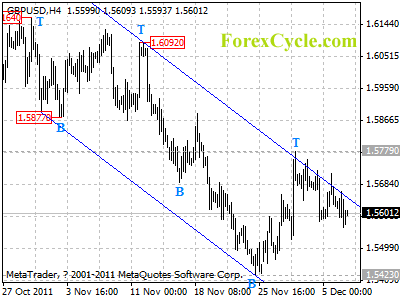
GBPUSD’s fall from 1.5779 extended to 1.5561

GBPUSD’s fall from 1.5779 extended to as low as 1.5561. Further decline is still possible later today, and next target would be at 1.5500 area. Key resistance is now at 1.5779, a break above this level will indicate that the downtrend from 1.6164 had completed at 1.5423 already, then the following upward move could bring price back to 1.6500 zone.

gbpusd

Daily Forex Analysis