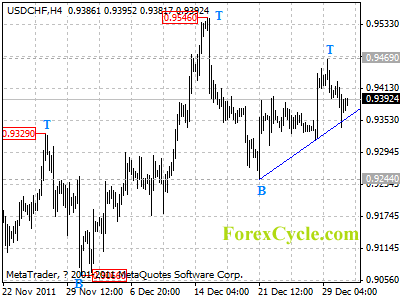
USDCHF stays above a upward trend line

USDCHF stays above a upward trend line on 4-hour chart, and remains in uptrend from 0.9244, the fall from 0.9469 would possibly be consolidation of uptrend. Another rise to test 0.9546 is expected, a break above this level could signal resumption of the longer term uptrend from 0.8569 (Oct 27 low). Support remains at the uptrend line, only a clear break below the trend line could indicate that lengthier consolidation of uptrend is underway, then the pair will find support around 0.8850.

usdchf

Daily Forex Analysis

Chinese Leaders Comment on 2012 Monetary Policy

Top Chinese officials have recently made public comments on the direction of monetary policy in China for 2012.  China’s President, Hu Jintao, said in his New Year speech: “We will continue to properly deal with the relationship among maintaining a stable and relatively fast economic growth, adjusting economic structure and managing inflation expectations.”  Meanwhile, People’s Bank of China Governor, Zhou Xiaochuan said the PBOC “will continue the prudent monetary policy and maintain the continuity and stability of its policies.”

The People’s Bank of China raised interest rates a total 75 basis points last year, and the required reserve ratio (RRR) by 300 basis points in the first half of the year, with one 50 basis point reduction in the RRR in December.  At the PBOC’s fourth quarterly monetary policy committee meeting, the committee emphasized recent domestic and international economic developments and their impact on continued implementation of prudent monetary policy, and the use of counter-cyclical monetary policy and macro-prudential tools.

Also, in acknowledgement to signs of stress in the domestic economy, such as social finance, local government debt, and falling house prices, Zhou Xiaochuan said: “Systematic financial risks will be effectively prevented to promote the healthy and fast development of the national economy,”.  The PBOC governor also noted “while keeping a reasonable social financing growth, the bank will also optimize the lending structure, deepen financial reforms and improve foreign exchange management.”
On the numbers, China has seen annual CPI inflation fall from a high of 6.5% in July 2011, to as low as 4.2% in November.  Meanwhile GDP growth slowed to 9.1% in the September quarter, from 9.7% in the March quarter; most commentators expect the Chinese economy to grow about 8% in 2012.  The Chinese Yuan (CNY) has appreciated by about 4.5% in 2011 against the US dollar, with the USDCNY exchange rate now trading around 6.30.

Exar Corporation Lowers Q3 Outlook

Exar Corporation (EXAR) said late yesterday it was cutting its outlook for the fiscal third quarter. Weaker economic conditions in Asia and Europe and continued inventory corrections are to blame for a lower revenue outlook across all product lines, the company said.

Gold Bubble Seen by Soros on Brink of Bear Market

Dec. 29 (Bloomberg) — Gold is poised to complete its 11th consecutive annual gain, the longest winning streak in at least nine decades, on the brink of a bear market. George Soros, the billionaire who two years ago called it the “ultimate asset bubble,” cut 99 percent of his holdings in the first quarter, Securities and Exchange Commission data show. Betty Liu reports on Bloomberg Television’s “In the Loop.” (Source: Bloomberg)

Jobless Claims Drop to Three-Year Low in Past Month

Dec. 29 (Bloomberg) — Fewer Americans filed applications for unemployment benefits over the past month than at any time in the past three years, a sign the U.S. labor market is on the mend heading into the new year. The four-week moving average for claims, a less volatile measure than the weekly figures, dropped to 375,000 last week, the lowest level since June 2008, Labor Department figures showed today in Washington. Betty Liu and Sara Eisen report on Bloomberg Television’s “In the Loop.” (Source: Bloomberg)

Sizemore on Buying Inflation-Protected Bonds in 2012

By The Sizemore Letter

Charles Sizemore gave his thoughts on inflation-adjusted savings bonds to Reuters’ Lou Carlozo:

As the times and technology advance, once-essential parts of our lives turn into pop cultural relics, from transistor radios to cell phones the girth of six-inch subs.

Now add the once ubiquitous paper U.S. savings bond, which will no longer be sold as of Sunday, January 1. That’s enough for some folks to make a pre-New Year’s Eve dash to the bank or credit union.

Some people may be racing for traditional Series EE bonds, so they can show their grandchildren what they look like. But for more people, it’s a chance to amass some high-yield inflation-proof Series I Savings bonds.

Here’s why: While you can buy $10,000 in I bonds today – $5,000 each in paper and electronic form — you can only buy half that much come New Year’s Day, when paper bonds go the way of the dodo. (Electronic bonds will remain available through TreasuryDirect.gov.)

True, paper bonds have a rich history that ties in to American patriotism and gift giving in families.

“The savings bond is an old product that’s been around forever, that grandparents bought for their grandkids to put in college funds — so it makes a big splash when you discontinue an investment option people are used to,” says Charles L. Sizemore, principal of Sizemore Capital Management in Dallas, Texas and author of the Sizemore Investment Letter.

Though new purchase limits take effect next week, “there are different ways to skin this cat,” Sizemore says. “If you want inflation protection, the I bond is a great investment. But there’s also the TIPS bond fund, which allows you to reach the same objective — inflation-adjusted bond returns.”

Like I bonds, TIPS pay a predetermined yield while adjusting the value of the bond’s principal to preserve purchasing power.

You can buy them through TreasuryDirect.gov or through a broker, and they essentially work much like I bonds. There are also several mutual funds that focus on TIPS.

To read full article, see Limited-time offer: Hurry for savings bond deals, certificates

Sozzi Sees Some Retailer Dividends, Buybacks

Dec. 29 (Bloomberg) — Brian Sozzi, an independent retail analyst, talks about investment strategy for the retailing industry. He speaks with Scarlet Fu and Sara Eisen on Bloomberg Television’s “InsideTrack.” (Source: Bloomberg)

Solar Breakthrough: Cheap Quantum Dot Solar Paint

Researchers have reduced the preparation time of quantum dot solar cells to less than an hour by changing the form to a one-coat quantum dot solar paint.

How?

Titanium dioxide (TiO2) nanoparticles are coated with cadmium sulfide (CdS) or cadmium selenide (CdSe.) The composite nanoparticles, when mixed with a solvent, form a paste that can be applied as one-step paint to a transparent conducting material, which creates electricity when exposed to light.

Although the paint form is currently about five times less efficient than the highest recorded efficiency for the multifilm form, the researchers predict that its efficiency can be improved, which could lead to a simple and economically viable way to prepare solar cells.

The scientists responsible for the research breakthrough, Mathew P. Genovese of the University of Waterloo in Canada, with Ian V. Lightcap and Prashant V. Kamat of the Radiation Laboratory and Department of Chemistry and Biochemistry at the University of Notre Dame in Indiana, will be publishing their study in an upcoming issue of the American Chemical Society’s publication Nano.

During an interview with PhysOrg.com Professor Kamat, John A. Zahm Professor of Science in Chemistry and Biochemistry and an investigator in Notre Dame’s Center for Nano Science and Technology (NDnano) and who led the research, explained, “Quantum dots are semiconductor nanocrystals which exhibit size-dependent optical and electronic properties. In a quantum dot sensitized solar cell, the excitation of semiconductor quantum dot or semiconductor nanocrystal is followed by electron injection into TiO2 nanoparticles. These electrons are then transferred to the collecting electrode surface to generate photocurrent.

The holes that remain in the semiconductor quantum dot are removed by a hole conductor or redox couple and are transported to a counter electrode. If we can optimize the paint preparation, it should be possible for anyone to open a bottle (or a can in the long run) and apply it to a conducting surface. This will decrease the variability between lab to lab or person to person as one encounters in a multi-step process. Having fewer fabrication steps and ambient preparative conditions should provide an economically viable transformative technology.”

During their research the scientists tested a number of different compounds, but found that a composite of mixed CdS/TiO2 and CdSe/TiO2 nanoparticles performed best, particularly when the CdS and CdSe was deposited directly on the TiO2 nanoparticles as a coating.

Describing their work they said that the nanoparticles were suspended in a water-alcohol mixture to create the binder-free paste, which was then applied to conducting glass surface and annealed at 200 degrees Centigrade. When coated on a glass electrode, the paint has an overall power conversion efficiency exceeding 1 percent. Although some multifilm quantum dot solar cells have efficiencies greater than 5 percent, the scientists believe that using different quantum dots and further optimization could significantly increase the efficiency of the paint.

Potential uses could include painting electronic devices such as cell phones to recharge their batteries, along with larger electrical devices such as computers, while rooftops, windows, and cars could be coated as well.

The scientists’ work has attracted some major governmental interest and the Department of Energy’s Office of Basic Energy Sciences is funding their research.

Professor Kamat concluded in a Notre Dame press release, “We want to do something transformative, to move beyond current silicon-based solar technology. The best light-to-energy conversion efficiency we’ve reached so far is one percent, which is well behind the usual 10 to 15 percent efficiency of commercial silicon solar cells. But this paint can be made cheaply and in large quantities. If we can improve the efficiency somewhat, we may be able to make a real difference in meeting energy needs in the future. That’s why we’ve christened the new paint, Sun-Believable.”

Source: http://oilprice.com/Alternative-Energy/Solar-Energy/Solar-Breakthrough-Cheap-Quantum-Dot-Solar-Paint.html

By. John C.K. Daly of Oilprice.com


Humana: A Defensive Play With Large Growth Potential

Humana: A Defensive Play With Large Growth Potential

by Jason Jenkins, Investment U Research
Thursday, December 29, 2011

If you thought the United States government was dysfunctional and inept in 2011… “you ain’t seen nothin’ yet.”

Let’s see, we saw one rating agency strip the United States of its AAA credit rating and the mind-blowing ineffectiveness of the deficit-cutting Supercommittee.

Now it’s 2012. Republicans and Democrats head into a presidential election year with hardened tax-and-spending battle lines that reek of class warfare. The trenches have been dug and as with any war of attrition, expect little progress from either side.

Most market analysts don’t expect either party to deviate from the script they’ve been reading from for much of next year. So, in conjunction with the European sovereign debt crisis, geo-political instability in the United States and the European Union will likely keep markets volatile.

Defense! Defense!

Defensive plays in this market are the “inside-the-box” strategies that are likely to provide sufficient cushion in the current period of extreme skepticism. The traditional defensive market sectors that are particularly attractive include consumer staples, utilities and health care stocks.

Given the approach, The Street ranks Humana (NYSE: HUM) as its sixth best stock of 2011 and one of its top nine defensive plays for 2012.

The Numbers…

Humana offers an array of health, pharmacy and supplemental benefit products through its medical centers and worksite medical facilities. The services offer target employer groups, government benefit programs, individuals, as well as primary and workplace care.

Net income for the third quarter of this year was reported at $444.8 million, or $2.67 per diluted share, compared to $393.2 million, or $2.32 per diluted share, in the year-ago quarter. Total revenue increased 11.4 percent year-over-year to $9.3 billion. For 3Q, revenue from premiums and services soared 13 percent, led by a 10-percent increase in average Medicare Advantage membership.

Humana is one of the largest providers of Medicare Advantage plans, privately run versions of the government’s Medicare program. Medicare accounts for 64 percent of Humana’s revenue.

Health insurers entered this year uncertain about the impact of a new healthcare overhaul rule governing medical-loss ratios, which essentially measure the percentage of premiums insurers spend on care. The impact of that rule on the business has turned out to be minimal, and insurers face no such uncertainties heading into next year.

Humana has a current dividend yield of 0.6 percent and a net income Compound Annual Growth Rate (CAGR) of 29.9 percent, based on Bloomberg data. In the past three months, the company accumulated 15.5 percent as compared to the S&P 500′s 6.4-percent gain. The company has announced a dividend of $0.25 payable January 31, 2012 to shareholders of record December 30, 2011.

2012 and Beyond

Of the 22 analysts covering the stock, 68 percent recommend it as a “Buy” and the rest rate it a “Hold.” There are no sell ratings on the stock. On average, analysts estimate 12.6 percent upside to $97.57 in value from current levels.

Humana has stated that it expects 2012 earnings of $7.40 to $7.60 a share. Many analysts expected an initial forecast from the company of $7 a share or less, a Citigroup analyst, Carl McDonald, said in a research note.

Health insurers have been helped the last several quarters by medical costs that have grown more slowly than expected. If that trend continues, the analyst said Humana earnings could top $9 a share next year.

A defensive stock with great growth potential looks like a great play in this these times.

Good Investing,

Jason Jenkins

Article by Investment U