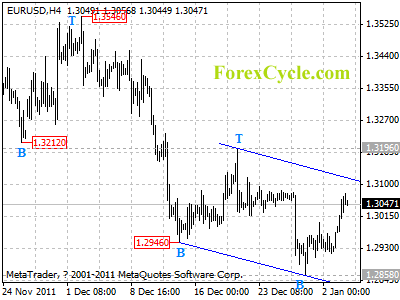
EURUSD’s bounce extended to 1.3076

EURUSD’s bounce from 1.2858 extended to as high as 1.3076. Further rise is still possible later today, and the target would be at the upper line of the price channel on 4-hour chart. Key resistance is at 1.3196, as long as this level holds, the price action from 1.2946 is treated as consolidation of downtrend from 1.4246 (Oct 27, 2011 high). Downtrend could be expected to resume after consolidation, and another fall towards 1.2500 is still possible. On the upside, a break above 1.3196 will suggest that the fall from 1.4246 has completed at 1.2858 already, then further rally could be seen to 1.3900 area.

eurusd

Forex Signals

The Eurozone Debt Dance Continues

When it comes to Greece and the Eurozone, it is difficult sometimes to tell just who is playing whom. The latest example of the delicate dance within the Eurozone was on display today following the release of a carefully-worded communiqué issued by a Greek government spokesperson. In this memo, the government announced that should Greece not receive the latest bailout pledge as negotiated late last year, it may have no other choice but to exit the Eurozone.

Obviously, this message had more than a hint of a threat about it. However, the intended audience for the message was not the Eurozone lawmakers – it was meant for the people of Greece themselves.

As part of the emergency funding agreement, Greece is required to implement massive spending cuts and new taxes to close the deficit gap in exchange for emergency funding. As can be imagined, these measures are not being welcomed with open arms by a population accustomed to easily-accessed public pensions and other government-funded largesse.

Germany too is dealing with its own PR nightmare. As the de facto “leader” of the Eurozone thanks to its leading economy, Germany is also a principal contributor to the massive bail-out packages. Naturally, there is a growing resentment amongst German taxpayers who feel they are being forced to pay the bills of sovereign countries that financed their lifestyle thanks to the generosity of others. Reinforcing the thought that German politicians are ready to play “hard ball” with Greece sends a subtle message to the German taxpayer cum voter, that their interests are being protected.

Meanwhile, the Greek government continues to face a rebellious population locked in what it feels to be a life and death struggle to maintain spending on social programs. Today, it was the turn of the nation’s doctors and pharmacists to go on strike and demonstrate against planned spending cuts.

In light of this opposition, the government maintains that failing to meet the conditions attached to the rescue plan is, in reality, a vote to secede from the Eurozone. This is clearly an attempt to convince the public to accept the conditions and vote in favor of the government’s planned spending cuts.

While there is certainly a battle going on to save the Eurozone, the real fight is the one to influence public perception.

Scott Boyd is a currency analyst and a regular contributor to the OANDA MarketPulse FX blog.


World’s Biggest Economies Face $7.6 Trillion Bond Tab

Jan. 3 (Bloomberg) — Governments of the world’s leading economies have more than $7.6 trillion of debt maturing this year, with most facing a rise in borrowing costs. The amount needing to be refinanced increases to more than $8 trillion when interest payments are included. Linda Yueh reports on Bloomberg Television’s “First Look” with Caroline Hyde. (Source: Bloomberg)

Bank of Uganda Holds Monetary Policy Rate at 23.00%

The Bank of Uganda held its new monetary policy interest rate (the central bank rate [CBR]) unchanged at 23.00%.  The Bank also reduced by 100 basis points the rediscount rate to 27.00% and the Bank Rate to 28.00%.  Bank of Uganda Governor, Emmanuel Tumusiime-Mutebile, said: “I acknowledge the fact that the long-term solution to controlling inflation rests on addressing the structural constraints and improving productivity, but controlling inflation in the short to medium term is extremely crucial in stimulating this long-term economic growth.”

Previously the Ugandan central bank increased its interest rate by 300 basis points in November, and 400bps to 20% in October, after hiking 200bps in September, and 100bps at its August meeting, and previously setting the new central bank rate at 13.00% at its June meeting.  The Bank only recently began using the 7-day interbank rate to influence inflation, also commencing official targeting inflation; the Bank previously announced an inflation target of 7%, and noted it has a 5% core inflation target in its September press release.  

Uganda reported annual headline inflation of 27% in December, down from 29% in November, and 30.5% in October, compared to previous readings of 28.3% in September, 21.4% in August, 18.8% in July, 18.7% in June, 16% in May, and 14.1% in April, while core inflation was 29% in December.  
Uganda reported annual GDP growth of 6.3% in the fiscal year to June, compared to 5.5% in the same period last year.  

The Ugandan shilling (UGX) has depreciated by about 8% against the US dollar so far this year; the USDUGX exchange rate last traded around 2,450, off from the highest (2,885) on record (against a low of 1570 in 2008).

Subsidies Aren’t the Real Problem for Alternative Energy

Subsidies Aren’t the Real Problem for Alternative Energy

by David Fessler, Investment U Senior Analyst
Tuesday, January 03, 2011: Issue #1678

No doubt you’ve seen plenty on the news the last few months about a certain solar panel maker, Solyndra.

The California-based company received a $528-million federal loan, with White House support, only to declare bankruptcy in September.

Beacon Power, which built flywheel energy storage devices, declared bankruptcy in late October, but not before drawing down the majority of its $43-million federal loan guarantee.

Should those companies have received the funding?

That’s a matter for Congressional committees to determine. But one thing is clear to me – the government shouldn’t be in the business of trying to pick winners. It will more often than not get it wrong – and taxpayers will turn out to be the losers.

And yet, here’s a news flash for you: No new energy source has ever been developed in the United States without government subsidies.

That’s right: The government has subsidized all energy sources that ultimately became viable. That includes oil drilling, which still receives a type of federal subsidy, in the form of the percentage depletion allowance, first put into place as part of the Revenue Act of 1913.

I’ve been perusing a 2008 report from the EIA, which lists the subsidy levels for all the different types of energy.

As a group, renewables (such as solar and wind) get the lion’s share of incentives and tax breaks ($4.8 billion). Refined coal (a treatment process that reduces carbon emissions in low-grade coal) receives about $2.3 billion. After that comes natural gas ($2.1 billion), nuclear power ($1.2 billion) and coal ($932 million).

But let’s look at federal support in a different way.

How many “subsidy dollars” does it take to produce one megawatt-hour (MWh) of electricity for each of those forms of energy?

Again, we turn back to the EIA data:

Refined coal: $29.81/MWh
Solar: $24.34/MWh
Wind: $23.37/MWh
Nuclear: $1.59/MWh
Coal: $0.44/MWh
Natural gas: $0.25/MWh

Go back and look at that last entry… natural gas. At $0.25 per MWh, it clearly gives the federal government its biggest subsidy “bang for its buck.”

It’s All About “Scale”

In the words of the famous American venture capitalist Vinod Khosla, “If it doesn’t scale, it doesn’t matter. Most of what we talk about today – hybrid, biodiesel, ethanol, solar photovoltaic, geothermal – I believe are irrelevant to the scale of the problem.”

Khosla’s hit the nail on the head. Natural gas scales. With the advent of new fracking technologies, it’s plentiful and cheap to pull out of the ground. That’s right now – not some time in the future.

And once a well is tapped, it continues to produce. There are no interruptions from sunless or windless days. No years of delay and public anxiety that come with building and maintaining a nuclear power plant. No additional and costly steps, like refined coal, where it has to be dug out of the ground and processed further (which uses yet more energy) before being sent on to market.

Alternative Energy’s Biggest Problem

Don’t get me wrong. When it comes to alternative energy, wind and solar in particular, the technologies are certainly viable.

As the industries scale to greater manufacturing volumes, cost comes out of the process.

Ultimately, I believe both will be successful without subsidies, but that day is three to five years away at best.

And even as they succeed in driving down manufacturing costs, alternative energy still won’t be able to produce electricity as cheaply as natural gas. At least not for a very long time.

Right now, we have more natural gas in this country than we’ve ever had. The cost of natural gas hasn’t budged in a year, and it’s not going to increase any time soon.

Storage levels are even higher than they were last year, and that was a record.

The bottom line is this: If it weren’t for the 36 states with Renewable Energy Portfolio Standards (RPS) that mandate utilities use renewable energy sources, solar and wind would still be science projects.

The Federal government, from the President on down, talk about getting us off foreign oil…

The reality is, they’re doing very little to foster the development of industries that’ll profitably achieve that goal. Instead, they’re trying to pick winners. Mr. Market will determine who the winners ultimately are. He always does.

Right now the winner is natural gas.

“The Tipping Point” For Natural Gas

And one of the biggest winners in that space is going to be Westport Innovations (Nasdaq: WPRT).

Westport is an “alternative energy” leader in its own right – it makes and sells vehicle engines and fuel-delivery systems that use natural gas for fuel.

Westport’s CEO said in early November that he sees 2011 as a “tipping point for the use of natural gas as a transportation fuel.”

And it looks like the company is seeing a corresponding leap in sales. Westport saw its revenue jump 80 percent in its most recent quarter, compared to year ago levels. And the company raised its forecast as well, expecting total revenue of $240 to $250 million this year.

Westport’s already linked some big marketing and supply ventures with the likes of Shell (the largest global LNG supplier) and General Motors, as well as three of the four largest makers of heavy-duty tractor-trailer engines.

The company now sells natural gas power systems for Ford F-250 and F-350 pickup trucks, as well.

So if you want to invest in the alternative energy “pioneers” (you know the kind… the ones with the stock market arrows in their backs), then gamble in the wind and solar sector…

Or buy a company like Westport that already has technology and timing on its side. And no government loan guarantees, either.

Good Investing,

David Fessler

Article by Investment U
Branson Aims to Inject Virgin Style Into U.K. Banking

Jan. 3 (Bloomberg) — British billionaire Richard Branson’s Virgin Money Holdings U.K. Ltd. has completd its acquisition of Northern Rock Plc from the U.K. government. Nicole Itano reports on his marketing strategy on Bloomberg Television’s “Countdown.” (Source: Bloomberg)

UBS Wealth’s Pu Favors N. Asia, `Optimistic’ on India

Jan. 3 (Bloomberg) — Pu Yonghao, Hong Kong-based chief investment strategist at UBS Wealth Management, talks about Asia financial markets and economies. Pu also discusses Europe’s sovereign debt crisis and the U.S. economy. He speaks with Rishaad Salamat on Bloomberg Television’s “On the Move Asia.” (Source: Bloomberg)

Blain, Schmieding See Revival of Europe Growth in 2012 (Video)

Jan. 3 (Bloomberg) — Bill Blain, co-head of the Special Situations Group at Newedge Group Ltd., and Holger Schmieding, chief economist at Joh. Berenberg Gossler & Co in London, discuss Europe’s growth prospects in 2012. They speak with Mark Barton on Bloomberg Television’s “On the Move.” (Source: Bloomberg)