EUR Tumbles Ahead of Non-Farm Data

Source: ForexYard

The euro saw heavy bearish movement throughout the day yesterday despite positive US data which typically helps the currency. Euro-zone debt worries continue to send investors away from riskier assets. Whether today’s US Non-Farm Payrolls can give the euro a boost to close out the week is still unknown.

Economic News

USD – Positive US Jobs Report Turns USD Bullish

The US dollar had a very bullish day yesterday, following a better than expected ADP Non-Farm Payrolls figure and Unemployment Claims report. Gains were made against the euro, British pound and Japanese yen. The EUR/USD fell to an 11-month low, while the USD/JPY shot up past the 77.00 level.

The ADP figure came in at 325K, well above the forecasted 176K. The ADP report is known as an important predictor of today’s Non-Farm Payrolls (NFP) figure. The NFP is widely considered the most important global economic indicator, and typically generates heavy market movements.

The NFP will measure the number of non-farm jobs added to US payrolls during the month of December. Analysts are predicting the number to come in at around 152K, which if true, would signal a sizeable increase over November’s figure.

The effect the NFP has on the markets has proven to be difficult to predict. On the one hand, a positive number tends to benefit riskier currencies like the EUR, GBP and AUD. On the other hand, should the figure come in below expectations, investors may decide to shift their funds toward safe-haven assets like the USD and JPY. Traders will also want to remember that the NFP number is very difficult to predict and it is not unheard of for the end result to come in well above or below original forecasts.

EUR – Euro-Zone News Sends EUR Tumbling

The euro extended its bearish trend on Thursday, as the euro-zone debt crisis continues to drive investors away from the currency and toward safer assets like the US dollar and Japanese yen. The EUR/JPY hit a fresh 11-year low while the EUR/USD dropped to its lowest level since December 2010. The bearish movement came in despite positive US jobs data which typically benefit riskier assets like the euro.

Today, traders will want to focus on the all-important US Non-Farm Payrolls figure, set to be released at 13:30 GMT. While a positive figure is expected, traders should not count on it helping the euro close out the week on a positive note. Any further negative news out of the euro-zone will likely cause the euro to drop further, especially against currencies like the greenback and yen.

JPY – Yen Tumbles Against USD Following US Jobs Report

The Japanese yen saw a very mixed trading session on Thursday. Against the euro, the JPY hit an 11-year high, largely due to the on-going string of negative news regarding the euro-zone debt crisis. At the same time, positive US jobs data sent the USD/JPY soaring above the 77.00 level.

Today, the Non-Farm Payrolls figure is likely to cause heavy volatility among yen pairs. A positive figure may cause the JPY to slip against some of the riskier currencies like the aussie or British pound. Should today’s news come in below expectations, traders can expect the safe-haven yen to receive a healthy boost against all of its main currency rivals.

Crude Oil – Crude Oil Sees Small Drop but Remains Bullish Overall

It appears that the price of crude oil peaked yesterday right around the $103.60 a barrel level before dipping in evening trading. That being said, the price of oil is still extremely high and analysts are forecasting the commodity to remain above the $100 level as long as tensions in the Middle East continue.

Today, traders can expect the current oil trend to continue following the recent EU embargo on Iranian crude oil. Furthermore, should the US Non-Farm Payrolls figure come in as predicted, crude oil is likely to see a boost along with other commodities to close out the week.

Technical News

EUR/USD

Technical indicators are showing that the pair may see an upward correction in the near future. The Williams Percent Range on the 8-hour chart has dropped into the oversold zone, while the RSI on the daily chart has dipped below the 30 level. Traders may want to go long in their positions.

GBP/USD

The 8-hour chart’s William Percent Range recently dropped below the -80 level, indicating that possible upward movement could occur. That being said, other technical indicators are inconclusive at the moment. Traders may want to take a wait and see approach for this pair.

USD/JPY

Most technical indicators are showing this pair in the oversold region. The Stochastic Slow on the daily chart has formed a bullish cross while the Relative Strength Index is hovering around the oversold zone. Traders may want to go long in their positions.

USD/CHF

The daily chart’s technical indicators are showing that this pair is in the overbought region and may see a bearish correction. The Williams Percent Range is currently above the -10 level, while the Relative Strength Index is at the 70 level. Traders may want to go short in their positions.

The Wild Card

GBP/CHF

The 8-hour chart’s Stochastic Slow has formed a bearish cross, while the Williams Percent Range on the daily chart is currently right around the -10 level. These are both signs that downward movement could occur in the near future. Forex traders may want to go short before the downward breach takes place.

Forex Market Analysis provided by ForexYard.

© 2006 by FxYard Ltd

Disclaimer: Trading Foreign Exchange carries a high level of risk and may not be suitable for all investors. There is a possibility that you could sustain a loss of all of your investment and therefore you should not invest money that you cannot afford to lose. You should be aware of all the risks associated with Foreign Exchange trading.


Central Bank of Trinidad & Tobago Keeps Rate at 3.00%

The Central Bank of Trinidad & Tobago kept its repo rate unchanged at 3.00%.  The Bank said: “While there are signs that credit demand may be increasing, the basis for a sustained economic recovery is still to be established.”  The Bank also noted “The increase in the headline inflation rate was mainly attributable to higher food prices. Core inflation, which excludes the impact of food prices, has been relatively well contained for most of 2011, indicative of the overall sluggish demand conditions in the economy.”

Previously the Bank had cut the interest rate by 25 basis points in March, and July this year.  Trinidad & Tobago reported headline inflation of 5.7% in November, compared to 3.7% in October, 2.5% in September, to 0.6% in August, but down from 12.5% in January 2011, and 13.4% in December last year.  Trinidad & Tobago’s currency, the Trinidad & Tobago Dollar (TTD), has traded in a very tight range against the US dollar this year; the USDTTD rate was last recorded at 6.39.  The central bank will next review interest rates on the 27th of January 2012.

www.CentralBankNews.info

Bangladesh Bank Lifts Repo Rate 50bps to 7.75%

The Central Bank of Bangladesh increased its repurchase rate by 50 basis points to 7.75% from 7.25% previously; also lifting the reverse repo rate by the same margin to 5.75% from 5.25 percent.  The Bank also moved on Wednesday to repeal interest rate caps on bank loans, which is designed to add a further contractionary impulse to the monetary policy mix. The Bank last raised the repo rate by 50 basis points around mid 2011.  Bangladesh reported inflation of 11.58% in November, and 11.42% in October 2011.  The economy of Bangladesh expanded by 5.83 percent in the year to June 2011.  Bangladesh's currency, the Bangladeshi Taka (BDT), last traded around 82 against the US dollar.

Why BHP Will Be the First Victim of China’s Economic Collapse

By MoneyMorning.com.au

“Land sales slowed sharply in China last year, according to a series of industry reports that highlight the deepening woes of debt-laden local governments that depend on land auctions as a crucial revenue source.” – Financial Times

The news isn’t getting any better is it?

In a moment we’ll show you why it’s still not too late to make a buck from China’s economic collapse using BHP. First, a refresher…

China’s Big Economic Problem

Falling land sales and falling land prices is a big problem for China.

Remember that much of China’s regional building program is paid for by selling bonds against land. It works something like this…

Chinese local governments sell bonds using land as collateral. The local government then uses the proceeds to build such things as sports stadiums, skyscrapers and swimming pools.

The bond buyers are assured they’ll get their money back because… well, property always goes up… and heck, look at the magnificent buildings… in the middle of nowhere!

Revenue that is generated from sporting events, leasing office space and swimming entry fees is used to pay the coupon on the bond. Eventually the bond is repaid when it reaches maturity (after say, 10 years).
Either the bonds are paid from the massive revenues made from these buildings (not likely). Or, as in all speculative Ponzi schemes, from the sale of other over-priced land.

In other words, China’s economy is built on two sets of foundations. Both equally as weak as the other: Western consumer credit (which we wrote about in yesterday’s Money Morning article The Sun Starts to Set on China’s Economy), and land speculation.

Both of which are certain to go bust.

So, how can you capitalise on this?

You could do a lot worse than keeping your eye on BHP Billiton.

BHP Tied to China’s Economy

So much of BHP’s revenue and profits rely on China’s economy. Its fortunes are completely linked to it. The chart below shows how close the link has been since mid-2008 (Shanghai Index – blue line; BHP share price – red line):

Shanghai Index - blue line; BHP share price - red line
Click here to enlarge

Source: Google Finance

News agency AAP reported last August, “Around 30 per cent of BHP’s business comes from China in the form of iron ore exports, a relationship which largely shapes Australia’s reliance on the Asian economic superpower.”

Dow Jones Newswires reported on Wednesday:

“Chinese copper smelters have settled copper processing fees from global miner BHP Billiton Ltd (BHP) at a lower level in 2012 compared with 2011…

“The processing fees, known as TC/RCs, were settled at $60.50 a metric ton for treatment charges and 6.05 cents a pound for refining charges, well below 2011 first-half TC/RCs of $72-$77/ton and 7.2-7.7 cents/lb as well as second-half TC/RCs of $90/ton and 9 cents/lb…”

Material companies that rely on Chinese trade turn down when the Chinese economy slows.

BHP has more than 30% of its business at risk on China. For the past four years, however, BHP shares have behaved as though 100% of its business is with China.

Simply because China’s influence on BHP reaches further than just the company’s direct trade…

It also relies on the trade between Rio Tinto and China… Brazil’s Cia Vale do Rio Doce and China… And Fortescue Metal and China.

Put another way, even though only 30% of BHP’s business is with China, the only thing that matters to investors is… that’s right, China.

BHP Our Stock of Choice

If you’re bearish on China’s economy like we are… you should probably be bearish on BHP… like we are.

But even though we’re convinced the Chinese economy will eventually collapse into a painful recession, we’re not saying it will happen right away. And it won’t mean BHP (or RIO and Fortescue) shares will fall in a straight line.

Experience tells us the market has a habit of grasping at straws and false hope. That’s where you’ll get short-term rallies even though the longer-term trend is down.

Yesterday, BHP shares closed down 1.1% at $35.82. Is that a significant level? We’re not sure.

Slipstream Trader, Murray Dawes loves shorting BHP.

But he got out of a short-term BHP trade a couple of days ago. The last we heard from him (he’s watching the market from Sydney this week, while your editor is keeping an eye on things from Gippsland) he’s waiting for the next chance to short BHP.

Our take on the chart is there’s a chance traders could push the share up by a dollar or so before it gets dumped again. BHP shares are volatile, as is most of the market, so anything could happen.

Cheers.
Kris.

Related Articles

The Sun Starts to Set on the Chinese Economy
2012-01-05 – Kris Sayce

The Chinese Economy and Australia: the Last of the Bubbles
2011-12-20 – Kris Sayce

The Other Side of Short Selling
2011-09-14 – Aaron Tyrrell

Why China’s Quicksand Economy Will Sink Australia
2011-11-24 – Kris Sayce

From the Archives…

2011: What We Got Right. What We Got Wrong.
2012-01-01 – Kris Sayce

Speculators v Spectators
2011-12-31 – Kris Sayce

The Great Australian Housing Shortage?
2011-12-22 – Kris Sayce

For editorial enquiries and feedback, email [email protected]


Why BHP Will Be the First Victim of China’s Economic Collapse

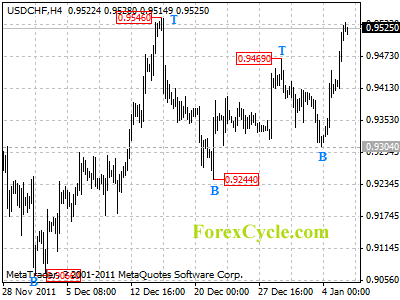
USDCHF is facing 0.9546 resistance

USDCHF is facing 0.9546 resistance, a break above this level will indicate that the uptrend from 0.8569 (Oct 27, 2011 low) has resumed, then further rise towards 1.0000 could be seen. Support is now at 0.9400, only breakdown below this level could indicate that lengthier consolidation of uptrend is underway.

usdchf

Daily Forex Forecast

Crude Reality: Why Consumers in the Northeast Will Pay More At the Pump

Crude Reality: Why Consumers in the Northeast Will Pay More At the Pump

by David Fessler, Investment U Senior Analyst
Thursday, January 05, 2011

I suspect most folks who drive to their nearest Wawa to gas up don’t pay a whole lot of attention to the price they pay. Unless the leftmost digit changes. That usually gets their attention.

But if you live in the Northeastern United States, as I do, you might just see that leftmost digit change from a “3″ to a “4″ in the next six months. $4.00 a gallon gas? Again?

It all has to do with two problems the major oil companies are facing right now. One is new emission regulation regarding ultra low-sulfur diesel (ULSD) fuel standards. Right now, it’s in high demand for trucks. Soon most states in the Northeast will require it for home heating use, as well.

Many refineries aren’t equipped to make ULSD in the quantities required, or their refineries aren’t designed to produce it at all.

The second problem is the crack spread. “Crack spread” is a term used by the oil industry. It’s essentially the difference between the price of crude and the price of the products refined from it.

In other words, it’s the profit that oil refineries can expect to make by “cracking” the crude oil down into its many refined products, the majority of which are gasoline and diesel.

That all works fine if crude prices remain relatively stable. Add volatility into the mix, ULSD requirements and crude price spikes (like the one we’re experiencing now), and it’s a whole different ball game.

The Wheels Are in Motion Towards Higher Prices

Here’s the scenario: If refineries have to pay too much for crude, and it’s heavier oil of lower quality, it costs more to refine it into gasoline and ULSD. If profit margins erode too far for too long, oil companies simply shut down their refineries, especially the aging, inefficient ones.

That will lead to higher prices, as more gasoline and diesel will have to be imported via rail and truck from other parts of the country, primarily Gulf Coast refineries. The added cost of transporting the fuel will be tacked on immediately. We’ll also very likely experience supply glitches. That will lead to price spikes on top of the transport costs.

Well that’s exactly what’s happening all over the Northeast. The EIA, in a report released just before Christmas, predicted that 50% of the refining capacity in the Northeast would be shut down by next winter.

Here’s what the EIA said in the report:

“Reduced short-term product supply flexibility due to longer delivery times and potential transportation bottlenecks for sources outside the region could increase price volatility.

“An increase in demand for ULSD due to changing state regulations could exacerbate the issue.”

The reasons, as we’ve stated above, are higher crude prices and ULSD requirements that some of the refineries simply can’t meet with the equipment they have.

In September, Sunoco, Inc. (NYSE: SUN) said it would shut down its two remaining refineries on the East Coast by the middle of 2012. Both have had several money-losing quarters in a row.

Then this past December, it decided to shut its Marcus Hook, New Jersey plant six months early. It temporarily shifted some of the production lost to its giant Philadelphia refinery, but it too is scheduled to be closed by this coming July.

Right on the heels of Sunoco’s announced closings, ConocoPhillips (NYSE: COP) shut down its Trainer refinery in Philadelphia immediately.

Both companies have other facilities that will remain open, along with Hess Corporation’s (NYSE: HES) Port Reading, New Jersey facility.

Northeast customers will be competing for gas and diesel with customers in other parts of the country, and in other countries. Higher prices here will be the result.

From the EIA:

“Higher price differentials for wholesale products compared with the Gulf Coast and market abroad would have to occur to incentivize producers to send more products to the Northeast.”

I’ve been saying for over a year prices for gasoline and diesel would be on the rise. Get used to it. These refinery closings are just one more reason why those of us in the Northeast will be paying more.

Natural gas, anyone?

Good Investing,

David Fessler

Article by Investment U

Deverell Says Base Metal Prices Have Fallen Too Far

Jan. 5 (Bloomberg) — Ric Deverell, head of commodities research at Credit Suisse Group AG, talks about the outlook for global commodity markets and food prices. Deverell speaks with Rishaad Salamat on Bloomberg Television’s “On the Move Asia.” (Source: Bloomberg)

Germann Says Hildebrand Must Restore Confidence in SNB

Jan. 5 (Bloomberg) — Hannes Germann, a lawmaker in the upper house of parliament from the Swiss People’s Party, talks about Phillip Hildebrand’s tenure as head of the Swiss National Bank after his wife purchased dollars in August. Germann speaks from Zurich with Maryam Nemazee on Bloomberg Television’s “The Pulse.”