The Brave New (Broken) World for Stock Traders and Investors

By MoneyMorning.com.au

I’ve said it before, and I’ll say it again.

The markets are broken.

It’s not that they’re not functioning on a daily basis, pricing risk and assets and performing their price discovery duties. They are doing that – or at least trying to.

Those are the little, daily things that markets do, and there are things there that are broken. (I’ll get to those things another time.) Think of those little things as the “hows” or the “mechanics” of buying and selling.

Think of the big things as the “whys” or the “psychology of investing.” Those are the things that are broken. Until they are fixed, or “things” change, drastically, we are in for some really wild swings in the months, quarters, and years ahead.

No More Buy-and-Hold Believers

First, there are two types of players in markets, stock traders and investors.

It used to be that investors dwarfed stock traders – by a huge margin.

Investors were the meat and potatoes and the vegetables, and stock traders were the gravy that made sure investors’ plates were liquid enough so that they didn’t choke when swallowing their meals.

But that’s all changed.

There aren’t that many truly long-term investors any more. It’s too dangerous to be an investor in the traditional sense. That’s why most investors, at least those that call themselves investors, are really all traders now.

I don’t mean traders in the high frequency sense, or even in the day trading sense. I mean they are stock traders because they invest for the future but can’t see beyond a few quarters, if that, so they have to get out of positions.

These traditional investors almost always have stop-loss orders down, or at least have stop-loss levels in mind as part of their investment “plans.” A lot of them now use profit targets, too. That hardly ever happened traditionally. Investors invested. They were buy-and-hold believers in a brighter future where, over time, assets appreciated, and they stuck with them.

Not anymore.

You can’t do that unless you have nerves of steel, tons of capital, and a generational approach to holding your positions. Even then, I say, good luck with that.

So, from the perspective of psychology, if it’s not safe to be an investor, but being in the markets is still a tremendous wealth-generating endeavour, stock trading will remain the tail wagging the old dog.

For me, that’s all well and good. I’m a stock market trader. I always have been. Sure, I used to have a bunch of long-term investments that I expected to always weather short-term trading and fluctuating economic cycles.

But those all ended up being a 50/50 proposition. Meaning I lost on about half of those investments and made money on the other half. I’m talking about maybe eight positions that I’d keep on the books for years.

Not anymore.

Why? Now I use that capital to trade bigger positions, because holding a diversified (I’m not including the few mutual funds that I used to own, that I jettisoned a long time ago) portfolio, even a well-constructed, concentrated one, didn’t work out.

My point is, think about how you look at the stock markets. Ask yourself if you are an investor or a stock trader. Ask yourself how much time you have, how much capital you have, and what kind of constitution you have… and do the math yourself.

Shah Gilani is a veteran US hedge fund trader and contributing editor to Money Morning (USA).

Publisher’s Note: This is an edited version of an article originally published in the US edition of Money Morning (www.moneymorning.com)

From the Archives…

A Story of Sell-Offs & Super Spikes by a Stock Market Trader
2012-01-07 – Murray Dawes

Why BHP Will Be the First Victim of China’s Economic Collapse
2012-01-06 – Kris Sayce

The Sun Starts to Set on China’s Economy
2012-01-05 – Kris Sayce

New Year’s Eve 2029: Will the Australian Stock Market Lose a Decade of Growth?
2012-01-03 – Kris Sayce

How to Buy Gold and Silver
2011-12-11 – Dr Alex Cowie

For editorial enquiries and feedback, email [email protected]


The Brave New (Broken) World for Stock Traders and Investors
Let’s Even Things Up For the Individual Investor

By MoneyMorning.com.au

You may have seen a strange ad in yesterday’s subscription version of Money Morning.

It began, “Are you interested in investigating insider trading, suspicious volume spikes, and price sensitive announcements?”

The ad appears in today’s subscription version of Money Morning too. (For your free subscription click here). Read it. And if you’re interested, send a cover letter and CV to [email protected].

We’re always looking to find ways to help you make money.


And our gut feeling is this is one way to do it. Like it or not, there are some stock traders and investors who act on confidential inside information. Of course, that’s illegal… and that’s NOT what we’re looking to do.

What we ARE looking for is whether a switched-on guy or gal can analyse this hard-to-find info and generate profitable trading ideas from it.

Australia is one of the least transparent share markets in the world. For example, according to research firm Morningstar, Australia’s funds industry ranks 14th out of 16 in the developed world in terms of disclosure.

Investors often have no idea what shares, bonds, or other assets their funds own, or how risky those assets are.

Our aim is to break open the industry stranglehold on price-sensitive info… and put it to use for you. Or at least see if it’s possible.

There’s certainly a lot of work to do. In a three month period in late 2010, ASIC generated nearly 20,000 alerts flagging suspicious trades.

Australia is almost the last share market in the world where some investors have a big information advantage over others. Let’s see if we can even things up a bit for the individual investor.

Cheers.
Kris


Let’s Even Things Up For the Individual Investor

The Fed’s Funny Money Merry Go Round

By MoneyMorning.com.au

We feel like we’ve been here before.

This morning, Bloomberg News reports:

“Stocks surged, sending the Standard & Poor’s 500 Index to the highest level in five months, and commodities rose for a third day amid speculation China may act to spur growth.”

Part of the reason was due to “good” news from U.S. aluminium producer, Alcoa [NYSE: AA]. According to Bloomberg, “Sales rose 6 percent to $5.99 billion, topping the $5.7 billion estimate in a Bloomberg survey.”

The company still made a loss. But that didn’t stop the shares piling on 4.5% during the day’s trade.

So, the future looks bright for stocks. Which must mean the U.S. economy and the Fed is in good shape too… or does it?


Because Bloomberg also reports:

“Federal Reserve Bank of San Francisco President John Williams said he sees a ‘strong’ case for more Fed purchases of mortgage bonds given his expectation that inflation will fall below 1.5 percent this year.”

So which is it? The economy is picking up… or it’s not… or it is, but not enough?

The answer is, we have seen this before.

The Seeds of Recovery

It’s recovery by stimulus… which isn’t really a recovery at all.

It’s like the PM saying Australia has a healthy car industry, while at the same time announcing the government is giving Ford Australia $34 million of taxpayer money… on top of a $103 million bailout from Ford Australia’s U.S. parent company.

And Holden gets a hand out too. $100 million of taxpayer money… that’ll teach you not to buy a Ford or Holden… because you’re paying for one anyway! And those who did buy Ford or Holden are paying for an already expensive car twice.

But we’ll have more on the madness of subsidies another day…

What we’re going through now is a repeat of the “Seeds of Recovery” mantra. The market last fell for this trick in 2009 and 2010.

Investors thought they saw things improving but forgot it was the delayed impact of central bank and government stimulus. So they bought stocks, believing the good times were back.

Only they weren’t. Soon enough the stimulus wore off and investors were back to square one.

So it seems the Fed’s John Williams knows what will happen next if the Fed doesn’t print more money to buy more assets. He knows the economy will head south and mainstream investors will lose all faith in the Fed.

But at the moment, the Fed and U.S. Treasury money-go-round goes on…

Not-So-Funny Money

Today the Financial Times reports:

“The US Federal Reserve sent $76.9bn in profits to the Treasury last year, according to the central bank’s preliminary results, showing how the Fed’s unconventional monetary policy has turned it in to the most profitable bank in history.”

The FT goes on – oblivious to the obvious:

“As part of its efforts to support the economy, the Fed has bought billions of dollars in Treasury securities to drive down long-term interest rates. The Fed earns interest of more than 1 per cent on many of those securities while it pays only 25 basis points to banks on their reserves. The difference allows it to record large profits which it remits to the Treasury.”

Profit for the Fed means profits for the U.S. Treasury, right? Wrong! It’s a funny-money merry-go-round. Think about who pays the Fed 1% interest. That’s right, the U.S. Treasury.

And because the Fed pays out 0.25% to banks for cash held on deposit, it can only give 0.75% (less expenses) back to the U.S. Treasury. Which means the Treasury makes a loss on the deal. Keep doing that over and over and it’s the surest way to Loserville.

But this is the muddle-headed world we live in. Where profits are losses… and a healthy industry is only healthy because it gets millions in taxpayer support.

For now the market loves any so-called good news it can get. If that means stocks going up due to an aluminium producer losing money… China providing more stimulus… and the U.S. Federal Reserve printing more money, then so be it.

But as we’ve seen before, this isn’t a recipe for a long-term rally.

Our message today is the same as before Christmas: Keep your safe money safe, and only punt with money you can afford to lose. Because this is still one heck of a risky market.

Cheers.
Kris

Publisher’s note: The brand new Slipstream Trader stock market video update recorded live this morning is now on YouTube. To watch it, click this stock market update video link. Murray says he’s in “observation mode” right now. Why? He told us earlier: “US markets are in short and intermediate uptrend but long term downtrend. They are quickly approaching large overhead resistance around 1300 in the S+P 500…

“How the market behaves near there is important.” Says Murray. “If it gets rejected once again and we see some weakness I can become aggressively bearish again. If it busts up through 1330ish then I will have to reassess my strong bearish stance. The ASX 200 is also flirting with the key 4200 level again. If it can hold above there we may see a short term spike higher. Another rejection from 4200 and a close below the 10 day moving average will increase my bearish conviction…” To listen to Murray explain all this in greater detail, click on the following link to watch his brand new stock market video update.

Related Articles

Special Report: Six Extraordinary Resource Investment Opportunities for 2012

The Sovereign Debt Cycle Continues

Paul Krugman is Dead Wrong: US Debt Does Matter

From the Archives…

A Story of Sell-Offs & Super Spikes by a Stock Market Trader
2012-01-07 – Murray Dawes

Why BHP Will Be the First Victim of China’s Economic Collapse
2012-01-06 – Kris Sayce

The Sun Starts to Set on China’s Economy
2012-01-05 – Kris Sayce

New Year’s Eve 2029: Will the Australian Stock Market Lose a Decade of Growth?
2012-01-03 – Kris Sayce

How to Buy Gold and Silver
2011-12-11 – Dr Alex Cowie

For editorial enquiries and feedback, email [email protected]


The Fed’s Funny Money Merry Go Round

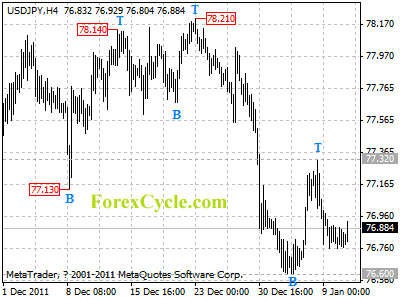
USDJPY stays in a trading range between 76.60 and 77.32

USDJPY stays in a trading range between 76.60 and 77.32. Lengthier consolidation in the range would likely be seen in a couple of days. Key resistance is at 77.32, a break above this level will confirm that the fall from 78.21 had completed at 76.60 already, then further rise to test 78.27 resistance could be seen. Support is at 76.60, only break below this level could trigger another fall to 76.00 zone.

usdjpy

Daily Forex Forecast

AUD/CAD Daily outlook – 11 January

AUD/CAD Daily outlook – 11 January

The Asian and much of the European session saw the Aussie gaining ground against the CAD on Tuesday. Late trading in the US saw the CAD strengthening and taking back its earlier losses.

 The daily charts formed a long tailed bearish pin bar rejecting the strong resistance level sitting at 1.0500. The chart below shows the strength of the resistance area.

audcaddailyoutlook11jan

With the bearish outlook from Tuesday’s price action and the solid rejection of strong resistance we’ll be looking to short the pair with initial targets at 1.0420 and a stop just above yesterdays highs. Should we not see the bearish momentum we’re expecting and a push higher the next relevant area of resistance sits at 1.0664 which is the markets most recent highs.

audcaddailyoutlook11jantarget

 Article by vantage-fx.com

Analyst Moves: EOG, CELG

EOG Resources (EOG) was upgraded today by Deutsche Bank (DB) from hold to buy with a $125 price target, as the firm has been seeing strong trends in production. Shares are higher by 3.25 percent.

Research in Motion’s M&A Options Less Likely Near-Term (RIMM)

UBS (NYSE:UBS) believes Research in Motion’s (NASDAQ:RIMM) near-term M&A options are less viable near-term given accelerating U.S. losses and likely another weak quarter. The firm believes any potential acquirer will want to see the business stabilize before pursuing the company.Shares are Neutral rated with a $15.50 price target.Research In Motion (NASDAQ:RIMM) has potential upside of 32.1% based on a current price of $15.35 and an average consensus analyst price target of $20.27.

Analyst Moves: CHH, NVR

Choice Hotels (CHH) was downgraded today by Credit Suisse (CS) from neutral to underperform with a $32 price target due to weaker unit growth. Shares are lower by nearly 2.2 percent.

Daily Market Wrap: January 10, 2012

The markets continued its modest rally at the start of earnings season, led by industrials and energy stocks as well as financials and materials. Aluminum producer Alcoa (AA) reported a loss, excluding one time items which met expectations, while revenue came in ahead of estimates.