The US-China Power Struggle… and What it Could Mean For Oil and Australian Energy Stocks

By MoneyMorning.com.au

In yesterday’s Money Morning article on global oil supply I wrote to you about the oil crisis brewing in the Straits of Hormuz. This is the narrow channel that runs between Iran and Saudi Arabia. Forty per cent of the world’s sea-borne oil is shipped through here. Iran recently threatened to close the channel in response to a US-led embargo on Iranian oil. Global oil supply could fall 40% if Iran followed through on its threats.


This is not a new story. Iran and the US have been squaring off for 10 years. Not that this means it is a less important story to monitor today.

In the last few days, Saudi Arabia has offered to bridge any shortfall in production. Iran is not happy about this and is warning of ‘unpredictable consequences’ in return.

The Saudis are not worried, and are pushing on.

The Saudi Oil minister, Ali Naimi, just announced a goal to keep oil prices in the region of $100 a barrel. The Saudis are the world’s largest oil exporters. November 2008 was the last time they set a goal, which was $75 a barrel. The oil price increased from $50 to $75 within six months. The price then oscillated around the $75 level for the next 12 months.

There are good reasons for both Iran and the US to avoid a conflict. The oil price certainly hasn’t soared in anticipation of conflict just yet. And if Saudi Arabia’s $100-a-barrel target becomes a reality, then prices will fall, not rise.

That’s not to downplay what might happen here. Far from it. Tempers are rising, Iran is unpredictable, and it has some powerful allies, such as China. In some ways, this is an indirect power game between the US, which is controlling Iran’s oil supply, and China, which buys Iran’s oil.

Another Flashpoint

I think what is happening in the Strait of Malacca may become more important than the Straits of Hormuz in coming years.

The Strait of Malacca is the shipping channel between Singapore and Sumatra. Ships carry around 14 million barrels of oil a day through this strait, which is not far behind the 17 million that move through Hormuz each day.

It is the shipping gateway to the South China Sea, which then joins the Pacific. At just 2 kilometres wide in places, 60,000 ships each year pass through the Strait – or one ship every 10 minutes. It has been a magnet for pirates in the past and is now heavily policed. The Strait of Malacca is the Achilles Heel for Asia’s oil supply.

South China Sea

Source: Googlemaps

You get an idea of why the gateway to the South China Sea is so important when you consider just how many people live in the region. Above the South China Sea you have 1300 million people living in China. To the east you have 100 million people in the Phillipines. In the south, 240 million people live in Indonesia. Then to the west, 200 million people are spread across Thailand, Vietnam, Cambodia, Laos and Malaysia. Let’s not forget there’s also 70 million people in Taiwan and South Korea.

All together, that is close to 2 billion people.

All clustered around a sea the size of Western Australia.

You can see why the South China Sea’s shipping channels are getting a bit busy. Particularly when you consider that most of the countries are in earlier stages of industrialisation: this is the period in an economy’s life that consumes the most resources.

To make things complicated, there is plenty of disagreement over who controls what parts of the Sea. China lays claim to most of the region. Vietnam’s claims overlie large swathes of China’s claims. China’s claims also cross over most of what the Philippines claims to own. Then Vietnam’s claims also overlie the Philippines’!

The disputed claims over the South China Sea are thought to be Asia’s most likely flashpoint for conflict. There have been scuffles between China and Vietnam in the past. But it’s amazing that there hasn’t been serious conflict more recently.

Rich in Natural Resources


You see, the South China Sea is also resource rich. It holds rich oil and gas fields. Some are in disputed waters, such as the Malampaya and Camago gas fields. It is also host to valuable fisheries. And, of course, the all-important shipping lanes.

With such valuable resources in the Sea, China has been flexing its military muscle recently in the region. Vietnam and the Philippines claim that its vessels involved in oil exploration and fishing have been harassed in recent months. A Chinese military commander quoted in a newspaper reminded its neighbours that ‘China is a big country, and its neighbours are small’.

Last year, US Secretary of State Hillary Clinton asked China to sort out the territorial disputes. China told Hillary to keep her nose out of it. Since then Obama has pledged to move more US military resources into the region, and has pledged to strengthen its presence. One of its first moves was to start deploying 2500 US Marines right here in Australia.

So the recipe for South China Sea stew looks very spicy. With 2 billion people crowded around a pond, some of the busiest shipping ways in the world, overlapping claims and a belligerent China bullying its neighbours. Now enter Team America to save the day.

This story is still brewing. But this could disrupt shipping channels in the future. And that would throw the oil market into chaos.

The Iran story will put a growing premium on energy production in low-risk regions, such as Australia. But I think what is happening in our own backyard, in the South China Sea, will have a greater impact on the value of Australian energy companies in the future.

Dr Alex Cowie,
Editor, Diggers & Drillers

[Ed Note: Leading US energy analyst Dr Kent Moor gives his insight in today’s other article on Iran oil and the brewing Straits of Hormuz crisis…and the direction of the oil price.]

Related Articles

Special Report: Six Extraordinary Resource Investment Opportunities for 2012

How Global Oil Supplies Could Fall 40% Overnight

The Markets Rally Like It’s 2008


The US-China Power Struggle… and What it Could Mean For Oil and Australian Energy Stocks

France plays down AAA loss

French President Nicolas Sarkozy was on a visit to Spain as his country mulled over S&P’s downgrade. His finance minister said France needed diversity and a strong banking system to weather the storm.

UK Central Bank Sees Rise in Credit Card Limits

Credit card limits rose in the final three months of 2011, according to the latest Credit Conditions Survey from the Bank of England, the UK’s central bank. This wasn’t the only increase to appear in this Survey, which also pointed to the growth in the availability to households of unsecured credit in the final quarter of the year – growth which we can expect to see (a little) more of between now and March. The first quarter of 2012 should also see a slight increase in demand for ‘other unsecured lending’ (i.e. other than credit cards, where we can expect a drop). 
The predictions in the Survey aren’t set in stone, of course. They’re subject to developments in the economies of the UK and other countries. In fact, lenders specifically commented that potential problems in the Eurozone ‘pose significant downside risks’ and could work against expected growth in the availability of unsecured credit over the next three months.
The most recent figures from the Bank of England show that total credit card debt in the UK stood at £56.2 billion at the end of November 2011. At that time, a further £151.3 billion was owed in ‘other’ unsecured loans and advances.
The Bank of England publishes its Credit Conditions Survey every three months. Understanding ‘trends and developments’ in the world of credit conditions is a key part of the Bank’s mission to ‘maintain monetary stability and financial stability’, so it surveys lenders every quarter.
It asks them what they’ve noticed about lending conditions over the last three months, and what they expect to see over the next three.

[Review] Clarity of Central Bank Communication About Inflation

The International Monetary Fund (IMF) has just released a working paper on central bank communication on inflation, which examines whether the clarity of central bank communications have changed with the economic environment.  The key finding of the paper is that there are “no strong indications that central banks were less clear in explaining their policies when faced with higher uncertainty or a less favorable inflation outlook.”  However, the authors note that the global financial crisis “did have a negative impact on clarity of central bank communication.”  The paper’s authors are: Bulir, Ales; Cihák, Martin; and Jansen, David-Jan.

Reference: Bulir,A., Cihák, M., & Jansen, D. (2012) Clarity of Central Bank Communication About Inflation. International Monetary Fund, Working Paper No. 12/9

Gold Trend Forecast for 1st Quarter of 2012

By Chris Vermeulen: www.TheGoldAndOilGuy.com

Over the past five months gold has fallen sharply and is no longer headline news which it once dominated back in 2011 when it was making new highs every day. The shiny metal has been under pressure because traders and investors started to pull some money off the table to lock in gains. Gold prices had surged so fast most advanced traders knew that final high volume surge was not sustainable. But the main reason gold topped out in my opinion was because the US Dollar index had put in a bottom and started to build a base. As we all know a rising dollar typically means lower stocks and commodity prices.

I have posted some charts below covering gold in detail using multiple time frames. The weekly which is long term, daily which is the intermediate trend and the 4 hour chart which shows gold momentum and intraday action. At the very bottom I talk about the US Dollar and what is happening with that.

Gold Weekly Long Term Trend Analysis

The weekly chart is not the most exciting time frame to follow as you will grow old watching it. That being said it is crucial for understanding the long term trend, price and volume analysis.

Below you can see that gold’s recent pullback has been a 3 wave correction, which is a normal pullback for any investment. But taking into account the rally from 2008 – 2011 I feel this pullback will have one more low put in before bottoming out. This would make for a 5 wave correction much like what happened in 2008.

Gold Trend Forecast


Daily Chart of Gold Showing the Intermediate Trend

The daily chart allows us to see gold intra-week price action and use the 150 moving average which is my preferred daily moving average. As you can see we are getting a similar pullback as 2008 with gold now trading under the 150 MA.

I would like to see gold make another lower low in the next 2-3 months. If that happens I feel it complete the correction and trigger a strong multi month or multiyear rally in gold.

Gold Price Forecast


4 Hour Intraday Chart of Gold

The 4 hour chart of gold allows us to see all the intraday price action which would normally not be seen with a daily chart. It also gives us enough data to build our analysis upon.

My preferred setup for gold which I feel if happens will trigger major buying in the yellow metal. If/when we get a rally in gold would also likely mean some more economic uncertainty has entered the market either from within the USA, Europe or China…

Gold Trading Newsletter Forecast


Weekly Dollar Index Long Term Analysis

The dollar has the potential to rally to the 87 – 88 level before putting in a major top. For this to happen we will need to see the Euro crumble (both currency and countries divide) in my opinion.

If you look at the weekly chart of gold and this chart of the dollar index you will notice that gold topped when the dollar bottomed. Over the past couple year’s gold and the dollar have had an inverse relationship to each other.

With all kinds of crap about to hit the fan overseas I think it’s very possible gold will rally with the dollar. Reason being there is way more people overseas who want to unload their euro’s and with all the negative talk and doubt with the US Dollar individuals will naturally want to buy more gold.

Dollar Index Trend


Weekend Trend Trading Conclusion:

In short, I expect a bumpy ride for both stocks and commodities in the first quarter of 2012. With any luck gold will pull back into my price zone shaking the majority of short term traders out just before it bottoms.  And we will be positioning ourselves for a strong rally buying into their panic selling.

To just touch base on the general stock market quickly. I have a very bearish outlook for stocks. If the dollar continues to rise it is very likely the stock market will fall into a bear market. So I am VERY cautious with stock at this time.

If you would like to receive my Weekly reports, updates and trading education videos each week join my free newsletter here:www.TheGoldAndOilGuy.com

Chris Vermeulen


Upward Pressure to Remain on Brent Crude in 2012

Upward Pressure to Remain on Brent Crude in 2012

by David Fessler, Investment U Senior Analyst
Monday, January 16, 2011

Oil prices have traded off a few dollars from their recent highs. The factors that will keep Brent above $100 a barrel for 2012 are the same ones that kept it above $100 all of last year.

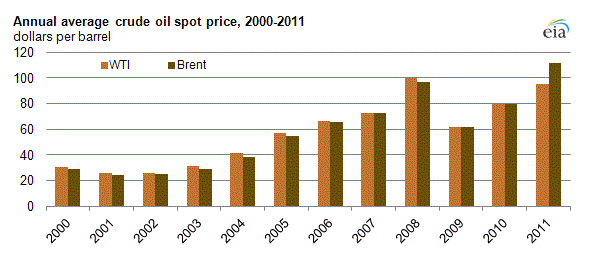
Take a look at the graph below, courtesy of the Energy Information Administration.

spot price oil chart

Brent spot prices averaged $111.26 a barrel for 2011. That was the first time in the history of oil that Brent averaged over $100 a barrel for an entire year.

West Texas Intermediate (WTI) averaged $94.87 a barrel, up $15 a barrel from 2010. WTI pricing reflected a discount to Brent based on supply constrains emanating from the Cushing, Oklahoma storage depot.

What’s Going to Keep Crude High in 2012?

Let’s start with the Arab Spring that’s already turned into the Arab Year. If Iran goes ballistic (no pun intended) and Iraq comes apart at the seams, it could turn into the Arab Decade.

Any sudden supply loss resulting from the closing of the Straight of Hormuz will send prices soaring. Even if nothing happens, prices will stay high until the standoff settles down.

Now let’s talk about demand. In the face of all the unrest that threatens 17 million barrels per day of world supply, we have increasing demand. As I write this, China is negotiating with Iran for cheaper prices on oil.

The country gets about 11% of its oil from Iran, and now it can get it cheaper, since its oil is effectively isolated from the rest of the world. The boycott takes Iran’s 2.6 million barrels per day off the world’s supply.

But China, India and the Middle East all experienced increasing demand for crude in 2011. During the first six months of last year, crude demand for countries not part of the Organization for Economic Cooperation and Development (OECD) saw demand increase 4%.

Even with declining OECD demand, overall world demand for crude increased by 1.2% in 2011. That growth will continue in 2012, keeping upward pressure on prices.

The third factor keeping crude prices high this year will be continued transportation bottlenecks. The giant Cushing Oklahoma crude storage facility is capacity limited to get crude out to Gulf Coast refineries.

The reversal of the Seaway Pipeline this June will partially alleviate this. The real problem is that crude production is ramping in Alberta’s oil sands, and North Dakota (the Bakken) and Texas’ (Eagle Ford) shale plays.

More oil is flowing into Cushing than can flow out. The facility is adding storage at a frenetic pace, and should have the capability to store an additional three million barrels later this year.

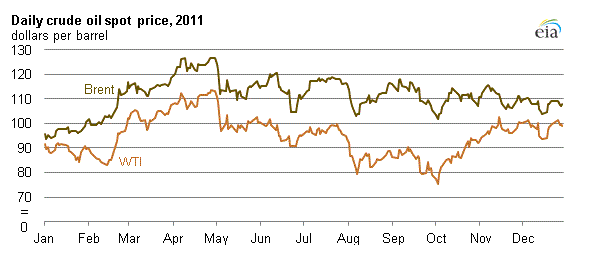
The lack of access to West Texas Intermediate (the Cushing benchmark) caused it to trade at a significant discount to Brent last year. In September, that discount was nearly $30 per barrel.

You can see the price of the two benchmarks in the graph below.

crude oil chart

Right now the spread is close to $10 a barrel, which is wide by historical standards. I expect that to continue to remain in the $10 to $20 per barrel range, since there’s little that will improve the accessibility of WTI in the short term.

The bottom line is this: Don’t expect oil prices to drop. Increasing demand and geopolitical unrest will keep Brent crude prices above $100 for a second year in a row.

Good Investing,

David Fessler

Article by Investment U

Euro Tumbles Following Ratings Downgrade

Source: ForexYard

The combination of a worse than expected Italian debt auction and the credit downgrading of several euro-zone countries on Friday, caused the euro to slip to fresh lows once again before markets closed for the week. Today, with US markets closed for a bank holiday, trades will want to pay close attention to any news out of the euro-zone, particularly the speech from the ECB President scheduled for 18:00 GMT.

Economic News

USD – USD Stages Reversal to Close out Week

After taking mild losses against its main currency rivals for the majority of last week, the USD was able to rally on Friday, as poor euro-zone news caused traders to shift their assets to safe-haven currencies. The EUR/USD hit a fresh 16-month-low after credit ratings for a number of euro-zone countries were downgraded. In addition to making gains on the euro, the greenback also turned bullish against both the Japanese yen and Swiss franc.

Turning to today, traders should note that US markets will be closed for a bank holiday and the dollar’s direction will likely be determined by news out of the euro-zone. Traders may want to pay careful attention to a speech from the ECB President later in the afternoon. With no dramatic announcements expected from the speech, investors may decide to extend the safe-haven dollar’s bullish run for another day.

Looking ahead to later in the week, news out of the US housing sector is forecasted to impact the dollar. The US housing crisis has been one of the biggest obstacles to economic recovery. Should this week’s data reinforce that sentiment, the USD may see some setbacks against some of the other safe-haven currencies, specifically the CHF and JPY.

EUR – EUR Hits Fresh Lows Following Credit Downgrades

The EUR finished last week on a decidedly bearish note, following the credit downgrade of a number of euro-zone countries. The common currency hit a fresh 11-year low against the yen and dropped to a 16-month low against the US dollar. In addition to the credit downgrade, investor pessimism in the euro-zone was also fooled by an apparent breakdown in talks over a Greek debt-swap and a worse than expected Italian debt auction on Friday.

This week, all eyes remain on the euro-zone to see if any viable solution to the current crisis will be announced. Today, the euro may see slight gains during the morning session as traders could deem the dollar overvalued and unload some of their short EUR/USD positions. Later in the day, a speech from the ECB President may set the tone for the common currency during evening and overnight trading. Traders will also want to pay attention to the German ZEW Economic Sentiment figure on Tuesday. As the biggest euro-zone economy, German fundamental indicators tend to have a significant impact on the euro.

JPY – EUR/JPY Hits Fresh 11-year Low

The Japanese yen finished off last week on a bullish note, as the currency hit a fresh 11-year high against the euro. The EUR/JPY fell following poor fundamental euro-zone news that highlighted just how fragile the current European crisis is. Investors responded to the news by shifting their assets to the safe-haven yen. Among the majors, the JPY is often viewed as a stable, less risky currency. Against the US dollar, the yen was not as fortunate as the USD/JPY shot up to close out the week at 76.95.

This week, the yen will once again be guided by euro-zone and US fundamental news. Further negative news out of Europe may lead to additional gains for the JPY against the common currency. What will be more interesting to see is how the yen reacts to a batch of US housing and manufacturing data set to be released later in the week. Last week’s US fundamentals came in below expectations. Should this week’s follow the same trend, the JPY may be able to recoup some of its recent losses against the greenback.

Crude Oil – Crude Continues to Fall Following EU News on Oil Embargo

Crude oil closed last week on a bearish note, after news that any EU ban on imported Iranian oil will likely be phased in over the next several months. The news helped settle investor fears that oil imports into Europe would not be disturbed in the immediate future. Crude oil finished out the week below the psychologically significant $100 a barrel level, following weeks of bullish movement due to Middle East tensions.

This week, traders will want to keep an eye on any developments in the Middle East. Further escalations in the conflict between Iran and the West will likely drive the price of oil significantly up. In addition, any news regarding the EU debt crisis is likely to influence the price of crude. The price of oil tends to rise and fall along with the euro. Should the common currency maintain its bearish trend, oil may follow.

Technical News

EUR/USD

Most long term technical indicators place this pair in oversold territory, meaning an upward correction is possible in the near future. The daily chart’s Williams Percent Range is around the -95 level, while the weekly chart’s Relative Strength Index has drifted below 30. Going long this week may be a wise choice.

GBP/USD

Following last week’s bearish trend, technical indicators are now showing this pair trading in neutral territory. The daily chart’s Relative Strength Index is currently at 40, which typically signifies that no significant movement is expected in the near future. Traders may want to take a wait and see approach for this pair.

USD/JPY

Most long term technical indicators are placing this pair in neutral territory, meaning that it may maintain its current trend for the time being. That being said, the Bollinger Bands on the daily chart appear to be tightening. If this continues, a price shift may take place. Traders will want to take a wait and see approach for this pair.

USD/CHF

Technical indicators on both the daily and weekly charts are placing this pair in overbought territory, meaning a downward correction may take place. A bearish cross appears to be forming on the weekly chart’s Stochastic Slow, while the daily chart’s Williams Percent Range has gone above the -20 level. Traders may want to think about going short in their positions.

The Wild Card

EUR/GBP

Following last Friday’s bearish run, technical indicators are now predicting an upward correction for the pair. The 8-hour chart’s Williams Percent Range is currently below the -80 level, while the 4-hour chart’s Stochastic Slow has formed a bullish cross. Forex traders may want to consider going long in their positions today.

Forex Market Analysis provided by ForexYard.

© 2006 by FxYard Ltd

Disclaimer: Trading Foreign Exchange carries a high level of risk and may not be suitable for all investors. There is a possibility that you could sustain a loss of all of your investment and therefore you should not invest money that you cannot afford to lose. You should be aware of all the risks associated with Foreign Exchange trading.


Gold Gains Alongside Dollar, “Clear Winner” from S&P Downgrades is Germany as “Only Bond Haven Left in Eurozone”

London Gold Market Report
from Ben Traynor
BullionVault
Monday 16 January 2012, 08:45 EST

U.S. DOLLAR spot gold prices climbed to hit$1647 an ounce Monday morning in London – 0.8% below last week’s high – while stock and commodity markets were broadly flat as markets absorbed Friday’s news of cuts to nine Eurozone sovereign credit ratings.

“Spot gold [however] is expected to fall to $1417 per ounce over the next three months,” warns Reuters technical analyst Wang Tao in the newswires Q1 2012 commodities outlook published Monday.

“[The] medium-term downtrend that started at the Sept. 6 high of $1,920.30 will continue.”
Spot silver rose to $30.10 per ounce – 0.9% up on Friday’s close.

The Euro meantime fell 1.8% in Monday’s Asian session – hitting its lowest level since September 2010 – before stabilizing as Europe opened. Conversely, the Dollar Index – which measures the US currency against six others – hit a 16-month high at 81.7.

Spot gold in Euros hit its highest level since December 8 at €41803 per kilo (€1300 per ounce) – 5.4% off September’s all-time high.

Ratings agency Standard & Poor’s has cut its credit ratings for nine Eurozone members, having placed fifteen members on CreditWatch negative at the start of December. S&P cited “insufficient” policy initiatives from Eurozone governments as the main driver for the decision, as well as its concern that fiscal austerity measures could prove “self-defeating”.

Those affected include France, which had its rating cut by one notch from AAA to AA+. Five others, including Germany, had their existing ratings affirmed. S&P’s move, which was announced after markets closed on Friday, leaves only three triple-A rated Eurozone members – Finland, the Netherlands and Germany. Of those, only Germany has a ‘stable’ outlook, with S&P’s outlook for the other two given as ‘negative’.

“S&P’s action has reinforced the market’s view that the only haven in the Euro region bond market is Germany,” says Peter Chartwell, fixed-income strategist at Credit Agricole in London.

“Germany comes out as a clear winner,” agrees Jacques Cailloux, chief European economist at Royal Bank of Scotland.

“The French downgrade will complicate future negotiations around fiscal integration and comes at a delicate time domestically…[Germany] will have its position at the negotiating table strengthened even further.”

“There are a lot of risks still ahead of us and we don’t think gold has priced in these risks,” reckons Societe Generale commodity strategist Jeremy Friesen, adding that S&P’s decision “is one of the incremental pushes for gold to appreciate.”

Representatives of Europe’s banks meantime are considering asking French president Nicolas Sarkozy and German chancellor Angela Merkel to try to break the deadlock in negotiations over the size of losses private sector Greek bondholders should take, after talks broke down on Friday, the Financial Times reports.

European leaders agreed last October that private sector involvement (PSI) should amount to losses of 50%. However, “some [Eurozone government] collaborators are not following that decision,” says Charles Dallara, managing director of the Institute of International Finance, which is negotiating with Greece on behalf of private sector bondholders.

Germany has long been a proponent of PSI as a key component of any Greek crisis solution. French banks meantime have the highest exposure to Greek sovereign debt of any major European banking sector, according to Reuters data.

In China meantime, protesting workers at the Sanyo electrical factory, have clashed with police in the southern city of Shenzhen, according to Chinese press reports. The protests over pay and job security are the latest to hit China’s manufacturing sector.

Last week, workers at Foxconn, which produces Microsoft’s Xbox, threatened to jump off the factory roof in a dispute over severance pay and job transfers, while production was halted at an LG Display factory last month after workers went on strike.

China’s Q4 2011 GDP figures are due to be released Tuesday, with many economists forecasting that growth will have dropped below 9% to its slowest pace since early 2009.

Here in London, representatives of the Hong Kong Monetary Authority met with UK Treasury officials today to discuss steps aimed at making London a major offshore center for Chinese currency dealing.

Demand for gold jewelry in India grew between 5% and 7% last year – and is set to grow by up to 15% in 2012 – according to Mehul Choksi, head of India’s largest jewelry retailer said Sunday.
However, dealers in India report that last week’s rise in spot gold prices has curbed demand at the start of the harvest season, which began yesterday.

The difference between bullish and bearish contracts held by noncommercial gold futures and options traders on New York’s Comex exchange – the so-called speculative net long – rose  2.7% over the week ended last Tuesday to the equivalent of 433.7 tonnes of gold bullion, ending four weeks of declines, according to the latest data from the Commodity Futures Trading Commission.

“The change in the net position was the result of speculative shorts being unwound,” says Standard Bank commodity strategist Walter de Wet.

“Although only a modest improvement this past week, the decline in short positions is encouraging. Perhaps the speculative market is becoming less apprehensive about gold’s prospects.”

Ben Traynor
BullionVault

Gold value calculator   |   Buy gold online at live prices

Editor of Gold News, the analysis and investment research site from world-leading gold ownership service BullionVault, Ben Traynor was formerly editor of the Fleet Street Letter, the UK’s longest-running investment letter. A Cambridge economics graduate, he is a professional writer and editor with a specialist interest in monetary economics.

(c) BullionVault 2011

Please Note: This article is to inform your thinking, not lead it. Only you can decide the best place for your money, and any decision you make will put your money at risk. Information or data included here may have already been overtaken by events – and must be verified elsewhere – should you choose to act on it.