Polysilicon: The Biggest Development for Green Energy

Solar energy detractors point to the fact that it can’t compete without “huge” government subsidies. And up until now, I couldn’t argue to the contrary.

But very soon, those detractors will likely be eating their words. I’ve said it many times in the past: Technology marches on, and the cost of manufacturing will come down.

Well the cost of manufacturing solar isn’t just coming down; it’s dropping through the floor. By the end of this year, solar will be so cheap it will compete with just about any other form of generation. It already does in some places, and at commercial scale levels. The best part? It will do it without subsidies.

You see, solar panel prices are about to cross a tipping point. It’s all due to the drop in price of a solar module’s most crucial ingredient: polysilicon.

The Polysilicon House of Cards

Polysilicon prices have collapsed 90% in the last five years. That translates directly into lower module costs, lower panel prices and ultimately into a lower installed cost per watt.

How did this happen? Way back in 2006, there was a run on polysilicon. It turns out it’s the same material used to make integrated circuits. But all of a sudden, the solar industry was booming, and competing for what was then a limited supply.

Its use for solar was rising rapidly, and 2006 was the first year that 50% of all polysilicon went into the manufacture of modules for solar panels. And panel manufacturers were clamoring for even more.

Polysilicon makers were laughing all the way to the bank, and then some. They essentially were an oligopoly, and were earning upwards of 40% margins on their product, according to a recent research report published by GTM Research.

Prices just kept rising along with demand, and by 2008 the shortage was so severe, polysilicon was selling for over $400 per kilogram on the spot market. Margins had risen to 70%.

Naturally, this lured new players into the market, and led existing makers to expand manufacturing capacity. But they overestimated how much was really going to be needed.

By 2011, much of this additional capacity began to come online, and polysilicon prices started falling. By March of 2011, the spot price had dropped to $80 per kilogram, and by this past December, it was all the way down to $30 per kilo.

This incredibly low spot price was all the leverage customers with long-term contracts needed to renegotiate lower prices.

GTM Research predicts that in 2012, these declining silicon prices will lead to even lower module prices. At the beginning of 2011, module prices were $1.80 per watt. By the end of 2011, they were halved to $0.90 per watt.

Closing in on Grid Parity

This year, GTM expects module prices to breach the $0.70-per-watt barrier and continue to head south. Of course, with other manufacturing costs and installation being relatively fixed, lower raw material means lower panel prices. And $0.70 per watt is below the magic $1.00-per-watt level that’s widely viewed as “grid parity” for solar.

That’s the point where it makes just as much sense to use solar as any other form of generation.

The system I installed at my farm is 10.08 kilowatts (KW). Over its 25-year lifetime, it’s expected to produce an average of 12,000 to 18,000 kilowatt-hours (kWh) per year.

I’m leasing my system for five years, and will then purchase it. My total all-in cost is about $27,000. (Since I’m leasing the system, I don’t receive any government subsidies or tax breaks.)

Let’s assume that the system produces the minimum amount per year, 12,000 kWh.

Multiplying by 25 and then dividing by the cost of the system, we come up with $0.08 per kWh. My current electricity from the grid operator costs $0.14 per kWh.

That’s almost a 50% savings. If I produce even more, my savings will be even higher.

And this system has panels that were manufactured in 2011. Panels made this year will be even cheaper, and so will the all-in cost.

Misinformation and Black Eyes

So what’s keeping solar from being widely adopted? Lack of information, for one…

The industry got quite a black eye over the Solyndra deal.

GTM Research Senior Analyst, Brett Prior, believes the industry will continue to grow at 10% to 20% per year for the foreseeable future. He had this to say about the polysilicon market today:

“After a half-decade of silicon demand outstripping supply, the aggressive expansion plans finally overshot.

“This supply/demand imbalance will push producers to lower contract prices closer to the level of manufacturing costs at $20 per kilogram, and will force higher-cost manufacturers to exit the industry.

“The end result is that the current roster of over 170 polysilicon manufacturers and startups will likely be winnowed down to a dozen survivors by the end of decade.”

I believe that as prices continue to drop, solar will continue to gain in popularity.

Big panel manufacturers like U.S.-based SunPower Corporation (Nasdaq: SPWR) will be around when the dust settles. They currently make the most efficient (19%) commercially available panels in the world. The stock is way off its highs of a year ago, but is up a healthy 22% since the beginning of the year.

So is it solar boom time? I don’t have a crystal ball, but with module prices continuing to drop, it becomes more attractive every day. That’s good news for the companies I mentioned above, as they’ll continue to improve as volumes ramp up. Investors certainly won’t find them any cheaper than they are right now.

Good Investing,

David Fessler

P.S. Our friends at Asset Strategies International, Inc. are offering Investment U readers a special limited time offer. To find out how to get a free Morgan Silver Dollar, click here.

Article by Investment U

10 Ways Protect Yourself From Fake Bullion Coins

The surge in precious metal prices has revitalized an unscrupulous business that’s been ripping off investors for thousands of years – the counterfeit bullion trade.

Today, the business of phony gold and silver dupes hundreds of millions of unwary investors every year.

In fact, one Chinese counterfeiter recently bragged about producing 100,000 fake U.S. silver dollars a year.

And he’s just one guy – the tip of a monstrous iceberg that America’s top counterfeiting watchdog calls “a global economic train wreck waiting to happen.”

Counterfeiters – especially from China – are becoming more and more sophisticated with their dishonest art. And modern counterfeit bullion can sometimes even deceive experts. But with a bit of information you can properly authenticate your precious metals and your investment will be guaranteed.

China has been the source of bogus retail goods for decades. From phony high-end watches to designer purses and luxury sunglasses, everyone knows that knock-offs are “Made in China.”

Global Piracy & Counterfeiting (GPC), America’s most quoted source on counterfeiting, says 10% of China’s GDP is a direct result of counterfeiting, and that China is the world’s leading manufacturer of counterfeit gold and silver bullion.

Most recently, the watchdog group has issued urgent warnings for precious metal investors about the dangers of today’s counterfeiting bullion trade. A few weeks ago, the group put out a press release stating:

The Global Piracy & Counterfeiting Consultants is calling counterfeit U.S. Silver Dollars, precious metal, coins, or bars, or counterfeit gold coins, a global economic train wreck waiting to happen, courtesy of the Chinese. Ten percent of China’s gross domestic product is related to counterfeiting, and the Global Piracy & Counterfeiting Consultants fears the problem is much worse than anyone knows.

Laser-imaging 3-D technology has made it much easier for counterfeiters to produce near-exact copies of mint dies. And today’s counterfeit bullion is of such high quality it can very difficult to spot, even to the veteran eye.

Counterfeit vs. Copy

It’s important to make the distinction between “counterfeit” and “copy” bullion coins. A “copy” is a coin that has borrowed its design from another coin. These coins may or may not be made of precious metals. There are many legitimate private mints that use copies of popular coin designs on their bullion. The term “copy” or “replica” just refers to the design, and is not generally intended to deceive.

A “counterfeit” or “fake” bullion coin intentionally misrepresents its metal content with the explicit intent to deceive a buyer. Various different metal alloys are used to create counterfeit bullion, depending on the nature of the particular fake.

Sometimes a counterfeit gold coin might really be minted mostly in gold. There are many well known examples of counterfeit gold sovereigns – produced in the 1950s and 1960s – that were minted with an alloy consisting of only 60% to 80% gold, instead of the proper 91.6%.

Other counterfeit bullion coins are simply base metals that have been plated with a precious metal. For example, this is a counterfeit silver bullion coin from China…
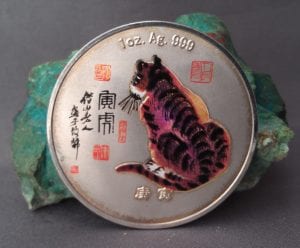
Counterfeit Chinese silver bullion coin

Source: Silver Coin and Bullion Photos

I bought this coin on eBay, knowing it was bogus and only paying a few dollars for it. I keep it as an example. Some hardcore numismatists even collect counterfeit coins in what they call a “black museum” or “black cabinet” collection.

This coin is just a base metal planchet (a coin blank) that has been stamped and plated in silver. But it is clearly marked as a one ounce .999 fine silver (Ag is the chemical symbol for silver) bullion coin.

Sometimes it’s not easy at all to recognize fake bullion coins. And you may not spot them at first. But there are a few simple techniques that anyone can perform to ID a potential fake.

10 Ways to Avoid Buying Fake Bullion Coins

1. The Bite Test – But Don’t Do This One

You’ve probably seen it in an old movie, or parodied on Looney Tunes – a grizzled, white-haired prospector biting a gold coin to verify if it’s the real deal. It might seem a little odd, but there’s a very good reason for this.

Compared to copper, silver, or other metals that might be used to fake it, gold is very soft metal. So simply biting pure gold will leave a tooth mark – while biting copper or silver will leave you with a dentist bill.

Biting real gold might land you at the dentist office, too. And, best-case scenario, you’ll have a real gold coin with tooth marks on it, which will definitely deflate the coin’s value. So I don’t recommend gnawing on any of your bullion coins, but just wanted to mention it.

2. Familiarize Yourself With the Weight of Bullion Coins

One of the biggest giveaways of a counterfeit bullion coin is its weight. Gold, for example, is a very dense and heavy metal. There are only three non-radioactive metals with a density higher than gold – tungsten, platinum and iridium. And these metals are either too expensive or difficult to work with. So a counterfeit gold coin will almost always be too light.

Counterfeit silver coins can also be too light. Often the discrepancy in weight is obvious. I don’t need a scale to tell that the coin above weights less than an actual silver ounce.

When it’s not so obvious, simply weigh your bullion with a reasonably accurate scale. And don’t forget to keep in mind the difference between 1 troy ounce (31.1 grams) and 1 avoirdupois ounce (28.3 grams). Gold and silver bullion coins are supposed to be 1 troy ounce.

3. Know the Correct Dimensions of Bullion Coins

Another dead giveaway of fake bullion coin is an incorrect diameter or thickness. Counterfeiters often alter the dimensions of bullion coins to add weight, meaning the coin or bar will be too large or too thick.

All legitimate government and private minters have standard dimensions for their bullion coins. You can find these dimensions in a coin catalog or online. If not, you should probably buy a different bullion product.

Get a reasonably accurate set of calipers and take measurements. The tolerances on legitimate bullion coins are miniscule. So when it comes to bullion coins with an inaccurate weights or dimensions, they’re generally fake.

4. Look At the Details – Color, Quality, Content, etc.

Another great way to ID a fake bullion coin is to closely examine the quality and color of the metal. Fake gold coins can appear either too dull or too shiny. And may sometimes also look casted and not pressed, leaving a grainy texture. Other fake bullion coins might be mottled or flecked on the surface.

Other signs of counterfeit bullion coins include tool marks or misshaped edges. The rim is also a good place to easily spot a fake gold coin. Counterfeit gold coins are sometimes made in halves, and then soldered or glued together. A seam on the rim of a gold coin where two halves were joined is a great indication that the coin is counterfeit.

Get a cheap magnifying glass or jewelers loupe and compare the details of the coin to one you know is legitimate. If you don’t have a real coin to compare with, find a photo online and compare the tiny details of the original with the one you’re checking.

Look at the space between letters, look at the size and number of elements. Misspellings or grammar mistakes are obvious signs of a phony. It’s rare, but counterfeiters do overlook simple things like spelling, especially when coins are made in foreign countries.

5. The Ring Test

All metals have a distinct sound when they clang together. It’s not the best way to spot a phony bullion coin, but it can certainly help once you’re familiar with a metal’s sound.

My favorite way to listen to a metal is to flip it. Some metals ring in the air after flipping off your thumb, while others do not. Both pure gold and silver will ring in the air. The counterfeit silver coin that I showed you above does not ring when I flip it.

If it were truly .999 fine silver, it would.

There’s a really cheap way to practice the ring test… Get two U.S. pennies; one minted before 1982, and one minted after 1982. Then, listen carefully for a ringing sound as you flip each one off your thumb.

The penny minted before 1982 will have a high-pitched ring while it flips though the air. The penny minted after 1982 won’t. This is because U.S. pennies minted before 1982 (there are rare exceptions) are made of 95% copper, a metal that will ring. Starting in 1982, the U.S. government began minting pennies with an alloy consisting of 97.5% zinc, a metal that won’t ring. Again, the ring test is not always the best way to spot a phony. But it certainly helps.

6. The Scratch Test

Geologists often use scratch tests in the field to identify a metal. Explorers will scratch a piece of suspect gold on a stone (an unglazed porcelain tile works best) and examine the color streak left behind.

Gold will leave a yellow streak, while something like pyrite will leave a greenish-black streak. But of course, scratching your bullion coins will devalue them, so this is another test that I don’t recommend. Moreover, a counterfeit coin might pass the scratch test if it’s been plated.

There is one scratch test for gold, however, that shouldn’t hurt the value of your coin too much if you just want to try it. Gold has a hardness of about 2.5 to 3.0 on the Mohs scale. Glass, on the other hand, has a hardness of 5.5 on the same scale.

Try scratching glass with the piece of gold. If it scratches the glass, it is definitely not gold, or is mixed with other metals and the purity is very low.

7. Use a Magnet

Both pure gold and silver are non-magnetic. If a bullion coin sticks to a magnet, it’s a counterfeit. Much of China’s counterfeit bullion is produced with iron-based planchets. And a magnet is a cheap, easy way to spot this kind of counterfeit. But like the ring test, a magnet can’t indicate a coin’s metal content with precision. As a good example, the counterfeit silver coin that I showed you above is not magnetic either. But it’s still a fake.

8. Gold and Silver Acid Tests

There are acid tests that you can perform to ensure the legitimacy of bullion. Gold, for instance, is a noble metal. It will not react or dissolve in nitric or sulphuric acid. Putting a spot of nitric or sulphuric acid on a legitimate Gold Eagle should cause no reaction. Acid solutions to test silver are also available.

Acid tests, however, haven’t gotten any safer since Woodstock. And even with the obvious danger of playing with dangerous chemicals aside, acid tests always damage a tiny portion of a coin, devaluing it. So the acid test isn’t exactly ideal for investors with small bullion holdings. However, if you own a large amount of bullion, testing a few coins from of your horde wouldn’t hurt.

9. Use a Counterfeit Gold Coins Detector

There are a few simple counterfeit gold coin detectors on the market. I do not own one personally, nor have ever used one, so I can’t speak from personal experience. However, the counterfeit gold coin detectors on the market today check for three fundamental elements of a legitimate bullion coin that we talked about today: weight, diameter and thickness.

The most popular counterfeit gold coin detector on the market today is the Fisch Fake Coin Identification Gauge.

The downside to the Fisch Fake Coin Identification Gauge (as I see it) is two-fold. First, one detector doesn’t work for all gold coins. Fisch makes a total of seven different-sized detectors. So you might have to buy more than one if you have a lot of different gold coins to test, which brings me to the second big downside – the price.

The Fisch Fake Coin Identification Gauge can set you back as much as $170 per gauge. Again, I don’t have one, and can’t speak from personal experience. But I just can’t see myself paying $170 for what looks like a thick piece of plastic. Besides, it would be cheaper to take your bullion to have it authenticated by an expert.

10. The Absolute Best Way – Only Buy Bullion From Reputable, Licensed Dealers

The absolute best way to avoid being conned is to buy gold and silver bullion from accredited bullion dealers, and avoid private party transactions. For instance, Investment U recommends Asset Strategies International, Inc. For more information on ASI, click here.

If you were sold counterfeit bullion, you can then take immediate action against the offending dealer, as opposed to waiting years and years only to find out you’re holding a worthless metal.

Also, it’s important to trust, but verify. It might be a good idea to buy from one dealer and get your investment appraised by another. Most of the time they’ll do it for free…

Conclusion

Take the time to learn about your bullion. It won’t take long. And I think you’ll find that it’s really very interesting. But more importantly, you’ll save headache and heartache further down the road.

Good Investing,

Luke Burgess

P.S. Our friends at Asset Strategies International, Inc. are offering Investment U readers a special limited time offer. To find out how to get a free Morgan Silver Dollar, click here.

Article by Investment U

EUR Stages Recovery Following EU News

Source: ForexYard

printprofile

News that euro-zone leaders came to an agreement to set up a permanent bailout fund lifted the euro throughout today’s trading session. While Greece still has yet to come to an agreement with its creditors regarding a debt-swap deal, investors responded to the EU news by shifting their funds away from safe-havens to riskier assets. The EUR/USD briefly crosses the 1.3200 line as a result, while the EUR/JPY shot up over 50 pips before staging a downward correction.

Analysts are still maintaining that any gains the euro makes in the coming days are likely to be temporary. Even if Greece finally announces a debt-swap deal, as it is widely expected to do by the end of the week, optimism in the euro-zone economic recovery is likely to be short lived. Signs that Portugal is close to defaulting on its debt are one several indications that the euro-zone crises is far from over.

Tomorrow, traders will want to pay attention to the US ADP Non-Farm Employment Change figure, as it is likely to determine the direction the euro takes in afternoon trading. Last week, negative US news led to major gains for the common currency. Should today’s news come in below forecasts, the euro may be able to extend its bullish trend.

Forex Market Analysis provided by ForexYard.

© 2006 by FxYard Ltd

Disclaimer: Trading Foreign Exchange carries a high level of risk and may not be suitable for all investors. There is a possibility that you could sustain a loss of all of your investment and therefore you should not invest money that you cannot afford to lose. You should be aware of all the risks associated with Foreign Exchange trading.

Earnings Roundup: XOM, PFE

Exxon Mobil (XOM) announced that its profit for the fourth quarter increased by two percent, mainly due to higher prices for crude oil. The company reported earnings of $9.4 billion, or $1.97 per share, versus $9.25 billion, or $1.85 per share, in the same period last year.

Gold Set for Biggest Monthly Gain of C21st, But Ends January with “Lackluster” Physical Interest in Asia

London Gold Market Report
from Ben Traynor
BullionVault
Tuesday 31 January 2012, 09:00 EST

U.S. DOLLAR gold bullion prices looked set to record their largest calendar month gain this century by Tuesday lunchtime in London.

Gold prices hit $1745 per ounce – just less than 14% up on the Dollar gold bullion price set at the last London Fix of 2011.

By this measure, January 2012 looked set to record the fourth-largest calendar month gain in the last three decades, and the biggest since September 1999, the month that saw the signing of the Central Bank Gold Agreement, which limited the sales of gold bullion by signatory central banks.

Stocks and commodities also gained Tuesday, while government bond prices dipped.

“In overnight trade in Asia, we continued to see lackluster physical interest,” says Marc Ground, commodities strategist at Standard Bank.

“[There was] even some scrap gold and silver coming to market from Japanese recyclers…nevertheless, prices held steady.”

Physical volumes on the Shanghai Gold Exchange Tuesday were down 28% on the previous day.
The first day’s trading after Lunar New Year saw “strong physical demand” on Monday, according to one gold bullion dealer in Hong Kong.

Silver bullion prices meantime hovered around $33.80 per ounce – 21.2% up on the start of January.

Industrial manufacturers meantime are set to use over 15,000 tonnes of silver in 2012 – 2.5% more than last year – according to estimates by Barclays Capital. Morgan Stanley meantime reckons investors may invest in 2000 tonnes of silver bullion via exchange traded vehicles – following net selling by such investors of 1300 tonnes last year.

“Silver got hammered [following last April’s peak],” says Dan Smith, head of metals research at Standard Chartered.

“Now we’re into a phase where it will do quite well…Appeal comes from its widespread use in both industry and investment. I think it’s relatively cheap.”

“The short-term investment argument is not entirely convincing,” counters David Jollie, strategic analyst at Mitsui Precious Metals in London, citing “weak industrial demand” in places like China.

Chinese silver imports in December were 36% down on their average for the last two years, customs data cited by newswire Bloomberg show.

Here in the UK, seasonally adjusted M4, the broadest money supply measure, fell 1.4% in December – its largest one month drop since the Bank of England began recording the data in 1982. The year-on-year fall was 2.5%.

Net consumer credit in November meantime fell by £377 million – the first net drop since last January and the biggest monthly fall since the data series began in 1993.

“There is clearly a risk that credit constraints may hinder the reallocation of resources required to rebalance the economy,” Bank of England governor Mervyn King said in a speech last week, adding that “there is scope for interest rates to remain low, and, if necessary, for further asset purchases [to facilitate quantitative easing].”

Eurozone unemployment meantime hit a record high last month at 16.5 million people – with the unemployment rate at 10.4% – according to official figures published Tuesday by Eurostat.

“In many cases you find firms continuing to delay investment projects,” notes Citigroup economist Guillaume Menuet.

“For those that are still making profits, hiring is being frozen, and for those which are under pressure to hit results or losing money, job losses are becoming the only solution that they have.”

Elsewhere in Europe, banks are preparing to borrow at least €1 trillion when the European Central Bank holds its 3-Year longer term refinancing operation next month – more than twice the amount borrowed at December’s 3-Year LTRO.

Greece meantime is hoping to conclude a deal with its private sector creditors by the end of the week, Greek prime minister Lucas Papademos said Tuesday. There remained however no agreement among European leaders over what to do about the deterioration is Greece’s fiscal position.

“Greece’s debt sustainability is especially bad,” German chancellor Angela Merkel said Monday.

“You have to find a way through more action by the Greek government, more contributions by private creditors, for example, in order to close this gap.”

At yesterday’s summit leaders agreed to accelerate the implementation of the €500 billion European Stability Mechanism, the Eurozone’s permanent bailout fund.

There was also endorsement of proposed new deficit rules – although a German suggestion that the EU appoint a budget commissioner to oversee Greece’s finance appears not to be receiving wider support.

“Surveillance of Greece’s progress is normal,” French president Nicolas Sarkozy said, “but there was never any question of putting Greece under guardianship.”

Over in the US, the Commodity Futures Trading Commission, which regulates gold futures and options trading on the New York Comex, has said it is considering new rules aimed at firms using automated and high-frequency trading systems as part of its efforts to implement the Dodd-Frank legislation on financial services.

Venezuela has completed the repatriation of 160 tonnes of gold bullion – around three quarters of its total reserves  that were held in US, European and Canadian banks – newswire Dow Jones reports.

“Venezuela’s gold is now in the hands of Venezuelans, secured by Venezuelans and at the service of all Venezuelans,” said Venezuela’s central bank head Nelson Merentes.

Gold bullion makes up 71% of Venezuela’s total foreign reserves, according to figures from the World Gold Council.

Ben Traynor
BullionVault

Gold value calculator   |   Buy gold online at live prices

Editor of Gold News, the analysis and investment research site from world-leading gold ownership service BullionVault, Ben Traynor was formerly editor of the Fleet Street Letter, the UK’s longest-running investment letter. A Cambridge economics graduate, he is a professional writer and editor with a specialist interest in monetary economics.

(c) BullionVault 2011

Please Note: This article is to inform your thinking, not lead it. Only you can decide the best place for your money, and any decision you make will put your money at risk. Information or data included here may have already been overtaken by events – and must be verified elsewhere – should you choose to act on it.


Jefferies’s Darby Says S&P 500 Index May Rise 10-12% (Video)

Jan. 31 (Bloomberg) — Sean Darby, global head of equity strategy at Jefferies Group Inc., talks about U.S. and emerging market stocks. He also discusses Europe’s sovereign debt crisis and the U.S. economy. He speaks with Rishaad Salamat on Bloomberg Television’s “Asia Edge.” (Source: Bloomberg)

HSBC’s Bloxham Expects RBA to Cut Rates in Next Meeting

Jan. 31 (Bloomberg) — Paul Bloxham, chief economist for HSBC Holdings Plc in Sydney and a former Reserve Bank of Australia official, talks about the nation’s economy and central bank monetary policy. Australian business confidence rose in December to the highest level in seven months after the central bank made the second of two consecutive rate cuts, a private survey showed. Bloxham speaks with Susan Li on Bloomberg Television’s “First Up.” (Source: Bloomberg)

Is It Easy to Identify Forex Broker Scam?

Forex is a $4.2trillion daily business. No financial trading hub can boast of the kind of money that circulates in the Forex market. Given that a few years ago, the daily Forex turnover was just about 30% of today’s values, it is safe to say that in the next five years, we may see the daily turnover reach almost $10 trillion. With so much money floating around in one financial hub, it is not surprising that the Forex market will naturally draw out the human element of greed in some of its participants.

Of all the participants in the Forex market, the brokers are in a better position to profit financially. They make money from spreads and commissions generated by traders, irrespective of the market conditions. In a situation where there is a quest and accompanying pressure by humanity to live well and have the best that life can offer, it is not surprising that some brokers engage in practices that short-change clients and scam money off them.

Many market players do not fully understand the business of Forex trading from the broker’s side before they delve into it. Let’s face it. A trader can only participate in Forex trading through a broker, and most of the time, the trader has to use a firm located far away from his location; possibly in another country. In these circumstances, a trader cannot afford to give his money to just anybody. The situation is not made any easier when you consider that many traders come across brokers through search engines on the internet. Usually it is the glamorous sales pages or the lucrative incentives such as bonuses that attract traders, and there is no room for a physical assessment of the broker’s assets to determine if they are worth what they claim they are.

Forex brokerage business is a bit like banking business. A brokerage needs to have segregated funds to be able to handle settlement of client orders. There has to be lots of liquid cash, distinct from whatever money traders have in the market or what the firm uses for its operations. After clients are settled, the Forex brokerage firm can then harmonize its accounts, know which trader has lost or which trader has made money and work it all out. Harmonizing up to 50,000 trading accounts daily is not an easy job, and deposits will not always cover withdrawals, and that is why a regulatory requirement (where brokers are well regulated) is that a Forex broker must have liquid cash, lodged in a segregated escrow account in a major bank for client settlement. Anything else will be equivalent to running a Ponzi scheme where money from one client is used to pay another client’s settlement.

So if your broker is having problems satisfying withdrawal requests, or out rightly refuses to payout large sums of money that have been accrued by traders as a result of trading profits, then it is almost assured that your broker is a scam broker. Non-payment of profits is the major complaint of scam brokers.

There have been cases where Forex brokerages which eventually folded and ran off with traders’ funds turned out to be businesses run from a kitchen by two or three individuals. No one would like a situation where you work hard and hand over your money to such an arranged brokerage, only for the operators to disappear to some remote island and live anonymously well with your money. One way to avoid this is to use online Forex trading forums to gather as much information about a broker before you commit.

Author: Alexander Collins. Stay safe, use your head and re-evaluate your broker now before it is too late. And last but not least visit my Forex trading blog. As I have many years trading experience, I know almost every unethical trick scam brokers use. On my blog, you can read about their 5 scam methods and identify your Forex broker scam.

Follow PipBurner on Google+: https://plus.google.com/114299061993276296858

Source: http://fastswings.com/FastSwingscom/Blogs/tabid/680/EntryId/1651/Is-It-Easy-to-Identify-Forex-Broker-Scam.aspx

Early Warning Signs that your Forex Broker a Scam

A trader whom we shall call Mr Dee sees a web page advertising a chance to make money from trading Forex. But this web page is one with a difference. He is taken in by the glamorous video of a pretty brunette detailing all the benefits of trading with the broker whose sales page he is looking at. Just then, something she says catches his attention. The broker is offering him a 100% bonus. He cannot believe his ears, but when he decides to pitch his tent with this broker and wires in $10,000. To his surprise, he is credited with an extra $10,000. But that is when he is told by his broker that he has to trade a certain number of times before he can withdraw any profits. He keeps trading, and when he then decides to make his first withdrawal after fulfilling the terms of the bonus, he gets an email saying he has allowed third party trading on his account, and his account is suspended and all funds seized. The broker cuts off all communications with him, and he is left bemused. Further investigation reveals that the broker is in a location which is completely unregulated.

In another scenario, another trader notices that he keeps getting stopped out in one of his Forex accounts even when the price quotes on other trading accounts indicate that the price action still had a few pips to go. He is at a loss as to why this is the case, and all emails to his broker are met with unconvincing responses.

In yet another scenario, trader notices that any time he trades high-impact  news items, and his trade is in a profit, his trading platform freezes up, and he cannot close his trades, until when the market has probably reversed against him. When he tries to withdraw any profits, he has made, his broker finds one reason or the other not to honor the withdrawal request.

 If your broker or any other broker you know has engaged in one or all the practices mentioned above, then that broker is a scam broker. The sad thing is that many cases like this occur, and they are not rare; they are commonplace. For any genuine broker out there, there are 10 scam brokers in operation. The wide geographical location and the absence of a specific global legal framework has made it difficult to pursue and prosecute such scam brokers, and traders have to rely on personal due diligence and a bit of luck or prayers to ensure that they pitch tents with the right brokers.

Here is a list of identified scam brokers, who have closed shop and disappeared with traders’ funds.

  • CrownForex.com
  • CRE Capital Corporation
  • CDH Global
  • Forexgen.com
  • GCI Trading.com (GCI Financial)
  • BForex.com

There are a whole lot of others out there. All you need to do is to check on Forex forums, and you will get so much information that it will almost be criminal for you as a trader to fall into the hands of these scam brokers.

Article was written by Alexander Collins. As a general rule, always choose brokers that are regulated and have a good track record when it comes to trading conditions and withdrawals. Stays the question: “How to choose a Forex broker?” Visit my Forex blog to learn how to choose a broker wisely, and what unethical tricks Forex scam brokers use to rip of retail traders.

Follow PipBurner on Google+: https://plus.google.com/114299061993276296858/

Auto Forex Trading: The Fundamentals of successful trading

With the increasing popularity of Forex trading, a new trend of FX Auto traders is evolving fast. There are many people, especially in today’s unstable economy, who see the Forex market as a safe-investment place. However, all of these new investors are united with the same issues – they don’t have any experience and have no willing to spend days and weeks to study it. So, these guys turn to Forex trading robots then.

Anyway, I am not going to tell you which strategy to choose, but all the written below is based on our choice of a “solid” trading strategy of trading (minimal risks to be taken). Further on, I’ll show you the consecutive steps which an auto-trading beginner should take on my own back. It will handle.

The first thing that I need to do before getting started with a trading robot is decided which kind of trader I am. Actually, I have already chosen – not interested in huge profits and risks, but smaller profits and smaller risks.

Therefore, I am choosing the trading strategy to accompany my trades. As I “fell in love” with a “solid” technique my system defined would not lose more than a certain number of pips in one trade.

As I am trading with an advanced Forex expert, surely I understand that it does the trading for me. I just do the adjustments according to my trading needs. The certain system that I choose also means the currency pairs for trading. So here I see one of the criteria for “loving” or “hating” a certain system – whether it offers needed pairs or not.

After doing all the above, I can actually get down to trading. Then my first step is choosing a system. The indicators of my “natural selection” would be basic parameters and applying a definite filter to the whole list of systems available. So I set:


  • System’s drawdown maximum for one position
  • Number of months since the system became profitable
  • The number of trades, which can’t be less than thirty (a base for accurate info analysis).

These are basic filters that I use, but better results demand more complex filters. To make it clear for myself. I should now compare the results for previous and current filter. I just check the bullet point – the percentage of profitable positions. If a system brings me 32% of them and 68% are losses, I’d better change it for the better ones.

Ok, let’s carry on. Now I am going to see how many positions the system can open at the same time. For instance, mine carries four, which means four times of the exposure of a system which opens only one position.

Now I am ready to examine my systems one by one. Firstly, I will carefully study the system’s chart. Certain periods of time give me the certain chart direction. That makes utmost importance to me! If I am playing “solid” strategy I don’t need so the system’s chart displayed extreme movements. I need it going upward and in small proportions.

Now I am looking at the screen which presents the detailed information about every position opened with this current system. Like an FBI agent working with the suspects’ thorough database, I can see all the details about past and present transactions: activity time, the date of position’s opening/closure, and other useful stuff on this system trade.

Once I went through all the selection “jungles” (and choose a suitable system) I should remember two things. I chose a system after handling all of those steps above, so I will stick to it whatever my emotions tell me. Point two is telling me to set a period of time after which I will adjust the filters again.

The Forex market is like a woman’s mood – has a phenomenal ability to change. Basically, it means my system could not match the chosen criteria next week or month. Alternatively, it could not match this actual period, but become suitable in a month.

As some bachelors wash their socks once in a week or month (oh, dear God!), I would perform this filter with the same “bachelor” periodicity according to my own configuration.

Written by Collins Alexander, founder of ForexEASystems and a blogger. Company that provides automated Forex trading systems and semi-automated Forex strategy. By the way, every Forex trader can find there some Forex freebies as MT4 indicator FX Pulse, Fibonacci and Pivot Point calculators. You can grab these free Forex trading tools at Pipburner – Forex blog.

Find PipBurber on Google+:  https://plus.google.com/114299061993276296858/

Source: http://alansforexblog.com/2011/12/09/auto-forex-trading-the-fundamentals-of-successful-trading/