EUR Bullish After EU Bailout-Fund Agreement

Source: ForexYard

The euro staged a small but significant upward correction during European trading yesterday, following an agreement among euro-zone leaders to set up a permanent bailout fund. The news briefly lifted the EUR/USD above the 1.3200 level, but the pair was not able to sustain its bullish momentum and began falling shortly after. Today, traders can expect heavy volatility in the marketplace ahead of the US ADP Non-Farm Employment Change at 13:15 GMT. A better than expected figure could help the USD in afternoon trading.

Economic News

USD – USD Takes Losses amid Positive Euro-Zone News

The US dollar slipped against its main currency rivals throughout the day yesterday, following positive euro-zone news that led to risk taking in the marketplace. The EUR/USD briefly drifted above the 1.3200 level, while the GBP/USD approached 1.5800 before staging a slight downward correction. Against the safe haven Japanese yen, the dollar was relatively unchanged after hitting a three-month low, which prompted fears that the Bank of Japan would intervene in the currency markets to limit the JPY’s growth.

Turning to today, a batch of significant US economic indicators are forecasted to generate market volatility during European trading. Particular attention should be given to the ADP Non-Farm Employment Change figure. The ADP figure is a precursor to Friday’s all important Non-Farm Employment Change. It is widely considered an accurate indicator of the current employment situation in the US and traders should be aware that heavy market movement will likely take place following its release. Should the figure come in above expectations, the USD could see a boost as a result.

EUR – EUR Stages Recovery Following EU News

News that euro-zone leaders came to an agreement to set up a permanent bailout fund lifted the euro throughout yesterday’s trading session. While Greece still has yet to come to an agreement with its creditors regarding a debt-swap deal, investors responded to the EU news by shifting their funds away from safe-havens to riskier assets. The EUR/USD briefly crosses the 1.3200 line as a result, while the EUR/JPY shot up over 50 pips before staging a downward correction.

Analysts are still maintaining that any gains the euro makes in the coming days are likely to be temporary. Even if Greece finally announces a debt-swap deal, as it is widely expected to do by the end of the week, optimism in the euro-zone economic recovery is likely to be short lived. Signs that Portugal is close to defaulting on its debt are one several indications that the euro-zone crises is far from over.

Today, traders will want to pay attention to the US ADP Non-Farm Employment Change figure, as it is likely to determine the direction the euro takes in afternoon trading. Last week, negative US news led to major gains for the common currency. Should today’s news come in below forecasts, the euro may be able to extend its bullish trend.

JPY – JPY Maintains Gains against US Dollar

The Japanese yen remained close to a three-month high against the US dollar throughout yesterday’s trading day. The JPY’s prolonged bullish trend prompted fears among traders that the Bank of Japan (BOJ) may intervene in the currency markets to limit the yen’s growth. A strong yen tends to have an adverse effect on Japan’s export heavy economy, and the BOJ has taken steps a number of times in the past to reduce the currency’s value.

Turning to today, the USD may be able to recoup some of its recent losses against the yen, providing a batch of US news comes in at or above expectations. Both the US ADP Non-Farm Employment Change and ISM Manufacturing PMI are likely to generate heavy volatility. Traders will want to pay attention to the results of both events, as they may set the trend for the USD/JPY for the next several days.

Crude Oil – Oil Soars Above $100 a Barrel

Positive euro-zone news generated a significant amount of risk taking yesterday, giving crude oil a healthy boost throughout the day. The commodity shot up over 150 pips, to well above the psychologically significant $100 a barrel level. Riskier commodities like crude oil often become more expensive when the euro goes up in value.

Today, traders will want to note the results of a batch of US news that could set the trend for oil going into the rest of the week. The US ADP Non-Farm Employment Change figure, set to be released at 13:15, is likely to generate the most volatility. Should the dollar capitalize on the results of the employment figure, crude may see a downward reversal as a result.

Technical News

EUR/USD

According to technical indicators on the daily chart, this pair is in overbought territory and may see a downward correction in the near future. A bearish cross has formed on the Stochastic Slow, while the Williams Percent Range is currently at the -10 level. Traders may want to go short in their positions ahead of the downward breach.

GBP/USD

Technical indicators are showing that this pair may have hit a significant resistance point and could see a correction in the near future. The daily chart’s Relative Strength Index is in well into the overbought zone, while a bearish cross has formed on the Stochastic Slow. Going short may prove to be the wise choice.

USD/JPY

Technical indicators on both the daily and weekly charts are showing that this pair is oversold and may see an upward correction in the near future. The daily chart’s MACD/OsMA has formed a bullish cross, while the weekly chart’s Relative Strength Index is hovering close to the oversold zone. Traders may want to go long in their positions.

USD/CHF

Most technical indicators show this pair trading in the oversold zone, meaning that an upward correction could take place in the near future. The Williams Percent Range on the daily chart is at the -90 level, while the Relative Strength Index on the same chart has dropped to the 15 level. Going long may be the preferred strategy today.

The Wild Card

CAD/CHF

Technical indicators on the daily chart are showing that this pair is oversold and may see an upward correction in the near future. The Stochastic Slow has formed a bullish cross, while the Relative Strength Index has drifted into the oversold territory. Forex traders may want to go long in their positions ahead of an upward breach.

Forex Market Analysis provided by ForexYard.

© 2006 by FxYard Ltd

Disclaimer: Trading Foreign Exchange carries a high level of risk and may not be suitable for all investors. There is a possibility that you could sustain a loss of all of your investment and therefore you should not invest money that you cannot afford to lose. You should be aware of all the risks associated with Foreign Exchange trading.


Canadian Dollar Loses Steam on Weaker U.S. Outlook

After recently touching a 90-day high against its U.S. counterpart, the Canadian dollar’s advance appears to have stalled. The pause coincided with news that for the first time since last May, Canada’s economy shrank as Statistics Canada reported that the economy contracted by 0.1 percent for the month of November.

While manufacturing and several other sectors managed a gain for the month, a drop in oil and gas production more than offset the gains. November’s decline in GDP comes on the heels of a very weak gain in October making it all the more likely that the final quarter of the year will fall well below Statistics Canada projections. Nevertheless, Statistics Canada, even after factoring in the slowing fourth quarter, still expects GDP to have expanded by 2 percent for the year.

The loonie, as the Canadian dollar is nicknamed, had earlier benefitted from signs that Greece and its creditors were close to working out a deal to swap maturing debt with new debt offered at a significant discount to the bond holders. However, with confidence fading that a deal was as close as originally thought, optimism quickly waned.

After breaking through to parity last week, the loonie lost ground on Tuesday falling to C$1.0034 per U.S. dollar Tuesday afternoon. The retracement can also be linked to the latest U.S. consumer confidence update which shows a significant decline in January. The consumer confidence index fell from 65 in December to just 61 in January – a value of 90 is regarded as a healthy consumer confidence rating.

Should the weaker sentiment translate into lower  U.S. consumer spending, the impact will have an immediate and negative impact on Canadian exporters who count on U.S. consumers buying 75 percent of all Canadian exports.

Article by forexblog.oanda.com

Motorola Solutions Increases Share Repurchase Program

Motorola Solutions (NYSE:MSI) announced it was boosting its share repurchase program to up to $3 billion from $2 billion.Motorola Solutions market cap is $14.91 billion, with shares outstanding of 325.5 million as of October 1st.The company has bought back $1.1 billion through December 31st, and has up to $1.9 billion left in the share repurchase program in 2012.The company also set April 30th as the date for its annual shareholder meeting.

Oil Investors Should Look Towards Dubai

By MoneyMorning.com.au

The way I see it, U.S. and European energy traders will be lucky if the door doesn’t hit them in the backsides as everybody heads for the doors.

Like so many Western investors, they still have their blinders on.

They think that if demand in the U.S. and the European Union (EU) begins to slide that oil prices will fall into the toilet right along with it.

But what they don’t see is that Asian oil demand is what actually “drives” the global oil market.


This is why today’s investors need to adopt an energy investment strategy focused on what is happening on the other side of the Pacific.

Because what happens there is critical to higher prices and profits here.

Here’s why.

First, consider Asian demand.

In the fourth quarter alone, Asian demand increased by 400,000 barrels per day even as consumption in the rest of the world fell by 700,000 barrels a day, according to the International Energy Agency (IEA).

Meanwhile, Chinese demand in particular is so strong that the Red Dragon is set to import more oil than the United States within two years, according to my projections.

And don’t take my word for it. Goldman Sachs Group Inc. (NYSE: GS) thinks the U.S. will be overtaken by China this year, while the IEA believes it will happen in 2020.

I think that’s splitting hairs frankly.

What matters is that Asian oil demand growth is likely to represent a staggering 70% of the world’s total oil demand growth this year. Or more depending on which studies you believe.

As China Rises the World Shifts Toward Dubai Oil

Second, consider the effect Asia has on how oil is priced.

U.S. investors have focused on U.S. and Brent oil prices for years, and with good reason. North American markets have been the largest in terms of both consumption and growth.

Now, however, Asia’s demand growth of more than 720,000 barrels per day dwarfs our own.

By comparison, U.S. demand growth is only 310,000 barrels per day while Europe’s demand growth is positively anemic at only 260,000 barrels per day, according to the IEA.

That means Dubai’s Mercantile Exchange is rapidly becoming the new pricing standard -quickly displacing the traditional Brent.

That’s where countries like China, Japan, Indonesia, Vietnam and others in the Asian Rim increasingly price their oil for delivery.

Sadly, most investors can’t even find Dubai on a map, but they’d better learn in a hurry.

Critics note that this is because Dubai crude is of lower quality and the Libyan revolution left world markets without sweet crude.

True, but they’re missing the point – Asian demand is shifting commodity pricing from London, New York and Chicago to Dubai, and even Shanghai, where traders believe it more accurately reflects regional pricing influences.

And as China’s demand grows, prices head higher.

Oil and Emerging Markets: As Simple as Supply and Demand

Third, consider infrastructure development in the emerging markets.

China and India are both constructing new refineries estimated to have more than 1 million barrels a day of processing capacity between them.

Admittedly, bringing an additional 1 million barrels a day of production capacity on line doesn’t sound like a lot in the scheme of things, especially when we’ve become numb to trillion-dollar deficits and bailouts. But think again.

The world consumes approximately 89.5 million barrels a day yet has production capacity of only 90 million barrels a day give or take.

This means the amount of production capacity being brought on line exceeds total current global excess production. It also means that the placement of that new capacity – in China and India – is likely to have a significant impact on global pricing.

Think about it. Supply and demand determines prices. It’s one of the most basic of all economic principles.

If demand increases or there is a disruption in supply, there is upward pricing pressure. If demand falls relative to supply, prices drop.

By the same measure, if there is a limited supply and growing demand coupled with new capacity, pricing power shifts from markets where demand has dropped to markets where demand is rising.

You see this in your own neighborhood on a much smaller scale already.

If there are two service stations in town and a third one is built, customers start buying from the third station… particularly if it’s closer to where they live, has more attractive prices, better gas, or is closer to the refineries servicing it.

Initially prices will drop in response to increased competition. But, over time, as the new entrant disrupts the existing supply and demand balance, prices actually tend to rise, particularly if the three service stations now have to fight over the same limited number of tankers serving the community.

Then there is the process of demand building to consider. New capacity arguably facilitates demand growth.

I think that’s a battle that’s already begun.

Take the Chinese government for example. Beijing is likely to use its newly built refinery capacity to boost strategic reserves.

Many people believe this will be a function of China’s growing military demand, but China’s growing transport sector is far more important because it moves the goods needed by 1.3 billion people to market.

So they’ll buy as much oil as it takes to prevent a revolution…even if it means we don’t have any left to buy (except at exorbitantly high prices). This is why Chinese oil companies have been buying up oil assets anywhere they can get their hands on them.

They know it’s an issue of domestic survival rather than global domination, as the West prefers to think about their action.

At the same time, the so-called Arab Spring has interrupted the capital investments needed to maintain current oil production, shipping, and pricing levels.

This is significant because oil markets cannot function without constant capital improvement and investment, at least not at current prices.

Factor in the vulnerable oil transportation routes in the Gulf, the Malacca Straits and one can easily envision $150-$200 a barrel in risk premiums alone if things heat up…even without open hostilities.

More if the shooting starts.

Either way, it’s time for western oil investors to take the blinders off.

Keith Fitz-Gerald
Chief Investment Strategist, Money Morning (USA)

This is an edited version of an article that first appeared in Money Morning (USA)

From the Archives…

Is There a Reason You’re Not Using the 90/10 Strategy?
2012-01-27 – Kris Sayce

In the Market or Under the Mattress?
2012-01-26 – Keith Fitz-Gerald

What if the Australian Dollar Was a Stock?
2012-01-25 – Kris Sayce

Why Tungsten and Other Strategic Metals Could Prove Good Investments
2012-01-24 – Dr. Alex Cowie

Will These Commodities Help You Claim The Best Investment Gains Of 2012?
2012-01-23 – Dr. Alex Cowie


Oil Investors Should Look Towards Dubai

Why You Should Pay Attention to the ASEAN Bloc

By MoneyMorning.com.au

China and India are now seen as distinct investment areas, rather than just another part of an emerging-market whole. But this isn’t true of Southeast Asia and the ASEAN bloc.

Few investors think about this region in its own right. And there are very few dedicated Southeast Asia funds. Even some that are supposed to focus on the region have drifted into investing in Korea, Taiwan and China.

Yet, this is a major part of the emerging world and it deserves far more attention than it gets.


From an investment viewpoint, the best way to assess Southeast Asia is to look at the ASEAN countries collectively, rather than as individual economies. The ten-member ASEAN bloc (Association of South East Asian Nations) consists of founders Indonesia, Malaysia, Philippines, Singapore and Thailand, as well as later entrants Brunei, Vietnam, Laos, Myanmar and Cambodia.

And there are several reasons why the region is well worth a look. First, ASEAN is slowly morphing from a talking shop, into what could be a meaningful economic bloc.

ASEAN has been around for a long time – the first five members joined in 1967. For much of that time it was largely meaningless, with little real cooperation between most of these members. But events of the last decade – such as the global financial crisis and the growing clout of China and India – have made Southeast Asia governments aware that they could benefit a great deal from pulling together.

ASEAN has a Bright Future

So ASEAN is now working towards the ASEAN Economic Community (AEC). This is a EU-style project to free-up movement of goods, capital and labour across the region. Whether some of the loftier goals for the AEC will be achieved isn’t clear. But when it comes into force in 2015, there should be very large cuts in tariffs and other barriers to trade and cooperation.

Second, a unified ASEAN is a significant marketplace by any standards. It has a population of almost 600 million, with better demographics than China, Europe or the US. Most people within ASEAN remain relatively poor, but most countries have an expanding middle class. If development continues successfully, it promises strong consumption growth for many years to come.

The third positive, is that there are few financial barriers to consumption and investment growth in the future. ASEAN learned a hard lesson from the 1997 Asian crisis and today local finances are in pretty good shape. Debt levels generally remain low for governments, households and corporates, while ASEAN banks are mostly well capitalised with good balance sheets. While most of the world must deleverage, ASEAN is on the right side of the credit cycle.

Fourth, ASEAN is diverse. It spans the entire range from wealthy, developed Singapore to poor, authoritarian Burma. This means it offers a wide range of investment opportunities. It’s well provided with natural resources, without suffering the ‘resource curse’ where unbalanced economies become too dependent on oil or mining. Even being often overlooked by investors can be an advantage, since there are plenty of under-researched companies where an active investor can find value.

ASEAN Still Has Risk

In case this sounds too Panglossian, ASEAN is obviously not immune to troubles in the rest of the world. It’s geared to export demand from the US, Europe and China, so recessions or slowdowns in these will definitely be noticed in Southeast Asia.

What’s more, financial ties in the form of European bank lending to the region means it will feel the impact of a European banking crisis. It’s worth noting though, that ASEAN is probably better placed than most of the emerging world, as most European lending to Asia is trade finance where the gap can more easily be filled by loans from governments and multilateral institutions such as the Asian Development Bank.

But I believe that ASEAN deserves more attention than it’s yet getting – and that there are some very attractive long-term opportunities here.

Cris Sholto Heaton
Contributing Editor, Money Morning (UK)

Publisher’s Note: This is an edited version of an article originally published in MoneyWeek (UK).

From the Archives…

Is There a Reason You’re Not Using the 90/10 Strategy?
2012-01-27 – Kris Sayce

In the Market or Under the Mattress?
2012-01-26 – Keith Fitz-Gerald

What if the Australian Dollar Was a Stock?
2012-01-25 – Kris Sayce

Why Tungsten and Other Strategic Metals Could Prove Good Investments
2012-01-24 – Dr. Alex Cowie

Will These Commodities Help You Claim The Best Investment Gains Of 2012?
2012-01-23 – Dr. Alex Cowie


Why You Should Pay Attention to the ASEAN Bloc

How to Win Even if the Australian Stock Market Doesn’t Go Up

By MoneyMorning.com.au

Calm.

There’s no other word to describe it.

Since the beginning of January the Australian stock market has gained about 5%. It has done so in a calm and unexciting way. (OK, there are two words to describe it.)

That doesn’t mean it has gone up in a straight line, because it hasn’t. But so far, the stock market has lacked the crazy market volatility we saw for most of last year.

If you’ve forgotten already, perhaps this chart will remind you:

market chart
Click here to enlarge

Source: Google Finance


So, does this mean it’s safe to pile back into the market?

After all, there are still a bunch of reasons why you wouldn’t buy into the Australian stock market: European debt problems, U.S. debt and economic growth worries, a slowdown in China, falling Aussie company profits.
But that doesn’t mean you should avoid it altogether…

Have the Pros Given Up?

In fact, we’ll argue the best time to buy risky assets is when the stock market is at its most risky. Mainly because the stock market has priced in much of the doom and gloom.

And while we won’t say the Australian stock market is at its most risky today, it’s pretty darn close to it. What’s more, it seems even the pros are giving up. We’re starting to see more stories such as this in today’s Australian Financial Review:

“The majority of superannuation funds have failed to meet their return targets over the past five, seven and 10 years…

“Some experts argue that super funds, which typically expect to return between 3 per cent and 4 per cent above the rate of inflation annually over the long term, should be lowering their return objectives to reflect the dismal outlook for economic growth.”

And even the Future Fund is making a big deal of having low exposure to the stock market. According to its latest quarterly report, the Future Fund has 31.6% in stocks. The rest is in cash, bonds and other investments.

Future Fund chairman David Murray says, “Super funds are over-allocated to Australian equities. There is not a lot wrong with having extra cash.”

So while we agree that most investment managers have too much of their clients’ funds in shares, we don’t believe investors and investment managers should lower their return objectives.

To our mind it’s admitting defeat. It’s like a train operator changing the timetable to reflect the late running of trains rather than trying to improve the service so the trains run on time.

The biggest mistake an investor can make is to give up.

You Need to Make the Time to Invest

Now, it doesn’t mean you have to hit the investing ball for six every year. What you have to do is actively manage your asset allocation.

That means putting money into safe assets and protecting your capital. But it also means putting part of your money into unsafe assets… investments that can move wildly up and down.

The question is, how much to allocate to these assets?

Here’s what you need to know: the more time you can devote to actively managing your investments, the less you need to put into risky assets. That sounds counterintuitive we know.

It means if you’re an investor who can stay home all day trading the stock market, you may only need to risk 5% of your portfolio on risky trades. Simply because you can quickly cut losses or lock in gains.

If you can spend some time – but not all day – on your share portfolio, then small-cap stocks are a good option. You could invest 5-10% of your portfolio to get leverage to a rising market. But you limit your downside if the stock market falls… because you’ve only allocated a small amount of your cash to small-cap stocks.

Whereas if you can’t devote much time to your investments you need to risk more. So you can potentially benefit from longer-term investment cycles. But the trouble with that strategy – as you’ve seen since 2007 – is it can take a long time for the cycle to run its course.

It’s nearly five years since the stock market topped out in 2007 and the market is still down about 40% from the peak.

How much longer will you have to wait for the stock market to breakeven with 2007? And then how much longer before you can gain back the returns you’ve missed out on?

Our guess is it could take at least five years to get back to 2007 levels. And 10 years is a long time and a lot of effort to make a 0% annualised return.

Understand the Big Picture Then Pick the Stocks

Bottom line: it’s not too late to try and make up for missed opportunities and negative returns over the past five years.

But the longer you wait the harder it is to make up lost ground.

That said, asset allocation is only part of the story. It’s also important to understand the broader market and economy (no-one said investing was easy!). Because if you understand the big picture it will help with your asset allocation.

Getting this right is the basis for our presentation at the After America investment conference in Sydney next month.

During the presentation we’ll follow up on some of the general themes (including asset allocation and portfolio management) we’ve addressed in Money Morning, plus we’ll provide specific investment advice on where you should put your money.

As we say, it’s not too late to make changes to your investment strategy… but the clock sure is ticking.

Cheers.
Kris.

Publisher’s note: If you enjoy reading Kris’s essays in Money Morning, you’ll love hearing him talking about the challenges facing Aussie investors in person. This March, Kris will be speaking at the first ever Port Phillip Publishing investment symposium in Sydney. Come along. Meet Kris. Ask him tons of questions. Marvel at how tall he is. For more information on our not-to-be-missed March conference, go HERE

Related Articles

The Conference of the Year for Australian Investors

Are ASX Energy Index Stocks Worth The Risk?

Will These Commodities Help You Claim The Best Investment Gains Of 2012?


How to Win Even if the Australian Stock Market Doesn’t Go Up

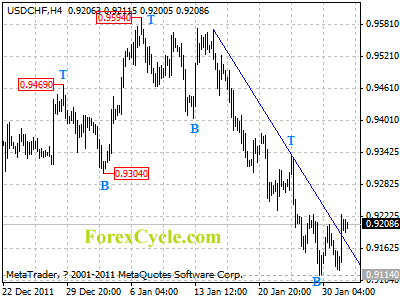
USDCHF breaks above downward trend line

USDCHF breaks above the downward trend line on 4-hour chart, suggesting that a cycle bottom has been formed at 0.9114. Further rally would likely be seen later today, and the target would be at 0.9300 area. Key resistance is at 0.9350, as long as this level holds, the bounce from 0.9114 is treated as consolidation of downtrend from 0.9594, and another fall towards 0.8900 is still possible after consolidation. On the upside, a break above 0.9350 will indicate that the downtrend has completed at 0.9114 already, then further rise towards 0.9594 previous high could be seen.

usdchf

Forex Forecast

Starbucks Inks Deal With Tata Global Beverages For India JV

Starbucks (NASDAQ:SBUX) entered into a joint venture with Tata Global Beverages to open stores in Mumbai and New Delhi in 2012, Tata’s Chairman RK Krishna Kumar said in Mumbai.The newly formed venture firm, Tata Starbucks Ltd., will operate Starbucks cafes all across India.Starbucks also announced Monday that it intends to boost prices in China.

Analyst Moves: AON, NKE

Aon (AON) was upgraded today by Morgan Stanley (MS) from underperform to neutral, with a price target of $50, as the company has been gaining market share, along with seeing an improvement in pricing trends. Shares are higher by about three quarters of a percent.