Bernanke’s Comments “Lend Support” to Gold, But Precious Metals Dip Following Strong US Jobs News

London Gold Market Report
from Ben Traynor
BullionVault
Friday 3 February 2012, 09:30 EST

SPOT MARKET gold prices slipped back below $1750 an ounce while stock markets rallied strongly following the release of better-than-expected US jobs figures on Friday.

The Bureau of Labor Statistics nonfarm payrolls report, published on Friday, shows that the US added a net 243,000 nonagricultural private sector jobs last month. In addition, both November and December’s nonfarm figures were revised upwards. The unemployment rate fell to 8.3%, down from 8.5% the previous month.

Silver prices also fell following the nonfarm announcement, while the US Dollar saw an immediate gain against major currencies such as the Pound, Euro and Yen.

Earlier on Friday Dollar gold prices hit their highest level in 11 weeks at $1762 per ounce, a level not seen since mid-November, following US Federal Reserve chairman Ben Bernanke’s appearance before Congress on Thursday.

“We are not seeking higher inflation,” Bernanke told the House Budget Committee, in response to comments from Republican representative Paul Ryan, who said he was “greatly concerned to hear the Fed recently announce that it would be willing to accept higher-than-desired inflation in order to focus on the [employment] side of its dual mandate.”

“We do not want higher inflation and we’re not tolerating higher inflation,” responded Bernanke, although elsewhere in his testimony he warned that “risks remain that developments in Europe or elsewhere may unfold unfavorably and could worsen economic prospects here at home.”

Fed policymakers revealed last week that a majority of them expects interest rates to remain near zero for at least the next three years. Bernanke added yesterday that the speed and aggressiveness of any future rate rises “may depend to some extent on the balance” between maintaining employment and pursuing price stability.

“These comments lent support to gold,” reckons James Steel, chief commodities analyst at HSBC in New York, noting that the Fed could opt for additional quantitative easing if progress towards full employment was inadequate.

US inflation as measured by the consumer prices index fell to 3.0% in December, down from 3.4% the previous month, but up from 1.1% 12 months earlier.

“As every day goes by, I see deflation in the things you own and inflation in the things you need,” said hedge-fund partner Kyle Bass at a meeting of the University of Texas’s $25.7 billion Investment Management Co. (Utimco) in Austin, Texas on Thursday.

“I’m against selling any of the gold,” Bass said, referring to the $1.2bn which Utimco now owns in physical gold bars after switching out of futures contracts then worth $992m in April 2011.

Over in Europe, Greece’s finance minister Evangelos Venizelos said Thursday that the European Central Bank would need to take losses on its Greek government debt holdings if Greece is to achieve the goal of reducing its debt-to-GDP ratio to 120% by 2020.

Greece is yet to agree a deal with its private creditors over the size of losses they will take. The lack of a deal throws into doubt Greece’s €130 billion second bailout, without which it will be unable to pay out on maturing bonds next month.

“Greece needs a new program, there’s no question about that, but Greece must create the conditions for it,” German finance minister Wolfgang Schaeuble said Thursday.

“We can’t pay into a bottomless pit.”

“Precious metals are enjoying some support from safe-haven demand as issues in the Eurozone once again weigh on investors’ minds,” says Marc Ground, commodities strategist at Standard Bank, who sees resistance for gold prices at $1768 per ounce.

Gold jewelers in India meantime the government to raise the duty drawback – the amount of duty exporters can claim back from the Department of Revenue – applicable to the gems and jewelry sector. The request from the Federation of Indian Exports Organisations follows the government’s decision last month to increase duty on gold bullion imports and switch to an ad valorem tax, which takes the form of a percentage of value rather than a discrete amount by weight.

Heading into the weekend, Dollar gold prices looked set to record their fifth straight weekly gain.
The gold price in Euros meantime was up 1.8% for the week by Friday lunchtime, and closing in on the four-month high touched earlier on Friday at €43,098 per kilo (€1340 an ounce).

Like those for gold, Dollar silver prices also hit their highest levels since November Friday morning, at $34.44 per ounce.

Based on London Fix prices, gold is up nearly 15% since the end of 2011, while silver is up by more than 19%. Despite silver’s rise, however, the world’s largest silver ETF, the iShares Silver Trust (ticker: SLV) has seen its holdings of bullion rise just 0.2% since the start of 2012.

By contrast, the amount of gold held to back shares in the SPDR Gold Trust (ticker: GLD), the world’s largest gold ETF has grown 1.8% over the same period, rising to its highest level since December 20 yesterday at 1277 tonnes.

Ben Traynor
BullionVault

Gold value calculator   |   Buy gold online at live prices

Editor of Gold News, the analysis and investment research site from world-leading gold ownership service BullionVault, Ben Traynor was formerly editor of the Fleet Street Letter, the UK’s longest-running investment letter. A Cambridge economics graduate, he is a professional writer and editor with a specialist interest in monetary economics.

(c) BullionVault 2011

Please Note: This article is to inform your thinking, not lead it. Only you can decide the best place for your money, and any decision you make will put your money at risk. Information or data included here may have already been overtaken by events – and must be verified elsewhere – should you choose to act on it.


Forex ct 3-2-12 Video News Update

Video courtesy of ForexCT – A leading Australian forex broker, liscensed by the Australian Securities & Investments Commission, offers the MetaTrader4 and PROfit Platform to retail traders. Other services include Segregated Accounts, Trading workshops, Tutorials, and Commodities trading.

US Non-Farm Payrolls Set to Generate Heavy Volatility

Source: ForexYard

Today’s US Non-Farm Payrolls figure, widely considered the most significant economic indicator on the forex calendar, is set to generate heavy trading today. At the moment, analysts are predicting that the US added somewhere around 150K jobs in January. Should the final result come in below expectations the USD may come under renewed pressure to close out the week.

Economic News

USD – Negative Euro-Zone News Gives USD Temporary Boost

Fresh concerns regarding Greece’s debt negotiations sent investors to safe-haven assets during the beginning of yesterday’s trading session. The news resulted in the US dollar recouping some of its recent losses against the euro. The EUR/USD dropped to the 1.3085 level before staging a correction during the evening session. The greenback was not as fortunate against other riskier currencies. The AUD/USD range traded for much of the day, maintaining its recent bullish trend around the 1.0725 level.

Turning to today, traders can expect significant volatility in the marketplace as the US Non-Farm Employment Change figure is set to be released. Wednesday’s ADP Non-Farm figure, which is widely considered an accurate predictor of today’s news, came in below expectations and resulted in some bearish movement for the US dollar.

At the moment, analysts are predicting that the US added 150K jobs in January. Should the final figure come in significantly below that number, the greenback may extend its losses. At the same time, traders will want to note that the employment statistic is notoriously difficult to predict. A better than expected figure is entirely possible, and could result in dollar gains ahead of markets closing for the weekend.

EUR – EUR Turns Bearish Following Greek Debt Uncertainties

The euro saw bearish movement during the European session yesterday, amid fresh worries that Greece’s negotiations with its creditors may prove to me more difficult than originally thought. Additionally, worries regarding Portugal’s sovereign debt added to investor pessimism regarding the euro-zone economic recovery. As a result, the EUR/USD dropped as low as 1.3085 before staging an upward correction toward the evening session. Similarly, the EUR/JPY tumbled almost 100 pips, reaching as low 99.59 before staging a reversal.

Turning to today, the US Non-Farm Payrolls Figure is likely to dictate the direction markets take and traders can expect extreme volatility when the indicator is released at 13:30 GMT. At the moment analysts are predicting that the US added around 150K jobs in January. A worse than predicted result is likely to weigh down on the dollar and could give the euro a significant boost to close out the week. At the same time, should the employment number come in above expectations, the common currency may extend its downward movement.

JPY – JPY Maintains Upward Trend against USD

The USD/JPY stayed largely bearish throughout yesterday’s trading session, as concerns continue to grow that the Bank of Japan (BOJ) may soon intervene to limit the yen’s strength. Japan’s export based economy is negatively impacted when the yen displays bullish strength. The USD/JPY was largely range trading yesterday between 76.03 and 76.20. Analysts are warning that should the pair drop to around the 75.50 level, the BOJ may make a move.

Whether or not the pair could drop that low today, will largely be dependent on the US Non-Farm Payrolls figure, set to be released at 13:30 GMT. Traders will want to note that should the figure come in below expectations, the yen is likely to extend its bullish trend on the dollar. Whether or not that will lead to the BOJ intervening in the market place is not yet known, but traders will want to pay careful attention to the news to find out.

Crude Oil – Crude Oil Tumbles amid Increase in Risk Aversion

Crude oil continued to fall throughout the day yesterday, as fresh euro-zone debt concerns drove investors away from riskier assets. The commodity fell as low as $96.24 a barrel during the European session before staging a slight upward correction. Fresh concerns regarding both Greek and Portuguese debt contributed to the bearish direction oil took. Crude often falls when there is a bearish outlook for riskier currencies, largely because the commodity becomes less attractive to international investors.

Whether or not crude will maintain this trend today will largely be dependent on the results of the US Non-Farm Payrolls figure, set to be released at 13:30 GMT. A worse than expected US jobs figure may weigh down on the dollar ahead of markets closing for the week. In such a case, the euro may see a boost which would likely result in a bullish reversal for oil.

Technical News

EUR/USD

After steadily increasing in recent days, technical indicators are now showing that this pair may see a downward correction in the near future. The daily chart’s Williams Percent Range is currently at the -10 level, while the Relative Strength Index has drifted above 70. Going short may be the preferred strategy today.

GBP/USD

Technical indicators are showing that this pair is in overbought territory and could see a bearish correction shortly. A bearish cross has formed on the daily chart’s Stochastic Slow, while the Relative Strength Index on the same chart is well into the overbought zone. Going short could prove to be the wise choice.

USD/JPY

While a bullish cross has formed on the daily chart’s Stochastic Slow, indicating impending upward movement, the Relative Strength Index on the same chart is in neutral territory. Traders may want to take a wait and see approach for this pair, as a clearer trend may present itself later on.

USD/CHF

Technical indicators on the daily chart show this pair trading in oversold territory, which is typically a sign of impending upward movement. The Williams Percent Range has drifted below the -90 level, while the Relative Strength Index is at 20. Opening long positions may be the wise choice.

The Wild Card

AUD/NZD

Most technical indicators show this pair trading in the oversold zone, typically a sign that upward movement could occur in the near future. A bullish cross has formed on the daily chart’s Stochastic Slow, while the Relative Strength Index on the same chart is hovering around the 30 level. forex Forex traders may want to go long in their positions today, ahead of a possible upward breach.

Forex Market Analysis provided by ForexYard.

© 2006 by FxYard Ltd

Disclaimer: Trading Foreign Exchange carries a high level of risk and may not be suitable for all investors. There is a possibility that you could sustain a loss of all of your investment and therefore you should not invest money that you cannot afford to lose. You should be aware of all the risks associated with Foreign Exchange trading.


Godzilla Will Come Out of Tokyo Bay Before Japan’s Economy Rebounds

By MoneyMorning.com.au

Let’s talk Japan.

Every year some analyst comes out with a variation of the story that Japan’s economy is about to rebound.

Usually the argument goes something like this: Japanese markets are impossibly cheap and the central bank will be there to prevent a catastrophe.

Or sometimes there is another variation of the Cinderella story.

Either way, don’t hold your breath. Japan’s economy posted its first trade deficit since 1980 last year and the big trade surpluses needed to drive the Nikkei back to its glory days are over.

At best, Japan’s economy is going to see balanced trade figures or a small surplus in the years ahead. It won’t be enough.

If you’re not familiar with what a trade deficit is, here’s what you need to know: Japan imported $32 billion worth of stuff more than it exported for the first time in 31 years.

Fighting the Demographic Tide


Critics say there are mitigating factors behind the figures and they’re right.

Against the backdrop of one of the world’s fastest aging populations, one of the lowest birth rates on the planet, a renewed reliance on foreign energy, and a yen that is so expensive that Japanese corporations are offshoring production, it won’t be long before the country eventually plows through its savings.

So $32 billion is just the beginning…

In fact, we are more likely to see Godzilla walk out of Tokyo Bay than we are to witness a return to Japan’s halcyon days.

Worse, I believe that within the next five years, Japan’s economy will long for the good old days when the trade deficit was merely $32 billion, instead of $100 billion, $200 billion or worse.

Not one of the things I’ve just mentioned – that the critics cite as short-term influences – are anything but continuations of much longer-term trends. Nearly all of them are being driven by Japan’s declining population.

You may not know this, but Japan’s population is projected to shrink by 30% by 2060. That means the total population will go from 128 million people today to only 87 million people in less than 50 years.

That’s hard to imagine since Japan is one of the most densely populated countries on the planet. But the effects are already visible.

In my neighborhood in Kyoto, for example, we see abandoned houses that fall in on themselves after people die and there are no longer any other family members to live there. We see schools that are shut down in the region because there are no kids to attend them.

We’re also seeing companies shuttered because there are no markets for their products, including my wife’s family kimono business, which closed after 300 years in existence.

Simply put, you just can’t grow a population or its stock markets without people.

Japan also has no immigration policy to speak of, so there is no means of replacing the “silvers,” or senior workers, who are leaving their productive years behind them.

By 2060 the number of people who are 65 or older is going to double. At the same time, the number of people in the workforce between 15 and 65 is going to shrink to less than 50% of the total population.

By 2050, there will be 75 retirees for every 100 workers. By comparison, in the United States in 2050 there will be about 32 retirees per 100 workers.

You’d think Japan could get “busy” and produce more children but even that’s problematic. The country has one of the lowest birthrates on the planet. Many young Japanese simply don’t want romance — let alone children.

In fact, many Japanese don’t even want sex.

As reported by CNBC, one AFP study reported that 36.1% of teenage boys between the ages of 16 and 19 have no interest in sex. That study in 2010 reflected results that were double the 17.5% reported only two years earlier. Girls are even worse, with more than 59% in the same age group reporting no interest.

Things are so bad according to one study I’ve seen, that at the current birth rate the last Japanese person will be born 953 years from now.

Game Over For Japan?


Critics challenge this assumption, arguing that somehow Japan’s hyper-aged will reinvigorate the economy in an orgy of retirement spending and consumption.

That depends on generous pensions and an intact financial system – neither of which Japan has at the moment.

Japan’s debt stands at 200% – 253% of GDP, depending on which studies you read, and is headed in the wrong direction. In fact, it looks like a ski jump that’s three times our own debt burden. Senior citizens I know are doing everything they can to hang onto their jobs for as long as they can.

As a result, there is literally nowhere for younger workers to go… except into low value “arubaito” or part-time work with no benefits, no promotions and very little economic value to contribute to Japan’s recovery.

My nephew, for example, struggled for years in such a job before getting training and finding work as a mechanic for Mazda.

Devastating Decline

To be fair, Japanese citizens purchase approximately 95% of Japanese debt. That’s why the country has been able to hang on and has not had its own Greek holiday.

By contrast, we borrow about 50% of our money as a nation from overseas, and we’re dangerously close to our own version of Greece’s meltdown.

But as the number of retirees rises and the number of workers falls, the Japanese government is going to have challenges maintaining this internal funding capacity.

At some point – either because there are not enough debt buyers or rates rise too high – they’ll have to turn to external creditors and interest rates that could easily be double the 1.5% the Japanese government pays lenders now.

At that point, debt payments would consume more than half of all government revenue according to The Atlantic.

And then it’s game over.

So what’s an investor to do? Well for one thing, I sure as hell wouldn’t invest in Japan on anything other than an extremely short-term basis.

Despite the fact that trade deficit numbers may ping-pong back into positive territory in the months ahead, there’s no reversing the current long-term trend.

The notion that the Nikkei is somehow undervalued is naïve if you do not take the population and its effect on debt into account.

While it is true there may be short bursts of growth, there’s no ignoring the fact that the bellwether index is trading at 8,802.51, or 77% below the high it achieved in 1990 and 12% below where it started in 1984.

With very few exceptions, money invested in Japan’s economy is going to get trapped there.

That’s why, unless you’ve got money to burn, you can say “sayonara” to Japan.

Keith Fitz-Gerald
Chief Investment Strategist, Money Morning (USA)

Publisher’s Note: This article originally appeared in Money Morning (USA).

From the Archives…

Is There a Reason You’re Not Using the 90/10 Strategy?
2012-01-27 – Kris Sayce

In the Market or Under the Mattress?
2012-01-26 – Keith Fitz-Gerald

What if the Australian Dollar Was a Stock?
2012-01-25 – Kris Sayce

Why Tungsten and Other Strategic Metals Could Prove Good Investments
2012-01-24 – Dr. Alex Cowie

Will These Commodities Help You Claim The Best Investment Gains Of 2012?
2012-01-23 – Dr. Alex Cowie


Godzilla Will Come Out of Tokyo Bay Before Japan’s Economy Rebounds

Facebook Shares – Notice for Mad Punters: Buy This Stock

By MoneyMorning.com.au

Whatever you think of Facebook (our old pal, Dan Denning says Facebook “diminishes the quality of your thought…”) there’s no arguing it’s a great example of free market entrepreneurialism.

For an eight year old company, it has come a long way.

According to the Form S-1 filed with the U.S. Securities & Exchange Commission, Facebook made a USD$1 billion profit in 2011. That’s the third year of profits in a row. It made USD$229 million in 2009 and USD$606 million in 2010.

Make a note. That’s profit. Facebook has more cash coming through the door than it has cash going out the door.


That sets Facebook apart from one of last year’s most-watched public offerings, Groupon Inc., [NASDAQ: GRPN]. In its last annual report Groupon lost USD$389 million in 2010.

And for the first nine months of last year it lost USD$214 million.

One Internet company makes a billion… another loses hundreds of millions.

But here’s the thing: just because Groupon loses money, it doesn’t make it any less entrepreneurial than Facebook.

Both guys behind the firms had an idea. They both figured they could make a bucket load of money from it. So they took a risk and got investors to back them.

The thing for investors, looking at both companies, is which is the better investment?

Should you buy Groupon while it’s still making a loss… but with potentially years of growth ahead of it? Or should you buy Facebook, which is set to trade at a premium? (Meaning that investors have built future profit growth into today’s price.)

Or maybe you should buy both.

Two Winners and One Loser


Well, let’s look at Groupon first. We’ll straight out say we wouldn’t buy it.

Simply because we don’t see it as a viable business. The company approaches businesses to convince them to offer discounts. Groupon then splits the revenue with the business customer.

For instance, if a restaurant offers a 50% discount off a $100 meal, it splits the remaining $50 with Groupon. That’s great for Groupon. But not so great for the business – effectively, discounting its product by 75% with no guarantee of repeat business.

To us, that seems a costly way to get customers. And it seems as though while Groupon and the end consumer win, the business loses.

That’s no way to build a viable business. For a company to succeed, each side (the company and consumer) needs to believe they’re getting a good deal. That’s the beauty of free market capitalism. Each side of a deal walks away thinking they’ve come out ahead.

We’re not convinced that happens with Groupon.

Compare that to Facebook, where everyone gets something of perceived value: Facebook makes money. Advertisers pay comparatively cheap ad rates to get in front of hundreds of millions of people. And consumers get to network, show off and play silly games.

Everyone’s a winner.

So, does that mean we’d buy Facebook? Let’s see…

Can Facebook Grow Profits 275%?


Even though everyone’s a winner, it doesn’t make Facebook a slam-dunk trade. As we say, investors have built profit growth into the current price.

Estimates are Facebook will list with a market capitalisation of USD$75-100 billion. That’s huge. It’s more than 100-year old technology company, Hewlett Packard [NYSE: HPQ], which has a USD$56.6 billion market cap.

And more than dot-com darling, Amazon Inc. [NASDAQ: AMZN], which has a market cap of USD$82.7 billion.

Not only that. If Facebook has a market cap of USD$75 billion, that would value it at 20-times sales, and 75-times earnings. That’s compared to Google Inc’s. [NASDAQ: GOOG] 20-times earnings.

In other words, investors figure Facebook still has plenty of growth. And maybe it has. But with a big premium priced in, investors have big expectations.

For example, let’s assume over time Facebook’s value will move closer to Google’s of 20-times earnings. In order to justify a market cap of USD$75 billion, Facebook will need to grow profits to USD$3.75 billion.

That’s a 275% increase on today’s profits.

But that doesn’t mean the Facebook share price would go up. As we say, the share price already reflects future growth. And if it doesn’t achieve the profit growth… oh boy, the share price of Facebook would soon take one heck of a beating.

And of course, investors won’t want the Facebook share price to stay still. Investors will want the share price to go up. For that to happen it needs profits to keep growing… USD$5 billion, USD$7 billion, even USD$10 billion or more.

In other words, it has to follow the same earnings growth as Internet giant, Google. That’ll be tough… but not impossible.

New Media Beats Old Media in Ad Growth


Online advertising is growing at more than twice the rate of non-online advertising. For instance, a report at the start of last year by MagnaGlobal projected the following ad growth rates:

Compounded Annual Growth Rates 2011-2016 by Medium

Source: MagnaGlobal


As you can see, every single “new media” ad channel is outgrowing the four “old media” ad channels.

Of course, some of the “new media” is growing from a low base. Such as online video, which only received USD$2.2 billion in ad dollars in 2009 compared with USD$109.5 billion for network television.

But the point is, online ads have plenty of room for growth. You can’t say the same for print advertising. You only have to look at revenues for the big media companies such as Southern Cross Media Group [ASX: SXL] to see how sales and profits have stagnated for the past five years.

So, yes, Facebook does “diminish the quality of thought”. And it is a vacuous, inane and shallow media. And the shares are likely to begin trading for an obscene premium over current profits. But…

This Stock Could Gain 588%


It’s also a great company.

It’s the perfect example of how a free market gives consumers a service they didn’t know they wanted. Remember, when businesses such as Facebook (and just a year before it, MySpace) were created, there was no guarantee of success.

It took guts by the company’s owners and investors to put time and money on the line.

Today, Facebook is a success. And the share price will reflect that.

The only dilemma for potential investors is whether Facebook will follow Google’s lead and gain 588% in eight years. Or whether it will follow MySpace down the toilet (Ed note: News Corp paid USD$580 million for MySpace in 2005… and sold it for USD$35 million in 2011 for a 93.9% loss!)

As a punter, we like Facebook as a red hot gamble. You wouldn’t want to bet your retirement fund on it, because there’s little doubt to us the shares will either soar or slump.

Facebook is a high-risk punt. It isn’t a stock for investors. It’s a stock for crazy speculators.

If that sounds like you… we’d say, go ahead, buy some.

Cheers.
Kris.

P.S. Facebook isn’t the only punt I recommend investors make in 2012. At an exclusive gathering of investors next month, I’ll explain which stocks to buy this year for maximum gains. You can reserve your seat to this event by clicking here

Related Articles

The Conference of the Year for Australian Investors

Are ASX Energy Index Stocks Worth The Risk?

Will These Commodities Help You Claim The Best Investment Gains Of 2012?


Facebook Shares – Notice for Mad Punters: Buy This Stock

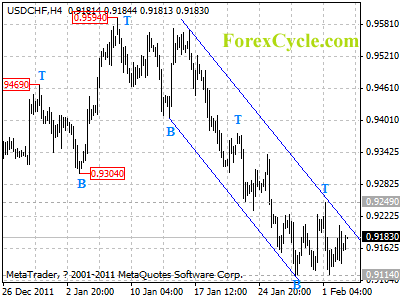
USDCHF traded in a narrow range

USDCHF traded in a narrow range between 0.9114 and 0.9249 for several days. The price action in the range could be treated as consolidation of downtrend from 0.9594. Key resistance is at 0.9350, as long as this level holds, downtrend could be expected to resume, and one more fall towards 0.8900 is still possible. However, a break above 0.9350 will indicate that the downward movement from 0.9594 had completed at 0.9114 already, then the following upward move could bring price back towards 0.9594 previous high.

usdchf

Forex Signals

Thursday 2/2 Insider Buying Report: ETFC, LBAI

Bargain hunters are wise to pay careful attention to insider buying, because although there are many various reasons for an insider to sell a stock, presumably the only reason they would use their hard-earned cash to make a purchase, is that they expect to make money. Today we look at two noteworthy recent insider buys.

Facebook’s Filing IPO Today

Eight years after it was launched from a Harvard dorm room, Facebook is expected to take its first major step to being a publicly traded company Wednesday, according to the Washington Post. The filing is the first step toward what’s shaping up to be one of the highest-buzzed market debuts in history.Facebook has made no secret about it plans to go public, and rumors have been circulating for months that the company would raise as much as $10 billion for the initial public offering — giving it a valuation of $75 billion to $100 billion — though reports Monday from the International Financing Review and the New York Times revised that number down to $5 billion. That number could continue to rise as Facebook measures demand for the stock, which is expected to have its market debut late this spring.

China to Play the Eurozone’s White Knight?

Since the early days of the Eurozone debt crisis, insiders have identified China and its $3.2 trillion in foreign reserves as a potential contributor to a Eurozone bailout fund. Today, Premier Wen Jiabao gave markets reason to believe this may yet be the case when Wen suggested that China is considering the options for how it may contribute to keeping the Eurozone together.

The original European Financial Stability Fund (EFSF) is scheduled to be superseded by the European Stability Mechanism (ESM) later this year. The ESM is expected to provide 500 billion euros ($656 billion) to the establishment of a bailout fund. Wen did not confirm whether  China would contribute to the ESM directly, but this does seem to be the most logical way China could help support the region.

China Desires a Stable Euro and Eurozone

It is in China’s interest to help stabilize the Eurozone. It is estimated that up to one quarter – or roughly 620 billion euros – of China’s foreign exchange is held in euros. Shielding this investment from further decline is obviously of vital importance to China.

However, China also wants to see prosperity return to the region as quickly as possible to protect its export interests.  The wider European Union is China’s largest export market with 282 billion euros worth of goods exported in 2010. Sales for 2011 continued to increase but at a slower pace and there is a growing worry that sales could soon start to decline.

German Chancellor Angela Merkel arrived in China today to kick off a three-day visit aimed largely at reassuring China that European leaders have a handle on the debt crisis.

Scott Boyd is a currency analyst and a regular contributor to the OANDA MarketPulse FX blog


Despite “Signs of Improvement” Bernanke Holds Near-Zero Rate Pledge

Speaking before the House Budget Committee in Washington today, Federal Reserve Chairman Ben Bernanke said that the U.S. economy appeared to be gaining in strength.

“Fortunately, over the past few months, indicators of spending, production, and job-market activity have shown some signs of improvement,” Bernanke testified. “The outlook remains uncertain, however, and close monitoring of economic developments will remain necessary.”

Despite the more positive tone, Bernanke reaffirmed a continuance of the Fed’s near-zero interest rate policy. Last month, the Fed extended its pledge to hold the line on interest rates for an additional year, stating that rates would likely remain at the record low cap of 0.25 percent until late 2014.

To offset fears that low lending rates could lead to inflation, Bernanke told the Committee that the Federal Open Market Committee (FOMC) still considered 2 percent growth to be the ideal target. Given  the current conditions, the FOMC expects inflation to remain “subdued”.

U.S. Consumer Confidence Falls Sharply in January

Bernanke’s testimony comes less than a week after the release of the January Consumer Confidence Index. The January result was a sharp decline in confidence, falling to 61.1 percent from 64.8 percent after two consecutive months of significant gains. The downturn in the index suggests consumers are increasingly worried that rising costs will take a greater bite out of household budgets.

There is hope that confidence will rise should the employment outlook continue to improve. For the final quarter of 2011, unemployment fell by half a percent to 8.5 percent and momentum appears to be gathering steam with claims for unemployment benefits falling more than expected for the week ending January 21st.

Scott Boyd is a currency analyst and a regular contributor to the OANDA MarketPulse FX blog