Why the US Unemployment Rate is a Slippery Statistic

By MoneyMorning.com.au

The Aussie market has started the week on a good note today, up over 1% after the US markets had a strong finish last week.

The S&P500 index is now just 1.8% away from its highest level since 2008. The Dow Jones index is now at a 3 ½-year high.
It seems like just five minutes ago the markets were on their knees. Sentiment was rock bottom as recently as Christmas. So what’s going on?

Data out of the US has been getting steadily better, and the latest instalment on Friday included the US employment numbers. The Bureau of Labor Statistics (BLS) announced 243,000 new jobs. This was the best result for nearly a year, and continues a steadily growing trend.

The chart below shows these monthly employment numbers for the last 8 years to put it in context. I’ve marked the last few months in red to highlight them.

US employment numbers getting better
Description: employment_numbers.png
Source: forexfactory

On the back of this, the unemployment rate fell from 8.5% to 8.3%.

8.3% is a good improvement from 9.0% just three months ago. A lower US unemployment rate is a sign of improving economic conditions in the world’s biggest economy. If it continues, it will boost stock markets in the US and Australia alike.

The 8.3% figure shows it has been making good progress down from its peak of 10.2%. It is accelerating towards the 5% level that means close to full employment.

But the only problem about government statistics is … well … THEY ARE CALCULATED BY THE GOVERNMENT.

Like lampposts to a drunk, statistics are better for providing support than illumination.

At best, you have to read deep between the lines to draw anything meaningful out of them with analysis. And at worst, you might as well use them to pick your lotto numbers. Statistics can be easily sliced, diced, refried and repackaged to suit a government’s purpose.

Let Me Show You What I Mean…

Imagine, say, a certain American president was keen to serve a second term. His chances would look much better if that stubbornly high unemployment number came down a bit after spending the last 3 years above 8%. Don’t you think?

And doesn’t it seem convenient that the unemployment figure is suddenly heading down in an election year?

A quick bit of digging shows there was one main reason for the big drop in the US unemployment rate. And it had little to do with 243,000 new jobs. Rather it was the record drop in the number of people counted as ‘looking for work’.

The BLS stopped counting 1.2 million people as being in the labour force.

This is the biggest drop on record. It’s very quick and easy to improve the unemployment number when a population the size of Dallas is wiped off the list.

How can the statisticians get away with this?

It’s all in the fine print. When their benefits run out after two years, job seekers drop off the list of those considered to be in the labour force. Hey presto! The labour force gets smaller, and the percentage of those within this that are working, magically gets bigger overnight. Nice one Uncle Sam.

You get a very different picture if you include those that have dropped off in this way. The unemployment rate would be over 11%.

If you also add those that just plain gave up (after three years of rejection letters), as well as those wanting full-time work but making do with part-time jobs, the figure would be 15.1%.

But 8.3% sounds much better in an election year, so that’s what we saw in the mainstream media over the weekend.

The US lost over 8 million jobs in 2008 and 2009.

In the two years since then, just 3.2 million of these jobs have been ‘recovered’. Just another 4.8 million jobs needed then! Even if the unemployment figure kept dropping at its current rate, it would still take more than 20 months for all those people to find employment.

But even then that wouldn’t be enough. The US is a huge country with over 300 million citizens. Its population is growing by around 3 million a year, about half of whom want work. So you can add another 6 million new job seekers on the market since the start of 2008.

About 130,000 new jobs are needed each month to keep the unemployment rate steady.

So I have some trouble swallowing that 8.3% unemployment figure, which is a very slippery statistic.

It’s not all bad news.

The number of new jobs is improving. Also looking better is the number of unemployment claims. This is the number of people that have lost their job for the first time. This has been falling and is now closer to the natural rate of turnover that we saw before the crisis.

New entrants to the job market back to a manageable pace

Description: unemployment_newies.png

Source: forexfactory

This lower number means there are fewer new job seekers coming into the market, giving it at least a fighting chance of recovering.
It has been a long slow road for the US job market, and there are some rays of light appearing.

Less people are losing their jobs and more jobs are being created. But the US job market needs this to continue for years for the true unemployment rate to improve.

The headline numbers might give the markets a boost in the short term, but no one should be cheering about a ‘US jobs recovery’ just yet.

Dr. Alex Cowie
Editor, Diggers & Drillers


Why the US Unemployment Rate is a Slippery Statistic

Citigroup Awarded Mandate From Veritable To Provide Hedge Fund Services

Citigroup (NYSE:C) announced today Veritable has awarded it a mandate to provide a comprehensive suite of hedge fund services including middle office, fund accounting, and investor services.Veritable is among the largest independently owned Registered Investment Advisors in the United States providing unbiased, tax efficient, integrated investment solutions for families of substantial wealth.Citigroup (NYSE:C) has potential upside of 30.6% based on a current price of $31.57 and an average consensus analyst price target of $41.22.

What’s In The News: February 2, 2012

This is what’s in the news for Wednesday February 2, 2012. The Wall Street Journal reports U.S. auto sales in January jumped 11% over a year ago to their fastest pace in almost four years. A number of auto makers, showing new confidence in the U.S. economy, revealed billion-dollar expansions of their American factories. The Wall Street Journal also reports Senator Herb Kohl (D-WI), chairman of the Senate Antitrust Subcommittee, said he would hold a hearing on the marketing alliance between Verizon Wireless (VZ, VOD) and Comcast (CMCSA) over concerns that together they could blunt competition in the telecommunications market, leading to higher prices. Bloomberg reports oil fell to its lowest level in six weeks as U.S. crude stockpiles increased more than expected and gasoline usage dropped to a 10-year low. Finally, Bloomberg also reports U.S. auto insurer Allstate (ALL) is investing in energy and real estate as near record-low interest rates squeeze income from bonds, said Chairman and CEO Thomas Wilson.

Sales of Ford Motor Up 7% In January

Ford Motor Company (NYSE:F) U.S. sales in January totaled 136,710 vehicles, a 7% gain compared with January 2011; retail sales increased 8%. Focus contributed to 30% of Ford Motor Company sales growth in January.The Ford brand totaled 131,589 vehicles in January.Ford Motor (NYSE:F) has potential upside of 26.7% based on a current price of $12.4 and an average consensus analyst price target of $15.72.

Introducing the Global Monetary Policy Rate Index

Central Bank News has developed a set of interest rate indexes to track broad trends in monetary policy across the globe. The index is essentially a GDP weighted average interest rate, thus the index can also be used to estimate the cost of capital, assessing monetary policy tightness/looseness, and other economic and financial analysis for the broad groups. There are four indexes: All, Developed, Emerging, and  Lesser Developed & Frontier markets.  The full methodology and components are detailed below.


Commentary:
As can be seen in the initial print of the chart, emerging markets and LDF markets were generally tightening rates during 2011, but have begun to reverse course given the the uncertain environment and deterioration in global economic conditions. As at January the indexes stood as follows: All 2.77% (2.58% in 2011), Developed 0.68% (0.70% in 2011), Emerging 6.52% (6.05% in 2011), and Lesser Developed & Frontier 7.13% (6.09% in 2011). Compared to the previous month the indexes have moved as follows: All -2bps, Developed unch., Emerging -6bps, LDF -2bps.

Methodology:
The indexes are compiled using Central Bank News’ proprietary global central bank interest rate database, and IMF (International Monetary Fund) GDP statistics from 2010 to calculate GDP weightings for each group. The groupings for Developed and Emerging markets are based loosely on the MSCI indexes, but as noted weightings are calculated using 2010 GDP. The LDF index comprises all countries that did not fall into the Emerging or Developed categories. Each index has the following number of components: All 81, Developed 13, Emerging 21, LDF 47.

See also: Carry Trade Index

Source: www.CentralBankNews.info

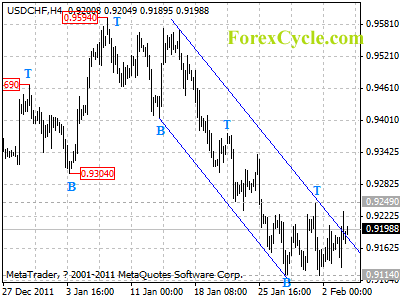
USDCHF broke above price channel

USDCHF broke above the upper line of the downward price channel on 4-hour chart last Friday, suggesting that a cycle bottom had been formed at 0.9114, and lengthier consolidation of the downtrend from 0.9594 is underway. Range trading between 0.9114 and 0.9249 would likely be seen in a couple of days. Key resistance is at 0.9350, as long as this level holds, we’d expect downtrend to resume, and one more fall towards 0.8900 is possible after consolidation, only break above 0.9350 could signal completion of the downtrend.

usdchf

Forex Signals

Jackass Investing: Don’t Do It. Profit From It

By The Sizemore Letter

“This book should not be controversial, but it will be,” writes Michael Dever in the introduction to Jackass Investing. “That is because investing, which should be a rational pursuit, is not… [M]ost people’s investment decisions are not based on rational facts. They’re based on myths and emotions.”

Regrettably, Mr. Dever is correct in his assessment. The belief in rational, efficient markets has been a core tenet of the investment faith since the 1950s. Only recently has the investment community begun to reach the conclusion that every successful practitioner already knew by instinct or learned through experience: humans are not always rational, and humans acting as a group are often even less rational than humans acting as individuals. And, again contrary to efficient market dogma, rather than avoid unnecessary, uncompensated risk, investors often engage in risk-seeking behavior (i.e. taking more risk than is necessary)—which is Dever’s definition of Jackass Investing.

Michael Dever is the founder of Brandywine Asset Management and a long-time technology entrepreneur. He is also a “macro,” top-down investor with a unique approach to allocation. Rather than look at asset classes (i.e. large cap stocks, emerging market bonds, etc.) Dever looks at return drivers, or the underlying fundamentals that drive the investment performance of a given asset. “Diversification” is not simply shifting money between asset classes—which, as 2008 demostrated with brutal efficiency, all tend to fall in lockstep during a crisis—but allocating your precious funds across different investing and trading strategies that exploit different return drivers.

Dever’s thought processes are not altogether different than those we apply in the Sizemore Investment Letter. We diversify based on durable macro themes—such as the rise of the Emerging Market Consumer or the coming of age of the American Echo Boomers—and not based on arbitrary asset class distinctions. Dever dedicates his book into exploding a series of myths that “permeate common financial wisdom”:

    1. Stocks Provide an Intrinsic Return
    2. Buy and Hold Works Well for Long Term Investors
    3. You Can’t Time the Markets
    4. Passive” Investing Beats “Active” Investing
    5. Stay Invested So You Don’t Miss the Best Days
    6. Buy Low, Sell High
    7. It’s Bad to Chase Performance
    8. Trading is Gambling—Investing is Safer
    9. Risk Can Be Measured Statistically
    10. Short Selling is Destabilizing and Risky
    11. Commodity Trading is Risky
    12. Futures Trading is Risky
    13. It’s Best to Follow Expert Advice
    14. Government Regulations Protect Investors
    15. The Largest Investors Hold All the Cards
    16. Allocate a Small Amount to Foreign Stocks
    17. Lower Risk by Diversifying Across Asset Classes
    18. Diversification Failed in the ’08 Financial Crisis
    19. Too Much Diversification Lowers Returns
    20. There is No Free Lunch

I initially took issue with Dever’s claim that stocks provide no intrinsic return. After all, stocks represent ownership shares of businesses and those businesses earn profits and (ideally) pay dividends.

But while this may be true, Dever correctly points out that the stock market returns realized by investors are driven by two (and in the end, only two) return drivers—the earnings generated by the companies comprising the market and the multiple that investors are willing to pay for those earnings. And except over the very long term, it is primarily investor psychology—the multiple investors are willing to pay—that determines stock returns. On that count, there are not guarantees. Your returns are at the mercy of the fickle and emotional whims of other investors.

As for Myth #2 on long-term, buy-and-hold investing, Dever points out that “All of the real stock market returns earned over the past 111 years can be attributed to a just an 18 year period—the great bull market that began in August 1982 and ended in August 2000. Without those years, the real, inflation-adjusted returns of stocks, without reinvesting dividends, was negative.” Investors today would no doubt nod their heads in understanding. Excluding the modest returns earned from dividends, investors have seen virtually no returns in over a decade. After adjusting for inflation, the returns are well into negative territory. Dever also correctly points out that for much of the period of time covered in long-term stock market studies, the United States was an “emerging market,” with the higher rates of growth that this implies.

Furthermore, studies that demonstrate “market” returns are meaningless because until recent decades, no one bought “the market.” Index funds didn’t exist, and stock market investing was a hobby primarily of the wealthy, not the middle class. And returns came primarily from dividends. “Just because something happened in the past does not mean it will reoccur in the future,” writes Dever. “We must first understand all of the return drivers, and then determine whether those return drivers are still valid.”

Well said.

Lest this review turn into book by itself, I’ll spare readers a review of the remaining 18 myths. I will, however, share one of Dever’s more amusing market analogies—the George Costanza trader.

Dever recounts the Seinfeld episode in which Costanza realizes that “every decision I’ve ever made, in my entire life, has been wrong. My life is the opposite of everything I want it to be. Every instinct I have, in every aspect of life… It’s all wrong.”

Costanza then decides to do the opposite of what his instincts tell him to do, and his life turns around. He gets a gorgeous girlfriend and the job of his dreams. This is the essence of contrarian investing; doing precisely the opposite of what our emotions—and the actions of other investors—tell us to do. Or, as Warren Buffett succinctly puts it, “being greedy when others are fearful and fearful when others are greedy.”

Overall, Jackass Investing is an entertaining and informative read. Consider adding it to your 2012 reading list.

Central Bank of the Dominican Republic Holds at 6.75%

The Central Bank of the Dominican Republic held its Monetary Policy (Overnight) Rate unchanged at 6.75%, and maintained the Lombard Rate at 9.00%. The Bank said: “Domestically, private credit, economic activity and inflation are performing in line with projections published in the recent Monetary Policy Report. Credit to the private sector continues to expand at a rate close to projected nominal GDP, so preserving the growth of domestic demand. At the same time, forecasts suggest the convergence of y-o-y CPI inflation to its target during the first quarter of 2012, indicating that, even in the midst of an election cycle, price stability and the continuity of macroeconomic policies will be maintained, creating an environment of certainty that facilitates decision-making among private sector economic agents.”


The Bank last raised the rate by 50 basis points in April, 25 basis points in March, and 100 basis points in February last year; the bank also reduced its Lombard Rate by 50bps to 9% in November last year. The Bank said annual inflation was 7.8% in December, compared to 6.17% in January 2011, this compares to the inflation target of 5.5% +/- 1% for CPI during 2012 (adopted under the inflation targeting framework).

The Dominican Republic’s currency, the Dominican peso (DOP), has weakened by about 4% against the US dollar over the past year, while the USDDOP exchange rate last traded around 38.88.

Currency Futures: Forex Speculators cut US Dollar bets. Aussie, Kiwi & Peso positions continue rise

By CountingPips.com

The latest Commitments of Traders (COT) report, released on Friday by the Commodity Futures Trading Commission (CFTC), showed that large futures speculators cut back on their US dollar long positions last week and Euro short positions improved for the first time in six weeks from their record low level.

Non-commercial futures traders, usually hedge funds and large speculators, decreased their total US dollar long positions to $14.22 billion on January 31st from a total long position of $20.09 billion on January 24th, according to the CFTC COT data and calculations by Reuters which calculates the dollar positions against the euro, British pound, Japanese yen, Australian dollar, Canadian dollar and the Swiss franc.

COT Values

Individual Currencies:

EuroFX: Currency speculators decreased their Euro short positions for the first time in six weeks as of January 31st after raising their short bets to a new record high the previous week. Euro net short positions totaled 157,546 short bets against the euro currency from the previous week’s total of 171,347 net short contracts.


The COT report is published every Friday by the Commodity Futures Trading Commission (CFTC) and shows futures positions as of the previous Tuesday. It can be a useful tool for traders to gauge investor sentiment and to look for potential changes in the direction of a currency or commodity. Each currency contract is a quote for that currency directly against the U.S. dollar, where as a net short amount of contracts means that more speculators are betting that currency to fall against the dollar and net long position expect that currency to rise versus the dollar. The graphs overlay the forex spot closing price of each Tuesday when COT trader positions are reported for each corresponding spot currency pair.

GBP: British pound sterling positions showed improvement for a second consecutive week and increased to their best level since December 20th. British pound positions saw a total of 26,214 short positions on January 31st following a total of 31,361 net short positions registered on January 24th, according to the CFTC data.


JPY: The Japanese yen net long speculative contracts reversed two consecutive weeks of declines, according to the latest data on January 31st. Yen long positions increased to a total of 56,669 net long contracts reported on January 31st following a total of 44,367 net long contracts that were reported on January 24th. Yen speculative positions are just below their highest level in over a year that was registered on January 10th when contracts surpassed the August 2nd level of 58,833 contracts.


CHF: Swiss franc speculators slightly trimmed their short bets against the Swiss currency for a second consecutive week as of January 31st. Speculator positions for the Swiss currency futures numbered a total of 11,222 net short contracts on January 31st following a total of 12,514 net short contracts as of January 24th. Swiss contracts have now been on the short side by more than 10,000 contracts for six consecutive weeks and positions have seen limited movements either way.


CAD: Canadian dollar positions slightly declined after improving the previous week for the first time in three weeks. Canadian dollar positions declined to a total of 19,409 net short contracts as of January 31st following a total of 18,909 short contracts reported on January 24th. CAD positions on January 17th had marked their lowest level in over a year and a total of 28,730 net short contracts.


AUD: The Australian dollar long positions continued higher for a sixth consecutive week as of January 31st. Australian dollar positions increased to a total net amount of 78,044 long contracts on January 31st after totaling 69,486 net long contracts reported as of January 24th. The AUD speculative positions are now at their highest level since July 26th when Australian dollar long positions totaled 81,438.


NZD: New Zealand dollar futures speculator positions rose higher and advanced for a sixth consecutive week through January 31st. NZD contracts increased to a total of 14,797 net long contracts as of January 31st following a total of 12,932 net long contracts on January 24th. NZD positions have now risen for six straight weeks from the December 20th low standing (which was the lowest position since March 29th when positions equaled 239 long contracts) and to the highest level since September 13th when net long contracts equaled 17,664.


MXN: Mexican peso speculative contracts improved for a fourth consecutive week and rose to the best position since August 23rd against the US dollar. Peso long positions numbered a total of 21,481 net long speculative positions as of January 31st following a total of 7,418 long contracts that were reported on January 24th. Peso contracts crossed over into a positive long position on January 24th for the first time since September 6th.

COT Currency Data Summary as of January 31, 2012
Large Speculators Net Positions vs. the US Dollar

EUR -157546
GBP -26214
JPY +56669
CHF -11222
CAD -19409
AUD +78044
NZD +14797
MXN +21481

Other COT Trading Resources:

Trading Forex Using the COT Report


Monetary Policy Week in Review – 5 February 2012

The past week in monetary policy saw 5 central banks adjusting interest rates, with increases from: Colombia +25bps to 5.00%, and Sri Lanka +50bps to 7.50%; and decreases from: The Gambia -100bps to 13.00%, Uganda -100bps to 22.00%, and Romania -25bps to 5.50%.  Meanwhile those that held rates unchanged were: Russia 8.00%, Malaysia 3.00%, Kenya 18.00%, the Czech Republic 0.75%, Egypt 9.25%, and Nigeria 12.00%. 
Following are some of the key quotes and comments from central bankers on their monetary policy decisions over the past week:
  • Romania (cut 25bps to 5.50%): “Looking at domestic developments, statistical indicators reveal the persistence of negative output gap despite positive dynamics in exports, industrial and farming outputs, the current account deficit staying at sustainable levels, but also a gradual recovery of credit to the private sector. The external environment shows that uncertainties remain regarding the resolution of the Eurozone sovereign debt crisis, with impact on investors’ risk aversion, capital flow volatility, as well as on global economic developments.”
  • Sri Lanka (raised 50bps to 7.50%): Taking into consideration these macroeconomic developments,  the Monetary Board of the Central Bank of Sri Lanka is of the view that the continuous increase in credit extended to the private sector by commercial banks needs to be addressed for two main reasons: First, to  curtail import related credit, thereby reducing the trade deficit and the current account deficit, and second, to effectively ensure that inflation remains at the mid-single digit levels in the second half of 2012 as well, notwithstanding the sharp build up of credit in 2011.”
  • Russia (held at 8.00%): “The dynamics of the main macroeconomic indicators in December showed persistent firmness of consumption beside the moderate production growth figures. Further decrease in unemployment rate, high real income growth rate and the continued expansion in consumer credit contributed to the acceleration of retail sales growth. The growth rate of investment in production capacity increased in December. However, industrial production growth rate in year-over-year terms decreased sharply compared to November, which was partly explained by the decline in particular components of the index due to weather-related factors. Production growth rates and economic confidence indicators remained rather low in the recent months.”
  • Nigeria (held at 12.00%): We are holding our first meeting of 2012 at a time that is possibly a turning point in the economic history of the country.  The dark clouds in the global horizon remain present.  Forecasts are for slower growth rates in the developed world and emerging markets.  The violence and tragic bombings in northern Nigeria continue to pose a source of concern for investors, and efforts are underway to find a lasting solution.  The recent demonstrations by citizens and opposition parties against fuel subsidy removal have also raised temperatures in the political space
Looking at the central bank calendar, the main event in the week ahead, given the ongoing sovereign debt crisis in Europe, will be the ECB meeting – the key question on people’s minds will be whether the ECB does anything further to assist or promote growth e.g. interest rate cuts, bond purchases. Meanwhile the Bank of England may increase its quantitative easing program. Elsewhere there is a diverse geography of banks meeting which will help provide insight into key economic developments around the globe.
  • AUD – Australia (Reserve Bank of Australia) expected to cut 25bps to 4.00% on the 7th of Feb
  • ISK – Iceland (Central Bank of Iceland) expected to hold at 4.75% on the 8th of Feb
  • PLN – Poland (National Bank of Poland)expected to hold at 4.50% on the 8th of Feb
  • GBP – UK (Bank of England) expected to hold at 0.50% on the 8th of Feb
  • EUR – EU (European Central Bank)expected to hold at 1.00% on the 8th of Feb
  • IDR – Indonesia (Bank Indonesia)expected to hold at 6.00% on the 8th of Feb
  • PEN – Peru (Central Bank of Peru)expected to hold at 4.25% on the 8th of Feb