Poor US retail data brings back risk aversion


By TraderVox.com

Euro continued its slide against the US dollar during the US session. Important data from US came as disappointing. The expected retail sales were expected to grow at 0.7% but the actual data came at 0.4%. The single currency lost the 1.3150 levels and printed a low of 1.3126. The low for the day of 1.3127, formed during the European session is almost respected. It has since then come above the 1.3150 and is currently trading around that level still down quarter a percent. The support may be seen at1.3100 and below at 1.3050. The resistance may be seen at 1.3250 and above 1.3210.

Sterling pound also lost ground against the US dollar. It has come again below 1.5700 levels and formed a fresh low of 1.5660 during the US session. Currently it has cove near the 1.5700 levels down half a percent for the day. The support may be seen at 1.5690 and below at 1.5650. The resistance may be seen at 1.5700 and above at 1.5730.

The US dollar is gaining against the Japanese Yen after the Bank of Japan’s announcement this morning. The pair is approaching the 78.50 levels up more than a percent for the day. The pair is looking bullish and can eye 79 levels. The support may be seen at 78.30 which is a strong support and down at 77. The resistance may be seen at 78.70.

As expected the US dollar is gaining against the Swiss frank on this risk aversion day and is hitting the 0.9200 levels. The high for the day so far is 0.9202 which is also a one week high. The resistance may be seen around 0.9210 and above at 0.9250. The support may be seen at 0.9150/60 and below at 0.9100.

The Australian dollar also lost against the US dollar during the US session and is currently trading below 1.0700 levels at 1.0690, down about 0.40% for the day. The support may be seen at 1.0670 and below at 1.0640. The resistance may be seen at 1.0700 and at 1.0740/50 levels.

The US dollar index has gained levels and comfortably trading above 79 levels at 79.42.

Article provided TraderVox.com
Tradervox.com is a Forex News Portal that provides real-time news and analysis relating to the Currency Markets.
News and analysis are produced throughout the day by our in-house staff.
Follow us on twitter: www.twitter.com/tradervox

Investing in Iraqi Oil


Iraqi Oil

In Douglas Adams’ iconic The Hitchhiker’s Guide to the Galaxy, Deep Thought tells us the ultimate answer to the ultimate question of life, the universe and everything is “42.”

The origin and meaning of that number has always intrigued fans.

But Douglas Adams explained that there was no real rhyme or reason why he chose “42.” It just popped in his head and he went with it.

I always liked Deep Thought’s answer because 42 is a key number for people in the oil business – it’s the number of gallons in a standard barrel of oil.

Now, I don’t think there are any sectors as exciting as oil, particularly now. We had a record year in 2011 in terms of prices. This year will be another record year as companies spend $598 billion on E&P. And next year looks like it will be a record year in its own right in terms of price, and it’s not even here yet.

Why? The U.S. Energy Information Administration (EIA) revealed last week that it expects the price of West Texas Intermediate (WTI) crude to average $104 per barrel in 2013.

That’s an astonishingly high yearly average, particularly in a time where Europe and the United States are trying to pull their economies out of the toilet. So a lot of energy investors are looking for opportunities to cash in.

Oil, Oil Everywhere

Right now, the price of NYMEX benchmark crude is over $100 per barrel. And it’ll likely stay above that threshold for most of 2012. The Iran nuclear standoff is providing a psychological updraft to price. And this is on top of the number of “black swan” events that drove the commodity markets in 2011.

The Arab Spring movement that began in late 2010 led to upheavals across the Middle East, impacting oil supply from countries such as Libya. And ongoing conflicts in Nigeria, Sudan and South Sudan are also weighing in.

But we’re about to see major supply bumps in the crude market… And some of the biggest bumps will come from countries that have seemingly fallen off investors’ radars.

  • Next year, the first production from Norway’s Barents Sea will start flowing.
  • Post-Ghadaffi Libya expects to double production by 2014.
  • The Kazakhstan Kashagan field will see its first commercial output in 2013.
  • Plus, we have all those rich shale plays in North America ramping up production, as well as continuing strength from the Canadian oil sands.

But possibly the most notable is the number of major projects in Iraq coming online. Over the next few years these projects may propel its oil industry to rival that of Saudi Arabia in terms of output.

The Power Struggle Looming As An Industry is Reborn

After nine years of conflict, the United States troops finally left Iraq late last year. It marked the official end of the war.

During most of the post-war U.S. occupation of Iraq, the country’s oil production averaged about two million barrels per day (bpd) – the highest it had been in two decades. But that output is growing. It now stands at 2.9 million bpd with plans to hit 3.4 million bpd in 2012.

Projects coming online in 2013 could skyrocket Iraq’s oil output to nine million bpd.

By 2017, Baghdad has set what many see as an overly ambitious goal of having Iraq’s oil production top 12 million bpd. That would rival the Middle East’s juggernaut Saudi Arabia.

It’s a boom time for the Iraqi oil industry.

Over the weekend, Iraq cut the ribbon on the first of five new single-point mooring export terminals that will ultimately handle five million bpd of export capacity.

Like Libya, decades under the thumb of a corrupt dictator, war and international sanctions hamstrung Iraq’s oil industry potential. But it’s entered a whole new era.

Though this new era isn’t without some controversy… The international race to tap Iraq’s massive 143 billion barrels in oil reserves has sparked a power struggle between Baghdad and the semi-autonomous Kurdistan Regional Government (KRG).

And international oil companies (IOCs) now find themselves stuck between a rock and a hard place.

The Difference is R=X/Y

The central Iraq government and KRG are competing for companies to come in and develop resources. But there’s tension brewing as Baghdad doesn’t formally recognize contracts IOCs ink with the KRG Ministry of Natural Resources.

For example, on Monday, Exxon Mobil (NYSE: XOM) was barred from competing for contracts in Iraq’s fourth oil and gas licensing auction in May. This is because Exxon signed six deals with the KRG.

Hess Corp (NYSE: HES) was barred last year by the Iraqi government from working anywhere else in the country after it had done the same. And now France’s Total S.A. (NYSE: TOT) is debating whether to negotiate with the Kurds, meaning it could end up blacklisted, as well.

But over the weekend, Total’s CEO said that the company won’t likely participate in the upcoming Iraqi auction anyway, citing the opportunities with the KRG are more attractive.

The biggest hurdle for IOCs is that if they work with the central Iraq government to develop fields in the country, they actually don’t own any of the oil they produce. Instead, they’re paid a service fee on each barrel they pump out.

Under the KRG contracts the companies share profits from oil sold with the KRG.

Kurdistan claims to hold 40% of Iraq’s oil reserves. So it’s a difficult choice – take a smaller return on a larger resource base or a larger return on a smaller one.

How to Play Three Recoveries At Once

I’m always on the hunt for opportunities in beaten-down neighborhoods of the markets – Japan, Europe, sectors affected by disaster, etc.

This why I think Total provides a really intriguing opportunity. And not just because it might go forward with some Kurdistan development.

Total is Europe’s third-largest oil company. Like most European companies, it took one on the chin in 2011, off about 16% from the highs it set in the spring. And the start of the year hasn’t been spectacular yet, with the company’s stock up about 3%.

Last year, its earnings rose 17%, but that was primarily due to the high price of Brent, because its output declined 1.3%. Fortunately, management wants to rectify this. And has an aggressive strategy to take on more risks in the oil and gas sector this year to bolster production.

A deal with the KRG would exemplify this move. As well as its recent deals in Uganda, Kenya and the Ivory Coast. It’s also looking to construct a crude processing plant in Saudi Arabia to reduce its overall exposure to European refineries. The company is going to spend more than $20 billion this year to expand its resource base. So, it’s building up a head of steam.

Even more intriguing is that it just inked a $34-billion deal with Japan’s Inpex – which sells natural gas to Tokyo Electric Power – to build one of the world’s largest liquefied natural gas (LNG) facilities in Australia.

So, we have a company not only involved in the ongoing recovery in Iraq, but also looking to capitalize on Japan’s increasing reliance on energy sources other than nuclear.

Plus, from a technical standpoint, Total’s inching closer to that coveted “golden cross” where the 50-day moving average crosses above the 200-day moving average. That’s one of those ultimate bullish signals.

Good Investing,

Matthew Carr

Article by Investment U

Investing in Vanadium


Vanadium (V)

The Metal That Inspired Henry Ford

In 1905, Henry Ford came across a remarkable metal that helped him to single-handedly revolutionize the budding American car industry.

After a car race in Florida, Ford examined the wreckage of a French racecar. He realized that many of the French car’s parts were made of a peculiar metal.

It was much lighter, and stronger, than the metal being used to build American cars. So Ford – seeing the opportunity to drastically cut material costs in his automobiles – rushed a specimen back to his laboratory. And it didn’t take long for Ford to learn that the French alloy steel contained one truly unique element: Vanadium.

Thrilled with the potential for using this low-weight, high-strength steel in his products, Ford rushed to finance and set up his own steel mill to make vanadium-alloy steel. And then, in 1908, he began using the new vanadium-alloy steel in the chassis of the time-honored Ford Model-T – reducing its weight to about half that of contemporary automobiles.

There’s no doubt that Ford’s assembly line process enabled the mass production and consumption of the Model T. But it was Ford’s use of the vanadium-alloy steel that gave American consumers a superior product – lighter, stronger and more affordable.

The fine even distribution of the elements – the uniformity of structure indicate the superior quality of vanadium.” – Henry Ford, 1910

Metallurgical technology has rapidly advanced since Ford’s time. New processes are continually being developed to improve the effectiveness and benefits of using vanadium as an alloying agent in steel.

And today, this exotic metal has become of the best steel strengtheners known to man. With modern processes, just 0.1% vanadium content in steel can double its strength.

Lightweight, high-strength alloy steels allow producers to build superior products with less steel, saving significant material costs. And in the coming years, significant increases in vanadium-alloy consumption are forecast as global industrial producers fiercely seek costs-saving measures while retaining quality.

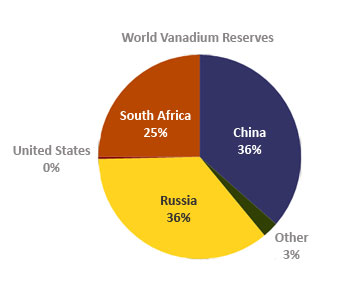
Vanadium isn’t a significantly rare metal – being about two or three times more abundant than copper. But like many other minerals, high concentrations that are economically feasible to mine are only found in a few places. Most of the world’s vanadium reserves are isolated in only three countries: China, South Africa and Russia. Less than 3% of the world’s resources of vanadium is located elsewhere.
Investing in Vanadium

Vanadium: Raging Opportunity for Growth

Vanadium demand is directly linked to global steel consumption – with 90% of world vanadium production consumed by the steel industry, which is poised for strong growth in the future.

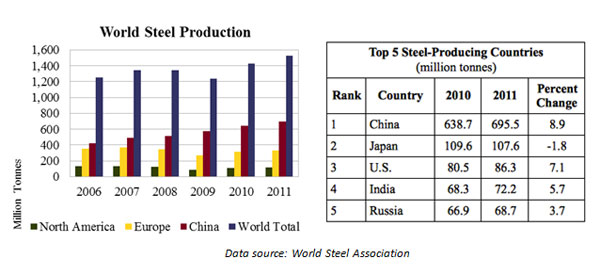
Last year, all major steel-producing countries showed increased steel output. The World Steel Association recently reported that global crude steel production reached 1,527 million tonnes in 2011 – a record for global crude steel production.
World Steel Production

This year, the World Steel Association forecasts global demand will increase an additional 6% to reach a new record over 1.6 billion tonnes. And the demand for vanadium should be rising with it.

In its 2012 Mineral Commodity Summary, the USGS agrees, saying, “Given the increase in steel demand, especially in China, it appears likely that, in the near term, vanadium demand will be strong.”

Increasing Global Vanadium Demand

Over the past decade, the demand for vanadium in the United States has increased 56%. And estimates suggest that vanadium demand is expected to continually grow at a compound annual rate of 7.8% thorough to 2015, fueled by increasing demand for stronger and lighter steel alloys.
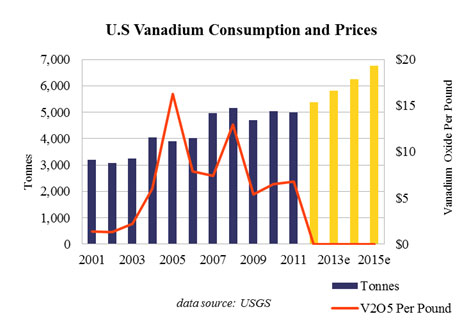
U.S. Vanadium Consumption and Prices

With increasing demand and relatively low current prices, vanadium shows interesting investment fundamentals. But, unfortunately for us as investors, getting exposure to this strategic metal can be a bit tricky.

Unlike many other commodities, there are no specialized vanadium ETFs, pool accounts, futures trading, or other funds dedicated to vanadium. Instead, buyers and sellers of the product negotiate privately, leaving only a small handful of alternative investments for us.

Investing in Vanadium

Believe it or not, vanadium bullion is available from private individuals. But there are no reputable minters that produce vanadium coins or bars. Moreover, vanadium bullion will be very difficult to sell – so I would strongly advise against owning vanadium bullion as an investment.

With no physical bullion or direct fund or pool account access, investors looking for vanadium exposure have to look to the equity markets for companies that mine the metal. And even there, exposure to vanadium is usually overlapped with other metals.

However, there are a handful of small public companies with good vanadium exposure. Here are a few:

Atlantic Ltd. (ASX: ATI) is an Australian-based junior mining company that recently began vanadium production at its 100% owned Windimurra vanadium project.
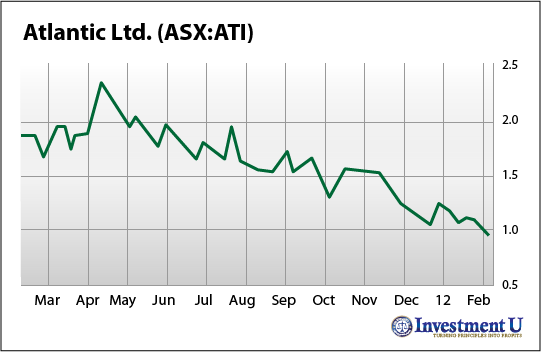
Atlantic Ltd.

Located in Western Australia, the Windimurra project is a world-class vanadium and haematite iron ore project that currently has 334,200 tonnes of vanadium reserves plus 546,800 tonnes of vanadium resources.

Once brought up to full capacity in 2013, production is expected to reach 6,300 tonnes of contained vanadium per year – 7% of the world’s vanadium supply.

EVRAZ plc (LON: EVR) is a large integrated steel, mining and vanadium business with operations on four continents.
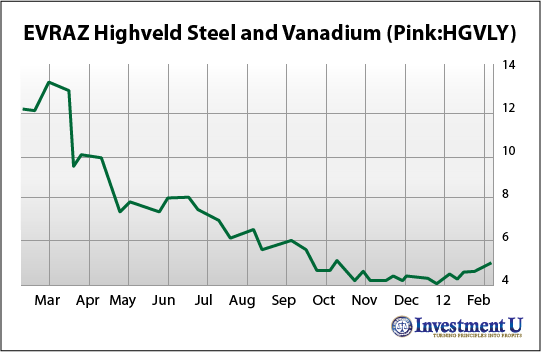
EVRAZ steel, mining, and vanadium

The company is ranked the fifteenth-largest steel producer in the world based on crude steel production of 16.3 million tonnes in 2010.

EVRAZ’s international vanadium business comprises EVRAZ Highveld Steel and Vanadium (OTC: HGVLY.PK) in South Africa, Russia and the Czech Republic, and Strategic Minerals Corp. in the United States and South Africa. EVRAZ produces various vanadium products, including its own registered alloy, Nitrovan, which is produced the company’s process of simultaneously adding vanadium and nitrogen to steel, creating a very high-strength product.

American Vanadium (CVE: AVC) is a Canadian-based vanadium-mining firm that’s currently developing its 100% controlled Gibellini project in Nevada – along with several adjacent vanadium properties.
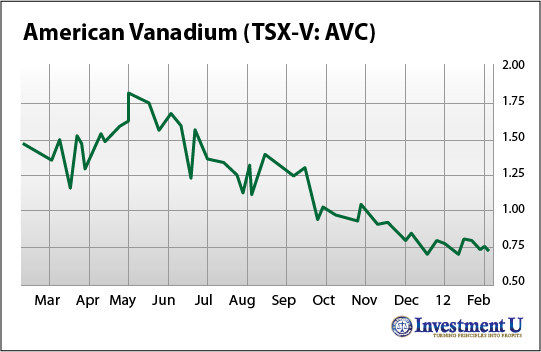
American Vanadium

The Gibellini project holds a NI 43-101 compliant resource of 131 million pounds of vanadium in the measured and indicated category, plus an additional 47 million pounds in the inferred category.

Permitting and detailed engineering are currently underway at Gibellini. Production is ultimately expected to reach an average of 11.4 million pound of vanadium pentoxide per year. This could potentially supply approximately 5% of current global vanadium demand. Once production begins, Gibellini will be the only producing vanadium mine in North America.

Wrapping it Up

Lighter, stronger steel means better products and significantly lower costs for both producers and consumers.

With the demand for lighter, stronger steel on rise, powerful steel alloying agents like vanadium will be increasingly sought after.

For speculators, this could mean good potential for significant profits from the right investment vehicle.

Good Investing,

Luke Burgess

Article by Investment U

RBI Makes Technical Adjustment to Bank Rate 350bps to 9.50%


The Reserve Bank of India [RBI] raised its old bank rate 350 basis points to 9.50% as a one-time technical adjustment to align it with the main policy rates (repo rate, and reverse repo rate).  The interest rate (specifically discounting and rediscounting) has largely remained disused since 2003, however it has some application in liquidity management, and consistency between rates is considered desirable.  The RBI last held its main repo rate at 8.50%, and reverse repo rate at 7.50% and cut its cash reserve ratio by 50bps to 5.50% at its January meeting.

GBP Finishing Weak Against the Greenback

Source: ForexYard

printprofile

Up against a safe haven U.S. dollar, the GBP is finishing a European session at a low point. The USD was unable to maintain gains against all of its counterparts on Tuesday, however, the Greenback did succeed in coming out on top of the Sterling.

While both the UK and the US received somewhat lackluster news in regards to CPI figures and retail sales, respectively, the GBP might have taken more of a hit from Moody’s Investor Service. The UK avoided being handed a downgrade but it did receive a warning from Moody’s that its AAA rating was in danger of being downgraded. After witnessing several euro zone countries being downgraded, including Italy, Portugal, and Spain, these warnings from Moody’s should not be taken lightly.

Forex Market Analysis provided by ForexYard.

© 2006 by FxYard Ltd

Disclaimer: Trading Foreign Exchange carries a high level of risk and may not be suitable for all investors. There is a possibility that you could sustain a loss of all of your investment and therefore you should not invest money that you cannot afford to lose. You should be aware of all the risks associated with Foreign Exchange trading.

National Bank of Kazakhstan Cut Rate 50bps to 7.00%


The National Bank of Kazakhstan cut its key refinancing rate by 50 basis points to 7.00% from 7.50% as inflationary pressures eased.  NBK Chairman, Grigori Marchenko, said: “If the level of inflation is the same, I think we could lower the refinancing rate again in April.”  Kazakhstan’s central bank last increased the interest rate in March last year by 50 basis points to 7.50%.

Kazakhstan reported inflation of 5.9% in January, 7.4% in December, 8.7% in September, compared to 9.0% in August, and 8.50% in July, and above the official inflation target of 8 percent.  Kazakhstan’s economy grew at an annual pace of 7.2% in 3Q11, up from 7% in the June quarter, and 6.8% in the March quarter.  

Kazakhstan recently returned its currency, the Tenge, to a “managed” free float, abolishing the tenge’s trading corridor at the end of February last year.  The Kazakhstani Tenge (KZT) last traded around 148 against the US dollar.

USD Retail Figures Arrive

Source: ForexYard

printprofile

U.S. retail figures for the month of January arrived this afternoon. After enjoying an increase of 0.8% for the month of December, the U.S. turned in a 0.4% gain. Many attribute this gain to the large amount of post-holiday shopping in the States. Large retail chains try their best to attract shoppers once the holiday season has ended. While these efforts paid off somewhat, the overall retail figures did not meet expectations of a 0.6% gain.

The USD did experience gains earlier in the day and with these numbers being released, there is the possibility that the strength of the USD will continue throughout the day. We’ve already seen strong numbers put up against the euro, Sterling, and Swiss Franc, be aware that the USD could solidify these gains.

Forex Market Analysis provided by ForexYard.

© 2006 by FxYard Ltd

Disclaimer: Trading Foreign Exchange carries a high level of risk and may not be suitable for all investors. There is a possibility that you could sustain a loss of all of your investment and therefore you should not invest money that you cannot afford to lose. You should be aware of all the risks associated with Foreign Exchange trading.

Technology Sector News: RAX, GOOG

Rackspace Hosting (RAX) announced fourth quarter earnings that exceeded analyst estimates in terms of revenue and earnings. The company earned $25 million, or 18 cents per share, on revenue of $283.3 million.

Moody’s Perspective Of The UK


By TraderVox.com

The markets were in a relatively bad mood yesterday. This was as a result of Moody downgrading the credit ratings of several European countries including Spain and Italy. Luckily despite the bad moods the markets didn’t react in the worst possible manner and attentions shifted to Moody, decision to give the United Kingdom a negative outlook. This does not speak well of the economic prospects of the united kingdom in the nearest future giving its AAA rating.

Moody defended that the United Kingdom had very weak macroeconomic conditions and expressed lack of complete faith in the British Governments implementation of its austerity programs and its efforts in cutting down its deficit. They also added that severely diminishing demand from other European countries for UK goods (note that they are UK’s main trade partners) would seriously affect the UK trade industries.

Analyzing further, Moody remarked that among the AAA countries left, UK had the largest debt.

Moody therefore concluded that the AAA- rating of the United Kingdom is at serious risk. The thought of what will happen to the GBP in the event of a downgrade is something that no one wants to even imagine.

Possibly that is why we witnessed a sharp drop in GBP/USD yesterday…

GBP/USD dropped a massive 55 pips just two hours into Moody’s announcement and has been heading for the 1.5700 support ever since.

We are awaiting a swift reaction from the British government as their immediate actions will now be scrutinized heavily.

U.K. Chancellor George Osborne was quick react, saying that the warning not only supported the government's ongoing programs, but is also a "reality check for anyone who thinks that the U.K. can duck its debts."

For now a warning from Moody's means that the U.K.'s rating could be downgraded in the next 12 to 18 months. Also, many are now speculating that S&P and Fitch may follow suit and warn the U.K. of a downgrade.

For now however the GBP is safe after yesterday’s drop.

Article provided TraderVox.com
Tradervox.com is a Forex News Portal that provides real-time news and analysis relating to the Currency Markets.
News and analysis are produced throughout the day by our in-house staff.
Follow us on twitter: www.twitter.com/tradervox