How The Mindset Differs When You Trade Forex By Yourself

By James Woolley

You will probably already know that there are a few different ways you can trade the forex markets. You can apply for a trading job in the City, whereby a bank will employ you to trade the markets on their behalf, or you can use your own money to trade from home or from work. Whichever you choose, you have to bear in mind that they are totally different.

To begin with, it is not easy to get a job with a top financial institution. You can by all means apply to every one of the banks in the City, but you will have no success at all unless you have a good degree from a good university behind you. There have been times when people have got in without a degree, but this is often because someone in their family has very good contacts.

If you like the idea of being a self employed forex trader, then it is a lot easier to get started. You can easily open an account with a forex broker and deposit some of your savings. Then you can trade whenever you want, providing you have an internet connection. With regards to the amount you need, it doesn’t have to be a six figure sum, but you do need to make sufficient profits to live on.

This is a notable difference because when you are employed as a trader, you are not actually trading your own money. There is still the pressure from above to make money of course, and you will receive some big cheques if you manage to do this, but at the back of your mind you always know that you have a big salary to fall back on.

When you are self-employed, you will not make any money at all unless you make a profit. Furthermore your standard of living is entirely dependent on how successful you are at trading the currency markets.

As a result of this, there are different pressures associated with each position, and they involve different mindsets to some degree. Those who work from home will have a different mindset to those working in the City because there are different incentives involved. One group of people are interested in earning big bonuses, whilst the other has to make money in order to earn a decent standard of living.

City traders have the luxury of being able to take a few more chances due to the fact that it is not their money on the line. People who work from home, however, do not have this luxury and have to preserve their capital at all costs before they can even think about making any money.

In some ways it is a lot easier to work in the City for a large bank. Even if the worst happens and you lose a lot of money from poor trading decisions, you will still have earned a huge salary before losing your job. It may not even get to that stage anyway because when working in the City you have a lot of trading tools at your disposal, which home-based traders simply cannot afford.

So overall you have to say that the two jobs are completely different, and you need to adopt a completely different mindset for each one. This is because there are different pressures involved. Even though your job is on the line when working for a bank, your entire livelihood is on the line when you work for yourself. So this is something that you should always bear in mind.

About the Author

Click here to read a full review of the Forex Profit Accelerator software and to learn about the 4 profitable trading strategies that are included with this software, and to find out what you should look for when choosing the best forex course.
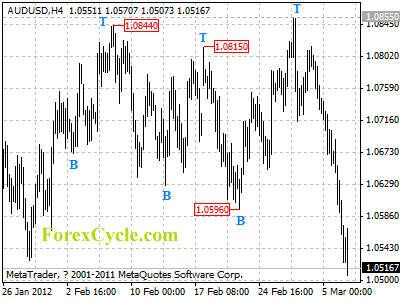


AUDUSD breaks below 1.0596 key support

AUDUSD breaks below 1.0596 key support and reaches as low as 1.0507, suggesting that the uptrend form 0.9861 (Dec 15, 2011 low) has completed at 1.0855 already. Further decline is expected after a minor consolidation, and next target would be at 1.0450. Resistance is at 1.0600, as long as this level holds, the downtrend from 1.0855 will continue.

audusd

Daily Forex Reports

Daily Market Wrap: March 6, 2012

Stocks fell sharply on Tuesday in the single largest decline for 2012 due to data that rekindled concerns about global growth, while a deadline loomed for private holders of Greek debt to agree to taking substantial losses. Gold was also down around 2% in and hovering near a 6-month low.

Reserve Bank of Australia Keeps Rate on Hold at 4.25%


The Reserve Bank of Australia (RBA) kept the cash rate on hold at 4.25%.  The RBA said: “With growth expected to be close to trend and inflation close to target, the Board judged that the setting of monetary policy remained appropriate for the moment. Should demand conditions weaken materially, the inflation outlook would provide scope for easier monetary policy. The Board will continue to monitor information on economic and financial conditions and adjust the cash rate as necessary to foster sustainable growth and low inflation.”

The Bank previously previously cut the cash rate by 25 basis points at its November and December meetings, meanwhile the RBA last increased the interest rate by 25 basis points in November 2010.  Australia reported annual consumer price inflation of 3.1% in Q4 last year, compared to 3.5% in Q3, 3.6% in Q2, and 3.3% in Q1, and 2.7% in the December quarter of 2010, and only just outside the Bank’s inflation target of 2-3%.  


The Australian economy expanded 1.0% in the September quarter (1.4% in Q3), after contracting -0.9% during the March quarter due to the impact of natural disasters; placing year on year GDP growth at 2.1% in the September quarter, 1.1% in the June quarter, and 1.2% in the March quarter.
The Australian dollar (AUD) has gained about 5% against the US dollar over the past year, after reaching parity and climbing as high as 1.10 last year; the AUDUSD exchange rate last traded around 1.05
The RBA next meets on the 3rd of April this year, and will release its March meeting minutes on the 20th of March.

USD on the Rise

Source: ForexYard

printprofile

The USD continued to make gains against traditionally riskier currencies on Tuesday. The greenback has solidified gains against the NZD, AUD, and CAD as a series of announcements have driven traders to the more stable USD. During afternoon trading on Thursday the AUD/USD stood at $1.0567, the NZD/USD was hovering around $0.8121 and the USD/CAD was close to $1.000.

Worries over the Chinese economy after its 2012 growth forecast was cut down to 7.5% prompted many investors to head towards the greenback as the dollar has traditionally provided a degree of stability. Also, the Australian government has left the option open to further interest rate cuts, thus increasing the overall uncertainty abound in the market.

Read more forex news on our forex blog.

Forex Market Analysis provided by ForexYard.

© 2006 by FxYard Ltd

Disclaimer: Trading Foreign Exchange carries a high level of risk and may not be suitable for all investors. There is a possibility that you could sustain a loss of all of your investment and therefore you should not invest money that you cannot afford to lose. You should be aware of all the risks associated with Foreign Exchange trading.

Nutrisystem Announces Earnings

Nutrisystem (NTRI) announced that it lost four cents per share in its fiscal fourth quarter, above analyst estimates of two cents per share. Revenue dropped to $66.9 million from $87.9 million a year ago.

One Premium Bond to Protect Your Wealth


Imagine buying a property that’s guaranteed to go down 3% to 5% every year. I’m not talking about the drop in the real estate market since the collapse, but a 3% to 5% drop every year, even during the best times in real estate.

To virtually everyone, except maybe IRS auditors, this is insane, but it’s exactly what most people get when they retreat to cash.

Here’s a real conversation I had last week, on this exact subject, with a couple while I was in Naples, Florida for The Oxford Club’s Chairman’s Circle meeting.

We were waiting for a table at the bar in a restaurant and I struck up a conversation with them. He and his wife are real estate developers from Atlanta.

This guy told me he made a bundle on his properties by getting out at exactly the right time in 2007. Not a planned exit, rather an opportunity popped up and he jumped on it. The timing just happened to be pure gold.

The bad news, Bob and his wife have been sitting on a huge amount of cash since then. He’s not sure what to do, but is leaning toward bonds of some type; he likes the safety. She is sure cash is the safest place and she’s not budging.

Bob knows cash is a losing proposition, but can’t get his wife off the fence.

So, I took my best shot at explaining how they might reach a good middle-of-the-road compromise in corporate bonds, my kind of corporate bonds, ultra-short maturities.

But first we had to convince the wife…

Cash is a Losing Proposition

So, I tried the straight-up approach that cash is a losing proposition in any market. By the time you pay taxes on any interest, if you can call what cash is earning now interest, and inflation takes it bite, you always end up losing.

The wife wasn’t budging, “At least we aren’t getting killed in the market!” she said.

“Ok,” I said, “think about how much you have missed since the bottom of the collapse, even if all you did was play the spy.”

Her response was, “No more stocks, too risky. We’re getting too old to take that kind of risk.”

My next volley, the house example, “How can you justify buying any property that loses money every year, good years and bad?”

She was stumped. How could that happen? That makes no sense. The house example was close enough to home that it registered. Her facial expression changed as the paradigm shift settled in.

I’m pretty sure she’ll never look at cash the same way, again.

I had hit pay dirt, she was listening.

“That’s exactly what’s happening to your cash,” I said. “Depending on your tax bracket, after taxes and inflation, you’re losing about 3% to 5% of the value of your money every year. It’s virtually the same thing as losing money on a property every year.

“How safe does that feel?” I asked.

Investors who run to cash during tough times have the same mental block about the safety of cash, and it’s tough to get them to see the real effect taxes and inflation have on their money.

The problem is that most investors who retreated to cash are there because they won’t or can’t afford the risk of the stock market and don’t know what else to do with their money. Getting them to move anywhere else is a very big deal.

Here’s one play for the “still stunned by the collapse” folks out there that will make a decent return even after taxes and inflation take their share.

Phh (Cusip: 693320af0) has a bond that has a 7.125% coupon that’s selling for a little premium at 101.9, $1,019. The annual return on this bond is around 5.09%, and it matures next March 15, 2013.

Normally, I don’t buy premium bonds… but this is the exception.

Remember, we are trying to get shell-shocked folks out of cash and into something safe and with a very short maturity to avoid any fluctuation if rates go up before next March. That puts severe limits on the number of available choices, so we’ll bite the bullet and pay a little bit more for this bond. Its annual return and very short maturity justify it.

A one-year maturity paying 5.09% with a BB- rating is as rare as flexible divorce lawyers. That’s a huge return in this market.

BB-, a little over 5% for less than one year; that’s a great deal in this market.

The ultra-short maturity gives us very limited market exposure – less than a year – and very good protection from a big drop in value if rates move up. That gives us a better bet of being able to get out at break-even if the cash is needed or the jitters return before maturity.

While the shell shocked among us may never be ready to get back into stock investing, this is a way to put some money to work to make something while they’re treading water.

The key to success in this bond market is to limit how much you put into each bond, always keep the maturities ultra short, a five-year average is best, avoid leveraged bond mutual funds and bonds funds with maturities over five years.

There are alternatives to the cash crash that’s silently robbing most folks, but these alternatives will require some level-headed decision making and realistic expectations. Unfortunately, that rules out a lot of people.

If you can stay out of the rate pig category, and not jump on the highest yield you can find, you can earn a very respectable return with almost no interest rate risk and virtually none of the risk of the stock market.

Cash is a guaranteed loss. Do something about it…

Good Investing,

Steve McDonald

Article by Investment U

Understanding the VIX Indicator

Article by Investment U

The Chicago Board Options Exchange’s (CBOE) VIX is a term that’s been thrown around a lot lately. Many investors use it as a market-timing indicator, but most of us don’t know what it is or how it works. Let’s take a look…

VIX is the symbol for the Chicago Board Options Exchange’s volatility index. It’s a weighted mix of the prices for a blend of S&P 500 Index options, from which implied volatility is derived. In laymen’s terms, it measures how much people are willing pay to buy or sell the S&P 500, with a higher volume of options suggesting more uncertainty in the marketplace.

The VIX Measures Implied Volatility

Implied volatility is the expected volatility of the underlying security – so we’re looking at a wide range of options on the S&P 500 Index. The VIX concentrates on the price volatility of the option markets, not the volatility of the index itself.

If implied volatility is high, the premium on options will be high, and the opposite is true. When investors see options premiums increase, there’s the assumption that we can expect future volatility of the underlying stock index, which represents higher implied volatility levels.

This VIX is an attempt to quantify fear in the marketplace because it reflects investors’ best predictions of near-term market volatility, or risk.

Rule of Thumb (usually): The VIX goes up when there’s turmoil in the market, and goes down when investors are quite content or at ease with the economic outlook.

What to Do With All This Technical Analysis…

This can get pretty convoluted, so let’s recap:

  •  The VIX measures the implied volatility (IV) in the prices of a basket of put and call options on the S&P 500 Index.
  • The VIX is used as a tool to measure investor risk.
  • A high reading on the VIX marks periods of higher stock market volatility.

Now how can the VIX be useful? Volatility works well to help identify market bottoms based on high volatility.

In most cases, when the VIX goes up, the S&P 500 goes down. When the VIX is at a high, the S&P 500 is at a low, which may be an excellent buying opportunity. However, you must ask yourself: If the VIX is very high, is there still a possibility that the market could take a further tumble?

This underlying fear makes buying during high stock market volatility an act not for the faint of heart. But, investors who used the high on the VIX to time their buys entered the market at or near the low. For us long-term investors, it’s a pretty good indicator of when the stock market is at or near a high – these are times when we see low or little volatility.

Remember, the VIX doesn’t give you the exact market high or low, but it’s going to put you in the neighborhood of both.

Good Investing,

Jason Jenkins

Article by Investment U