Good Non-Manufacturing Data, Not Good Enough to Lift

ISM non-manufacturing number came in higher than expected at 57.3. That’s a 12-month high, up from 56.8 in January, and it maintained the upward trend established since last September. Business activities, new orders and price indices maintained above 50 for 31 consecutive months. Employment, export and import indices were still within the expansionary territory, although they were slightly lower than their readings a month ago. Major equity indices fell today however, due to concerns on slowing growth in areas outside of the United States. Precious metals also fell across the board with silver and platinum leading the way.

IBM Captures Top Position in Server Sales, Price Hits All-Time High

IBM announced today that according to technology research firm Gartner, IBM captured the top spot in server sales in the fourth quarter of 2011 and accounted for 1/3 of the total market share during that period. For full year 2011, it captured 30.5% of the overall market share, edging out its closest competitor by 1.5%. Stock rallied over a percent today and broke the important $200 milestone. It was up 7% YTD, outpacing the Dow’s 4%, and up 25% in the last 12 months.

Euro Regains Lost Ground

Source: ForexYard

printprofile

As trading has continued into the evening hours the euro and Australian dollar were able to gain back some of the losses taken in the last couple trading sessions. Various bits of news coming from these countries may have influence the recent upsurge that occurred this afternoon. In Europe there was a brief reprieve in the single currency’s recent decline as six Greek banks indicated they would participate in Greece’s debt swap. France’s second largest bank also indicated they would be willing to join in on the debt swap. This calmed several worried investors regarding the possibility that Greece may still default on its debt obligations this month. As of this afternoon, the euro is running up against the USD at $1.3150.

News from Australia regarding its GDP forecast indicated growth of 0.4% which falls well below the 0.7% that investors expected. Despite the lackluster news from Australia, the aussie dollar was able to stabilize this afternoon against the USD. The aussie is currently hovering near $1.0570.

Forex Market Analysis provided by ForexYard.

© 2006 by FxYard Ltd

Disclaimer: Trading Foreign Exchange carries a high level of risk and may not be suitable for all investors. There is a possibility that you could sustain a loss of all of your investment and therefore you should not invest money that you cannot afford to lose. You should be aware of all the risks associated with Foreign Exchange trading.

National Bank of Poland Keeps Rate on Hold at 4.50%


The Narodowy Bank Polski‘s Monetary Policy Council maintained its benchmark 7-day interest rate on hold at 4.50%.  The Bank said: “The Council decided to keep the NBP interest rates unchanged. The Council does not rule out the possibility of further monetary policy adjustments in the future, should the positive signs of economic activity in Poland continue and the outlook for inflation returning to the target fail to improve.”

The Bank also kept the following interest rates unchanged: the rediscount rate at 4.75%, the Lombard rate at 6.00%, and the deposit rate at 3.00%.  The Bank last raised the interest rate by 25 basis points to 4.50% in June last year, and held the interest rate unchanged at its previous meeting.  

Poland reported annual headline inflation of 4.1% in January, 4.6% in December, 3.9% in September, compared to 4.3% in August, 4.1% in July, with previous readings of 4.2% in June, 5% in May, 4.5% in April, 4.3% in March, and just higher than the Bank’s official inflation target of 2.5% +/- 1%.  


The Polish Zloty (PLN) has weakened by about 11% against the US dollar over the past year; the USDPLN exchange rate last traded around 3.17.  The National Bank of Poland next meets on the 4th of April 2012.

American Eagle Announces Earnings

American Eagle Outfitters (AEO) announced that earnings dropped to $51.3 million, or 26 cents a share, in the fiscal fourth quarter from $87 million, or 44 cents a share, in the same period last year. Revenue increased by 14 percent to $1.04 billion.

Risk off sentiment across the board


By TraderVox.com

Tradervox (Dublin) – The single currency has come under the pressure during the US session as it formed a fresh low below 1.3100 levels at 1.3095. It has retreated a little from the lows and is currently trading around 1.3130, up about 0.15% for the day. The bearish outlook in the markets is posing the threat of losing the 1.3100 levels.The support may be seen at 1.3110 and below at 1.3080. The resistance may be seen at 1.3170 and 1.3220.

The sterling pound is trading around 1.5730,up marginalyl about 0.10%. Pound also lost against the US dollar during the US session although it has come off the lows of 1.5695 recently. Like Euro, the Pound is also under the pressure. The support may be seen at 1.5720 and 1.5700 levels. The resistance may be seen at 1.5760 and 1.5800 levels.
 
The USD/CHF pair is approaching the 0.9200 levels during the US session and it formed a high of 0.9200. It is a 3 week high for the pair. It has come off the high recently and is currently trading around 0.9160, down about 0.28% for the day. The support may be seen at 0.9150 and below at 0.9110. The resistance may be seen at 0.9180/90 and above at 0.9250 levels.
 
The US dollar is gaining against the Japanese Yen and is currently trading around 80.90, up marginally for the day. The pair is approaching the 81 levels. The support may be seen at 80.70 and below at 80.35. The resistance may be seen at 80.90 and 81.40 levels.
 
The Australian dollar slid against the US dollar and reached close to the 1.0500 levels. It is presently trading around 1.0570, up about 0.20% for the day. The support now may be seen at 1.0500 and below at 1.0450. The resistance may be seen at 1.0590/0600 and 1.0650 levels.
The US dollar index is trading around 79.75. It failed to break the 80 levels.

Disclaimer
Tradervox.com is not giving advice nor is qualified or licensed to provide financial advice. You must seek guidance from your personal advisors before acting on this information. While we try to ensure that all of the information provided on this website is kept up-to-date and accurate we accept no responsibility for any use made of the information provided. Opinions expressed at Tradervox.com are those of the individual authors and do not necessarily represent the opinion of Tradervox.com or its management. 

Article provided TraderVox.com
Tradervox.com is a Forex News Portal that provides real-time news and analysis relating to the Currency Markets.
News and analysis are produced throughout the day by our in-house staff.
Follow us on twitter: www.twitter.com/tradervox

Yemen Oil Production: The Arab Spring’s Quiet Revolution


As tension boils in the Middle East, oil prices are surging once again…

Over the past four weeks, crude oil has risen to $107 a barrel over global supply concerns involving Iran, Israel and the western world.

As The Australian reports, “The threat of an Israeli attack on Iran’s nuclear facilities has pushed world oil prices up by 15% in the past month and raised fears that… once again spell global economic havoc.”

Energy investors are understandably nervous. The Middle East is the world’s top oil-producing region, as well as the region with the world’s largest oil reserves. Iran accounts for 9% of the oil produced in the world. And today, it’s facing increasing pressure to end its nuclear program, or else.

“President Barack Obama,” MSNBC states, “said Sunday the United States will not hesitate to attack Iran with military force to prevent it from acquiring a nuclear weapon…”

One thing’s for certain, none of this news is going to help bring down oil prices anytime soon.

Yet, despite so much tension in the Middle East, there’s still hope for the future…

Another Dictator Down

Last week in Yemen, after 33 years as the nation’s autocratic ruler, President Ali Abdullah Saleh stepped down from power.

The transition, overseen by the Gulf Cooperation Council (GCC), makes Yemen just the fourth country in the Middle East to get rid of its dictator since the Arab Spring uprising began in late 2010.

And for Yemen, it signifies an opportunity for new beginnings… Well, hopefully it does.

Yemen’s new leader, Abed Rabbo Mansour Hadi, is already talking about some much-needed reforms. But he was also the former Vice President of Yemen when Saleh was President. So, right now, no one is sure how genuine Hadi is.

After all, he was elected president in a one-man race, even if Saleh and opposing parties did agree on him as a successor. And Hadi has already received approval from the Unites States and its allies.

In fact, according to Washington Post columnist David Ignatius, as an ex-military officer Hadi “understood that the corrupt Yemeni system needed reform. He has promised to hold a referendum within 18 months on a new constitution.”

That’s not all either… Hadi has also promised for real democratic elections by 2014. Not to mention, the United States is also insisting him to reform military pay. As David Ignatius writes, “In Yemen, the military is corrupted because soldiers are paid through their division commanders, who skim money and undermine morals.”

Whether or not Hadi will follow through on all of his promises has yet to unfold. But Yemen could be on the verge of a new energy era that ushers in some much needed prosperity and unity.

Yemen’s Outlook

As it stands today, Yemen is one of the poorest countries in the Middle East. Yet, as the U.S. Energy Information Administration (EIA) says, is strategically located “at the tip of the Arabian Peninsula on the Bab el-Mandeb, one of the world’s most important shipping lanes.”

Last year, Yemen’s oil production rates sank another 34% to just around 170,000 barrels per day. Yemen is the ninth-largest oil producer in the Middle East. But as you can see, rates have been falling for many years now.
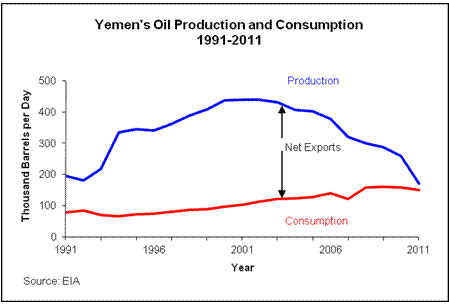
Yemen Oil Production

Yet, a newly formed government just may help Yemen produce 500,000 barrels of oil per day, or more.

In fact, Iraq is just one example of a country where oil production has steadily risen since reforming its government. According to International Business Times, Iraqi oil production is expected to hit a 30-year high in 2012.

Yet there’s no doubt major challenges are up ahead for Yemen.

Al Qaeda is another big hurdle. In 2011, the EIA said anti-government strikes were the main reason Yemen was under the 200,000-barrels-per-day mark in terms of oil production.

But despite all the drab news, Yemen is proof that radical reform is still sweeping across the Middle East region. And it’ll be very interesting to see how soon it is before foreign investment comes pouring in.

Good Investing,

Mike Kapsch

Article by Investment U

Crude Oil 4hr outlook – 07 March

Crude Oil 4hr outlook – 07 March

Crude oil has continued its recent decline falling and closing below the 105.50 area suggesting a push back higher may be resisted.

The initial recent decline was started by a strong bearish pin bar reversal as seen in the below chart. 2 bearish Hikkake’s can also be seen strengthening our short term bearish outlook.

oil4hroutlook07mar

A bearish flag pattern has also started to form on the 4hr chart signaling further losses could be expected. A sequence of highs, lows, lower highs and lower lows is also starting to form which may confirm the bears are taking control.

oil4hroutlook07mar2

With the strong bearish short term outlook traders may look to short crude, initially targeting the next level of support which sits at the 103.70 area.

oil4hroutlook07mar3

We’ll be looking to short the market upon a break of yesterdays lows at the 104.50 area with initial targets placed at 103.70. With the strong bearish outlook at present, it may be possible to place a tight stop loss resulting in a 1:2 R :R ratio.

Article by vantage-fx.com

The S&P/Case-Shiller Index and Housing


The S&P/Case-Shiller is a composite index of home price indices for 20 major metropolitan statistical areas in the United States. The index is published monthly by Standard & Poor’s and uses the Karl Case and Robert Shiller method of a house price index using a modified version of the weighted-repeat sales methodology. This method is able to adjust for the quality of the homes sold, unlike simple indices based on averages.

The Case-Shiller Index was developed in the 1980s by three economists: Allan Weiss, Karl Case and Robert Shiller. These same three later founded a company to sell their research; that company was purchased by Fiserv, Inc., which tabulates the data behind the index. The data is then distributed by Standard & Poor’s.

Let me try to get to the core of what’s going on. Each index from the 20 different areas measures the changes in the prices of single-family houses using the repeat-sales method. This process takes a look at and compares the sale prices of the same properties over time. New construction isn’t included because they’re new and have no previous price by which to compare – these houses haven’t been previously sold, and there’s no way to calculate how their sale prices have changed.

The indices, aside from the national index, are published on the last Tuesday of each month at 9 AM EST. There’s a two-month lag time in the data that’s reported, so the report issued last Tuesday only covers home sales through December.

Housing Market Bottoming?

The S&P/Case-Shiller composite index declined 0.5% on a seasonally adjusted basis, in line with economists’ expectations, after falling 0.7% the month before. Single-family home prices ended 2011 on a downbeat note as a drop in December prices sent the seasonally adjusted index down to 136.63, which is its lowest level since 2003.

“After a prior three years of accelerated decline, the past two years has been a story of a housing market that is bottoming out but has not yet stabilized. Up until today’s report we had believed the crisis lows for the composites were behind us,” David Blitzer, Chairman of the Index Committee at Standard & Poor’s, said in a statement.

“The pick-up in the economy has simply not been strong enough to keep home prices stabilized. If anything it looks like we might have reentered a period of decline as we begin 2012.”

The State of the Housing Market

Here’s the skinny: The numbers have shown that there’s an uptick in activity, but that’s not translating into rising prices. The main culprit for this is an imbalance between supply and demand.

Michael Feder, CEO of real estate data and analytics firm Radar Logic, says his firm’s daily readings on the market show a shifting mix of housing activity away from the foreclosure-related or distressed sales in favor of more traditional sales.

“Sellers are acquiescing to the new reality in pricing,” Feder says. The demand for housing is out in the market, but buyers are going to take the risk of further price depreciation. There’s a line in the sand and they won’t pay more. Unlike earlier in the downturn, sellers are finally coming to grips with the reality of what they can get. While that sounds encouraging, Feder is quick to warn that the general sentiment in the market is cautious.

And another cautiously optimistic voice out there is Karl Case, who lends his name to the index. The numbers have historically showed that the number of households usually grows by at least 1 million to 1.5 million every year. That number actually fell between March 2010 to March 2011, as young people stayed with their parents and more people shared homes.

But from March to December, the number of households picked up again. It’s just a question of how long it will take for demand to catch-up with supply and kick the recovery into another needed gear.

Good Investing,

Jason Jenkins

Article by Investment U