Cocktails and Central Banks

By MoneyMorning.com.au

Spending time in high altitudes is bound to affect your brain.

That was the conclusion of your reporter as we watched the flight attendant perform the pre-flight safety routine. The assorted editors and crew of Port Phillip Publishing were on our way to Sydney for ‘After America’. The flight attendant seemed to have forgotten he was in customer service and not showbiz…

Instead of showing you how to put on the oxygen mask, he struck a funny pose with it. Instead of showing you where the exits were, he gave you a knowing wink and flapped his arms about. You can’t blame him for trying to get a laugh. It was an instructive presentation – just we all became experts in bad acting, not surviving a crash!

But we made it to Sydney…

It was a near run thing. There was one person conspicuous by his absence outside the office this morning as the bus was ready to leave: Money Morning editor, Kris Sayce.

Normally he is conspicuous by his presence. He’s tall. He was also late. Or so we presumed. We couldn’t ring his mobile. He doesn’t have one. Being a contrarian, lone-wolf personality type is perfect for a career in investing. It’s just not great for the person stuck organising the group.

Finally, ‘After America’ is Ready to Begin

The official start isn’t until this evening. Although there will be plenty to talk about over cocktails and wine. I know Greg Canavan, editor of Sound Money. Sound Investments has plenty to say. At 10 am tomorrow morning he will explore whether China has a credit bubble – and the implications for Aussie investors.

The supply of credit is no doubt going to be a theme. Dylan Grice, the first keynote guest speaker at the conference, wrote the following some time ago:

Financial historians have shown that every single financial crisis since the 1870s has been preceded by rampant credit growth…the fact is all bubbles end in tears. The innocent bystanders who go to work not realising that their jobs derive from unsustainable demand suddenly find they’re out of work, through no fault of their own. The investors who believe the hype – generally but not exclusively naïve retail investors – get completely wiped out, or worse find themselves in debt after leveraging into the story.

Aftermath of the Credit Boom


In a normal world, central banks would not be part of the conversation. Now they dominate the conversation, because there is no discussion worth having that can risk not factoring them in. They have come between you – as an investor – and the price mechanism… the only signal you can trust. False signals lead to bad investments, as Dylan Grice makes clear.

I must confess to quoting the same Grice comment in a previous article. Probably later at the bar I’ll quote it all night. But it’s a good example of why Dylan Grice is going to be talking about inflation – central bankers being the villains.

Surprisingly, having seen a preview of Dylan Grice’s presentation, the US Federal Reserve Chairman looks like a hero. That’s because there is a slide where Bernanke is dressed as Superman. Wearing his underpants on the outside of his trousers suits his act – getting things mostly backwards. I’m sure Dylan Grice will conclude something like that, but we won’t know for sure until tomorrow. We’ll keep you posted.

Dylan Grice is the only keynote presenter that is not speaking about China or the USA specifically. The other keynote speakers, analyst and author Satyajit Das, Dr. Paul Monk and futurist David Thomas, will reveal their insights tomorrow too. From the conference notes, it’s possible to infer there’ll be a diversity of viewpoints and angles. No doubt it will lead to a dozen or more investing ideas.

The Port Phillip Publishing editors already have plenty of ideas lined up. Both Kris Sayce, editor of Australian Small Cap Investigator and Dr. Alex Cowie, editor of Diggers & Drillers, will examine how different demand trends in China will benefit certain stocks. And, of course, Murray Dawes, Slipstream Trader, is going to examine the price action of the key commodities in the crossfire of the US-China rivalry.

There is certainly plenty to get through. Don’t forget you’re more than welcome to take part and have your say by sending in any questions or comments to [email protected]. We’ll pass on what we can to the presenters and editors – who knows, maybe you’ll end up in the DVD!

But first – its cocktails at seven as conference attendees settle themselves in. The best part, talk is free. The second best bit is the cocktails are on us.

Callum Newman
Roving Reporter, ‘After America’

Cocktails and Central Banks

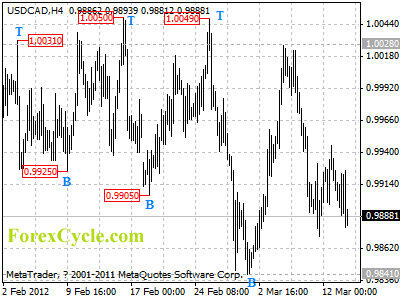
USDCAD remains in consolidation of downtrend

USDCAD remains in consolidation of the downtrend from 1.0422 (Dec 14, 2011 high). Lengthier sideways movement in the range between 0.9841 and 1.0050 would likely be seen in a couple of days. Support is at 0.9841, a breakdown below this level could signal resumption of the downtrend, then next target would be at 0.9700-0.9800 area. Only break above 1.0050 could indicate that the fall from 1.0422 had completed.

usdcad

Daily Forex Forecast

Snooki Voted Most Overpaid Celebrity!

If you think Snooki is not worth all the hype and gets paid too much money for acting a fool on national television…. you’re not alone!Snooki has been voted to the most overpaid celebrity!! The new survey was done by FITNESS Magazine and Yahoo! F…

Analyst Moves: AAPL, SWKS

Apple (AAPL) today had its price target raised to $699 by Jefferies (JEF), as the firm expects the new iTV product to be a hit. Shares are higher by over 2.7 percent.

Susquehanna Says Buy Walgreen April $33 Calls On Potential Volatility

Susquehanna released a note to clients advising to buy Walgreen (NYSE:WAG) April $33 calls as the stock may rise in the wake of an FTC announcement on Express Scripts (NASDAQ:ESRX) and Medco (NYSE:MHS) merger.A Susquehanna derivative strategist Christopher Jacabson said there was a high probability of near-term volatility.Shares of Walgreens rose 2.1% to $33.48 on March 9th.

CNN May Acquire Mashable.com

Time Warner’s (NYSE:TWX) CNN is in talks to acquire website Mashable.comMashable reports on technology and social media news and has been privately held for seven years.Last year, CNN.com acquire iPad app Zite for around $20- 25 million, which allows users to read and view what users are interested in reading.A spokeswoman for Mashable declined to comment.Time Warner (NYSE:TWX) has potential upside of 16.1% based on a current price of $36.38 and an average consensus analyst price target of $42.25.

What’s In The News: March 13, 2012

This is what’s in the news for Tuesday, March 13, 2012. The Wall Street Journal reports that on Wall Street, increasing appetites for borrowing and investing are fueling a bond market revival, increasing revenue at firms that took a beating in 2011. Bloomberg reports JPMorgan Chase & Co. (NYSE:JPM) last year became the first bank to crack the list of 10 largest U.S. stock and bond fund managers, according to Strategic Insight. Bloomberg also reports Germany’s government may start the sale of its real estate management company next month, looking to raise over $2.3B to reduce its deficit, sources say. Finally, Reuters reports The Renault, Nissan (NSANY) alliance will take a majority stake in Russian automaker AvtoVAZ in the coming weeks.

Central Bank of Russia Holds Refi Rate at 8.00%


The Central Bank of Russia kept its benchmark refinancing rate steady at 8.00%.  The Bank said: “The dynamics of the main macroeconomic indicators in January showed that the rates of growth in consumption were still higher than in production. Real wage growth rate remained high, partly due to its dynamics in the public sector of economy, while the rate of unemployment remained rather low. The consumer credit activity also stays robust. At the same time production growth rates remained moderate and economic confidence indicators kept rather weak in the recent months. Considering recent domestic and international macroeconomic developments the Bank of Russia judged that the current level of money market interest rates within the interest rate corridor was appropriate in the coming months.”

The Russian central bank previously cut the refi rate 25bps at its December meeting, while it last raised the fixed overnight deposit rate by 25bps to 3.50% in May, and the benchmark refinancing rate by 25 basis points to 8.25% in April this year.  Russia reported annual inflation of 4.1% in January, down from 6.8% in November, 7.2% in September and October, down from 8.2% in August, 9% in July, and 9.4% in June, meanwhile Bank Chairman Sergey Ignatiev is trying to keep inflation between 6% and 7%. 

Russian economic growth was recorded at 5.2% y/y in Q3 this year, compared to 3.4% in Q2, 4.1% in Q1, and 4.5% in the December quarter of 2010; the IMF is expecting 4.5% growth for the full year.  The Russian Ruble (RUB) has weakened about 4% against the US dollar over the past year, while the USDRUB exchange rate last traded around 29.41.  The Bank plans to meet again in early April.

www.CentralBankNews.info

Bank of Japan Announces 2 trillion yen Enhancement to Loan Program


The Bank of Japan held its interest rate at 0-0.10% and announced 2 trillion yen of enhancements to “the Growth-Supporting Funding Facility” (GSFF) resulting in the GSFF expanding to 5.5 trillion yen. At the Bank of Japan’s regular meeting, board member Mr. R. Miyao proposed to increase the amount of the Asset Purchase Program by about 5 trillion yen, but the proposal was defeated by a majority vote. The Bank noted it will continue with “powerful easing” until it judges its new 1 percent inflation goal to be in sight.


The Bank said: “Japan’s economy currently confronts the long-term structural challenge of declining trend growth rates amid rapid population aging.  Tackling this challenge is crucial for establishing a new basis for economic growth.  The goal of overcoming deflation will be achieved through such efforts to strengthen growth potential and via support from the financial side.  With this in mind, it is important for business firms, financial institutions, the government, and the central bank each to continue exerting themselves in their respective roles.”
The Bank of Japan added another 10 trillion yen to its 65 trillion yen quantitative easing program last month, after it expanded its asset purchase program in October by another 5 trillion yen to 55 trillion yen, and previously announced additions to its quantitative easing program during its August meeting.  The Bank had previously changed its asset purchase program in March last year, when it added a further 5 trillion yen to its target.