China and The Revolution

By MoneyMorning.com.au

We never thought a chat about pure mathematics and statistics could be interesting. You probably think the same thing.

Last night at the welcome cocktail party for ‘After America’, one of the delegates managed to change our mind. We practically wanted to start doing algebra on a beer coaster. There were a lot of interesting conversations like that. One of the older gents from Bundaberg in Queensland started talking about property investing and ended up talking about women. The conclusion for both was the same: he’d won and he’d lost.

People had come from all over Australia to join us. They shared the same worries mostly – financial instability and preserving hard earned savings. They were looking for income and ideas to grow their wealth. But don’t think the mood was sombre. The room practically hummed as people swapped stories. They swapped plenty of empty glasses for full ones too.

Dan Denning: The Crisis is Not Over

Stomach full, mobile off, eyes front: Thursday was underway early. There was a lot to get through. Your reporter did his best to catch what he could…but there was so much. We are already thinking about buying the DVD ourselves, to see what we missed. Keep in mind that what’s below is a summary at best, made on the run.

Master of ceremonies, Dr Marcus Matthews, opened the show with the idea that we were going to engage in the dangerous practice of thinking for ourselves. He didn’t leave us wondering. When you embrace ideas outside the mainstream, you’re either early – or wrong.

But as Dan Denning said, you’re always free to change your mind. But you always have to be ahead of the market. That much was clear. But getting ahead isn’t going to be easy in the next ten years.

Does Australia have anything to worry about the European debt crisis? Yes. The notion that Australia has decoupled from the major economies and forged an unbreakable link with China is wrong. So is the notion that Chinese bureaucrats can override 1.2 billion individuals to produce a desired effect.

Ultimately the financial system is global, and the crisis will shift from the periphery (Europe, Japan) to the centre – the United States. The global monetary regime – based on the US dollar – is in terminal decline. It is not stabilising, or recovering. There are three alternatives: a new order, disorder or chaos.

In the meantime, expect some of these: capital controls, more debt monetisation, political/social unrest and the nationalisation of finance. He named a US bank that recently failed a stress test. We won’t name it – we just hope you don’t have shares in it.

Part of the wider breakdown is the collapse of the western welfare state. When governments have to borrow money to pay off debt they have already incurred, the endgame is nearing. It’s not quite there yet for the United States – at the federal level anyway. But it’s practically about to smash the door down in Japan. The yen is a pillar of the current monetary order – the order that is collapsing.

The theme: Prepare for disorder. But never rule out chaos.

Greg Canavan: China Has Its Own Problems

There is a myth of a seamless transition: that a rising China will neatly replace a falling America. While that may be true in the long sweep of this century, it’s not much good for investing over the next five to ten years. We’ll be lucky to do well in the market over the next ten years – for general or index investors, anyway. Your focus should be on wealth preservation – if you can take your focus off the volatility. Markets will be anything but stable.

Today, governments have huge debts. So does the private sector. The world has barely seen anything like this. But when history goes against us – after all, history has gone against plenty of people before – we at least have the luxury of preparing. We can also be ready to buy in when the market panics. It’s going to do that a lot more than we’re used to.

Which brought him to China. Greg’s knowledge of economics and markets shone through here – fifteen years in the trenches of finance will do that. He talked about China like this:

  • Massive internal imbalances
  • An epic credit boom
  • Fragile financial system
  • Blocked currency
  • Run by the party for the party
  • Horrible demographics

China can’t fill the power vacuum left by America in the short term. Why?

The big powers of the past have always had open capital markets.

China doesn’t. China’s capital controls means its citizens cannot move its savings out of the country. All they can do is stick it in the bank. With inflation higher than the interest rate, they’re losing purchasing power. If China tries to change its policy, and allowed investment overseas, the unintended consequence might be that capital would go to where it’s treated best, or better – and flood out of China. This would cause the Chinese banking system to collapse and the yuan to fall through the floor.

That was one scenario. The conclusion is that China’s central planners are in for a tough time. Another question Greg posed was whether China is going to cause a big re-evaluation in gold. Could it go to $5,000 an ounce. …$10,000… who knows? Nobody. But it might. Whatever the figure, it will make today’s spot price look cheap.

Dylan Grice: Know What You Don’t Know

Dylan Grice is an alternative strategist at Societe Generale. His historical perspective goes back to ancient Greece. When he starts talking about ancient Rome, for him it’s practically the near past. The Great Depression is something like yesterday. The lesson is simple: ever since money has been used, there’s always been a temptation to debase and clip it.

Which brought us to inflation. Grice said it’s almost always a fiscal problem. Not a monetary problem, as Milton Friedman famously said. When governments go broke…like now…and can’t tap the financing…like now…they fiddle with the books…like increasing the balance sheets of central banks…until they lose control.

Central bankers are in charge of the price of credit – the most important price in the world right now. It’s a problem that they keep getting it wrong. It’s also a problem that we all think at some point they’re going to get it right. That’s another problem – telling ourselves stories despite the facts.

The facts say the western welfare state has huge unfunded liabilities that cannot be paid. The idea that the core of Europe is sound and the problems are contained to the periphery is wrong.

Dylan Grice sketched a strategy to deal with it. Gold, an Asian currency and solid companies that are not bets on the future. He gave an example of the type of company he was looking for. In response to a question, he said Australian real estate didn’t look a good bet, regardless of inflation.

There was only Kris Sayce to go. We wanted to include his talk in these notes but we are well over time already. We were worried that the delegates might have been fatigued by the time Kris came on stage. That their minds might’ve begun to wander slightly.

There was no danger of that. Kris knows how to make a bang. More tomorrow.

Callum Newman
Roving Reporter, ‘After America’

China and The Revolution

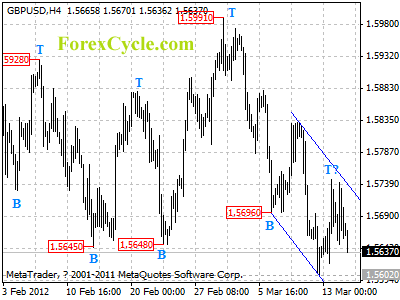
GBPUSD stays in a downward price channel

GBPUSD stays in a downward price channel on 4-hour chart, and remains in downtrend from 1.5991, the price action from 1.5602 is treated as consolidation of the downtrend. Another fall would likely be seen after consolidation, and next target would be at 1.5500 area. Support is at 1.5602, a breakdown below this level could signal resumption of the downtrend. Resistance is at the upper line of the channel, only a clear break above the channel could signal completion of the downtrend.

gbpusd

Forex Signals

Greek Debt Woes Far From Solved, Debt to Spread to Other Countries

1. Convince European officials to provide another bailout to the tune of 130 billion euros? Check.

2. Persuade your creditors to “voluntarily” accept 100 billion euros less in repayment? Check.

3. Close the Eurozone debt file as “solved”? Not a chance.

Despite the unprecedented amount of financial support Greece has received over the past two years or so, does anyone seriously believe Europe’s debt problems are over? At best, Greece has avoided a near-term default, but this in no way nudges Greece any closer to sustainability. For proof, one need only look to last week’s bond yield for proof.

True, the bond auction was held prior to the official announcement confirming the second bailout package, but the market knew the deal was ready for final approval. It is also true that even with the guarantee of more bailout money and the bond swap deal in place, yields on Greek debt remains considerably higher than other Eurozone member nations.

In last week’s offering, the yield for new 11-year Greek bonds averaged around 19 percent, while 30-year bonds were in the 14 percent range. By way of comparison, the benchmark German 10-year yield is currently only about 3.6 percent.

To be blunt, these yields are simply not sustainable and there is no way Greece can afford to borrow money at the current rates. With its ability to borrow curtailed, Greece will have to rely on further spending cuts and massive tax hikes to meet its budgetary needs. Few believe this will happen.

Just look at the ferocity of the protests against the initial austerity efforts which are little more than a drop in the bucket when you consider the enormity of the present deficit gap. In order to avoid insolvency, Greece will continue to rely on assistance from the rest of the Eurozone for the foreseeable future.

It would be bad enough for the euro were it just Greece facing this predicament, but there are several other countries sharing the same fate. It’s just that Greece is the furthest along this inevitable path so it receives most of the news coverage.

Hungary Warned About its Debt

On Tuesday, Eurozone officials emerged from a hastily-arranged meeting to announce that Hungary must reduce its debt level to 3 percent of GDP by the end of this year. Failure to do so will result in the suspension of EU funds earmarked for development projects for the country.

Interestingly, Spain, facing its own fiscal challenges, received permission to run a deficit equal of 5.3 percent of GDP rather than the original target of 4.4 percent. Naturally, this is not going over well with Hungary’s government and even the Austrian finance minister is questioning why one Eurozone member is being held to a more challenging standard than other members.

Still, it is Portugal that remains the odds-on favorite to be the next sovereign nation to be forced to appeal to its neighbors for help. Following two rounds of Long-Term Refinancing Operations (LRTOs) to recapitalize the European banking system, bond yields did decline for many Eurozone nations. But even with its two-year rate declining to 12.48 percent, Portugal’s current yields are more than double this time one year ago with no relief in sight.

Article by forexblog.oanda.com

BB&T Changes Acquisition Agreement with BankAtlantic

A change in an acquisition agreement in the business world this morning. BB&T Corporation announced in a press release an amendment to its November 1, 2011 agreement to acquire BankAtlantic. The core provisions of the original agreement will stay the same with BB&T acquiring approximately $2.1 billion in loaned and $3.3 billion in deposits. BB&T will pay an estimated $301 million above the net asset value of BankAtlantic. Under the terms of the modified agreement, BB&T will assume BankAtlantic Bancorp’s obligations with respect to roughly $285 million of outstanding trust preferred securities. As a result, the companies have agreed to form a new limited liability company, which will receive about $424 million of loans and $17 million of real estate owned and other assets previously held by BankAtlantic.The companies expect the deal to close in the second quarter, subject to regulatory approvals.

Retail Sales in February Rise to a 5-Month High

New economic data released today, showing retail sales have climbed in February to a five-month high. The Commerce Department reported Tuesday that retail sales rose a seasonally adjusted 1.1% to $407.8 billion.The rise is from an upwardly revised 0.6% increase in January. Excluding autos, retail sales advanced 0.9% last month adding to January’s upwardly revised 1.1% gain.This data comes before a Federal Reserve policy meeting and subsequent statement which is expected at 2:15 pm. Even with these numbers, economists still aren’t anticipating any extreme shifts in policy.

Norway Central Bank Cuts Policy Rate 25bps to 1.50%


Norway’s central bank, Norges Bank, cut its key monetary policy rate by 25 basis points to 1.50% from 1.75% previously.  The Bank’s Governor, Oystein Olsen, said: “The continuing downturn abroad and the strong krone are contributing to keeping inflation low and are weighing on growth in Norway. Against this background, the Executive Board has decided to reduce the key policy rate.”  Further noting: “The current outlook suggests that the key policy rate may remain low longer than projected earlier. There is a high level of uncertainty regarding economic developments, and we have monetary policy leeway in both directions.”

At its previous meeting the Bank slashed interest rates by 50 basis points, after increasing the interest rate by 25 basis points to 2.25% in May last year.  The Bank expects inflation to remain relatively low in relation to the 2.5 percent inflation target; Norway reported annual inflation of 1.2% in February this year, compared to 1.6% in September, 1.3% in August, 1.6% in July, 1.3% in June, 1.6% in May, and 1.3% in April last year.  


Norway’s economy grew by 0.6% in the December quarter (0.8% in Q3, 0.5% in Q2, and -0.5% in Q1 last year), placing GDP growth at 1.5% on an annual basis (4% in Q3, -0.4% in Q2, and 0.9% in Q1). The Norwegian krone has weakened about 1% against the US dollar over the past year, while the USDNOK exchange rate last traded around 5.82

Risk aversion returns as Euro threatens 1.3000 level


By TraderVox.com

Tradervox (Dublin) – Euro continued its downslide against the US dollar during the US session as Euro is threatening the 1.3000 level. The pair is currently trading around 1.3025, down about 0.43% for the day. The support may be seen at 1.3000 and below at 1.2950. The resistance may be seen at 1.3060 and above 1.3100. The pair tried to pull back during the European session but the pullback was shortlived as it lost all the gains.

The Sterling Pound has the 1.5700 handle and is currently trading around 1.5675, down about 0.21% for the day. The support may be seen at 1.5650 and below at 1.5600. The resistance may be seen at 1.5700 and above at 1.5760. Like Euro, the pound is also under pressure in the US dollar strengthening move.
 
USD/CHF rallied above the 0.9300 levels with risk aversion sentiment across the board. It printed a high of 0.9329, the levels last seen during the late January. The pair is trading near the high at 0.9320, up about 0.96% for the day. The resistance may be seen at 0.9350 and above at 0.9400. The support may be seen at 0.9300 and below at 0.9250 levels.
 
The USD/JPY is approaching the 84 levels and printed a fresh high of 83.81 during the US session. The pair is trading near the high at 83.77, up more than a perccent for the day. The resistance may be seen at 83.80 and 84.30. The support may be seen at 83.30 and below at 83.
 
The downtrend in AUD/USD pair has brought the pair near the 1.0400 levels as it prints a fresh low of 1.0426. The pair is trading 1.0440, down about 0.92% for the day. The support may be seen at 1.0420 while the resistance may be seen at 1.0450 levels.
 
The US dollar index is trading near the 81 levels.

Disclaimer
Tradervox.com is not giving advice nor is qualified or licensed to provide financial advice. You must seek guidance from your personal advisors before acting on this information. While we try to ensure that all of the information provided on this website is kept up-to-date and accurate we accept no responsibility for any use made of the information provided. Opinions expressed at Tradervox.com are those of the individual authors and do not necessarily represent the opinion of Tradervox.com or its management. 

Article provided by TraderVox.com
Tradervox.com is a Forex News Portal that provides real-time news and analysis relating to the Currency Markets.
News and analysis are produced throughout the day by our in-house staff.
Follow us on twitter: www.twitter.com/tradervox

GBP Falls as Unemployment Rate Rises


By TraderVox.com

Tradervox.com (Dublin) – Despite the frantic efforts made by the BOE, the UK economy seems to be sinking lower. Without talking about the QE program which has been marred with a lot of questions, the unemployment data from the UK seems to make a big blow to the BOE’s efforts. The jobless claims have increased more than it was anticipated by most economists. The report released today showed that the unemployment-benefit claims rose by 7,200 to reach 1.612 million making this the 12th monthly increase in a raw. Most of the analysts and economists who were surveyed had expected an increase of 5,000.

There has been a very heated debate on whether the BOE is making the right move in buying government bonds and these results are expected to intensify the debate further. Prime Minister David Cameron will be put to task by the opposition politicians who think that he is cutting government spending too fast. According to Samuel Tombs of Capital Economics, the figures points to a weak picture hence laying doubt on the current economic growth in the country.

After the release of this report, the pound pared gains against the dollar showing the impact of the result in the market; however, the pound gained against the euro. This can be related to the positive reports coming from the US market and the fear over the euro crisis that still lingers. The pound traded at $1.5675 against the dollar at 15:29 GMT after it reached $1.5744 earlier in the day in London. The pound gained 0.2 percent against the euro to trade at 83.13 pence per euro.

According to the Office of National Statistics, the number of unemployed people rose by 28000 to reach 2.67 million as the number of people in work rose by 9,000 to reach 29.1 million. These results came just days after surveys if manufacturing and services indicated that the economy had returned to growth in the first quarter. The economy had contracted by 0.2 percent in the last quarter forcing the BOE to embark on a QE program.

 Disclaimer
Tradervox.com is not giving advice nor is qualified or licensed to provide financial advice. You must seek guidance from your personal advisors before acting on this information. While we try to ensure that all of the information provided on this website is kept up-to-date and accurate we accept no responsibility for any use made of the information provided. Opinions expressed at Tradervox.com are those of the individual authors and do not necessarily represent the opinion of Tradervox.com or its management. 

Article provided by TraderVox.com
Tradervox.com is a Forex News Portal that provides real-time news and analysis relating to the Currency Markets.
News and analysis are produced throughout the day by our in-house staff.
Follow us on twitter: www.twitter.com/tradervox