EUR/USD Fails to Move Below 1.3000 Level

Source: ForexYard

The US dollar largely maintained its recent gains against the euro throughout yesterday’s trading session, as a batch of positive US data continued to boost confidence in the American economic recovery. The EUR/USD spent much of the day trading around the 1.3050 level, after dropping as low as 1.3002 during Asian trading. As we begin to close out the week, traders will want to pay attention to two US indicators set to be released today. The Core CPI, set to be released at 12:30 GMT, and the Prelim UoM Consumer Sentiment figure, scheduled for 13:55 GMT, are both considered valid indicators of economic health and could help the dollar extend its gains.

Economic News

USD – USD Retreats Slightly vs. Yen

After breaking the psychologically significant 84.00 level during Asian trading yesterday, the USD/JPY retreated during much of the European session. The pair fell some 80 pips before stabilizing around the 83.30 level. The EUR/USD spent most of the day trading around the 1.3050 level, after dropping as low as 1.3002 during early morning trading. Despite the relatively small losses taken by the greenback yesterday, market sentiment is still overwhelmingly bullish for the dollar. Positive US indicators, including yesterday’s weekly Unemployment Claims figure, continue to boost confidence in the American economic recovery.

As we close out the week, traders will want to pay attention to several US economic indicators. The Core CPI figure, set to be released at 12:30 GMT, is considered a valid indicator of inflation and has the potential to create dollar volatility. Later in the day, dollar pairs could also see some movement following the release of the Prelim UoM Consumer Sentiment. Analysts are forecasting the indicator rose to 75.8, following last month’s figure of 75.3. If true, the dollar could see additional gains before markets close for the weekend.

EUR – Euro Falls vs. CHF Following SNB Statement

The euro tumbled vs. the CHF during European trading yesterday, following the Swiss National Bank’s (SNB) Monetary Policy Assessment. The assessment stated that the SNB would actively work to make sure the EUR/CHF does not trade below the 1.20 level. As a result, the EUR/CHF dropped some 65 pips, reaching as low as 1.2073 during European trading. The euro also had a bearish day vs. the Japanese yen. The EUR/JPY was down over 100 pips, reaching as low as 108.56, before bouncing back to the 109.00 level.

Turning to today, euro traders will want to keep an eye on several US indicators which have the potential to bring the EUR/USD down. The pair came dangerously close to dropping below the psychologically significant 1.3000 level yesterday, before bouncing back to the 1.3500 level. Should any of the US news today come in above expectations, investor confidence in the US economic recovery may continue to go up, which could turn the EUR/USD bearish once again.

JPY – JPY Sees Gains against EUR and USD

After several days of continuous bearishness, the Japanese yen was able to recoup some of its losses during yesterday’s trading session. The USD/JPY, which had recently gone as high as 84.15, tumbled close to 85 pips throughout the European session yesterday, before stabilizing at the 83.30 level. The EUR/JPY fell over 100 pips yesterday, reaching as low 108.57, before staging a mild recovery and stabilizing around 108.85.

Turning to today, yen traders will want to keep an eye on several US indicators scheduled to be released over the course of the day. The recent monetary easing policy from the Bank of Japan continues to weigh down on the yen. Analysts are predicting that, given the poor state of the Japanese economy and recent strong US economic indicators, the USD/JPY has the potential to reach 85.00 in the near future. Should any of the US news come in better than expected today, the yen could reverse yesterday’s gains before markets close for the week.

Gold – Gold Sees Mild Gains in Trading Yesterday

After spending much of the week stuck in a bearish trend, gold saw mild gains during yesterday’s trading session. The price of gold had dropped as low as $1634.09 an ounce on Wednesday, largely due to the strengthening US dollar. A strong USD typically limits the appeal for high yielding commodities, like gold. The trend briefly changed yesterday, and the precious metal was able to reach as high as $1650.91 during the evening session.

Despite yesterday’s slight upward movement, analysts warn that gold’s bearish trend may continue for the foreseeable future. US indicators continue to show that the American economy is growing. It would appear that for the time being, a bullish dollar means that any upward movement by gold may be limited.

Technical News

EUR/USD

The Slow Stochastic on the 8-hour chart has formed a bullish cross, indicating that upward movement could occur in the near future. This theory is supported by the Relative Strength Index on the daily chart, which has crossed into oversold territory. Going long may be the wise choice for this pair.

GBP/USD

Most long-term technical indicators show the GBP/USD trading in neutral territory at this time. The daily chart’s Williams Percent Range and Relative Strength Index are both range trading. As there is no defined trend, traders may want to take a wait and see approach for this pair ahead of any major movements.

USD/JPY

Technical indicators on the daily chart continue to show that this pair is overbought and could see downward movement in the near future. These include the Slow Stochastic, which has formed a bearish cross, and the Relative Strength Index which is currently at 80. Going short may be the wise choice for this pair.

USD/CHF

The daily chart’s Williams Percent Range is currently well into the overbought zone, indicating that a downward correction could occur in the near future. This theory is supported by the Relative Strength Index on the same chart, which is currently around 75. Going short may be the wise choice for this pair.

The Wild Card

USD/NOK

Following the upward movement this pair has seen in recent days, technical indicators now show downward movement may occur in the coming days. A bearish cross on the daily chart’s Slow Stochastic signals a possible reversal. Additionally, the Williams Percent Range is trading at the -20 level, indicating that a bearish correction could occur. Forex traders may want to go short in their positions.

Forex Market Analysis provided by ForexYard.

© 2006 by FxYard Ltd

Disclaimer: Trading Foreign Exchange carries a high level of risk and may not be suitable for all investors. There is a possibility that you could sustain a loss of all of your investment and therefore you should not invest money that you cannot afford to lose. You should be aware of all the risks associated with Foreign Exchange trading.


IMF Approves More Funding for Greece’s Bailout

Good news for Greece and the Euro zone. The International Monetary Fund has just approved 28 billion euros in funding for the cash-strapped country over the next four years.The IMF statement said today it will allow 1.65 billion of the funds for immediate release to add to Greece’s economic bailout. The country’s total bailout package now amounts to 172.7 billion euros.This is the second bailout Greece has received over the past couple years. Back in May 2010 it received it’s first bailout amounting to 110 billion euros. In return for both bailouts, government officials are implementing cost-cutting measures, slashing pensions and salaries while raising taxes.

What’s In The News: March 16, 2012

This is what’s in the news for Friday March 16, 2012. The Wall Street Journal reports U.S. and EU regulators are investigating Google (NASDAQ:GOOG) for bypassing privacy settings of millions of users of Apple’s (NASDAQ:AAPL) Safari browser, sources say. The Wall Street Journal also reports the Commodity Futures Trading Commission plans to expand day-to-day monitoring of the commodities and futures markets, targeting high-speed trading firms. Reuters reports The explosive Goldman Sachs (NYSE:GS) resignation letter has increased pressure on U.S. regulators to quickly put in place a tough version of the Volcker rule. Bloomberg reports highly indebted Italy paid $3.4B to Morgan Stanley (NYSE:MS) in January to unwind derivative contracts from the 1990s that backfired, sources say. Finally, Bloomberg also reports a Supreme Court ruling on whether the U.S. health care law is constitutional won’t stop market forces transforming how Americans get their medical care, says Cigna (CI) CEO David Cordani,

Confidence Builds as U.S. Jobless Claims Drop to a Four Year Low

The U.S. saw jobless claims drop last week to a level matching a four year low set in March 2008, Bloomberg reports. Economists and experts believe that the decline indicates the U.S. economy is on an ever firmer recovery.The New York Federal Reserve gave indication that the industries in the area had improved economically and were hiring more while firing less. Average workweeks in the state doubled as well. Similar performance could be seen elsewhere in the Northeast.New applications were projected to be down to 350,000, a drop from 365,000 the previous week. The jobless decrease is accompanied by a three week trend of job growth of over 200,000 jobs a week.

Watsco Acquires Carrier’s HVAC Distribution Network (WSO,UTX)

Watsco (NYSE:WSO)(NYSE:UTX) has agreed to acquire Carrier’s HVAC distribution network in Canada.Carrier is a unit of UTC Climate, Controls & Security. The business will operate as a JV under the name Carrier Enterprise Canada with Watsco owning 60% and UTS Climate, Controls & Security 40%.The Canadian distribution network operates 35 locations and had revenues of approximately $330 million in 2011 serving 5,000 customers in all of the provinces and territories of Canada.

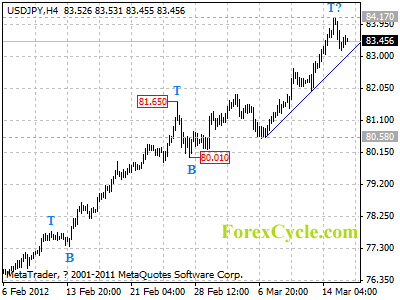
USDJPY stays above a rising trend line

USDJPY stays above a rising trend line on 4-hour chart, and remains in uptrend from 80.58, the fall from 84.17 is treated as consolidation of the uptrend. Support is at the trend line, as long as the trend line support holds, uptrend could be expected to resume, and another rise towards 85.00 is still possible, only a clear break below the trend line could indicate that lengthier consolidation of the uptrend is underway, then sideways movement in a range between 82.50 and 84.17 could be seen.

usdjpy

Daily Forex Forecast

AAON Misses Estimates (AAON)

AAON (NASDAQ:AAON) reported Q4 EPS of $0.09, may not be comparable to consensus estimates of $0.21.Revenues in the quarter fell 3.6% year-over-year to $63.4 million, missing estimates by $12 million.

‘After America’: Threats and Opportunities

By MoneyMorning.com.au

Billionaire US investor Jim Rogers is bullish on China.

We can safely say regular Money Morning editor Kris Sayce is not. That might be putting it the wrong away. It would be like saying Man vs. Wild star Bear Grylls tries an adventurous meal every now and again: it understates the case.

Kris was making his speech for ‘After America’. We were half way through the first full day of the conference. There was no slowing down. Kris said China is an ‘entrepreneurial desert’ whose economy is based on ‘the lowest common denominator: cheap labour’.

The top brass in government spend money to build pointless stadiums and buildings. The idea that the West was ‘exporting’ capitalism to China was a joke. Most of the Western world is as socialist as the comrades in Beijing, anyway.

But it doesn’t mean you can’t make a buck investing. There is always an opportunity when people are free to create wealth. Natural gas is a key sector to investigate in 2012. It’s not without risk. But speculation could have a place in your investment strategy.

Balancing and allocating your portfolio, he added, is not as complex as the marketing industry – sorry, the finance industry – would have you believe. You can do most of it yourself (and save the fees) through a handful of carefully selected investments.

Price Action

After lunch, Murray Dawes broke down charts, such as BHP and oil, in detail. Every investor could benefit from listening to the Slipstream Trader. Actually, we should say from watching. Murray is a trader. Charts are important. If you’re considering ordering the audio or DVD of the After America conference and you’re interested in Murray’s work, we humbly suggest you choose the visual option.

Murray didn’t let us forget price action is always a map of human psychology. And we must always remember that our own mind and emotions can be our biggest enemy. We’re all a mixture of biases and assumptions. Not to mention ego – the biggest trap of all. We need to manage risk, but get exposure to large upside potentials. It’s a balancing act.

Nick Hubble knows about those. At one point he had four juggling balls in the air. He also got the delegates on their feet. He had a powerful strategy for buying shares at a discount with a view for income in a world of low-growth capital gains.

The Last Hour of the Day

Six of the presenters were on a panel. People were free to ask what they liked. The discussion came to how the cost of credit had been held artificially low and the resulting crisis. The conclusion: If you give everyone free drinks people are going to get drunk.

Dylan Grice suggested popular anger directed against banks should be directed to those who (mis)priced credit in the first place – central bankers. And the system that put them in that position of power. Sadly, the guys who took us here are still in control.

But it doesn’t mean we are powerless. We can control our own investment strategy if we are mindful of the wider context. The first rule of a bear market is not to lose money.

As we got ready to wrap up, there was a surprise announcement. Professor Steve Keen had decided to do an unscheduled speech to open the following day …things are going to get even more interesting! Stay tuned.

Callum Newman
Roving Reporter, ‘After America’


‘After America’: Threats and Opportunities

Egyptian-Israeli Natural Gas Contract Casualty of Arab spring?

As last year’s Arab spring has slowly roiled eastwards from Tunisia to the eastern Mediterranean, the two most concerned governments are the U.S. and Israel, that are watching their carefully constructed defense alignments crumble to the populist forces unleashed.

After decades of repression, the Arab “street” is finding its democratic voice, which is rejecting the cozy decades-long security and energy arrangements carefully stitched together by Washington to ensure Israeli security. In the “brave new world” emerging, it is increasingly obvious that the post-Arab Spring governments, inhaling Western democratic ideals relentlessly promoted as the way forward, have a radically different agenda than those proposed by Washington and Tel Aviv.

Viewing social upheavals decades ago, in 1973 Henry Kissinger, President Nixon’s Secretary of State commented prior to the CIA overthrow of the democratically elected government of Chilean socialist President Salvadore Allende “I don’t see why we need to stand by and watch a country go communist due to the irresponsibility of its people.”

Now the Arab spring seems to be embracing two policies anathema to Washington – a rejection by Egypt of its ties to Israel, carefully fostered by assassinated Egyptian President Anwar Sadat and his successor, Hosni Mubarak, Egypt’s President until 13 months ago, when the Arab spring populist uprising unseated him and his administration’s cozy energy arrangements with Israel, which provided Tel Aviv with 2/5 of its natural gas import requirement needs.

In a development largely overlooked in the Western press, in an evening session on 12 March the Egyptian People’s Assembly demanded the deportation of the Israeli ambassador Yaakov Amitai, and the withdrawal of the Egyptian ambassador from Tel Aviv.

And oh, the nullification of the country’s natural gas sales to Israel.

The People’s Assembly vote was unanimous.

Why?

As a protest against Israel’s recent campaign against the Palestinians in the Gaza Strip, which the Egyptian Assembly considers a flagrant violation of human rights.

Newly founded Egyptian democratic handwriting on the wall? Assembly speaker Saad al-Katatny asked a special parliamentary committee to follow up the implementation of the demands with the government, releasing a People’s Assembly statement commenting, “Egypt after the revolution will never be a friend of the Zionist entity, the first enemy of Egypt and the Arab nation,” demanding that the Egyptian government review all its relations and agreements with that “enemy” along with calling for stopping Egyptian natural gas exports to Israel.

So, how serious a threat?

Egypt is the Arab’s world’s largest country and has played a central role in Middle Eastern politics for decades. In 1979 Egyptian President Anwar Sadat made peace with Israel under terms of the Camp David agreement. Sadat’s initiative led to Egypt being expelled from the Arab League for a decade, and in 1981 Sadat was assassinated by Islamic extremists, to be succeeded by Hosni Mubarak, who ruled Egypt until February of last year, when the “Arab Spring” swept him from power.

The tenuous peace established by the Camp David accords, liberally lubricated by massive U.S. aid, endured until February 2011, and quite aside from marginalizing the Arab world’s military superpower, further paid off Israel with the opening in 2005 of Egypt’s $500 million East Mediterranean Gas Company Ltd. (EMG) pipeline, which supplied 40 percent of Israel’s natural gas through an underwater pipeline from the Egyptian city of El Arish on the northern Mediterranean coast to the Israeli port of Ashkelon.

The East Mediterranean Gas Company Ltd. was established in 2000 and is jointly owned by Egyptian General Petroleum Corp., which owns 68.4 percent of the venture, and its 170 million cubic feet of gas per day of exports and met nearly half of Israel’s natural gas needs until the Arab Spring swept Cairo a year ago.

The latest Egyptian National Assembly vote puts that at risk.

But it’s not as if Tel Aviv has been unaware of the consequences of Cairo’s “Spring,” as the East Mediterranean Gas Company Ltd. Pipeline has been bombed 13 times since Mubarak’s overthrow, most recently on 5 March, and remains closed at present.

The National Assembly’s motion at present remains largely symbolic because only Egypt’s current government, the Military Council, can sign off on such decisions.

That said, the vote is a startling manifestation of the feelings of the Egyptian people, and, as such, can hardly be ignored in the Middle East’s rising embrace of democratic values, as assiduously promoted by Washington. The only problem for the U.S. is that Egyptian voters had a somewhat different perception of what being able to choose in their foreign relations entailed, and after decades of Mubarak’s rule, have a somewhat different view of the future from their Washington ‘advisers.”

Egyptian voters have resoundingly rejected Washington’s exhortations and accordingly, Israeli consumers had better be ready to turn down both their thermostats and air conditioning, as the winds of change of the Arab Spring continue to roil the Middle East and bring new political realities into being, undoubtedly not all to Washington and Tel Aviv’s liking.

Source: http://oilprice.com/Energy/Natural-Gas/Egyptian-Israeli-Natural-Gas-Contract-Casualty-of-Arab-spring.html

By. John C.K. Daly of Oilprice.com