Profit Opportunities in China

By MoneyMorning.com.au

Ed Note: David Thomas, BRIC expert and entrepreneur, gave a great presentation at ‘After America’, Port Phillip Publishing’s first investing conference. Today he shares some ideas on China…and where to look for investment opportunities. You can pre-order the After America DVD now to learn more, plus his thoughts on India, Brazil and Russia.

China has three imperatives, as comprehensively described in their 12th Five Year Plan (2011 – 2015):


Going Out


Driving investment offshore, in real corporate assets to diversify their exposure to US Treasuries, to secure resources and commodities. Also to upgrade their service sector (tourism, education, healthcare, technology, financial services etc.). This creates new opportunities for foreign companies to participate in China’s industrial revolution and nation-building activities.

Going West


Investing in the development of their 2nd and 3rd tier cities in their inner and western provinces, increasing productivity and consumption, creating jobs and continuing the process of rapid urbanisation, whilst focusing on the progressive industries of the 21st century (IT, biotech, high value manufacturing) and a cleaner, sustainable environment for their increasingly urban population.

Going Green


Accelerating the development of clean technology with a commitment to spend US$65 billion each year (investment in renewable energy spending has grown at 77% p.a. since 2008) in the development of new renewable energy sources (hydro, nuclear, solar, wind, biomass and more efficient use of coal and existing energy sources). And clean energy vehicles to reduce their dependence on fossil fuels and improve the environment by a 40% to 45% reduction in carbon intensity from 2005 levels by 2015

But the key to the future growth of their economy depends on an increase in domestic consumption. Leading companies, entrepreneurs and business leaders are competing for access to their rapidly growing market. Opportunities exist across the board, but one example of this is in the area of fresh and organic food.

Fresh and Organic Food

China’s domestic food market is already very strong and vibrant and, with its rapidly growing middle class and urbanisation program, is in a state of transition. For centuries, the Chinese have purchased their daily fruit, vegetables, meat and other perishables from local fresh produce markets.

More recently, with increasing urbanisation, modern supermarkets are gaining popularity and the trend to purchase weekly is slowly becoming more convenient for busy commuters. In the past, little attention was paid to the origin or treatment of the food, as “fresh” was simply considered the best option.

Whilst fresh is still a major consideration, Chinese shoppers are now focused on food safety, health and diet. The spate of food quality incidents and a heightened awareness of the effects of pesticides have produced a more discerning consumer and fresh and organic options have gained popularity.

Soil depletion, over-cultivated land, pollution and public health issues have also forced the Government to look for solutions. They see organic farming as a potential remedy and for the past 30 years have been working on initiatives to develop a national standardisation body.

When it comes to fresh and organic food products, price sensitive Chinese consumers still pay close attention to whether produce is grown locally or internationally. With time, and as China continues to develop their local food industry, more local options and choice will become available to local consumers. In the meantime, foreign players are beating a path to China’s door.

David Thomas
Contributing Writer, Money Morning

Profit Opportunities in China

How to Invest in the Fastest-Growing Energy Business of the 21st Century – Before it’s Worth $96.4 Billion Dollars

By MoneyMorning.com.au

In this article, we’re going to show you a different way to profit from nuclear power… Yes, nuclear power.

But not in the way you may think.


Because, as you’ll soon see, this opportunity has nothing to do with buying the last of the beat-down uranium stocks from the ‘Fukushima Fire Sale’… Giving terrorists access to nuclear fuel… Or subjecting anyone, anywhere, to the risk of radiation poisoning.

In fact, this is an opportunity to make money CLEANING UP the nuclear industry. And by cleaning up, we mean SHUTTING DOWN.

You see, as of July 2011, the World Nuclear Association has retired the following nuclear related facilities from operation:

  • 100 uranium mines…
  • 85 commercial power reactors…
  • 45 experimental or prototype reactors…
  • 250-plus research reactors…
  • And ‘a number’ of fuel cycle facilities…

All of them need to be decommissioned.

A Long Way to Go

But so far, the International Atomic Energy Agency (IAEA) reports, only 17 of the 218 commercial nuclear reactors on the ‘permanent shut down’ list have been dismantled completely and made ‘perfectly safe’…

This is why New Scientist recently reported, ‘Decommissioning nuclear power plants will become a huge global business in the 21st century’.

Guess how much it costs to decommission a single nuclear power plant… Around half a billion dollars. Let’s call it $480 million.

Multiply that by the 201 reactors the IAEA says still need to be dismantled and you’re looking at a $96.4 billion dollar industry.

And that’s just the spoils that will go to the clean-up crews. As you’ll see in a moment, there are plenty of other businesses on the outskirts of this industry who could claim a slice of this monster-profit pie.

You see, even if more countries follow Germany, Italy and Switzerland and pull the plug on their nuclear plants, it will be great news for this sector. Because the number of plants to decommission will grow – fast.

And then there are the ‘pro nuclear’ countries, such as China and India. According to the World Nuclear Association, China’s demand for uranium may rise to 20,000 tonnes a year by 2020… That would be equal to 39.6 per cent of the 50,500 tonnes mined around the world in 2010… Because it has plans to build 100 new reactors. And Srikumar Banerjee, Chairman of the Atomic Energy Commission, says India will increase its nuclear capacity 13-fold in the next 20 years…

And you know what that means… Sustained demand for nuclear power plant decommissioning services well into the future.

Therein lies the heart of what could be a huge profit opportunity for you as an investor.

Sustainable Demand


This is a service we will need from today all the way through to at least 2060.

Whether it’s investing in the companies that produce gear to protect workers from radiation… (Such as UniTech Services Group, a fully owned subsidiary of UniFirst Corp [NYSE: UNF].)

Tech companies that produce the gadgets and machinery used – right now – to shut down plants safely…

A small-cap tech innovator coming up with faster, safer ways to clean up the closed plants…

Or the groups that decommission the plants…

This sector could give you MORE gains than any cheap uranium stock.

Of course, this business is yet to take off. As we said above, only 17 plants have been fully and safely shut down so far. But there are hundreds to go. And that number is growing all the time.

Is there profit potential in this idea? There could be. But then again, maybe there’ll be nothing in it for investors.

Either way, it’s a new way of looking at the nuclear energy problem. And with gas prices at record lows, maybe this is where fossil fuels make a comeback.

It would be ironic if the thing to kill the nuclear energy industry wasn’t the rabid green movement… but fossil fuels!

Aaron Tyrrell
Editor, Money Morning

The “After America” Archives…

‘After America’: The World Reset
2012-03-17 – Callum Newman

‘After America’: Threats and Opportunities
2012-03-16 – Callum Newman

China and The Revolution
2012-03-15 – Callum Newman

Cocktails and Central Banks
2012-03-14 – Callum Newman

Prelude to ‘After America’
2012-03-13 – Callum Newman


How to Invest in the Fastest-Growing Energy Business of the 21st Century – Before it’s Worth $96.4 Billion Dollars

Mental Skills For Successful Technical Trading

Are you wondering why you are not making money in the forex market despite all your efforts ? Do you find the market too difficult ?

Sure you are missing out something, and the most important: the mental skills. The mental skills needed to face the current forex market conditions, and to profit from it are:

Hope
self-Transcendence
Imagery

Even if there is no hope, you have to create it

Being a successful trader is a long journey, we all underestimated in the beginning. As the time pass by, we come to the conclusion that the trading strategy or strategies we are currently using are no more consistent. Now, we want to quit…

There is no more hope, no long term perspectives of getting anything good from this market. That is the line which separate winners from losers. In order to advance in our life, we need to be hopeful of a brighter future no matter what happens. To be more clear, when there is no hope, we need to create it. Hope is a powerful force existing within us.

How to activate hope and keep it strong ?

Living one’s life as a mission

Living one’s life as a mission for the true happiness of other human beings generate a constant flow of joy to advance even when we face hard times. As people say, building self-discipline is too difficult, almost impossible. But following a strong discipline, and rule built by the others is something easier than anything else.

This is the daily life of the trader. A trader trading a firm capital’s will strictly respect the minimum and maximum applied to him by the company’s rules. But, being in his own, he won’t be able to follow the same rules with the same commitment. That’s why living one’s life or viewing your trading activities as a mission to help other people in the future is the shortest way to achieve discipline, a maintain a burning hope…

Feeling trading difficulties as an insult…

Not insults in the way that they defeat you, but a prevarication to yourself, but as a call to firmly determine yourself in order to show them what you can achieve in your life and trading career. In the late 80, when China was trying to open to the western world, they came out producing some movies we all like in the beginning. Some Shaolin or Karate movies. The bottom line was almost the same.

A young man, or sometimes a kid saw his father or uncle being killed by murderers, and he decides to avenger him. So a few weeks later, he will start to train, train and train to death. Finally, at the end of the movie, after several trading months and hard struggles he will end up killing those who murdered his relative.

Even the bandit chief…This is the kind of spirit; we have to conquer and develop with our trading activities. When Mahatma Gandhi decided to start his non-violence struggle, he and his friends made a great vow : They bloodshed themselves swearing one to an other this :

“ in this battle we are going to start, the guy who is not ready to fight till the final victory, it’s better for him to quit right away. But if you decide to follow the group, and in the middle of the difficulties you betray, we are going to kill you by all means…”

When we have such images in our minds, we can never be defeated, by any challenging situation. This is what we call commitment. If you don’t swear to yourself or even to somebody else, make sure all the effort you are making, are just joke and only joke.

The real change in the direction of your trading career comes in when you put your determination and goals as an oath on a piece of paper and come back from time to time to read it and refresh your determination.

In short, the 2 ways to keep our hope strong is to live our life as a mission and to feel our trading difficulties as an insult.


Kevin Fiollo is a Forex trader and a currency exchange… He has been working with several companies before starting his own. He advises important money transfer agencies while managing his company…

Find his daily market and economic reflexions at:

http://www.yen-to-pounds.net/Forex-Articles-Reflexions.html


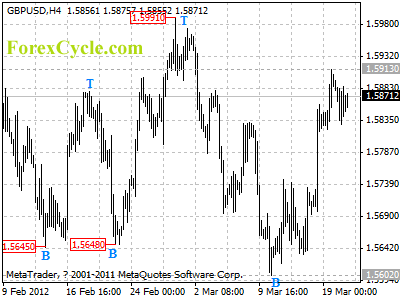
GBPUSD remains in short term uptrend from 1.5602

GBPUSD remains in short term uptrend from 1.5602, the pullback from 1.5913 is likely consolidation of the uptrend. Support level is at 1.5800, as long as this level holds, uptrend could be expected to resume, and another rise to test 1.5991 previous high resistance is possible. On the downside, a breakdown below 1.5800 will suggest that a cycle top has been formed at 1.5913 on 4-hour chart, then further fall towards 1.5602 could be seen.

gbpusd

Daily Forex Forecast

Are the Efforts of the World Central Banks Working?

By Elliott Wave International

The Fed is not the world’s only central bank dealing with debt. Watch as Steve Hochberg, EWI’s chief market analyst, shows what has happened to GDP in countries around the world as other central banks try to “inject liquidity” into the system.


EWI’s NEW free report, The Economic Rot Beneath, reveals important economic numbers that you are not currently reading in the mainstream headlines — but you should be. For instance, did you know stocks priced in real money (gold) are down 87%? Or that U.S. manufacturing jobs are half of what they were in 1979? Or that housing starts per capita are back to 1922 levels? Learn what’s really going on in the U.S. economy. Download your free report now.   

Global market needs Canada’s crude

Canada’s natural resources minister told delegates at the International Energy Forum in Kuwait that his country was on the cusp of becoming an “energy superpower.” Canada ranks No. 6 in terms of global oil production, but much of its crude exists in the form of oil sands. European leaders are considering a measure that would classify oil sands as an environmental issue, prompting Canada to threaten to take the issue to the World Trade Organization. With the U.S. political system in a deadlock over Canadian crude, the Ottawa government is now working to convince the international community that the global market is in jeopardy if polices “discriminate against oil sands.”

Drill-happy critics of the Obama administration are painting the Keystone XL oil pipeline planned from Alberta as a panacea to U.S. economic woes. Because of debates over the planned route through Nebraska, however, the White House has pushed the issue aside for now. The pipeline company behind the project, TransCanada, has opted for a smaller leg in the United States while the Canadian government has thrown its support behind the Northern Gateway pipeline meant for Asian exports.

Canadian Natural Resources Minister Joe Oliver said his presence at the IEF summit in Kuwait proved his country was “an emerging energy superpower.” Canada has around 175 billion barrels of proven oil reserves, which means it’s the only non-OPEC member in the global top five, just behind Saudi Arabia and Venezuela.

European leaders in March were unable to reach a decision on whether or not to characterize oil sands as an environmental issue. Critics of oil sands note that its production releases much more CO2 into the atmosphere compared with regular crude oil and its tendency to sink in water makes it a particular concern if spilled. Some critics have dubbed it the dirtiest form of oil on earth and advocate an outright ban. The European government is set to consider the issue by June.

Oliver, however, complained to IEF delegates that any policy that would discriminate against oil sands would be harmful to the global market and overall energy security. Last year, the global economy was threatened by a loss of crude oil from war-torn Libya, OPEC’s No. 7, so sidelining oil sands from Canada could be much more severe.

“Our government believes that the free market is the most efficient and cost-effective means to ensure the proper allocation of resources for the development and supply of energy,” said Oliver.

Just as Obama said there’s no “silver bullet” that can magically push U.S. gasoline prices to something American consumers consider fair, there’s nothing in a global market that’s easily replaced. Singling out Canadian oil means potentially sidelining an oil supply larger than Iran’s, something a depressed European economy could hardly stomach. But as with Iranian crude, if the Europeans don’t want it, they don’t have to buy it. While that’s an oversimplification of the issue, the world still needs as much oil as it can get. Europe is embracing a greener economy. But until global economic engines run on something other than petroleum products, when Canadian crude oil is at stake, it’s time to just let it flow.


Source: http://oilprice.com/Energy/​Crude-Oil/Is-it-Time-to-​Abandon-the-Oil-Sands-Debate.​html


By. Daniel J. Graeber of Oilprice.com

Cisco Concludes Acquisition of Limewire

Cisco (NASDAQ:CSCO) announced on Monday that it has completed its acquisition of LightWire for $271 million.LightWire will assist Cisco in distributing high-speed network support for data centers and other customers.Cisco Systems (NASDAQ:CSCO) has potential upside of 14.8% based on a current price of $20.16 and an average consensus analyst price target of $23.14.

Lions Gate Entertainment Shares Rise Before Release of The Hunger Games

Lions Gate Entertainment (NYSE:LGF) shares increased to 6.3% to $14.04 in afternoon trading today as investors look ahead to the release of their suspected smash-hit The Hunger Games. The film, based off the best-selling novel, is being predicted to take $100 million or more domestically in its opening weekend.The prospect of a new huge franchise is also good news for Lions Gate. This can be attributed to the most popular series currently, The Twilight Saga. The most recent film in the franchise grossed $138.1 million domestically, a number many analysts are saying the Hunger Games will surpass. Lions Gate Entertainment is currently above its 50-day moving average (MA) of $11.40 and above its 200-day of $8.36.

Central Bank of Egypt Cuts RRR 200bps to 12.00%


The Central Bank of Egypt reduced the required reserve ratio (RRR) by 200 basis points to 12.00% from 14.00% previously.  The Bank said: “In light of the current liquidity situation which has emerged on the back of domestic and global developments, the CBE’s Board decided to reduce the RRR from 14 percent to 12 percent. This measure will provide permanent liquidity into the banking system and help ease credit conditions in the market

Previously the Bank maintained its interest rates unchanged when it announced policy settings in February this year.  Egypt reported annual consumer price inflation of 9.55% in December, up from 8.21% in September, 8.49% in August, 10.4% in July, compared to 11.8% in June, 11.9% in May, and down from 12.1% in April.  The toll of the revolution was seen as Egypt’s gross national product contracted by 4.2% year-on-year in the third quarter of the 2011/2012 fiscal year and investment fell 26% due to uncertainty arising from the political upheaval.

Real GDP expanded by 0.3% in Q1 2011/2012 (0.4% in Q4 2010/2011), full year GDP growth was 1.8% in 2010/2011 vs 5.1% in the 2009/2010 year.  The Egyptian pound (EGP) has weakened about 2% against the US dollar over the past year, while the USDEGP exchange rate last traded around 6.04

Central Bank of Nigeria Keeps Policy Rate on Hold at 12%


The Central Bank of Nigeria maintained its monetary policy interest rate at 12.00%.  The Bank also held the cash reserve ratio at 8%.  Bank Governor, Lamido Sanusi, said: “In arriving at its decision, the Committee was faced with a choice between two options. One option was to consider, in view of  the  improving global economic environment, a moderation in headline inflation, slowdown in monetary aggregates and fiscal spending and the crowding out effects of high interest rates, a reduction in the policy rate. This argument was considered but rejected on the basis of a number of factors. These included persistent underlying core inflationary pressures, the need to continue supporting the naira and build up external reserves, the necessity for attracting and retaining foreign investment and the need for consistency and stability in the macroeconomic environment.


Previously the Nigerian central bank also held rates unchanged, and last raised the the monetary policy rate by 275 basis points to 12.00% at its October meeting, after increasing by 50 basis points in September rate 75 basis points in July, and increasing it by 50 basis points at its May meeting this year.  Nigeria reported annual headline inflation of 10.3% in December, compared to 10.5% in October, 9.3% in August, down from 9.4% in July, 10.2% in June, 12.4% in May, 11.3% in April, and 12.8% in March, and just above the Bank’s inflation target of 10%.  

The Nigerian government doubled the minimum wage to 18,000 Naira recently.  Nigeria reported annual GDP growth of 7.72% in the June quarter, after growing 7.43% in the March quarter, while the Bank had forecast 2011 growth of 7.8%.  Nigeria’s currency, the naira (NGN), has weakened about 2% against the US dollar over the past year, the USDNGN exchange rate last traded around 157.65.