The Big Risk That Everyone’s Forgotten: Rising Food Prices

By MoneyMorning.com.au

Most investors are feeling cheerful. Bullish bonhomie abounds.

But beware: consensus thinking among investors tends to be wrong. When sentiment changes, the impact on markets can be nasty. And the higher stocks have climbed, the bigger the potential damage to prices.


What might be the catalyst for such a change in trend? Often the biggest threats to markets stem from unexpected events, or from something that had been discounted as a risk factor.

There’s one such risk that everyone was worried about a year ago. Since then, it’s dropped right off the radar screen.

But it could be about to come back and bite us again.

Don’t Forget the Risks of Rising Food Prices

This time last year, one statistic was freaking out politicians and markets alike: global food prices had risen by more than a third within a year.

Demand was growing faster than supply; bad weather had caused poor harvests; soaring feed costs made animals more expensive to rear. So farmers had to push up selling prices to make ends meet.

Speculation almost certainly played its part too. Central banks had decided that QE – quantitative easing, ie printing money – was the answer to all the world’s ills.

But this extra cash ended up in the hands of bankers and traders. And true to form, it started to burn a hole in their pockets, so they punted big chunks of it on the commodity markets.

That made matters worse. Then the surge in the cost of basic foodstuffs filtered into supermarket prices. This drove up overall inflation.

Here in the well-fed West, we put up with it, and accepted we’d have less to spend on other things. But elsewhere, soaring food prices caused riots, and were a major factor in the Arab Spring uprisings. The 2007-2008 world food price crisis was repeating itself.

The Beauty of Markets

But the beauty of markets is that they’re largely self-correcting. That’s another way of saying that rising prices make the production of those basic foodstuffs more appealing. Farmers see rising prices, so they plant more crops and rear more animals. As a result, supply picks up, and prices fall.

And market forces did kick in: last year saw a record wheat crop; other cereals also saw better harvests; strong demand for culled cows and higher milk prices boosted dairy livestock markets; and so on.

So the last 12 months have been much better for food consumers. Wheat prices in particular fell by 18% in 2011. Between last February and the end of last year, the Food and Agriculture Organisation (FAO) Food Price Index – the UN’s main food price measure – dropped by around 11.5%.

But global food costs are on the rise again. The FAO index rose by 1% in February alone. This is the second month running that global prices have gone up. And while that still leaves the index 10% down on a year ago, it’s a worrying sign.

What is causing the price rises this time round? Adverse climatic conditions are still affecting key growing regions such as South America and Europe, according to the FAO.

Wheat prices are up 9% from this year’s low on 18 January. Soybean prices are 20% higher than they were in November on concerns that hot, dry weather would hurt South American crops. Unhelpful conditions in Brazil, the leading exporter of sugar, have driven up its cost too.

For the moment, the FAO reckons there’s no great cause for alarm: the world won’t see a repeat of the 2007-2008 and 2010 food cost explosions. But that may be too sanguine a view.

That’s because global inventories of wheat and soybeans are falling more rapidly than expected. This could drive supply and demand out of kilter again, which would drive prices higher once more.

The US Department of Agriculture (USDA) has just cut its forecasts for world wheat stockpiles on 31 May by 1.7%. That would reduce them to a level lower than expected by all 21 analysts surveyed by Bloomberg.

Soybean reserves will hit a three-year low by 31 August this year, says the USDA. Even more dramatic, levels of corn inventory held in the US – the world’s top grower and exporter – are now forecast to drop to their lowest levels since at least 1996. Farmers aren’t keeping up with rising demand for food, livestock feed and biofuel.

What’s more, the USDA lowered its outlook for Brazil’s wheat crop by 4.9% compared with last month and Argentina’s by 3.1%. Again, that is likely to lead to higher prices than were earlier expected.

And if food costs do start to rise more rapidly, there’s a high chance those bankers will want to get involved again with their QE cash. If central banks print even more money – and there’s every chance of that – commodity speculators will be given further ammo to drive prices up.

David Stevenson
Associate Editor, MoneyWeek (UK)

Publisher’s Note: This article originally appeared in MoneyWeek (UK).

The “After America” Archives…

‘After America’: The World Reset
2012-03-17 – Callum Newman

‘After America’: Threats and Opportunities
2012-03-16 – Callum Newman

China and The Revolution
2012-03-15 – Callum Newman

Cocktails and Central Banks
2012-03-14 – Callum Newman

Prelude to ‘After America’

2012-03-13 – Callum Newman


The Big Risk That Everyone’s Forgotten: Rising Food Prices

Goldman Equity Strategists Say Buy Google Calls And CarMax Calls Ahead Of Earnings

Goldman Sachs (NYSE:GS) issued a not to clients advising them to Buy Google (NASDAQ:GOOG) April $635 straddles before earnings estimated to be on April 13th, and CarMax (NYSE:KMX) April $35 calls before its earnings report on April 5th.Goldman equity derivatives Catherine Fogertey and John Marshall said they see unusually high profitability patterns from buying options before earnings for list of names that include Google (NASDAQ:GOOG), Nike (NYSE:NKE) and IBM (NYSE:IBM) according to the note.They said CarMax could report positive comp this quarter after used car sales improved faster than most expected.

Robert Prechter releases a complimentary online edition of Elliott Wave Principle

Classic Investment Book, Elliott Wave Principle, Now Available Free:
Robert Prechter has released a complimentary online edition of Elliott Wave Principle: Key to Market Behavior. All 248-pages of this classic investment book can be on your screen in just minutes. Elliott Wave Principle will teach you the 13 waves that can occur in the charts of the financial markets, the basics of counting waves, and the simple rules and guidelines that will help you to apply Elliott Wave for yourself. You’ll learn the method successful investors have used for decades.

Access Your Free Copy of Elliott Wave Principle, Now.

Every successful trader or investor has a method that they rely on to make investment decisions. Without a method, investors must rely on the advice of others or their own emotions to make these decisions.

Elliott Wave analysis provides an objective method to forecast the direction of the markets. This theory was first brought to the public’s attention in 1978, in Frost and Prechter’s text Elliott Wave Principle. This classic book continues to sell thousands of copies each year. If you are at all familiar with technical analysis, you have probably heard about this method and read analysis based on the theory. It is used by successful investors and traders across the globe.

Now you can learn how to apply Elliott Wave analysis to the markets you follow FREE. For the first time ever, Robert Prechter has released an online edition that gives you instant access to the full 248-page book.

Until now this online edition was only available as an added benefit to subscribers of Elliott Wave International.

Elliott Wave Principle will teach you the 13 waves that can occur in the charts of the financial markets, the basics of counting waves, and the simple rules and guidelines that will help you to apply Elliott Wave for yourself. In addition to the theory, you will also learn the mathematical background, including Fibonacci analysis, and you’ll see examples of Elliott applied in indexes, stocks, and commodities.

As Prechter and Frost state in the Author’s Note:

“We trust our readers will be encouraged to do their own research by keeping a chart of hourly fluctuations of the Dow until they can say with enthusiasm, ‘I see it!’ Once you grasp the Wave Principle, you will have at your command a new and fascinating approach to market analysis.”

If you are looking for an objective, time-tested approach to trading the markets, try learning the method that successful investors have used for decades!


Access your online edition of Elliott Wave Principle – Key to Market Behavior, now. It’s FREE.

About the Publisher, Elliott Wave International
Founded in 1979 by Robert R. Prechter Jr., Elliott Wave International (EWI) is the world’s largest market forecasting firm. Its staff of full-time analysts provides 24-hour-a-day market analysis to institutional and private investors around the world.


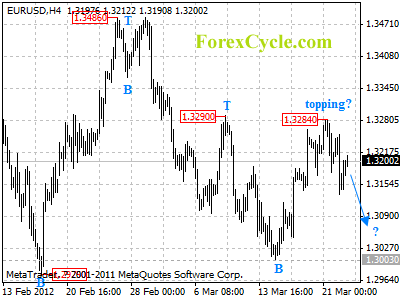
EURUSD pulled back from 1.3284

Being contained by 1.3290 resistance, EURUSD pulled back from 1.3284, suggesting that a cycle top is being formed on 4-hour chart. Further decline would likely be seen later today, and next target would be at 1.3050 area. Key resistance is at 1.3290, only break above this level will indicate that the fall from 1.3486 had completed at 1.3003, then the following upward movement could bring price to test 1.3486 previous high resistance.

eurusd

Daily Forex Forecast

Macy’s Begins New Plan to Build Sales

Department-store retailer Macy’s (NYSE:M) unveiled a three-year plan on Wednesday in an effort to boost business from the younger generation. The company is aiming to increase its product offerings and improve the shopping experience in its mstylelab merchandise segment and Impluse segment. Both brands are catered toward the 13-30 demographic.To improve the shopping experience, the department store is planning in-store improvements as well as a new marketing strategy. The company estimates the younger generation spends about $65 billion annually for the type of goods it sells. Macy’s (NYSE:M) has potential upside of 6.8% based on a current price of $39.7 and an average consensus analyst price target of $42.42.

Analyst Moves: XOM, DFS

Exxon Mobil (XOM) was upgraded today by JP Morgan (JPM) from underweight to neutral with a $92 price target, as the stock is undervalued at current levels. Shares are lower by about six tenths of a percent.

Crude Oil Drops on Thursday

Source: ForexYard

printprofile

Crude oil made a sharp downward movement on Thursday as an array of news affected currencies and commodities across the board. The biggest factor in crude oil’s drop on Thursday was the poor PMI numbers from China. This follows after weeks of indications that China’s manufacturing sector had been shrinking in recent months. Additionally, overall demand from Europe continues to drop, further influencing Thursday’s drop for crude oil.

While the U.S. released actual numbers on its crude oil inventories that were far below market predictions, the price of oil still dropped considerably and hovered close to 104.64 for most of Thursday afternoon. Heading into Friday, investors will want to keep an eye on whether or not domestic data from the U.S., including the recent drop in unemployment claims, has any influence on crude oil.

Forex Market Analysis provided by ForexYard.

© 2006 by FxYard Ltd

Disclaimer: Trading Foreign Exchange carries a high level of risk and may not be suitable for all investors. There is a possibility that you could sustain a loss of all of your investment and therefore you should not invest money that you cannot afford to lose. You should be aware of all the risks associated with Foreign Exchange trading.

Euro Drops Against Yen and Dollar


By TraderVox.com

Tradervox (Dublin) – Shaky Eurozone PMI has caused the euro to decline against the safe haven currencies. The PMI result came in below the 50 boom-bust value indicating contraction in the market. The euro declined against the yen and the dollar after the manufacturing and services index contracted more than forecasted for the month of March. This has boosted demand for the safe haven currencies hence increasing the value of the yen and the dollar against the euro.

The Japanese currency advanced against all the major currencies after the release of the report showing a decline in the manufacturing index in China. Many economists have raised concerns about the state of the global economy following the report. South pacific dollars were the worst affected by this report declining to their lowest in two months. The two largest economies in the euro region registered unexpected declines in the industrial index forcing the Stoxx Europe 600 index to drop for the fourth day.

The euro declined against the yen as reports from Japan indicate that the economy is better off. Economist and analysts are keeping a keen eye on the 82.85/65 support zone for the USDJPY pair as they try to establish signs of retracement. After the China report and the eurozone PMI reports, the Australian dollar slid by 0.8 percent as the New Zealand dollar declined by 0.9 percent to settle at $1.0377 and 80.85 cents respectively.

Steve Barrow, a Standard Bank Plc Analysts in London, indicated that the report from the euro region is a big blow to the improvements that have been made over the last few months concerning the euro zone crisis. He said that the reality of the euro-zone economic improvement “myth” has dawned on the investors causing a decrease in risk appetite.

The euro declined by 1.1 percent against the yen to settle at 108.98 at the beginning of the New York session and also dropped against the dollar declining 0.4 percent to sell at 1.3159. The yen increased against the dollar by 0.7 percent to sell at 82.83 yen per dollar.

Disclaimer
Tradervox.com is not giving advice nor is qualified or licensed to provide financial advice. You must seek guidance from your personal advisors before acting on this information. While we try to ensure that all of the information provided on this website is kept up-to-date and accurate we accept no responsibility for any use made of the information provided. Opinions expressed at Tradervox.com

are those of the individual authors and do not necessarily represent the opinion of Tradervox.com

or its management. 

Article provided by TraderVox.com
Tradervox.com is a Forex News Portal that provides real-time news and analysis relating to the Currency Markets.
News and analysis are produced throughout the day by our in-house staff.
Follow us on twitter: www.twitter.com/tradervox