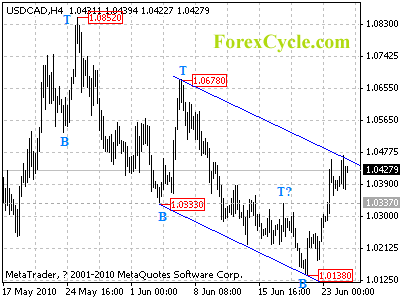
USDCAD has reached falling trend line

USDCAD has reached the falling trend line from 1.0852 to 1.0678. A clear break above the trend line resistance will indicate that the fall from 1.0852 has completed at 1.0138 already, then further rally could be seen to 1.0600-1.0700 area. However, as long as the trend line resistance holds, the bounce from 1.0138 is treated as consolidation of downtrend, one more fall towards 1.0100 is still possible.

For long term analysis, USDCAD formed a cycle top at 1.0852 level on weekly chart. Rang trading between 0.9930 and 1.0852 would more likely be seen in next several weeks.

usdcad

Weekly Forex Analysis

Do you know about market divergences?

By Adam Hewison – In the market there are two types of market divergences that can occur:
a bullish divergence and a bearish divergence. Both of these divergences are important and you need to know how they work and how you can benefit from this knowledge.

In this short educational trading video, I will show you the tools I use to spot market divergences. We will be using the Relative Strength Indicator (RSI) and the Moving Average Convergence Divergence indicator (MACD) which was developed by a friend and mine, Gerald Appel.

As always our videos are free to watch and there are no registration requirements. If you would like to comment on this or any of our other videos, please feel free to do so on our Trader’s Blog.

Watch the New Video Now…

All the best,
Adam Hewison
President of INO.com
Co-founder of MarketClub

Prechter on CNBC: Market Pro: Long Bear Market Looming

Prechter on CNBC: Market Pro: Long Bear Market Looming

Robert Prechter, president of Elliott Wave International, tells host Maria Bartiromo why he sees dark days ahead on CNBC’s Closing Bell.

Download Your FREE 50-Page Ultimate Technical Analysis Handbook
In this free 50-page eBook from Bob Prechter’s Elliott Wave International, you will discover some of the very best technical methods used by the top professional technicians in the world. You will learn which tools are best for analyzing chart patterns, which are best for anticipating future price action, even which are best for spotting high-probability turning points. Download Your Free Technical Analysis eBook here.

China’s Historic De-Pegging Is Much Ado About Nothing

China’s Historic De-Pegging Is Much Ado About Nothing

By Justice Litle, Editorial Director, Taipan Publishing Group

China’s de-pegging announcement got the currency bulls all hot and bothered this week. The excitement was most definitely premature.

This past weekend, an announcement of great importance came forth from China. To kick off a “new era,” we were told, the Chinese yuan would be de-pegged from the U.S. dollar.

Excitable types on the long side of the market thought this a very big deal. Stocks gapped open higher to start the week, with emerging market equities faring particularly well. But it wasn’t long before currency markets sagged as reality came to light: The West had been juked once again.

To be “juked” – or, more fully, “juked out of one’s shoes” – is an American football term. Roughly, it means to be faked out, played for a sucker, or otherwise made a fool of, by a sufficiently fleet-footed opponent.

The art of the juke requires natural dexterity and the ability to game a defender’s intentions. The would-be juker will typically “feint” or “dance” in one direction, push hard off a planted foot, and then quickly pivot the other way. If done correctly, the defender may even fall down in a heap upon lunging into empty space.

That is more or less what happened to the China currency bulls this week. All kinds of good things were supposed to happen with the revaluation of China’s currency. And those good things may indeed happen – some far off day well down the road. Trouble being, we have zero idea when.

Chart: WisdomTree Yuan ETF
View Larger Chart

The implied promise of the de-pegging is that China’s currency will be allowed to rise (in comparison to the $USD). Less trumpeted is the fact that the yuan can actually fall now as well.

While the PBOC (People’s Bank of China) may give the yuan a bit more elbow room, they are quite likely to stick to the super-tight range they have maintained for some time now. How tight is super-tight, you ask? Here is one way to look at it: Over the past two years, the WisdomTree Yuan ETF (CYB:NYSE), has traded in roughly a one-dollar range… a max fluctuation of four percent on the $24-and-change buy price.

Veteran Trading Expert Reveals Controversial New “PowerSignal” – Vows to Help You Turn $5,000 Into $1.2 million!

After generating 8,527% total gains in a legally documented “beta-test”… veteran trading guru Adam Lass is ready to help you get very, very rich.

Follow this link for your exclusive investment report from WaveStrength PowerSignal.

The timing of the de-pegging announcement was laughably political. Given the upcoming G-20 meeting in Canada, the dragon’s primary goal was to deflect protectionist heat.

“Don’t look at us! We’ve listened to your requests – see? We let the yuan rise in value by a whopping 0.4%! (Never mind that it fell back the very next day…)”

If you listen hard, you can almost hear the snickers from Beijing. As hopers grasp at straws, the mandarins laugh up their sleeves…

(By the way, you should read what my fellow Editor Adam Lass thinks about China. Sign up here for his investment commentary.)

Why China Will Stay Its Hand

There are multiple reasons why the dragon cannot afford a meaningful strengthening of the yuan in the near term, much as the U.S. and Europe might wish it so. Here are a few:

  • Hot money inflows. Were the yuan to rise swiftly, a flood of “hot money” inflows could rush in and destabilize China’s home markets, some of which are already quite frothy. The PBOC has been careful to deter currency speculators by quashing hopes of a quick pop.
  • Export sensitivity. There is a ways to go yet before domestic consumption takes over as the key driver of China’s economy. For now, the dragon’s ability to export manufactured goods remains a vital growth prop… and that means high sensitivity to export competitiveness, which would be hurt by a suddenly stronger yuan (especially given spending slowdown trends in the West).
  • Labor competitiveness. China is already enduring a series of factory strikes and forced wage hikes as workers demand better pay. These higher wages reduce China’s competitiveness as an outsourcing destination, and a strengthening currency could further encourage multinationals to look to China’s neighbors. Given its full-employment mandate, Beijing can ill afford such a trend.
  • Real estate risks. China’s real estate market is hot – smoking hot – and that means trouble when the bubble bursts, of the sort that an overly strong currency would only make worse. As the LA Times reports, “Home prices in major cities including Beijing and Shanghai have easily doubled over the last year as families and investors rush to grab a piece of the Chinese dream. A typical 1,000-square-foot, two-bedroom, one-bath apartment in the capital now costs about $274,000. That’s 22 times the average annual income of a Beijing resident…

Saying Goodbye to Santa Claus

Ever since China led global markets off the 2009 lows last year, responding to the crisis with a half-trillion-dollar stimulus package and a burst of economic vigor, investors have come to regard the dragon as a sort of Santa Claus… a benevolent spreader of hope and cheer, handing out investment gifts to good little boys and girls.

Global economy looking down in the mouth? China will lead us back to the promised land. Commodity investments in need of a boost? China will hoover up excess supply. U.S. debt levels looking scary? China will soak up the excess there too. U.S. consumers looking tapped? Chinese consumers to the rescue. And so it goes.

There is an element of logic to the above expectations, but more than a dollop of wishful thinking too. The reality is that China is no benevolent savior… that the debt-driven problems we face are still real and deep… and, last but not least, that “hope” does not count as a legitimate strategy (and never has).

In sum, the de-pegging of the yuan is indeed good news from a longer-term perspective, as China moves one baby step closer to the “free markets for free men” ideal that greases the wheels of global trade. But in the short run, the news is much ado about nothing.

How YOU can “tax” THEM

Our Pulitzer Prize-nominated journalist-turned-analyst shows you the 100% legal way to “tax” the U.S. government for $1,150,000 or MORE…

He reveals everything in a FREE underground wealth exposé.

Don’t forget to follow us on Facebook and Twitter for the latest in financial market news, investment commentary and exclusive special promotions.

About the Author:

Justice Litle is the Editorial Director of Taipan Publishing Group, Editor of Justice Litle’s Macro Trader and Managing Editor to the free investing and trading e-letter Taipan Daily. Justice began his career by pursuing a Ph.D. in literature and philosophy at Oxford University in England, and continued his education at Pulacki University in Olomouc, Czech Republic, and Macquarie University in Sydney, Australia.

BP Oil Spill and the Affect on Spot Crude Oil Prices

By Russell Glaser – The U.S. Gulf of Mexico oil rig disaster continues to make daily headlines and rightfully so. Millions of barrels of oil are estimated to have spilled into the Gulf of Mexico, making this the worst oil spill in U.S. history. Following this disaster will be extensive litigation and stiff regulation from the U.S. government. This may have the influence of raising the price of spot crude oil over the long term.

On April 20th when the Deep Water Horizon oil rig exploded in the Gulf of Mexico and killed 11 of the 126 BP crew members. No one expected the oil rig to leak as much oil as it has and to continue to leak for this long. Even today BP is siphoning off oil and gas from the uncapped well after an undersea robot crashed into a system designed to collect the oil from the leaking well. Underwater TV cameras and constant media coverage have engrained the pictures of oil rushing out into the sea at a frantic pace from the oil well and into the Gulf.

The Obama administration has come under intense pressure because of the handling of the spill. As a response, the administration issued a temporary six month ban on deepwater drilling. However, this ban was later overturned by a U.S. court. The administration is currently appealing.

Fines and penalties may come from the government as well. A number of lawsuits have been filed as a result of the spill and many more will follow which should drag on for years to come.

BP has always accepted its responsibility for the spill and has acted in such a manner by foregoing its Q2 and Q3 shareholder dividends. The company has already put aside $20B into an escrow account in order to meet spill claims. The Independent Claims Fund (ICF) will be independently managed outside of BP and will require BP to pony up $5B in 2010 and $5B every year until 2013. However, the ICF does not limit BP’s liability for the oil spill.

This is the least BP can do as it appears the company chose cost cutting measures over the necessary safety requirements on the oil rig. This may have caused the explosion although no official enquiry has published its findings.

The impact on the price of crude oil is palpable. A drop in production from the moratorium on deep water drilling may reduce future supplies of crude oil. Further government regulation may also limit new exploration and cause an increase in price as integrated oil and gas companies may be forced to take more safety precautions to prevent another disaster such as this from BP.

However, since the explosion at the Deep Water Horizon oil rig on April 20th, the price of spot crude oil is down 14%.

Forex Market Analysis provided by Forex Yard.

© 2006 by FxYard Ltd

Disclaimer: Trading Foreign Exchange carries a high level of risk and may not be suitable for all investors. There is a possibility that you could sustain a loss of all of your investment and therefore you should not invest money that you cannot afford to lose. You should be aware of all the risks associated with Foreign Exchange trading.

EUR/JPY Reaching Towards a Significant Support Level

By Yan Petters – The EUR/JPY fell about 1,800 pips in merely two months since April; however the bearish momentum seems slowing. For the past month, the pair has been trading within a restricted range, and now the price is approaching its lower boarder. Will the EUR/JPY break the range?

• The chart below is the EUR/JPY 1-day chart.
• The technical indicators used are the Bollinger Bands, the Slow Stochastic, the MACD and the Relative Strength Index (RSI).
• The pair has been trading within a restricted range recently, between the 108.00 and the 113.50 levels.
• At the moment, the RSI has failed to enter the ‘Over-Bought’ zone, and is pointing down. This indicates that the bearish move has potential to proceed.
• The MACD seems about to complete a bearish cross. If the cross will be completed, this will further verify that the bearish pressure is getting stronger.
• The next significant support level is located at the lower boarder of the range, at the 108.00 level. If the pair will breach this level, it has potential to drop towards the 106.50 level.
• However, if the pair will fail to cross the support level, it might bounce back up, towards the upper boarder of the range, and might reach as high as the 113.50 level

Forex Market Analysis provided by Forex Yard.

© 2006 by FxYard Ltd

Disclaimer: Trading Foreign Exchange carries a high level of risk and may not be suitable for all investors. There is a possibility that you could sustain a loss of all of your investment and therefore you should not invest money that you cannot afford to lose. You should be aware of all the risks associated with Foreign Exchange trading.

Dollar Advances on Riskier Currencies Following Fed Statement

Source: ForexYard

The U.S. dollar traded well against riskier currencies like the AUD and loonie in overnight trading, but at the same time, took some losses on currencies like the yen and euro. Investors are trying to digest the most recent Fed statement and how it reflects the current state of the global economic recovery. Traders can expect this trend to continue, as we are expecting little in the way of significant news events today.

Economic News

USD – Greenback Makes Gains as Risk Aversion Resumes

Risk aversion appeared to rule the day on Thursday, and carried over into overnight trading today. The latest Fed statement gave a fairly pessimistic view about the current state of the U.S. economic recovery. This appears to be the case despite the fact that the most recent American unemployment number represented a significant improvement over last week’s figure. It appears that investors have now fully accepted the idea that American record low interest rates are to remain in place for the foreseeable future.

Generally speaking, when investors begin to fear the pace of the global economic recovery, they sell off their riskier assets and buy up safe-havens like the USD. Yesterday was no different, as the greenback was able to make fairly large gains on both the aussie and loonie. AUD/USD dropped some 75 overnight, before making a slight recovery in early morning trading. USD/CAD shot up almost 60 pips before leveling off. Currently the pair stands at approximately the 1.0415 level.

Today a relatively slow news day may lead to low volatility in the market place. Still, traders will want to watch out for the U.S. Final GDP figure, set to be released at 12:30 GMT, and the U.S. Revised UoM Consumer Sentiment Report at 13:55 GMT. Both reports have the potential to inject some life into the marketplace, with a result at or below expectations likely to benefit the greenback.

EUR – EUR Tumbles Vs. Safe Haven Yen

While the EUR/USD pair continues to fluctuate somewhat erratically, the European currency has continued to take losses against the Japanese yen. An increase in risk aversion has largely fueled the euro’s drop against the JPY. Late yesterday, the pair tumbled well over 100 pips, before making a slight correction in overnight trading. Currently the pair is trading around the 110.40 level. At the same time, the euro was able to make substantial gains against the British pound, shooting up some 75 pips yesterday.

Today, traders can expect the euro to have a relatively mild day, largely due to the lack of substantial European economic indicators. Furthermore, with investors likely to continue selling off their riskier assets, the euro may take some small losses in afternoon trading.

JPY – Safe Haven Yen Hits 1-Month High Against USD

USD/JPY tumbled yesterday to a 1-month low following the pessimistic American economic outlook painted by the U.S Federal Reserve yesterday. The pair was at one point trading as low as 89.25, dropping over 100 pips in 24 hours. The greenback was able to stage a mild recovery, moving up to its current level of around 89.55. The yen was also able to make some significant gains against the British pound yesterday, as GBP/JPY tumbled some 130 pips before correcting itself.

Today, the yen may very well continue with yesterday’s trend. Last night’s Tokyo Core CPI Report indicated that consumer prices in Japan fell at a slower rate then predicted, a positive sign for the Japanese economy. Furthermore, with U.S. dollar and euro both forecasted for slow close to the week, it is likely the Yen will once again come out on top.

Crude Oil – Crude Down for the Week on Fears of Continued Economic Crisis

Crude oil continued to trade below the $77.00 level in overnight trading, as renewed fears about the pace of the global economic recovery kept prices down. Continued low prices are setting up crude for its first weekly decline in the last 3-weeks. With investors selling off their riskier assets, traders can expect oil prices to remain around their current levels at least until next week.

At the same time, should the U.S. news set to be released today, turn out to be positive, crude prices could go up as risk taking may return to the marketplace. Traders will want to keep an eye on how currencies like the euro and British pound react to the news later. If they begin to move up, there is a good chance that oil may move up as well.

Technical News

EUR/USD

The 4-hour chart is showing mixed signals with its RSI fluctuating at the neutral territory. However, the daily Chart’s RSI is already floating in the overbought territory indicating that a bearish correction might take place in the nearest future. When the downwards breach occurs, going short with tight stops appears to be preferable strategy.

GBP/USD

The pair has been range-trading for a while now, with no specific direction. The Daily chart’s Slow Stochastic providing us with mixed signals. The 4 hour charts do not provide a clear direction as well. Waiting for a clearer sign on the hourlies chart might be a good strategy today.

USD/JPY

The price of this pair appears to be floating in the over-sold territory on the daily chart’s RSI indicating an upward correction may be imminent. The upward direction on the hourly chart’s Momentum oscillator also supports this notion. Going long might be a wise choice.

USD/CHF

The cross has experienced much bearishness in the past 3 weeks, and currently stands at the 1.1015 level. There is much evidence in the chart’s oscillators that supports a possible bullish correction today. This is supported by the daily chart’s RSI. Going long with tight stops may turn out to bring big profits today.

The Wild Card

SPI 200 (ASX)

After the recent sharp drop a correction may be taking place today as the RSI seems to be floating in the oversold territory on the hourly and 8 hour charts and a bullish cross is evident on the 4 hour chart’s Slow Stochastic. CFD traders may be advised to go long for the day.

Forex Market Analysis provided by Forex Yard.

© 2006 by FxYard Ltd

Disclaimer: Trading Foreign Exchange carries a high level of risk and may not be suitable for all investors. There is a possibility that you could sustain a loss of all of your investment and therefore you should not invest money that you cannot afford to lose. You should be aware of all the risks associated with Foreign Exchange trading.

Forex Daily Market Review June 25, 2010

By eToro – The Euro edged higher as investors have become dollar bearish as opposed to Euro bullish.  The markets will continue to chop around until next week, when many economic releases are available to alter the market.
Click here to read the full daily Review

Forex Market Analysis provided by eToro

Disclaimer: Trading in the Foreign Exchange market might carry potential rewards, but also potential risks. You must be aware of the risks and are willing to accept them in order to trade in the foreign exchange market. Don’t trade with money you can’t afford to lose.

USDCAD is testing channel resistance

USDCAD has reached the upper border of the falling price channel on 4-hour chart, a clear above the channel resistance will indicate that the downtrend from 1.0852 has completed at 1.0138 already, then the upwards movement could bring price back towards 1.0852 previous high. On the other side, as long as the channel resistance holds, the bounce from 1.0138 is treated as correction of downtrend and another fall towards 1.0138 is still possible.

usdcad

Daily Forex Forecast

If They Don’t Own Gold, Don’t Trust Their Opinion on Gold

If They Don’t Own Gold, Don’t Trust Their Opinion on Gold

By Justice Litle, Editorial Director, Taipan Publishing Group

As an asset class, gold stirs the passions. Some folks love it, and others despise it. Be wary of those who will never own gold.

As I write this note to you on Friday, fingers flying over keys like the flickering quotes on my screens, Pink Floyd’s “Learning to Fly” is playing on my speakers.

It’s an appropriate tune, because gold is once again “learning to fly” now. After one or two scrapped take-off attempts, the yellow precious metal has broken out to fresh all-time highs. (Well… nominal highs at least. To break inflation-adjusted highs – which will happen sooner or later – gold will have to trade above $2,000 per ounce.)

Your humble editor has spilled a fair amount of ink (pixels?) on gold these past few years. Here are a few examples:

The argument for gold is nuanced, powerful and compelling. You will find various elements of it in the archives above (should you care to look).

At heart, though, the case for gold is simple. After a quarter-century of fiscal irresponsibility, we have spent all we have… and spent yet more on top of that. Now the credit lines are nearly tapped out.

Against such a backdrop, in which debt levels remain high and growth remains stubbornly low, there is little for desperate politicians to do but print, print, print… and the only “neutral currency” not subject to the ravages of a printing press is gold.

If you’ve been a Taipan reader for any length of time, you already have a fair grasp of the facts. You have probably also realized how far we are from the financial mainstream. Taipan Daily is willing to put things bluntly when others will not… to “tell it like it is,” or at least tell it like we see it (with you being the final judge). That said, if you’re not a subscriber, sign up for Taipan Daily for free, right here.

And so, with that in mind, a quiet suggestion: If they don’t own gold, don’t trust their opinion on gold.

Veteran Trading Expert Reveals Controversial New “PowerSignal” – Vows to Help You Turn $5,000 Into $1.2 million!

After generating 8,527% total gains in a legally documented “beta-test”… veteran trading guru Adam Lass is ready to help you get very, very rich.

Follow this link for all the details on WaveStrength PowerSignal.

Pomp and Nonsense

Why does this need to be said? Because gold is an emotional precious metal. As an asset class, it stirs the passions. Some folks love gold, and others irrationally despise it. Either way, investing and trading decisions tinged with emotion are not to be trusted.

As gold has marched steadily higher, an amazing amount of hand-waving and pooh-poohing has taken place… most of it from individuals who have never owned gold in their lives and likely never will.

(If gold is too high priced for these dismissive souls now, at a measly twelve hundred bucks and change, how on earth will they bring themselves to buy in at $2,000… or $4,000… or higher still?)

In many ways, gold is despised because its ascendancy is an affront to an established way of life. A rising gold price means the system is not working. It means the old “buy the dips” mentality, in which the same old fiscal fixes continue to work, has gone by the wayside. Relentlessly rising gold means the easy way of life established these past 25 years – a “simpler time” that many money managers wish they could return to – has gone the way of the dodo.

So we hear over and over how gold is a “barbarous relic.” (Funny – no one calls the Federal Reserve system a relic, though they’ve been consistently screwing things up since 1913.)

We also hear from sour-grapes types and knee-jerk attention seekers that gold is just a fad… that the infatuation will die down any time now.

Chart: Gold Index

But these viewpoints are rooted in emotion, not facts. The newspaper columnist who turns his nose up at gold is not merely dismissing an asset class. He is expressing discomfort at the pressing onset of a strange reality he does not understand.

Meanwhile, the market “contrarians” who bellow about gold going lower – even as it marches ever higher on daily, weekly and monthly charts – are merely grasping for straws of attention, trying to restore old guru glories lost.

A Cheap Insurance Policy

There is something else important the naysayers and doubters fail to understand: Gold is a low-cost insurance policy.

Ask yourself the following. How much faith do you have in the Federal Reserve? How about the Bank of England (BOE), the European Central Bank (ECB), or the Bank of Japan (BOJ)?

Our financial and political leaders have not just performed poorly in a time of serious crisis, they have performed spectacularly badly. These past few years have been the fiscal version of the BP oil spill. Who is to say the powers that be won’t bungle things worse – much, much worse – when the full-blown “Act II” of the global financial crisis hits with full force?

Against the backdrop of breathtaking financial, social and geopolitical risks the whole world faces now, the truly crazy stance (in your humble editor’s opinion) is not owning gold. Those who blithely assume everything will work out are like Florida beachfront property owners, happy to forego insurance as the hurricane bears down.

Have You Heard of “pShares”?

Not only could “pShares” hand you the payday of a lifetime with an initial stake of just a couple hundred bucks… but they’re also subsidized by the U.S. government.

Learn how to stake your claim for as much as an 808% return on these government-sponsored options.

Last Train

The other open question in respect to gold is one of supply and demand. Some feel there is more than enough gold to go round at current levels. How can gold be worth such an exorbitant price, these critics whine, when all it does is sit there?

Others, like credit and debt strategist David P. Goldman, take a different view:

What’s the price of the last ticket on the last train out of Paris on the night the Germans march in? Whoever is carrying the most cash will get it, and that will be the price.

…Central banks alone own about 4.8 million tons of gold. The world produces about 2,200 tons. Suppose that central banks wished to increase their gold holdings by 1 percent. That’s 48,000 tons or so, or more than 20 times annual mining production.

What’s the price elasticity on that sort of thing? How badly do you need that ticket out of Paris?

Speaking of central banks… “Last year, foreign central banks were net buyers of gold for the first time since 1997,” CNN reports. “India, China and Russia have been the biggest buyers. And more recently, the Philippines and Kazakhstan jumped into the fray with big purchases of the precious metal during the first quarter…”

There are at least three different motives for owning gold – as speculation, as investment and as long-term insurance policy. Speculation is the motive most sensitive to price changes, insurance the least.

Whatever your motives and methods, your humble editor would advise considering gold not just as a standalone asset, but in the context of other potentially risky assets you own… like the fiat currency-denominated cash in your portfolio, for example.

And when seeking opinions on what gold means and where gold is going, be wary of those who don’t own it (and who never will).

Don’t forget to follow us on Facebook and Twitter for the latest in financial market news, investment commentary and exclusive special promotions.

About the Author:

Justice Litle is the Editorial Director of Taipan Publishing Group, Editor of Justice Litle’s Macro Trader and Managing Editor to the free investing and trading e-letter Taipan Daily. Justice began his career by pursuing a Ph.D. in literature and philosophy at Oxford University in England, and continued his education at Pulacki University in Olomouc, Czech Republic, and Macquarie University in Sydney, Australia.