Quadrillion Dollar Debt: ‘Day of Reckoning’ Looms

What Will Happen as $1,000,000,000,000,000 in Global Debt Winds Down?
July 22, 2010

By Elliott Wave International

The biggest balloon in the world is deflating.

This balloon had been inflated with a quadrillion (1015) dollars, which is to say: This balloon was filled not with air but with debt from around the globe.

What will happen as this global debt winds down? In two words: Deflationary Depression — the likes of which could be unprecedented in history.

Want to Know How to Prosper in a Deflationary Depression?
If you haven’t yet given Robert Prechter’s deflation argument your full attention, you should know now that
yesterday was the best time to do so. Download Prechter’s 60-Page Guide to Understanding Deflation here.

A thousand trillion in debt can’t be wished away or swept under the rug. No one can “forgive” the debt. The consequences of unwinding this debt could be as massive as the dollar figure itself.

We’ve heard plenty about the debt problems of Greece, Spain, Portugal and Italy.

But how about the world’s second largest economy? Consider this fact reported in the Japan Times (July 8):

“Japan’s government debts are the highest the world has ever seen, at 219 percent of gross domestic product, according to the International Monetary Fund.”

Then there’s the world’s sixth largest national economy. In January 2009,  Robert Prechter wrote this in the Elliott Wave Theorist:

“British banks have amassed $4.4 trillion worth of foreign liabilities, twice Britain’s annual GDP. … England, moreover, ‘has not defaulted since the Middle Ages.’ The possibility that it may do so again is yet another indication that the bear market is of … (larger) degree, exactly as Elliott wave analysts have predicted all along.”

Remember, Japan and Great Britain are major world economies. Imagine what the debt totals would look like in a line-item analysis of other nations, regions, states, provinces and municipalities around the world, including the U.S.

De-leveraging will likely lead to a deflationary crash — a “day of reckoning.”

How can you prepare for a deflationary crash?

To start with, keep your money safe. As Bob Prechter mentions in the June 2010 Elliott Wave Theorist:

“Investors should be primarily in greenback cash and Treasury bills.”

He also describes holdings which should be strictly avoided.

Want to Know How to Prosper in a Deflationary Depression?
If you haven’t yet given Robert Prechter’s deflation argument your full attention, you should know now that yesterday was the best time to do so. Download Prechter’s 60-Page Guide to Understanding Deflation here.

This article, Quadrillion Dollar Debt: ‘Day of Reckoning’ Looms,was syndicated by Elliott Wave International. EWI is the world’s largest market forecasting firm. Its staff of full-time analysts lead by Chartered Market Technician Robert Prechter provides 24-hour-a-day market analysis to institutional and private investors around the world.

Forex: Positive Earnings push Risk Sentiment higher. US Dollar falls as Stocks gain

By CountingPips.com

The US dollar has declined in forex trading today as positive risk taking has provided a boost to higher yielding currencies and the US stock markets. Today’s forex action has seen a reversal of yesterday’s dollar strength as the American currency has declined against the euro, British pound sterling, Australian dollar, New Zealand dollar, Canadian dollar and the Swiss franc. The dollar has traded slightly higher against the Japanese yen after reversing off a fresh low point for the week at the 86.33 exchange rate earlier today.

Strong company earnings reported for the second quarter have pushed positive risk sentiment in the markets today as AT&T, Caterpillar, 3M and UPS all surpassed their earnings forecasts.

The Dow Jones industrial average has advanced by approximately 200 points to trade over the 10,300 level today and reversing yesterday’s decline. The NASDAQ has increased by approximately 50 points or 2.3 percent so far today while the S&P 500 has risen by over 20 points to climb to the 1092.82 level. In commodities, Oil has advanced by almost 3 percent to the $78.72 per barrel level while gold has been virtually unchanged at $1191.60 per ounce.

The market’s positive mood on earnings has brushed aside the downbeat economic releases out of the US today. Weekly jobless claims increased by more than expected as of July 17th to a seasonally adjusted total of 464,000, according to the Department of Labor. This was an increase of 37,000 workers from the previous week while the four-week moving average saw an increase of 1,250 workers. The number of workers seeking continuing employment insurance as a July 10th fell by 223,000 workers to a total of 4,487,000.

US leading indicators, a measure of future economic activity, fell by 0.2 percent in June, according to the release from the Conference Board. June’s score follows a revised increased by 0.5 percent in May and did come in better than the market forecasts that were expecting a 0.3 percent decrease for the month.

US existing home sales also declined in the month of June, according to the report by the National Association of Realtors. Existing home sales fell by 5.1 percent in June to an annual rate of 5.37 million homes following a decline of 2.2 percent in May. Despite a decrease, the results were better than the market forecasters that were expecting a 9.9 percent downfall and on an annual basis, existing home sales were still 9.8 percent higher than the June 2009 sales level.

NAR chief economist Lawrence Yun commented on the sales results saying, “Broadly speaking, sales closed after the home buyer tax credit will be significantly lower compared to the credit-induced spring surge. Only when jobs are created at a sufficient pace will home sales return to sustainable healthy levels.”

Tomorrow’s economic news releases include the United Kingdom’s second quarter GDP report, the Canadian consumer price index and the eagerly awaited results of the European Union’s bank stress tests.

Forex Trading: An Update On The Euro

By Adam Hewison – Late last week I produced a video on the euro (which was posted on INO’s blog on Monday), making a case that the currency was very close, if not at its highs. Since then, we have had two significant events fall into place which made the dollar skyrocket against the euro.

This new video shows you exactly what transpired and where we are so far this week. I think you’ll find it interesting and informative.

As always this video is free to watch and there is no need for registration.

I would appreciate that if you have comments on this market that you please leave them for everyone to see.

Watch the New Video Here…

All the best,
Adam Hewison
President of INO.com
Co-founder of MarketClub

Bank of America Bears Going for the Kill

bank of america, BAC, stock market, stock trading, daily stock picks, online trading, BAC analysis,

The Bank of America, the largest bank holding company in the US in terms of assets, or the BAC in the New York Stock Exchange reported that its second quarter net earnings had slipped by 3% to $3.12 billion from $3.22 billion in the same leg the year before. Still, the company managed to hike its consumer loan business which caused its quarter-over-quarter net income to expand by 15%. In any case, the drop in its revenues from last year led investors to sell-off its shares.

As you can see from the chart, the shares of BAC made a bearish gap following the company’s earnings report. At the present, BAC is exchanging just above the 13.50 support. A break below this level would be critical as its next support would already be at 10.0. Technically, a move lower seems to be more probable. Notice that its shares are already trading below the 50-day and 200-day moving averages. Given this, it would therefore need a lot more buying interest to keep it afloat. Both the RSI and MACD are likewise showing some bearish signals with the former having a score of less than 50 and the latter just turning negative. What’s worse is that a bearish gap is usually followed by a couple more gap downs. Time to sell at strength?

More on LaidTrades.com

Silver’s Silver Lining: Buying on the Bounce

By Greg Holden – The summer of weak price movements for precious metals is now fully underway and investors are watching as the price of gold and silver are trading sideways. This price action has a long history. For one reason or another, the price of precious metals has usually flattened throughout the months of June, July and August, and then shot back up prior to the holiday shopping seasons, which begin to build momentum around mid-October.

Our technical charts on silver tell this story quite nicely. We see that the sharply rising value came to an end about two months ago, and has been range trading widely between $17.20 and $19.50 an ounce ever since.

The expectation among many analysts seems to be that silver should continue trading in the $17s through the month of August. This flat trading behavior may then start to die out towards September when the steadily rising prices we’ve seen among the precious metals markets these past two years continues with full force.

A ray of sunshine for investors, however, is the predictable bouncing behavior we should see in silver prices for the next month or so. I’d expect to see silver bouncing against the $17.20 price mark at least one or two more times before continuing a strong uptrend heading into the global holiday shopping season. Entry orders for long positions around that price are to be expected; I would be surprised to see a major breach below that point as a result.

Let’s take a quick look at the chart to see what I’m talking about. Below is the daily chart of silver provided by ForexYard. I’ve drawn Fibonacci retracement lines over the chart to illustrate the support and resistance levels relevant.

It’s clear that at the 50% retracement level we have a very solid support line which has repeatedly been tested these past two months. This line is also on the price of $17.20 an ounce which, as mentioned earlier, represents the lower border of our range-trading trend.

As such, I’d expect investors to feel excited that silver, while not the highest priority for many commodity investors, is actually an investment opportunity of great value. It’s not every day we get such beautiful entry points!

Silver – Daily Chart

Forex Market Analysis provided by Forex Yard.

© 2006 by FxYard Ltd

Disclaimer: Trading Foreign Exchange carries a high level of risk and may not be suitable for all investors. There is a possibility that you could sustain a loss of all of your investment and therefore you should not invest money that you cannot afford to lose. You should be aware of all the risks associated with Foreign Exchange trading.

Schnitzer Steel Industries Soared After UBS Upgrade

SCHN, schnitzer steel industries, stock market, stock trading, online trading, SCHN analysis, daily stock picks

Schnitzer Steel Industries, an American steel manufacturer, or SCHN in the Nasdaq index soared yesterday when its shares were upgraded to “Buy” from “Neutral” by UBS. the company’s profit outlook was raised by the mentioned bank due to rising scrap prices and the increasing demand from China for its materials.

As you can see from its chart, it had been trading within a descending channel for quite some time up until last week. It then went flat for a couple of days before surging. As a result of yesterday’s price action, it was able to break above its 50-day moving average and the 46.00 resistance. Its next obvious resistance now would be its 200-day MA. If it is able to move past it, it could continue to rise until it encounters some selling pressure at 56.00. On the flip side, the 46.00 marker should be able to keep it from falling any further in case it weakens. The RSI’s reading, however, is suggesting a probable move higher.

More on LaidTrades.com

Spot Crude Oil Entry Opportunity

By Russell Glaser – The 4-hour chart shows a trading range along with a buy signal that could indicate a rise in spot crude oil prices above the static level that the commodity has seen over the past two months.

Looking at the 4-hour chart for spot crude oil, a trend line has begun on May 25th and shows the appreciation for the pair over with the price action taking place above the trend line. It is a modest uptrend as the slope of the trend line is less than a 45 degree angle, but nevertheless an up sloping trending line.

A minor trend line has been included for when the commodity surged higher on July 7th. Since then the price has risen and dropped back towards this minor trend line and has created an opportunity to go long on the commodity.

When the price fell to a low of $76.15, this was close to the minor trend line. At the same time a bullish cross was forming on the slow stochastic oscillator, providing an a buy signal. The price bounced off of the minor trend line and has since moved higher.

Buying near a trend line can many times be a good opportunity to enter following a pullback in the price. For more conservative traders, a stop can also be placed underneath the minor trend line should the price break lower.

Traders can target the first resistance level (R1) at a price of $78.15. A close above this level would then move the next price target to just below the $80 (R2).

A protective stop can be placed below the support level of $75.65. A close below this level would nullify the minor trend line and the price could then test the next support level at $71.00 (S2) along with the long term trend line.

Forex Market Analysis provided by Forex Yard.

© 2006 by FxYard Ltd

Disclaimer: Trading Foreign Exchange carries a high level of risk and may not be suitable for all investors. There is a possibility that you could sustain a loss of all of your investment and therefore you should not invest money that you cannot afford to lose. You should be aware of all the risks associated with Foreign Exchange trading.

EUR and GBP Tumble Following Bernanke Speech

Source: ForexYard

Both the euro and British pound fell against the safe haven currencies yesterday, following a speech from FED Chairman Bernanke which caste doubt over the pace of the global economic recovery. While the euro has traded steadily against the U.S. dollar in overnight trading, it continues to fall against the yen.

Economic News

USD – USD Sees Moderate Gains Following Return to Risk Aversion

The U.S. dollar broke the bearish trend it had been experiencing since early last month yesterday, following a speech by the Fed Chairman which led to gains for safe haven assets. The speech from Chairman Bernanke was unlike his more recent statements, in that it did not paint a solid picture of the global economic recovery. Following the speech, investors dumped riskier currencies in favor of the greenback.

Both the euro and British pound tumbled versus the dollar. EUR/USD has dropped over 100 pips over the last 24 hours, and currently stands at the 1.2768 mark. GBP/USD dropped close to 200 pips over the course of yesterday’s trading session, before staging a slight comeback. At the moment, the pair is trading around the 1.5180 level.

While risk aversion appears to be the predominant market sentiment at the moment, investors will be cautiously awaiting several U.S. economic indicators set to be released today. At 12:30 GMT, the weekly U.S. unemployment figures are set to be released. With analysts predicting a slight increase in unemployment over last week, investors may continue to buy up safe haven assets in the afternoon, thereby boosting the dollar.

In addition, traders will also want to pay attention to the existing home sales report set to be released at 14:00 GMT. A decrease in home sales from last month is predicted, which if true will likely lead to further risk aversion. That being said, any unexpected increase in the home sales figure may lead to gains for the euro against the greenback.

EUR – Euro Breaks its Bullish Streak. Falls Against Yen

After a more than two month bullish streak, the euro saw serious losses against the safe haven currencies throughout the day yesterday. In addition to the 100 pip loss against the U.S. dollar, the euro also fell versus the yen. EUR/JPY has fallen over 200 pips in the last 24 hours. Analysts attribute the drop to a speech yesterday from the Fed Chairman, in which he made statements that created doubt in the pace of the global economic recovery.

Today, the euro may be able to recover some of its losses depending on the results of the French and German manufacturing data, set to be released at 07:00 GMT and 07:30 GMT, respectively. Analysts are forecasting both figures to show expansion in the manufacturing sectors of France and Germany. If the predictions turn out to be true, investors may be enticed to buy up some of the riskier currencies like the euro in morning trading. At the same time, U.S. data set to be released later in the day, are expected to show further declines in the American economy. If true, the euro may see some more losses against the dollar and yen.

JPY – Yen Soars Against Majors as Risk Aversion Returns

Following yesterday’s gains, the yen continued its bullish trend against the majors in overnight trading. Since 20:00 GMT last night, GBP/JPY has tumbled around 85 pips to its current level of 131.33. Meanwhile, it appears that the JPY has fully confirmed its status as the premier safe-haven currency by making substantial gains against the U.S. dollar. The dollar dropped some 60 pips during overnight trading against the yen. Currently USD/JPY is trading around the 86.50 level.

Today, a lack of Japanese news events means that yen values will likely be determined by U.S. economic indicators. Traders will want to pay attention to the U.S. Fed Chairman’s testimony at 13:30 GMT and the Existing Home Sales Report at 14:00 GMT. Should either of these events lead to further uncertainty in the pace of the global economic recovery, the yen will likely continue its bullish trend as a result.

OIL – Oil Prices Tumble Following Surprise Increase in Reserves

Investors were surprised to learn of an increase in U.S. crude oil supplies yesterday. The news indicated that oil demand in the world’s largest energy consuming country was less than originally thought, causing oil prices to tumble. Since yesterday afternoon, the price of crude oil went from 78.60, to its current level of 76.40.

Analysts are predicting a further drop in prices today, assuming the U.S. unemployment data and existing home sales figure come in as forecasted. Both news events are expected to illustrate the slow pace of the U.S. economic recovery. Typically, during times of economic uncertainty, oil prices tend to fall. At the same time, should any of the American data come in better than expected, the price of crude may rise as a result.

Technical News

EUR/USD

The pair slipped yesterday to the minor support level near 1.2770 following the bearish engulfing candlestick pattern on the daily chart. Despite the change of the trend to the upside, current momentum is lessening, shown by the falling Momentum (14) indictor and a Slow Stochastic that is also heading lower. The next support for the pair rests at the 1.2670 level.

GBP/USD

Yesterday’s price action presents two key points on the daily chart. The price of the cable rose as high as the lower channel line which was previously broken and is now being used as a resistance barrier. Despite the sharp drop in value of the pair, the price managed to close above the 20-day simple moving average (SMA). Traders can use the SMA as a support level and as a basis for an entry long on the pair with a target at the 1.5300 level.

USD/JPY

The Relative Strength Index on the 4-hour chart shows an acceleration of the downtrend for the pair and could lead to a further drop in the price. The pair is currently testing the support level at 86.25. A breach below this level could take the pair to the 84.80 level as the daily chart shows a lack of technical support between the two levels.

USD/CHF

Tuesday’s trading ended slightly lower for the day but formed a hanging man candlestick pattern, signaling an end to the upward movement in the pair. Yesterday’s bearish move in the pair confirms the correction has run its course and the pair looks to head lower to its next support at 1.0400.

The Wild Card

Oil

Yesterday’s sharp drop in price may have made for a good entry opportunity to go long on spot crude oil. The price closed at $76.35, near the 38.2% Fibonacci retracement level from the previous bearish trend. A breach back above this price could give CFD traders an opportunity to enter long with a target at the resistance level of $78.10.

Forex Market Analysis provided by Forex Yard.

© 2006 by FxYard Ltd

Disclaimer: Trading Foreign Exchange carries a high level of risk and may not be suitable for all investors. There is a possibility that you could sustain a loss of all of your investment and therefore you should not invest money that you cannot afford to lose. You should be aware of all the risks associated with Foreign Exchange trading.

Forex Daily Market Review July 22, 2010

By eToro – Trepidation related to the stress test announcement lead the Euro lower against the dollar.  The Euro has moved to support and should grind higher. Click here to read the full daily Review

Forex Market Analysis provided by eToro

Disclaimer: Trading in the Foreign Exchange market might carry potential rewards, but also potential risks. You must be aware of the risks and are willing to accept them in order to trade in the foreign exchange market. Don’t trade with money you can’t afford to lose.

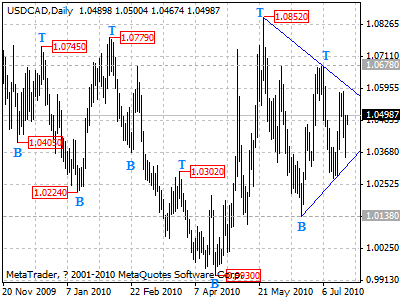
USDCAD is forming a triangle pattern

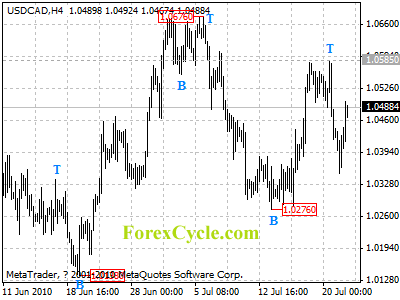
USDCAD is forming a triangle pattern on daily chart. Resistance is at the upper boundary of the pattern, now at 1.0605, a clear break above this level will indicate that the uptrend form 0.9930 has resumed, then another rise towards 1.0852 (May 25 high) could be seen. Support is located at the lower boundary of the pattern, now at 1.0321, a clear below this level could bring price towards 1.0000 area.

usdcad

usdcad

Daily Forex Forecast