The Euro’s On a Bullish Track! – July 26, 2010

EURUSD july 26 27, euro, US dollar, eur usd, usd eur, usd euro, forex, forex trading, daily forex picks, online trading, forex market

Good day forex friends! It’s been a long time since I last posted about FX but now I’m back! So here it is! In today’s canvas is an update of the EURUSD pair. As you can see from its daily chart, the euro has been recovering very well after it hit a low of around 1.1900 against the greenback back in June. Technically, the pair appears to have reversed already as evidenced by its breakout from an inverted head and shoulders pattern and its move past the long term downtrend line. While it is still quite possible for the EURUSD to turn south again, the chances of it moving higher, though, in my opinion, is now better than before. At present, the pair is trekking on an uptrend line. And as long as this line is left intact, the pair would most likely head higher. If it clears the 1.3000 resistance, it could aim for 1.3300. A break of the uptrend line, however, could send it back down to at least 1.2700.

Fundamentally, the expected increase in the GfK German Consumer Climate (from 3.5 to 3.6) and the probable hike in Germany’s as well as in the euro zone’s inflation figures could send the euro higher versus the greenback. Germany’s month-over-month CPI for July is seen to jump to 0.3% from 0.1% while the euro zone’s year-over-year consumer prices are also projected to rise by 1.7%, better than 1.4% logged during the previous month. The anticipated dip in Germany’s July unemployment rate (from 7.7% to 7.6%) could also send the euro higher. Given these projections plus the recent rally in the global markets, the confidence at least in the German market would have likely increased as well.

More on LaidTrades.com

The New Zealand Dollar (Kiwi) To Rise Ahead of the RBNZ Rate Hike? – July 26, 2010

NZDUSD july 26 27, kiwi, new zealand dollar, forex, forex trading, online trading, daily forex picks

Hiyo peeps! On this post is the daily chart of the NZDUSD pair. As you can see, the pair has been generally trading sideways for the past several months now. Though for the past two months, it has been showing some promising upswings. After falling to a low of 0.6560 back in June, the pair has seen rallied all the way back to 0.7300. If only I was able to buy at June’s low, I would have netted about 740 pips already in just two months! Oh well. In any case, the pair now is approaching a critical resistance just above 0.7300. A failure to successfully clear this level could push it down near the short term uptrend line again which is somewhere around 0.7150. A break of the high just above 0.7300, on the other hand, could propel it to 0.7400, 0.7500, or even 0.7600.

On the economic front, it looks like the New Zealand dollar or the Kiwi would be on the bright side of things for this week. You see, on Wednesday at 9:00 pm GMT, the Reserve Bank of New Zealand (RBNZ) is widely expected that it would raise its interest rates from 2.75% to 3.00%. While there is still an outside opportunity that the RBNZ would surprise the markets by not raising its rates, the NZD would still move higher at least up until the release of the central bank’s decision. From today until Wednesday, the market still has a lot of time to price in the projected rate hike. The recent rally in the global equities as well due partly to the stellar corporate earnings in the US could also ease the market’s tentativeness.

In any case, as what I’ve mentioned, the RBNZ could also postpone its rate hike due to New Zealand’s weaker-than-expected retail sales figures. New Zealand’s headline retail sales only grew by 0.4% during the last month compared to the 0.6% consensus. The country’s core retail sales likewise tallied a dismal 0.2% dip. Moreover, the softer-than-anticipated quarterly CPI of 0.3% could likewise factor in the bank’s decision to hold any rate increases. So if the bank does not hike, then the Kiwi would most likely take a hit.

More on LaidTrades.com

EUR Rises Above $1.30 before Consumer Confidence Reports

By ForexYard – Positive economic data as well as optimistic earnings reports published lately have boosted demand for riskier currencies, pushing the EUR back above the $1.30 level. Traders should continue following these indicators as a continuation of optimistic news will likely intensify the current trend.

Tody’s Leading Events:

6:00 GMT: EUR – GfK German Consumer Climate
14:00 GMT: USD – CB Consumer Confidence

Consumer confidence is a highly useful indicator as it lends insight into future consumption as well as manufacturing. The more people are confident about their future, the more they will be willing to purchase. Consumer spending accounts for a major part of economic activity; therefore, consumer confidence is a very valuable indicator.

Forex Market Analysis provided by Forex Yard.

© 2006 by FxYard Ltd

Disclaimer: Trading Foreign Exchange carries a high level of risk and may not be suitable for all investors. There is a possibility that you could sustain a loss of all of your investment and therefore you should not invest money that you cannot afford to lose. You should be aware of all the risks associated with Foreign Exchange trading.

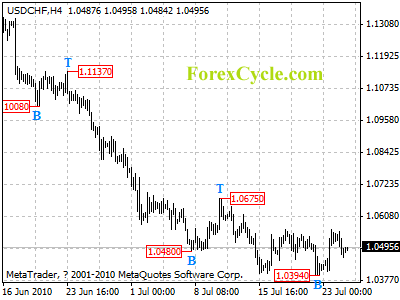
USDCHF trades in a range between 1.0394 and 1.0675

USDCHF trades in a range between 1.0394 and 1.0675. Another rise towards 1.0675 resistance is expected later today. As long as this level holds, the price action in the range is treated as consolidation of downtrend from 1.1730 (Jun 1 high), and another fall to 1.0300 is still possible, and a breakdown below 1.0394 could signal resumption of downtrend, only rise above 1.0675 could indicate that the fall from 1.1730 has completed at 1.0394 already.

usdchf

Daily Forex Signals

Technicals vs. Fundamentals: Which are Best When Trading Crude Oil and Natural Gas?

By Elliott Wave International

If “fundamentals” drive trend changes in financial markets, then shouldn’t the same factors have consistent effects on prices?

For example: Positive economic data should ignite a rally, while negative news should initiate decline. In the real world, though, this is hardly the case.

On a regular basis, markets go up on bad news, down on good news, and both directions on the same news — almost as if to say, “Talk to the hand cuz the chart ain’t listening.”

Unable to deny this fly in the fundamental ointment, the mainstream experts often attempt to reconcile the inconsistencies with phrases like “shrugged off,” “defied” or “in spite of.”

That begs the next question: How do you know when a market is going to cooperate with fundamental logic and when it won’t? ANSWER: You don’t.

Get FREE access to Elliott Wave International’s most intensive forecasting service for the global Energy markets. Now through noon Eastern time July 28, you can get timely intraday charts, forecasts and analysis for Crude Oil and Natural Gas. You’ll also get daily, weekly and monthly analysis and forecasts for all major Energy markets and Energy ETFs. Access FreeWeek now.

Take, for instance, the first three news items below regarding the July 22 performance in crude oil, versus the fourth headline, which occurred on July 23:

  1. Crude prices surge nearly 4% in their sharpest one-day percentage gain since May. The rally was “aided by fears that Tropical Storm Bonnie will enter the Gulf of Mexico over the weekend and disrupt oil production.” (Wall Street Journal)
  2. “Oil Prices Soar As Gulf Storm Threat Looms” (Associated Press)
  3. “The storm should keep oil prices bubbling if it continues to strengthen and remain on track.” (Bloomberg)

vs.

  1. “Oil Slips From Surge Despite Storm Threats” (Commodity Online)

Unlike fundamental analysis, technical analysis methods don’t rely on the news to explain or predict market moves. They look at the markets’ internals instead.

Get FREE access to Elliott Wave International’s most intensive forecasting service for the global Energy markets. Now through noon Eastern time July 28, you can get timely intraday charts, forecasts and analysis for Crude Oil and Natural Gas. You’ll also get daily, weekly and monthly analysis and forecasts for all major Energy markets and Energy ETFs. Access FreeWeek now.

This article, Free Insight Into Crude Oil’s Next Big Move,was syndicated by Elliott Wave International. EWI is the world’s largest market forecasting firm. Its staff of full-time analysts lead by Chartered Market Technician Robert Prechter provides 24-hour-a-day market analysis to institutional and private investors around the world.

Forex: Large Speculators decrease short Euro positions for third week in a row. Swiss Franc positions gain

By CountingPips.com

The latest Commitments of Traders (COT) data out on Friday showed that futures speculators continued to decrease their bets for the U.S. dollar against the euro for a third week as of July 20th, according to the COT data released by the Chicago Mercantile Exchange. Non-commercial futures positions, those taken by hedge funds and large speculators, were net short the euro against the U.S. dollar by -24,251 contracts after being net short the euro by -27,050 contracts the week before on July 13th.

Euro short positions have now declined for three straight weeks and sentiment has turned around quickly in the past few months with euro short positions having come off the all-time low level of -113,890 in May to being now at the best level since January.

The COT report is published every Friday by the Chicago Mercantile Exchange (CME) and shows futures positions as of the previous Tuesday. It can be a useful tool for traders to gauge investor sentiment and to look for potential changes in the direction of a currency or commodity. Each currency contract is a quote for that currency directly against the U.S. dollar, where as a net short amount of contracts means that more speculators are expecting that currency to fall against the dollar and net long position expect that currency to rise versus the dollar.

The British pound sterling was the only other major currency in addition to the euro that was net short in the CME futures market against the dollar as of July 20th while the Australian dollar, New Zealand dollar, Japanese yen, Swiss franc, Canadian dollar and Mexican peso all had a net long amount of contracts against the dollar.

The British pound net shorts decreased for a second straight week to -26,767 short positions from a total of -34,671 that were reported net short on July 13th. The Swiss franc positions turned to net long a couple of weeks ago and edged higher to 15,113 long contracts from 14,590 long contracts and have increased for three straight weeks.

The Japanese yen  net long contracts dipped last week to 40,911 from 47,359 net long contracts on July 13th. This interrupts a streak of five straight weeks of increases for the yen but yen positions have risen substantially from being short by -65,612 contracts on May 4th.

The Australian dollar futures positions gained for second straight week and were net long by 32,886 contracts as of July 20th following a net 23,480 long contracts on July 13th. The New Zealand dollar futures positions rose higher for a fifth straight week with 8,973 long contracts this week after a total of 5,452 long contracts as of July 13th.

The Canadian dollar long positions declined to a net 16,424 long contracts after 22,038 net longs the week before while Mexican peso long contracts advanced for a second straight week to 35,886 longs from 28,135 longs the prior week.

COT Data Summary (vs. the US Dollar) as of July 20th, 2010

Euro: -24,251 shorts from -27,050
British pound sterling: -26,767 shorts from -34,671
Australian dollar: 32,886 long contracts from 23,480
Canadian dollar: 16,424 long contracts from 22,038
Japanese yen: 40,911 long contracts from 47,359
Mexican peso: 35,886 long contracts from 28,135
New Zealand dollar: 8,973 long contracts from 5,452
Swiss franc: 15,113 long contracts from 14,590

Go to the Commitment of Traders CME raw futures data

EUR/AUD – Short-Term Buy; Long-Term Sell

By Greg Holden – The euro has been losing ground against the Australian dollar (AUD) for more than a year now, but we have been seeing signs of a pause at the current level, near a price of 1.4500. Traders who were expecting positive news about a euro rebound, however, may be sorely disappointed. The current pause has taken the shape of a consolidation trend, or pennant formation, on the weekly chart.

The pennant formation is typically known as a pause in the market which occurs right before a continuation of the previous trend. It forms after a sustained trend is broken, but then the price is unable to continuously break out of the previous pattern and gradually consolidates towards a point (see chart below). Once the point is reached, the previous trend – in the case of the EUR/AUD, a downtrend – will continue as before since trader sentiment wasn’t able to support the breaking of the trend.

Technical Analysis

– The chart used here is the EUR/AUD weekly chart, provided by ForexYard.

– The indicators being shown are the Relative Strength Index and Stochastic (slow).

– Point 1 on the chart represents the long and steady downtrend experienced by this currency pair over the past year-and-a-half.

– Point 2 marks the consolidation point of the pennant formation. As we can see, the current price sits near the lower border of the pennant formation and we may expect an upward move before it reaches the tip.

– Out indicators are both showing gradual upward pressure which supports the notion that we may see an upward price move prior to the conclusion of the pennant.

– As an additional side-note, this morning’s release of the Australian Producer Price Index (PPI) showed a far worse-than-expected release of only 0.3% growth, and may be putting pressure on the AUD in the short-term, also supporting the notion of an upward movement in this pair throughout the next day or two.

EUR/AUD – Weekly Chart

Forex Market Analysis provided by Forex Yard.

© 2006 by FxYard Ltd

Disclaimer: Trading Foreign Exchange carries a high level of risk and may not be suitable for all investors. There is a possibility that you could sustain a loss of all of your investment and therefore you should not invest money that you cannot afford to lose. You should be aware of all the risks associated with Foreign Exchange trading.
Gold Prices Arrive at Decision Point

By Russell Glaser – Spot gold prices continue to fall as risk appetite grows and traders seek out assets with higher yields. The commodity is approaching significant technical resistance in the long term trend.

Positive economic data from Europe along with varying data releases from the U.S. has created an environment ripe for risk taking. A rising euro, equity markets, and spot crude oil prices show just how traders are taking on more risk, while shunning safe haven assets. The recent price action of spot gold tells this story well.

Last week’s European industrial new orders surprised the market with a 3.8% rise on expectations of a decline of 0.1%.

British preliminary GDP came out stronger than expected, positing a 1.1% gain on expectations of only a rise of 0.6%.

Despite testimony from Fed Chairman Ben Bernanke that signaled an uncertain outlook for the U.S. economy, U.S. equities rose as the Dow Jones Industrials finished up for the week by 3.24%.

All of this positive info can be seen in the declining price action for spot gold.

The weekly chart shows an evening doji star candlestick pattern had formed, a warning that the long term bullish trend is changing. The top occurred at the record high price of spot gold at $1265. Confirmation of the pattern came the next week with the long red candlestick. Supporting the downward move is a doji candlestick that formed the following week after the evening star pattern.

The sharp downward movement in the price broke through the support level of $1224.70 and looks set to continue to head lower to the next support for the commodity which rests at $1169. This is close to the long term bullish trend line that began in October of 2008.

A close below this line would signal a shift in the long term trend to the downside and a target at the 23.6% Fibonacci retracement level at $1118, followed by the 32.8% Fibonacci level at $1026.

Should the downward price action fail to continue, the targets to the upside would be located at the resistance level of $1224, and the all time high for the price of spot gold at $1265.

Forex Market Analysis provided by Forex Yard.

© 2006 by FxYard Ltd

Disclaimer: Trading Foreign Exchange carries a high level of risk and may not be suitable for all investors. There is a possibility that you could sustain a loss of all of your investment and therefore you should not invest money that you cannot afford to lose. You should be aware of all the risks associated with Foreign Exchange trading.

Euro-Zone Bank Stress Tests Fail To Support the Euro

By Yan Petters – Last week’s trading session ended with the publications of the Euro-Zone Bank Stress Tests results. The results were considered to be positive as they showed that most of the major banks within the Euro-Zone are able to sustain another economic turmoil.

The expected to reaction to this publication should have been a stronger Euro; however the Euro wasn’t supported as a result. The main reason that the Euro wasn’t boosted is the questionable methodology of the tests. Many analysts claim that the tests weren’t strict enough, and that they fail to represent the real situation of the major banks. The main question regarding the results is how it can be that banks from Greece and Portugal, who are known to have unusual difficulties, managed to pass the tests?

The discussion regarding the results of the stress tests results are likely to proceed during the next few days, and will probably have a large affect on the market. Traders are advised to remain updated on this issue.

Today’s leading publication will be the U.S. New Home Sales which is expected at 14:00 GMT. This report measured the number of new single-family homes that were sold during June. If the end result will beat expectations for 317,000 new homes, the Dollar is likely to be supported.

Forex Market Analysis provided by Forex Yard.

© 2006 by FxYard Ltd

Disclaimer: Trading Foreign Exchange carries a high level of risk and may not be suitable for all investors. There is a possibility that you could sustain a loss of all of your investment and therefore you should not invest money that you cannot afford to lose. You should be aware of all the risks associated with Foreign Exchange trading.

Bank Stress Tests Fail Support the Euro Due To Questionable Reliability

Source: ForexYard

After a long time waiting, the Euro-Zone’s famous Bank Stress Tests results were finally published on Friday evening. The results failed to reassure investors regarding the stability of the European banking system as analysts claimed that the test weren’t strict enough. As this week begins, the reliability of the tests will remain the main topic. Will it eventually boost the Euro?

Economic News

USD – The Dollar Ends A Volatile Trading Week Following Mixed Data from the U.S.

The Dollar saw mixed results against the major currencies during last week’s trading session. The Dollar had ups and downs vs. the Euro, and eventually the EUR/USD level closed at the 1.29 level. The Dollar also slightly strengthened against the Yen, while falling against the Pound.

The Dollar’s volatile session came as a result of the mixed data from the U.S. economy. On one hand, the housing sector provided positive data last week. The U.S. Building Permits report showed that 0.59M new residential buildings permits were issued during June. The meaning of the data is that the quantity of future construction will rise; obtaining a permit is among the first steps in constructing a new building.

However on the other hand, the unemployment reports delivered negative signals. The weekly Unemployment Claims report showed that jobless claims in the U.S. increased more than forecasted to 464,000. The number of individuals who filed for unemployment insurance for the first time during the past week rose from 427,000, and failed to reach expectations for 449,000.

As for the week ahead, many interesting economic reports are expected from the U.S. The most significant publications look to be the New Home Sales, the Consumer Confidence, Durable Goods Orders indices, the Unemployment Claims, and the Gross Domestic Product (GDP). All these reports have potential to impact global trading and the Dollar in particular, and traders are suggested to follow the end results.

EUR – Stress Tests Fail to Ease Investors’ Concerns from a Possible Debt Crisis

The Euro saw a volatile session during last week’s trading. The Euro began last week’s trading with a bullish trend vs. the Dollar and the Yen. However the Euro then saw sharp drops and by the end of the week, resumed to its previous levels.

The Euro had a rising trend with the beginning of the week as positive data from the Euro-Zone supported the 16-nations currency. The German Producer Price Index (PPI) rose by 0.6% in June, beating expectations for a 0.2% rise. The report suggested that inflation in Germany rose for the 4th consecutive time, reassuring investors that the German economy is recovering. The European Industrial New Orders report also provided an unexpected positive data. The report showed that industrial orders in the Euro-Zone rose by 2.8% in May, well above expectations for a 0.1% drop.

However, by the end of the trading week, the Euro erased its profits, as the European Bank Stress Tests failed to reassure investors concerns from a possible sovereign crisis. The tests showed that merely 7 banks have flunked the stress test, out of 91 major banks that were tested. The supposedly positive data failed to create an impact in the market as investors felt that the tests may not have been strict enough. However, traders should take under consideration that European governments are putting a lot of efforts in the attempt to convince investors regarding the reliability of the tests results.

As for the week ahead, a batch of data is expected from the Euro-Zone. Traders are advised to focus on the German Preliminary Consumer Price Index (CPI), which will prove if the German inflation is indeed rising as last week’s PPI data showed. Traders should also keep in mind the affects of the bank stress tests, as these results will continue to impact the market this week.

JPY – Yen Weakens Against the Majors

The Yen fell against most of the major currencies during last week’s trading session. The Yen dropped about 100 pips vs. the Dollar and about 300 pips against the Pound, and the GBP/JPY pair is now trading near the 135.50 level.

The Yen dropped last week due to speculations that Asia’s economic recovery is advancing. These speculations have increased risk-appetite in the market, and have turned investors to look for riskier assets. The Yen is considered to be a safe-haven currency, and tends to fall as risk aversion weakens. The speculations came following several reports which showed that South Korea’s economy grew faster than analysts forecasted, and Japanese exports rose more than expected.

As for this week, many interesting publications are expected from the Japanese economy. The main news events that traders are advised to follow are the Retail Sales on Monday and the Tokyo Core Consumer Price Index (CPI) on Thursday. If the reports will continue to provide positive signals, the Yen might weaken further as investors will continue to look for higher-yielding assets.

OIL – Crude Oil Prices Consolidates Around $79 a Barrel

Crude oil prices continued to climb during last week’s trading session. A barrel of crude oil was traded around $76 a barrel at the beginning of last week and as the week progressed, crude oil prices soared, and a barrel of crude oil is now trading around $79 a barrel.

Crude oil strengthened last week due to several positive economic reports from the U.S. and the Euro-Zone. The positive reports have created speculations that global energy demand will increase, and as a result, crude oil prices consistently rose. The bullish trend halted close to the weekend as concerns regarding tropical storm Bonnie have eased due to reports claiming that the storm has weakened.

As for this week, traders are advised to follow the main publications from the U.S. and the Euro-Zone, as they have significant affect on oil prices. Trades should also follow the U.S. Crude Oil Inventories report on Wednesday as this tends to have an instant impact on spot crude oil prices.

Technical News

EUR/USD

Last week’s trading has led to a doji candlestick formation on the weekly chart indicating a potential reversal lower for the pair. Traders will want to combine this signal with other technical indicators for confirmation before entering short. The next significant resistance level rests at the 38.2% Fibonacci retracement level at 1.3110. The next support level is found at last Wednesday’s low of 1.2730.

GBP/USD

The 2-month bullish correction has pushed the price above significant technical resistance levels, signaling a shift in the long term trend of the pair. The weekly chart shows the price broke the long term downward sloping trend line that began in July of 2008. The price has also moved above the 200-day simple moving average line. Traders will want to be long on the pair with the next resistance level coming in at 1.5520, April’s high.

USD/JPY

Last week the pair failed to break below the support level of 86.25. Momentum for the pair has reversed as the Momentum (10) is trending higher. The price is looking to break above the resistance at the 20-day simple moving average line. A breach above this line could take the pair to the resistance level at 89.15, close to the long term downward sloping trend line. The potential correction could lead to a good setup to enter short in the direction of the trend.

USD/CHF

The Relative Strength Index on the 4-hour chart shows the pair in overbought territory, indicating a downward correction could take place. That being said, according to most other technical indicators, the pair is trading in neutral territory with no clear direction. Traders may want to take a take a wait and see approach today, as a clearer picture may present itself later.

The Wild Card

AUD/USD

The Stochastic Slow on the 8-hour chart indicates that a bullish cross has formed, meaning a downward correction may occur today. This theory is supported by the Relative Strength Index on the 4-hour chart. Forex traders may want to go short in their positions for this pair today, as bearish movement will likely occur.

Forex Market Analysis provided by Forex Yard.

© 2006 by FxYard Ltd

Disclaimer: Trading Foreign Exchange carries a high level of risk and may not be suitable for all investors. There is a possibility that you could sustain a loss of all of your investment and therefore you should not invest money that you cannot afford to lose. You should be aware of all the risks associated with Foreign Exchange trading.