Forex Weekly Market Review Aug 9, 2010

By eToro – The Month of August has had a rollercoaster ride as the beginning of the week saw a continuation of July’s excellent performance. The market consolidated during the week, and was pushed lower after the Department of Labor reports a worse than expected employment report. Overall, the US employment picture was disappointing with a few positive aspects. For the week, the S&P 500 Index climbed 19 points or 1.9%.

Click here for the full review

Forex Market Analysis provided by eToro

Disclaimer: Trading in the Foreign Exchange market might carry potential rewards, but also potential risks. You must be aware of the risks and are willing to accept them in order to trade in the foreign exchange market. Don’t trade with money you can’t afford to lose.

Negative NFP Release Weakens The Dollar Vs. The Majors

Source: ForexYard

Following a relatively calm trading week, the U.S. Non-Farm Payrolls data managed to boost volatility in the market, bringing down the U.S. dollar in the process. The dollar fell to an 8-month low against the yen and to its lowest level against the euro since May. The main question now is whether the dollar will continue to slide, or will a correction take place?

Economic News

USD – Dollar Tumbles Following Disappointing Employment Data

The U.S. dollar fell against most of its major rivals during last week’s trading session. The dollar lost about 300 pips vs. the euro and about 400 pips against the British pound. The dollar saw bearish movements against the yen as well.

The dollar’s downtrend against most of the major currencies came as a result of disappointing data from the U.S. economy. The U.S. housing sector saw further negative data after the Pending Home Sales report was published. The report showed that the number of home sales set to be finalized declined by 2.6% in June, failing to reach expectations for a 0.5% rise.

The dollar’s bearishness was further reinforced on Friday, after the release of the U.S. employment data. The U.S. Non-Farm Employment Change report showed that the number of employed people during July, excluding the farming industry, dropped by 125,000, failing to reach expectations for a 106,000 decline. The news emphasized the uncertainty regarding the current U.S. employment situation, and has led to questions regarding the U.S. economic recovery.

Looking ahead to this week, many interesting publications are expected from the U.S. economy. The release which is likely to have the largest impact on the market looks to be the Federal Funds Rate, which is scheduled for Tuesday. The Federal Funds Rate is in fact the U.S. interest rates for August. Traders are also advised to follow the U.S. Trade Balance, the weekly Unemployment Claims and the Consumer Price Index.

EUR – Euro Raises against the Dollar; Sees Mixed Results Vs. The Pound and the Yen

The euro saw mixed results vs. the major currencies during last week’s trading. The euro gained about 300 pips against the U.S. dollar. As such, the EUR/USD pair reached its highest level since May. However against the British pound and the yen the euro failed to strengthen, and mainly saw ups and downs.

The main reason for the euro’s gains vs. the dollar seems to be the general weakness of the American economic recovery. Due to several negative economic releases from the U.S. economy, especially the Non-Farm Employment Change, the dollar fell against all the major currencies, including the euro.
Nevertheless, the euro continues to trudge vs. the rest of the major currencies as the economic condition of the euro-zone remains vague. While many reports claim that the European Central Bank will manage to recover from the sovereign debt crisis, the economic data being released from the euro-zone’s leading economies fail to support that theory. In addition, the ECB continues to keep the euro-zone’s interest rates at a record low of 1.00%. ECB President Trichet claims that the euro-zone economies are growing. At the same time, his decision to leave rates at a record low sends mixed signals to investors, which leads to the many fluctuations in prices.

As for the week ahead, traders are advised to follow the publications from the leading economies of the euro-zone, such as Germany and France. In particular, traders should follow the German Preliminary Gross Domestic Product (GDP) report, scheduled for Friday. The GDP measures the change in value of all goods and services produced by the economy, and its publication is likely to have a large impact on the euro.

JPY – Yen Rises To an 8-Month High against the Dollar

The Yen rose to an 8-month high vs. the U.S. dollar during Friday’s trading session. The Yen gained about 200 pips against the dollar last week, and the USD/JPY pair dropped as low as the 85.00 level. The Yen saw mixed results vs. the euro and the British pound.

The yen strengthened vs. the dollar following disappointing data from the U.S. economy. The Non-Farm Payrolls report, which was released on Friday, showed that the amount of employed people in the U.S. has dropped for the second month in a row in July. In addition, this has added to concerns that global economic recovery might take longer than expected and as a result boosted demand for safer assets, such as the yen.

As for this week, a batch of data is expected from the Japanese economy, yet the most interesting economic publications look to be the Overnight Call Rate. The Overnight Call Rate is the Bank of Japan’s (BoJ) interest rates decision for August. Current expectations are that the BoJ will leave rates at 0.10%, the lowest in the industrial world. However, should the BoJ decide to hike rates, heavy volatility could hit yen pairs.

Crude Oil – Crude Oil Drops To $80 a Barrel

Crude oil saw a volatile session during last week’s trading. Crude oil began the week at around $79 a barrel, and by midweek rose to $83 a barrel. However by the weekend, oil erased most of its gains, and was trading around the 80.00 mark.

Crude oil fell to $80 a barrel on Friday following the lower-than-expected U.S. Non-Farm Employment Change data. The disappointing data boosted concerns that demand for energy in the U.S, the world’s largest consumer of energy products, will decline. It currently seems that as long as the U.S. and the euro-zone do not show stronger signs of recovery, crude oil might weaken further.

Looking ahead to this week, traders are advised to follow the major economic publications from the U.S. and the euro-zone. Traders should also focus on the U.S. Crude Oil Inventories report, which is scheduled for Wednesday, as this report tends to have an instant impact on the market.

Technical News

EUR/USD

The Stochastic Slow on the daily chart shows a bullish cross has formed, indicating that a downward correction may take place in the near future. The Relative Strength Index on the 4-hour chart supports this theory. Traders are advised to go short on their positions today, as bearish movement is expected.

GBP/USD

Technical indicators are decidedly mixed for the pair at the moment. While the Relative Strength Index on the daily chart is currently well into overbought territory, the Stochastic Slow on the 8-hour chart is showing a bearish cross has formed. Traders are advised to take a wait and see approach today, as a clearer picture is likely to present itself later on.

USD/JPY

Most technical indicators show the pair currently trading in neutral territory, which typically means that no major movement will occur today. At the same time, a bearish cross has formed on the 4-hour chart’s Stochastic Slow. Traders will want to watch out for a possible upward correction for the pair this afternoon.

USD/CHF

Technical data is showing the pair trading in neutral territory at the moment, meaning a major price shift is unlikely to occur today. That being said, during these low volatility periods, unexpected movement may occur. Traders are advised to take a wait and see approach for the pair today.

The Wild Card

Gold

The RSI on the 8-hour chart shows the commodity trading well into overbought territory, meaning a downward correction is likely to take place. The Stochastic Slow on the daily chart supports this theory. Forex traders are advised to go short with tight stops in their positions today.

Forex Market Analysis provided by ForexYard.

© 2006 by FxYard Ltd

Disclaimer: Trading Foreign Exchange carries a high level of risk and may not be suitable for all investors. There is a possibility that you could sustain a loss of all of your investment and therefore you should not invest money that you cannot afford to lose. You should be aware of all the risks associated with Foreign Exchange trading.
Forex Market Review: Daily Forex Analysis 2010-08-09

Forex Market Review & Analysis by Finexo.com

The Dollar tumbled to an eight-month low against the Yen and dropped versus the Euro after data showed the U.S lost twice as many jobs in July as expected, fueling concerns that the Federal Reserve may need to take additional steps towards providing extra stimulus measures. On Friday the U.S Labor Department reported that Non-Farm payrolls fell by 131K, compared with an expected drop of 63K.  While the private sector (excluding government agencies) rose by 71K, below market expectations of a 91K rise. Meanwhile, the unemployment rate dropped from 9.6% to 9.5%.

Canada’s dollar was the worst performer among the majors last week after the disappointing payroll report. At the same time, Canada unemployment rate increased from 7.9% to 8.0% after the country unexpectedly lost jobs in July. The Canadian currency fell 1% to C$1.0268, following the report.  Meanwhile, the Australia Dollar was up against that of the U.S for a third consecutive week.  The Aussie touched $0.9222 following the U.S employment report, the currency’s highest price since early May.

EUR/USD

The Euro surged against the Dollar on Friday, hitting $1.3332 after a weaker-than-expected Non-Farm Payroll report. The pair finished the week at the highest level since early May, barely below $1.3300.
Tomorrow, the Federal Reserve will announce its benchmark interest rate decision. Analysts predict that the FOMC will hold the key interest rate at its current range of 0 to 0.25%. As usual, the Dollar will be heavily affected by Bernanke’s speech. Increased signs that the economy may be slowing down, may push the Fed to declare a new program for buying assets or renew its committee to low short-term policy rates, moves that could weigh heavily on the value of the Dollar.

GBP/USD

The Sterling hit a six-month high near $1.60 on Friday, its fourth consecutive weekly gain against the Dollar, propelled by the U.S’s disappointing job report and increased confidence in the U.K economy. The GBP/USD rose 0.6% to $1.5993 following the report, the pair’s highest price since February 3rd. The British currency gained more than 1.9% last week. On Thursday, the Bank of England Monetary Policy Committee left target for bond holdings at 200 billion pounds and held the overnight interest rate at 0.5%.

Forex Market Review & Analysis by Finexo.com

Disclaimer: Trading the foreign exchange (Forex) carries a high level of risk, and may not be suitable for all investors.

Dollar Falls To a 3-Month Low against the Euro

By Dan Eduard – The U.S. dollar continued with its bearish trading throughout last week. The main reason for the dollar’s downfall was the disappointing Non-Farm Employment Change release. The report showed that there were 131,000 less employed people in the U.S. in July compared to June. This has shaken up investors’ confidence in a quick recovery for the U.S. economy.

Nevertheless, EUR/USD didn’t reach a 3-month high due to the negative employment data alone. The dollar has been falling against the euro consistently for the past 3 months, as investors suspect that the euro is still under valued. For those of you who caught this trend at its beginning, you stand now with a profit of over 1,200 pips. For those of you who didn’t, now might be your only chance to enjoy this solid trend, as a correction will eventually take place.

Today, there aren’t any news events that are expected to have a large impact on the market. This means that traders are advised to follow the equity markets in the U.S., euro-zone and Japan. Traders should also take under consideration that crude oil saw a relatively sharp slide on Friday, and thus a bullish correction might take place today, with the potential to reach the 82.00 level.

Forex Market Analysis provided by ForexYard.

© 2006 by FxYard Ltd

Disclaimer: Trading Foreign Exchange carries a high level of risk and may not be suitable for all investors. There is a possibility that you could sustain a loss of all of your investment and therefore you should not invest money that you cannot afford to lose. You should be aware of all the risks associated with Foreign Exchange trading.

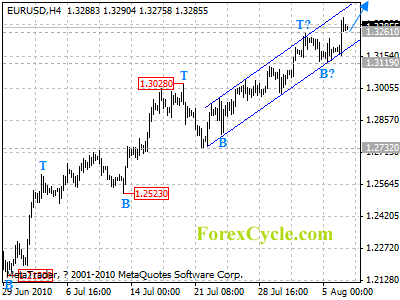
EURUSD continues its upward movement

After a minor consolidation, EURUSD continues its upward movement from 1.2732 and the rise extended to as high as 1.3333 level. Support is at the lower border of the price channel on 4-hour chart, now at 1.3194, as long as the channel support holds, another rise is still possible and next target would be at 1.3500-1.3600 area. On the downside, a clear break below the channel support will indicate that the rise from 1.2732 is complete.

eurusd

Daily Forex Forecast

USDCHF’s downward movement extended to 1.0331

USDCHF’s downward movement extended further to as low as 1.0331 level. However, the pair had lost momentum, move sideways in a range between 1.0250 and 1.0550 would more likely be seen in a couple of weeks. Key resistance is at 1.0675, a break above this level will indicate that a cycle bottom has been formed on daily chart and the fall from 1.1730 is complete, then the following upward movement could bring price to 1.1200-1.1300 area.

For long term analysis, USDCHF formed a cycle top at 1.1730 level on weekly chart. Further fall to 1.0200 to reach next cycle bottom on weekly chart is expected in a couple of weeks.

usdchf

Weekly Forex Analysis

Forex Daily Market Commentary August 6, 2010

By GCI Forex Research

Fundamental Outlook at 1400 GMT (EDT + 0400)

USD

The higher initial jobless claims data caused some consternation despite the fact that it is not included in the upcoming payrolls figure. The dollar lost some ground versus the safe haven JPY and CHF as Treasury yields moved lower but otherwise the dollar remained rangebound versus the rest of the G10 currencies ahead of the payrolls report. Risk-seeking was muted as equities finished flat. Data this week has largely been positive, which helped ease investor worries of further easing by the Fed but a payrolls disappointment could again stoke those fears. Our team expects headline figures and private payrolls to be more or less in line with consensus. In the event of a positive payrolls print, we expect dollar upside versus the EUR and the JPY. But a disappointment would again see the CHF and JPY gain versus the dollar. We also expect the CAD  to have the highest beta to the release among dollar bloc currencies.

EUR

The ECB did not alter policy and President Trichet sounded cautious for the outlook for the rest of the year. He was constructive on better than expected Q2 and initial Q3 data but it did not prove much support for the euro as those releases were in the past and he said that it would be clear the second half would be less buoyant. Trichet said no changed would be made in the projections with risks to inflation and growth balanced for now and offered no new information on sovereign bond purchases and liquidity tenders, only to say that the ECB will do what is needed. Admittedly it does not look as if either the ECB or the Fed might change rates any time soon. The ECB’s policy does however entail comparatively small risks for the future. While the Fed relies on an extremely high monetary policy stimulus there is a risk of inflation causing problems at a later stage

GBP

As expected the Bank of England left rate levels and the volume of bond purchases unchanged. The BoE is facing a problem, in that due to the fiscal consolidation there are risks for the economic outlook, while on the other hand the rate of inflation is still stubbornly high and likely to remain so. The inflation report, due for publication next week, is likely to reflect this: Growth is likely to be revised downwards while inflation is likely to be revised upwards. All in all the BoE is likely to take a ‘wait and see attitude’, wanting to observe the effects of the government’s savings measures first. A first rate step is therefore not to be expected until the second half of 2011. Today’s data on industrial production is likely to be relatively neutral against this background. Even though we expect a result slightly above consensus, positive momentum for Sterling is likely to be relatively limited.

CAD

Canadian Finance Minister Flaherty said the Canadian dollar would have to go significantly above parity before he gets concerned with the level. This is in contrast with earlier concerns that currency strength could act as a brake on growth. We have noted that growth differentials make the Canadian dollar a good candidate for relative value in the G10 and Flaherty also said that the Canadian dollar’s rise makes sense given demand for investments and fundamentals. The labour data release will be important to see if domestic momentum continues but USDCAD will be more susceptible to the US labour data release. The more volatile Ivey PMI is also due.

AUD

Our team does not anticipate any major revisions to the RBA’s growth and inflation forecasts in its quarterly Statement of Monetary Policy. They also note that recently softer data and the RBA’s latest statement focussing somewhat on the ‘uncertain global outlook’ raises the chance that they remain on hold for several months.

TECHNICAL OUTLOOK

EURUSD NEUTRAL Momentum is slowing; upside potential toward 1.3511 with next resistance lying at 1.3692. Near-term support comes in at 1.3060/29 ahead of 1.2737.

USDJPY BEARISH Bearish pressure holds above 84.83, break of the level would expose next support at 81.85. Near-term resistance holds at 86.66 ahead of 88.12.

GBPUSD BULLISH Focus is on 1.5969 Fibonacci level break of which would open up the way for further gains towards 1.6069 and 1.6458 next. Near-term support is at 1.5696 ahead of 1.5400.

USDCHF BEARISH Currently holds support at 1.0348 with near-term resistance at 1.0581 ahead of 1.0676. Overall focus on 1.0131; break of the level would expose 0.9918.

AUDUSD BULLISH Trend is bullish; expect the gains to target 0.9389 ahead of 0.9850. On the downside, initial support lies at 0.8896 ahead of 0.8634.

USDCAD BEARISH Violation of 1.0139 has exposed further weakness towards 0.9931 key low. Initial resistance is at 1.0274 ahead of 1.0396.

EURCHF BULLISH Need a break above 1.4041 to confirm the bullish trend. Initial support lies at 1.3730 ahead of 1.3511.

EURGBP BEARISH Outlook is bearish with focus on 0.8245 Fibonacci support break of which would expose 0.8068. Near-term resistance lies at 0.8416 ahead of 0.8532.

EURJPY NEUTRAL Motion is sideways; 115.19 and 110.02 mark the near-term directional triggers. 107.32 defines a key support level.

Forex Daily Market Commentary provided by GCI Financial Ltd.

GCI Financial Ltd (”GCI”) is a regulated securities and commodities trading firm, specializing in online Foreign Exchange (”Forex”) brokerage. GCI executes billions of dollars per month in foreign exchange transactions alone. In addition to Forex, GCI is a primary market maker in Contracts for Difference (”CFDs”) on shares, indices and futures, and offers one of the fastest growing online CFD trading services. GCI has over 10,000 clients worldwide, including individual traders, institutions, and money managers. GCI provides an advanced, secure, and comprehensive online trading system. Client funds are insured and held in a separate customer account. In addition, GCI Financial Ltd maintains Net Capital in excess of minimum regulatory requirements.

DISCLAIMER: GCI’s Daily Market Commentary is provided for informational purposes only. The information contained in these reports is gathered from reputable news sources and is not intended to be U.S.ed as investment advice. GCI assumes no responsibility or liability from gains or losses incurred by the information herein contained.

EURO Soared Over the US Dollar On Dismal NFP Result – August 6, 2010

EURUSD august 6, EUR/USD, EUR, USD, US dollar, euro, eur usd, usd eur, usd euro, forex, FX, forex market, forex trading, daily forex picks, daily fx picks, online trading, currency trading, forex analysis, forex forecast

Hello forex peeps! On today’s fx feature is the 4-hour chart of the fiber or the EURUSD pair. In my previous post about it (please see it here) last August 3, I mentioned that as long as its uptrend holds, it would continue to move higher… and it did. As you can see, the pair had consolidated into a symmetrical triangle after reaching a high of 1.3262 on August 3. It then broke out to the upside after finding support at the uptrend line. The presence of a hidden bullish divergence (where the price moves higher and the stochastics moves lower) and its oversold condition when it fell back to the uptrend support could have also led the investors to buy up the euro in exchange of the USD. Still, the pair is facing some heavy selling pressure at 1.3300. Given this, it might a harder time in moving above the mentioned level. It would more likely consolidate again or even retrace before it shoots up again. A break, however, of the uptrend line could push the EURUSD back to 1.3100. But since it is on an uptrend, a move higher is more likely to take place.

The euro’s recent jump was due to the dismal result of the US’s non-farm payrolls (NFP) report. Imagine, US firms about 131,000 jobs in Jul which was far worse than the expected 63,000 job cuts. The country’s unemployment rate, though, managed to remain at 9.5%. Nonetheless, the worse-than-projected NFP count spurred some risk aversion in the market. The difference this time though is that the euro, as mentioned, soared against the greenback. Usually, the EUR gets sold off whenever there is risk aversion in the markets since investors generally seek shelter under the safety of the USD whenever these happen. But apparently, the market is already becoming wary of the US’s recovery which in turn leads them to question the viability of the US dollar.

For the past week, I have observed that the movement of the USD has been more or less positively in line with the US’s fundamentals.Will this trend continue? We will see. If it does then any weak economic update from the US next week could push the EURUSD higher. The Fed is scheduled to release its interest rate decision on Tuesday (August 10) while the US’s inflation and retail sales numbers are due on Friday (August 13). watch out for any downbeat outlook and dovish statements by the FOMC and/or weak inflation and retail sales numbers!

More on LaidTrades.com

FOREX: Dollar, Stocks on defensive as US Employment falls by 131,000 workers in July

By CountingPips.com

The US dollar has been on the defensive today against the other major currencies in the forex market following the eagerly awaited government employment report that showed US jobs fell for a second straight month. The dollar has lost ground against the euro, British pound sterling, Japanese yen, Australian dollar, New Zealand dollar and Swiss franc while trading higher against the Canadian dollar in the early going of the US trading session.

The US stock markets, meanwhile, have also started off the day with declines as the Dow Jones industrial average fell lower by over 100 points while the NASDAQ and S&P 500 have declined by approximately 35 points and 15 points, respectively. Gold has made gains higher by $13.50 to trade at the $1210.70 level while crude oil has been declining to the $80.99 level.

The US government nonfarm payrolls report, released by the US Department of Labor, showed that US jobs declined by 131,000 workers in July following the revised decline of 221,000 workers in June. The July report was worse than expected as market forecasters were looking for 65,000 jobs lost and marked the second consecutive month of job losses following five straight monthly increases. June’s report was revised from the original 125,000 jobs.

The unemployment rate remained the same at 9.5% after falling from 9.7% in June as the total number of workers looking for work was essentially unchanged at 14.6 million workers.

The private sector created 71,000 jobs in July but that was offset by a decline in the temporary census government worker positions by 143,000 jobs. The private sector increase for July follows a revised gain of 31,000 private sector jobs for June. Overall for 2010, the private sector employment payrolls have increased by 630,000 workers.

The goods producing sector increased by 33,000 jobs in July as manufacturing jobs added 36,000 workers while construction jobs decreased for third straight month by 11,000 positions. Mining and logging also managed to add 8,000 workers to the goods producing sector.

The service sector added 38,000 jobs for the month with healthcare positions increasing by 27,000 workers. Professional and business services cut 13,000 workers and financial activities lost 17,000 workers.

Government employment decreased by 202,000 workers for the month as the loss of temporary centers workers contributed heavily to this category and to the overall monthly job loss. This is a second straight month the government payroll has lost over 200,000 workers following June’s decline of 252,000 workers as the temporary census jobs end.

FOREX: EUR/USD Daily Chart – The Euro (EUR/USD) continuing to advance higher today versus the US dollar to above the 1.3300 exchange rate for the first time since early May. This marks a new 3-month high and has the Euro increasing against the dollar for the sixth straight week.

Forex Trading, Euro, US Dollar, Fx Chart, EUR/USD

Russia Drought & Trading: Is Wheat the hottest market in the world?

By Adam Hewison – Never miss another major move again, and this headline proves it.

Severe Russian drought forces grain export ban – Moscow, Russia (CNN) — As Russia reels from the worst drought in nearly 40 years …

The wheat market is the hottest market in the world right now due to severe drought in Russia. But how did MarketClub’s “Trade Triangle” technology do in this rocket-to-the-stars market?

MarketClub’s “Trade Triangle” technology received a “go long” wheat signal over 6 weeks ago. Wheat was trading at $5.17 back then. It is now trading at over $8.00 a bushel.

Wheat is one of the six key components in MarketClub’s World Cup Portfolio (WCP – formerly World Commodity Portfolio). In the twelve quarters we have tracked this portfolio, wheat has been profitable in 11 out of those twelve quarters. This quarter looks to be a bonanza with profits in excess of $11,000 per contract.

In the this video below I show you the move, the “Trade Triangles,” and the results. It is a not to be missed video.

All the best,

Adam Hewison
President of INO.com
Co-creator of the MarketClub

To see more of Adam’s Videos click here or sign up for Adam’s Free 10-part Professional Trading Course.