Bernanke Speech to Impact Dollar

Source: ForexYard

The US Prelim GDP, to be released at 12:30 GMT, is the primary publication today that is set to determine the level of the US dollar. The other main release that are is to dominate forex trading, especially for currencies, is the publication of the British Revised GDP at 8:30 GMT. Traders are also advised to follow Fed Chairman Bernanke’s speech at 14:00 GMT. This speech is very likely carry a higher than usual impact on Dollar volatility.

Economic News

USD – Dollar Falls on Increased Risk Appetite

The US dollar fell against most of its major currencies on Thursday, as gains in stocks and commodities prompted investors to wade into riskier currency trades. By yesterday’s close, the USD fell against the CHF, pushing the oft-traded currency pair to 1.0240. The dollar experienced similar behavior against the EUR and closed at 1.2720.

In addition, a slide in new US home sales and weak durable goods orders highlighted weakness in the US economy, but analysts said that such data has failed to stoke safe-haven demand for the dollar, as it did earlier in the month.

Another leading indicator released yesterday was US unemployment claims. This number handedly beat last week’s results but failed to provide strength to the dollar as investors may be waiting for key data due to be released today to implement their trading strategies.

Looking ahead to today, the most important economic indicator scheduled to be released from the US is the Prelim GDP at 12:30 GMT. Traders will be paying close attention to today’s announcement as a stronger than expected result may boost the USD in the short-term. Traders are also advised to follow Fed Chairman Bernanke’s speech at 14:00 GMT. This speech is very likely to impact dollar volatility. Traders are advised to watch closely, as this is likely to set the pace of the dollar going into next week’s trading.

EUR – EUR Rises on Gains in European Shares

The EUR rose on Thursday as early gains in European shares, following a climb on Wall Street, indicated improving demand for riskier assets. As a result, the EUR hit a session high against the dollar at around 1.2745 before pulling back to around $1.2720. The 16-nation single currency experienced similar behavior against the GBP and closed at 0.8190.

European shares rose 0.8%, clawing back from a five-week low on forecast-beating results, although gains were capped after US data on Thursday raised concerns the world’s biggest economy risks sliding back into recession. That shift, just getting underway, could take the shine off the soaring EUR in the coming months.

Sentiment in the euro zone’s regional economy has brightened in the past week following better-than-expected news. The EUR is showing signs of resilience even though there was volatility throughout non-euro crosses. It will be crucial for traders to identify how the preceding economic indicators from the US, European and Japanese economies will affect their positions.

JPY – Safe-Haven Yen Climbs vs. Rivals

The Japanese yen has strengthened against most of its major counterparts, continuing to prove that for the time being this is the solid currency that traders can rely on to provide them with steady profits. The yen extended gains versus the dollar on Thursday, to trade above 84.40 amid a broad sell-off in the USD. The JPY also saw bullishness against the EUR and closed at 107.30.

Investors worry about the rise in the JPY as it makes Japanese products less competitive abroad and hurts the value of overseas sales when translated back into the Japanese currency. With steady gains, primarily against the dollar, much of the yen’s bullish movement could be contributed to the repatriation of overseas earnings by Japanese companies into the local economy. This has had a positive effect on major JPY currency pairings, as the rising turmoil in the market is leading to more investment in the Japanese currency.

Crude Oil – Crude Oil Rises above $73 a Barrel

Oil prices extended gains to rise above $73 a barrel Thursday, as regional stock markets advanced and recent sharp losses in crude drew more buyers. Crude has fallen about 11.5% from around $82 a barrel early this month as more evidence of a slowing US economy suggested that demand for oil and gas would remain sluggish.

In addition, a weaker US dollar tends to boost the price of dollar-priced commodities as it lowers the price to holders of other currencies and reduces the value of the oil producers receive.

Technical News

EUR/USD

This pair appears to be providing mixed signals today. The shorter time frames are floating in neutral territory, giving no clear indication. The daily chart shows the price just exiting the over-sold territory on the RSI and Stochastic, while the weekly chart has what appears to be a recent bearish cross on the Stochastic (slow) and is now descending lower. Waiting for a clearer sign of direction may be wise today.

GBP/USD

The price of this pair has recently entered the over-sold territory on the hourly RSI, and seems to be just exiting the over-sold territory on the daily RSI. These notions, combined with a recent bullish cross on the hourly Stochastic (slow), seem to suggest that going long would be a reasonable tactic today.

USD/JPY

This pair continues to float within a distinct, long-term bearish channel. The weekly chart has begun to provide hints that the pair may correct upwards in the near future, however. The weekly RSI has the price sitting just on the border of the over-sold territory. The weekly Stochastic (slow) shows the same thing. This pair may be preparing for an upward movement, but for now the down-trend remains dominant.

USD/CHF

The price on the USD/CHF has recently entered the over-sold region of the daily chart’s RSI and may experience upward pressure in the near future as a result. This pair’s weekly chart also has the pair in the over-sold territory, and shows fresh bullish crosses on the Stochastic (slow), both of which support the notion of an impending upward movement. Going long may not be a bad choice today.

The Wild Card

Gold

After a few weeks of sustained upward movement, the price of Gold now appears to be gearing up for a downward slide. The daily RSI has the price floating in the over-bought region for some time now, suggesting strong downward pressure. The weekly Stochastic (slow) has almost formed a bearish cross, and will likely do so by the beginning of next week. This provides forex traders a great chance to call the reversal point on a precious commodity like Gold and ride out the downward movement for a healthy profit.

Forex Market Analysis provided by ForexYard.

© 2006 by FxYard Ltd

Disclaimer: Trading Foreign Exchange carries a high level of risk and may not be suitable for all investors. There is a possibility that you could sustain a loss of all of your investment and therefore you should not invest money that you cannot afford to lose. You should be aware of all the risks associated with Foreign Exchange trading.

USD/CHF – Bearish Until SNB Intervention

By Russell Glaser – The Swiss franc continues to perform well, particularly versus the two major currencies the dollar and the euro. Traders are anticipating intervention by the Swiss National Bank (SNB) to halt the appreciation of the franc. The assumption is the SNB will jump in and attempt to weaken the franc on the open market. This provides traders an opportunity to enter into a strong trend as the USD/CHF targets its 2010 low.

The franc was stronger today with the USD/CHF trading as low as 1.0221before closing 1.0250. This follows an opening day price of 1.0280. The EUR/CHF was also lower, trading at 1.3025, after opening the day at 1.3072.

Many have been caught off guard following the strength of the franc despite its reputation as a safe haven asset. The renewed vigor follows the last time the SNB ended its intervention in the currency markets and the USD/CHF dropped 10% of its value.

In addition to safe haven buying, fundamentals in the Swiss economy are also a positive for the franc. According to SNB board member Jean-Pierre Danthine, deflationary pressures have all but disappeared. Retail sales in July climbed 0.9% from the previous month. Today the Swiss employment level was released on par with market estimates of 3.97M. Speculators may also have a hand at pushing the Swiss franc as far as it will go until the SNB shows its resolve to stop the appreciation.

Looking at the technicals, the USD/CHF is currently trading at the support level on the weekly chart of 1.0250 (S1). We will be looking for a close below this level to trigger further selling. The next target for the pair rests at the January low for the pair at 1.0130 (S2). Any move to the upside should see resistance at this week’s high of 1.0450, followed by the downward sloping trend line that begins in the middle of July.

Forex Market Analysis provided by ForexYard.

© 2006 by FxYard Ltd

Disclaimer: Trading Foreign Exchange carries a high level of risk and may not be suitable for all investors. There is a possibility that you could sustain a loss of all of your investment and therefore you should not invest money that you cannot afford to lose. You should be aware of all the risks associated with Foreign Exchange trading.
Forex Daily Market Review Aug 27, 2010

By eToro – Stronger than expected German GfK confidence, along with the return of some calm in the peripheral bond markets, help the Euro reclaim the 1.27 level.  The markets should continue to consolidate ahead of the US employment report next week.

Click here to read the full daily Review

Forex Market Analysis provided by eToro

Disclaimer: Trading in the Foreign Exchange market might carry potential rewards, but also potential risks. You must be aware of the risks and are willing to accept them in order to trade in the foreign exchange market. Don’t trade with money you can’t afford to lose.

USDCHF: Prices should stay below (1.04500) in order to maintain the bearish outlook

Down Trend

Prices should stay below (1.04500) in order to maintain the bearish outlook.. USDCHF is facing a selling pressure pushing it down as long as it remains below (1.04500) any four hours close below (1.01613) will open the way for the instrument to test the next support level at (1.01017). Any four hours bare close above (1.04500) will change instrument`s direction. Traders should consider selling each rally with a stop loss at (1.04500).

Important Price Levels
Resistance1.026601.030101.034101.038401.04490
Support1.019771.016131.010171.006531.00353


By 4xEagleEye.com


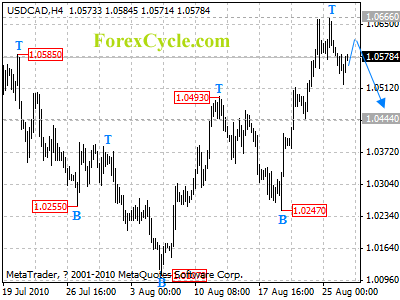
USDCAD failed to break above 1.0676

USDCAD failed to break above 1.0676 (Jul 6 high) resistance and formed a cycle top at 1.0666. Pullback towards 1.0400 area would more likely be seen in next several days. As long as 1.2400 support holds, the fall from 1.0666 could be treated as consolidation of uptrend from 1.0107, one more rise to 1.0750 is still possible, however, below 1.0400 will indicate that the rise from 1.0107 has completed at 1.0666 already, then deeper decline could be seen to 1.0200 zone.

usdcad

Daily Forex Forecast

Forex Daily Market Commentary

By GCI Forex Research

Fundamental Outlook at 1400 GMT (EDT + 0400)

USD

The dollar weakened slightly versus some of the higher beta currencies amid yet another data disappointment. The lower than expected durable goods and new home sales figures ratcheted up worries of a double dip scenario and more potential Fed easing but equities and Treasury yields managed to close higher. Investors could be at the point where they now expect further Fed easing, which could remain supportive to risk-seeking. However, the relatively muted dollar reaction, especially with the better than expected German IFO data, also indicates investor uncertainty surrounding future G10 policymaking as G10 central banks have sounded more dovish as of late. That uncertainty could help the dollar at the current juncture and the spotlight is getting more intense on Fed Chairman Bernanke’s upcoming speech with every negative data print. Overall durable goods orders rose much less than expected in July though the June decline was revised upward. Details were also softer and revisions to inventories and shipments data should add 0.1% to Q2 real GDP growth. Our economists now expect a 1.1 point downward revision to Q2 GDP to 1.3% from 2.4% and still forecast 1.5% for real GDP growth in Q3. New home sales have been more volatile but mortgage apps signal some stabilization. EURUSD traded 1.2609-1.2726, USDJPY 83.90-84.84.

EUR

The EUR fared well though the better-than expected German IFO did not give as much of a boost as had been thought. A Portuguese auction passed without incident and worries over Ireland’s debt position remains but sentiment is stable for now. The IFO business climate came in at 106.7 (cons. 105.7) and the expectations index dipped slightly to 105.2 (cons. 104.3).

German Finance Minister Schaeuble is not worried about recent bond spread widening and said Greece is doing its job on curbing its deficit. Schaeuble also said the euro is in a reasonable trading range.

JPY

USDJPY has continued to drift higher in the last few sessions as the government rhetoric has increased but the pair is still sub-85, which has investors still on edge. Japanese PM Kan noted that he did not talk about intervention in a meeting with business leaders. However, he noted that cooperation between authorities would continue, and BoJ Governor Shirakawa will be attending the Jackson Hole meetings this week.

The merchandise trade balance improved on the month, with export growth coming in stronger than expected at 23.5%y/y, and imports were down. The results may cause investors to further question the need for intervention at this stage, and we continue to doubt any prospect of the BoJ coming in the near term.

TECHNICAL OUTLOOK

EURUSD BEARISH Break through 1.2606 has exposed next support lying at 1.2434 with scope for 1.2152 next. Near-term resistance holds at 1.2933.

USDJPY BEARISH Decline through 84.73 halted at 83.60, which lies ahead of 79.75 key support. Near-term resistance at 85.20 ahead of 86.38.

GBPUSD NEUTRAL While resistance is at 1.5713 holds, move below 1.5324 would put odds in favor of a negative trend. Next support lies at 1.5125 ahead of 1.4906.

USDCHF BEARISH While resistance at 1.0676 holds expect loses to target 1.0131 and 0.9918 next.

AUDUSD BEARISH Momentum is negative; initial support is defined at 0.8663 ahead of 0.8531. Only a move above 0.9080 would hurt the negative tone.

USDCAD BULLISH Upside potential capped at 1.0677 ahead of 1.0853. Initial support lies at 1.0383 ahead of 1.0248.

EURCHF BEARISH Defines fresh trend lows. Clearance of 1.3000, psychological support level exposes 1.2755. Near-term resistance at 1.3242 ahead of 1.3458.

EURGBP BEARISH Focus is on 0.8068 and 0.7974 support levels. Short-term resistance is defined at 0.8247 ahead of 0.8363.

EURJPY BEARISH Bearish pressure held above 104.72; breach of the level would expose 100.00, round number support. Near-term resistance is defined at 108.87 ahead of 111.11.

Forex Daily Market Commentary provided by GCI Financial Ltd.

GCI Financial Ltd (”GCI”) is a regulated securities and commodities trading firm, specializing in online Foreign Exchange (”Forex”) brokerage. GCI executes billions of dollars per month in foreign exchange transactions alone. In addition to Forex, GCI is a primary market maker in Contracts for Difference (”CFDs”) on shares, indices and futures, and offers one of the fastest growing online CFD trading services. GCI has over 10,000 clients worldwide, including individual traders, institutions, and money managers. GCI provides an advanced, secure, and comprehensive online trading system. Client funds are insured and held in a separate customer account. In addition, GCI Financial Ltd maintains Net Capital in excess of minimum regulatory requirements.

DISCLAIMER: GCI’s Daily Market Commentary is provided for informational purposes only. The information contained in these reports is gathered from reputable news sources and is not intended to be U.S.ed as investment advice. GCI assumes no responsibility or liability from gains or losses incurred by the information herein contained.

4 Steps To Financial Trading

By Jonathan Dayan – These days it’s easier than ever before to become a financial trader. Thanks to the internet there are literally hundreds of trading platforms offering financial trading online.

If it’s easy to start trading for yourself it can also be quite confusing. It is for this reason that many people who give online financial trading a try don’t end up sticking with it. In this article I’ve broken down the process of starting out as a financial trader into a few easy to follow steps which should help first time traders navigate their way through the process of starting out.

Step 1: Choose the right platform for you

As a beginner it’s important to find a trading platform that will offer you good customer service, a practice trading account, trading tools and market tips, and community trading features. There are too many trading platforms out there to list but it’s worth pointing out that  few of them actually meet all these requirements. A number of blog sites will offer you more or less impartial reviews of the various financial trading platforms, enabling you to compare different platforms feature by feature. Before you even go to the reviews, however, be clear about the features that matter most to you.  Personally I think that a free practice trading account based on live market rates is an absolutely vital criteria for choosing a trading platform – many traders are very reluctant to ever deposit funds with a trading platform that doesn’t offer the opportunity to try the platform out first, for free, and I agree completely. Ultimately, though, the most important features of a platform are its usability and its reliability in handling deposits and withdrawals. Based on all these features and on its ease of use in particular, I’d recommend eToro above other platforms to first time traders because it’s the platform which best meets these key needs of the beginner trader.

Step 2: Start practicing

There is no better way to get started as a trader than to actually open some trades for yourself. When you do so with a practice account you avoid the risk that you’ll lose money when you’re still stuck learning the basics. Practice trading is in my view the single most important activity for the beginning trader. Through practice you can get to know the inner workings of the trading platform which you’ll be using as well as the assets which you plan to start trading. Each asset is different. Each has its own unique nuances which can only be learnt by actual trading. When practice trading it’s important to try to model your trading as much as possible on the actual scenarios you’re likely to see when you make the switch to trading for real. That means that if you’re planning to trade real funds of a few hundred dollars then making practice trades on accounts of $20,000 won’t prove all that helpful for you. Trade the assets you’re likely to want to trade for real at the time that’s likely to prove most convenient – note that assets trade differently depending on the time of day as the volume of trade in the market rises and falls.

Remember: practice is important. Don’t cut corners, or let your excitement to get started cause you to pass over this vital step.

Step 3: Do your homework

To succeed as a financial trader you’re going to need at least a basic understanding of the principles upon which the financial markets operate, and unfortunately that means homework. This is quite an unpopular step for many people, who are deterred at the thought of the hours of complicated reading which are required before they can get past this hurdle. It doesn’t need to be that way. Not only are there a lot of engaging and even entertaining ways for you to learn the basics of trading out there, it’s also a project which you should try to space out through time, rather than trying to cover it all in one go. The level of financial knowledge you’ll need when you start out trading is quite different to what will suffice 6 months down the line, when you’re doing large volume trades in higher risk configurations. Be modest in your learning aspirations, particularly when you start out trading. Make sure to cover the basics early: understanding the principles of trading – e.g. knowing ask from bid, long from short, dollars from euros etc- and leverage, which is the concept which causes most first time traders to founder. Beyond this point I think it’s better to see the learning process as a continuing on-the-job activity which you’ll get to a little each week.

Step 4: Start small

When you’re ready to start trading for real, try to do so, in the first instance, by trading small amounts of money which you can afford to risk. When you start out you’re trying to master the dynamics of trading not to make your fortune on your very first trades. First determine how much money you’re willing to risk in your learning phase. If the answer is $200 then try to make sure that you actually get some use out of that money. Don’t take the entire amount and put it all on just a single trade with sky high leverage and in effect limited chance of success. The money you’re using early on is a test budget so treat it accordingly. Try trading the assets which most interest you and use the leverage level you feel comfortable with, although a good tip at this point is to keep your leverage as low as you can. For this reason make trades at the lowest lot sizes possible – that way you can keep both the margin you invest and the leverage you trade with as low as possible. Experiment in trading style when you’re starting out. Don’t just trade the euro/dollar and nothing else and trade both sides of the market (long and short) that way you’ll learn more quickly what style suits you best. If you’re trading through a social trading network like the eToro OpenBook then use this practice phase to shadow multiple traders in order to find the trader whose style best fits your trading goals. Not every trade you make will wind up a success but that really isn’t the point. You’re trying to find the approach that suits you best and you’re going to have to experiment a little if you’re ever going to find it.

These are my initial four steps to financial trading. Of course there’s a lot more that could be said on this topic, none of which, however, is worth half as much as registering for a practice account yourself and actually starting to give trading a try.

Forex Market Analysis provided by eToro

Disclaimer: Trading in the Foreign Exchange market might carry potential rewards, but also potential risks. You must be aware of the risks and are willing to accept them in order to trade in the foreign exchange market. Don’t trade with money you can’t afford to lose.

Platinum Flag Formation Foreshadows Sharp Drop

By Greg Holden – I’m going to make a prediction here, then explain why I assume this. My prediction is this: Platinum prices are currently testing the lower boundary of a flat channel and, due to a number of factors which will be explained, the price is forecast to climb higher, with target prices at $1,565 and $1,600. However, upon reaching these price targets, we may expect a sharp decline in price, below the lower border of the flat channel.

Here’s why I make this forecast. First, as stated, the price is trading within a flat range with clear highs and lows, drawn in red lines on the chart (see below). It’s clear to see that the price is also moving upward at the moment, which supports this notion.

Second, the Fibonacci lines drawn on the chart demonstrate that the 23.6% support line (near $1,520 an ounce) has proven difficult for the price to breach. This level appears to represent one of the strongest psychological support lines for this commodity, and seems to highlight the fact that this commodity’s minimum accepted price by investors is around $1,500. For a variety of reasons, traders simply won’t allow the price to fall below that price.

Third, both of our oscillators – the RSI and Stochastic (slow) – agree with an upward movement. When the price fell towards $1,500, the RSI entered the over-sold territory and is now mirroring the price’s movements upward; which also suggests that momentum is building in an upward direction. The Stochastic (slow) has also recently touched the over-sold region and crossed the averages, representing a bullish cross. All of this together supports the idea of an upward move towards $1,565 an ounce, or possibly higher.

Platinum – Daily Chart

But don’t forget that I also said there is an expected sharp drop following the success of reaching this higher target. This is where I want to draw your attention to the long, sharp drop in price which occurred in May. We can call this sharp drop a flagpole, since it appears to have created the conditions for a flag formation.

Flags are precisely what you see above: a flat channel following a sharp movement. Channels are usually confirmed when three tops/bottoms have successfully formed. This verifies the trend. We can see above that we have two tops/bottoms, so we should expect to see one more, which indeed appears to be forming right now. Once the flag formation/channel has been confirmed, 9 times out of 10 we would then see the flag come to an end and the previous direction (i.e. the direction of the flagpole) continue. So, if I’m right, the price should climb towards $1,565, and perhaps even $1,600, after which the price may drop sharply, roughly the same size as the previous flagpole (meaning a price around $1,300).

So that concludes the analysis on Platinum, but before I end I want to provide a parallel with the EUR/USD. As I’m sure we’re all aware, commodities are priced in USD. This means that the EUR/USD typically provides similar movements to commodity prices.

Here is the EUR/USD daily chart with the same Fibonacci lines and oscillators.

EUR/USD – Daily Chart

The EUR/USD is currently consolidating towards 1.3000. The market has been fluctuating back and forth between risk appetite and risk aversion. This has created the consolidation pattern you see in this chart above. As you can see from the red lines drawn, the price has just touched the lower border of this trend (which is also a significant support level on the Fibonacci) and then bounced off. It is now ascending towards the upper border with a target around 1.3200, after which it will likely descend back towards roughly 1.2800.

As you may have assumed, a rising EUR/USD represents a declining USD, which also supports the idea of rising commodity prices (since they would be getting cheaper). Additionally, if the price of the EUR/USD does hit 1.3200 and then declines, this would mirror the same movement in Platinum prices once they reached $1,565, or $1,600.

More on the EUR/USD: after a consolidation trend like that seen above finishes, it is usually followed by a sharp movement, but the direction is traditionally unclear, at least from a technical standpoint. This gives us the unique opportunity to also use Platinum prices to predict the direction of the sharp movement of the EUR/USD after it consolidates at 1.3000. We know from the “flag formation” on Platinum that a downward movement is expected, at least from a technical point of view. This also means that after the consolidation point is reached on the EUR/USD that a strengthening dollar is being forecast, and the EUR/USD may drop towards 1.2300 or even 1.2200.

Let’s do a quick recap to finish:

1) I’m predicting that Platinum prices are going to rise, then fall sharply after hitting $1,565, or $1,600.
2) Technical oscillators like the RSI and Stochastic (slow) support this notion.
3) There is a flag formation on Platinum which supports the idea that prices will fall sharply after climbing towards the aforementioned targets.
4) The EUR/USD is also consolidating and is currently expected to move higher, which makes commodity prices rise from being cheaper in USD.
5) The EUR/USD may drop sharply towards 1.2300 or lower after it consolidates around 1.3000, due to what we can predict from the Platinum flag formation.

Forex Market Analysis provided by ForexYard.

© 2006 by FxYard Ltd

Disclaimer: Trading Foreign Exchange carries a high level of risk and may not be suitable for all investors. There is a possibility that you could sustain a loss of all of your investment and therefore you should not invest money that you cannot afford to lose. You should be aware of all the risks associated with Foreign Exchange trading.

Short Term Technical Analysis for Majors (07:30 GMT)

EUR/USD

Correction off 1.2586, 24 Aug fresh low, has tripped 1.2725 resistance today, reaching 1.2744. Near term outlook, however, remains negative, with scope for break below 1.2608/1.2586 to test 1.2522. Upside, 1.2770 caps for now, and possible break here to attract 1.2831, 20 Aug high.

Res: 1.2770, 1.2831, 1.2880, 1.2903

Sup: 1.2649, 1.2608, 1.2586, 1.2522

GBP/USD

Attempts to complete a third phase higher in a corrective structure from 1.5371, 24 Aug low. Earlier daily false break higher out of a rising channel dominates for an eventual return to weakness. Only regain of 1.5670/1.5700 zone would return to strength.

Res: 1.5617, 1.5670, 1.5687, 1.5700

Sup: 1.5482, 1.5460, 1.5425, 1.5400

USD/JPY

Completed a multiday bear configuration to extend the underlying downtrend. 83.58 has been reached so far, ahead of the current corrective bounce which should precede a fresh push lower to test key trendline support at 83.25.

Res: 84.87, 85.11, 85.42, 85.68

Sup: 84.50, 84.04, 83.58, 83.25

USD/CHF

Probes lower to breach previous 1.0257 low, following reversal after an upside failure ahead of key 1.0463, 19 Aug lower high. Risk is set at 1.0230, ahead of this year’s interim low at 1.0130. Immediate resistance now stands at 1.0327/35.

Res: 1.0327, 1.0335, 1.0380, 1.0400

Sup: 1.0230, 1.0182, 1.0162, 1.0130

Market Analysis by www.windsorbrokers.com

Forex Daily Market Review Aug 26, 2010

By eToro – A combination of a better than expected German IFO report
(106.7 compared to the expected 105.7) and an increase in
an appetite for US equities pushed the Euro up on the day,
as it reclaimed the 1.27 level. The Euro is still on the defensive
and will likely test 1.25 level.

Click here to read the full review

Forex Market Analysis provided by eToro

Disclaimer: Trading in the Foreign Exchange market might carry potential rewards, but also potential risks. You must be aware of the risks and are willing to accept them in order to trade in the foreign exchange market. Don’t trade with money you can’t afford to lose.