Are the Dollar and Euro to be Dance Partners in Lieu of Domestic Growth?

Pick your movie metaphor, but it appears that the U.S. Dollar and the Euro are entwined in their own version of the “Last Tango in Paris”, where neither is sure where the relationship will head, but time marches on.  Ever since the Greek debt crisis hit the global stage in May, markets have been in turmoil, until finally resuming something short of normalcy in the past few weeks.  Volatility has subsided.  Fundamentals seem to mean something once again, but uncertainty still hangs like a foreboding cloud over the horizon.

A look at the “EUR/USD” chart history for the past year does not reveal any hints of where it might head either:

Forex news reports have showcased the Euro’s ten-year march to fame and glory.  It bobbled in 2008 when Lehman Brothers went down, but resumed its march thereafter, only to tumble once again in May.  It rests now around the $1.30 mark, the same range it visited during its 2008 fall.  Perhaps, U.S. tourists and businessmen will get more for their buck when traveling to Europe these days, but there are more important issues to consider going forward.

The Euro and Greenback have been tied together in this sideways trading pattern for over a month.  German exporters are brimming with confidence and have been quick to grasp a competitive advantage in the global export market, luxury cars and all.  U.S. exporters remain hopeful, but the turmoil in commodity markets happened after planting season had already begun, leaving no opportunity to adjust priorities.  U.S. importers are eyeing European goods once again, but more imports, even at reduced prices, will only exacerbate a deficit-laden trade imbalance and weaken the Dollar more.  The two dance partners twirl about as all onlookers debate when the dance will end and a breakout will occur.

Europe has well-documented debt issues among its weaker member states, known euphemistically as the PIIGS (Portugal, Italy, Ireland, Greece, and Spain).  Concerns about a possible Greek default on its national debt are surfacing again in the news, and German bankers are disturbed that Spain has ignored requests for fiscal austerity and resumed public spending on national projects.  The U.S. has debt and deficit problems of its own, corporations are sitting on nearly $2 trillion in cash but will not hire domestically, and any government policy changes in an election year are highly unlikely.

On balance, the relative value of the respective economies may be deadlocked due to fundamentals for some time to come.  As for near-term projections, the analysts at Forecasts.org stand by their forecast of a weakening Dollar for the remainder of the year, as the Euro rises to $1.35 in December and crests at $1.36 in the quarter thereafter.  Although there has been a brief dollar comeback of late related to not only the Euro, but also other “basket” currencies, the question is will this strength hold if poor preliminary GDP news is released this Friday?  This entire week is laden with economic data releases, and consumer confidence figures and another speech by Fed Chairman Bernanke will complete the Friday trinity, so to speak.

The major “elephant in the room” that is blocking progress is the need for domestic growth.  Domestic growth creates employment and increases tax revenues that can reduce deficits and pay down debts.  According to the IMF’s recently published “World Outlook Report”, GDP growth for developed countries of the world has been on a 40-year decline from 4% in 1970 down to 2% for 2010 and the five years ahead.  A GDP growth figure of 1.5% is seen as necessary to provide enough jobs for the growing population on annual basis.  While we languish about 2%, developing countries are more in the 8% range, with China trying to rein their industrial growth machine back to 9.7% for 2010.

Gold has also made an incredible run up of 7% in the last four weeks, indicating that risk aversion is once again creeping into market psychology.  Concerns of a possible double-dip recession or a Greek default have investors worried.  Although corporate earnings were up in the stratosphere, the emphasis was on Asia for future growth, while most of Asia is presently consolidating their near-term growth plans.  Pessimists believe that a major drop in the S&P 500 is imminent.

But, the beat goes on, as does the “EUR/USD” dance.  In the “Last Tango in Paris”, Marlon Brando recants from his young French protégée, but soon presses for more commitment, only to be rebuked by a gunshot that leaves him dying on a staircase balcony.  The two lovers were “caught up in the frenzied beat of a carnal dance they could not seem to stop.”  Hopefully, our Greenback will have a better fate, or at least choose a waltz instead.

laidtrades.com

Create Your Own MT4 Trailing Stop EA

By Warren Seah

Never before has trading been done with so much ease and precision over the past decade. With the introduction of MT4 platform for Forex traders, traders can enjoy much more ease and automation with MT4 Expert Advisor function.

With MT4’s own mq4 language, you can create more automated strategies and introduce flexibility into your trading system. Meaning that you free up much more time from monitoring and can choose to spend more time to discover newer strategies.

The benefits of creating your own EA are aplenty:

1) Incorporate your manual strategy into automation 2) Do backtesting on your trading strategy against chart history to see the viability of the strategy 3) Execute your trade strategy precisely and accurately without much delay 4) Removes emotional attachment from your trade, allowing you to trade logically 5) Allows you to customize and make changes instantly when your strategies aren’t working to what you first foreseen

There are still many more and I leave that to you to find out. But I want to highlight to you is the endless possibilities that MT4 expert advisor function brings to a retail trader. Being in control of what you wish to create, you will learn more fundamentals to trading and important lessons as you seek to find trading strategies to be used in automation.

As most retail trader do not know the importance of trade management and exit strategies in trading where it might bore them, MT4 allows these boring topics to be brought together and put them all into automation if you have no wish to touch them.

This require initial manual work on your part to create your own MT4 trailing stop EA which can babysit your trades for you and exiting trades when the market tells it to do so. But creating an EA is not easy as you thought it might be as programming knowledge is needed. Normally for programming design by professionals will set you back a few thousand dollars but I can tell it is worth the price tag.

Why? Cause I am sure you do not want a slip shod attempt in creating a trade management EA that gives you problem especially when you are trading live account. But there is a way to look for a trade management EA without spending so much money. You have to tap into the expertise of the trader’s community.

Yes. Retail traders will always find a way to solve their trading problems and try to automate much of the process as possible, therefore they will create their own EA for themselves and also to share within the trading community at a much lower price.

I always believe that when you share and give back to the community, you will reap goodness in other areas. So look out for traders who develop their own systems and create their own EA that may suit your needs as well too. This saves you much time and money to create something similar.

About the Author

By Warren Seah

“Introducing 11 Exit Strategies, What Every Disciplined Traders Need … Go Without It You Could End Up Being A PIP VICTIM Just Like Thousands Of Traders Out There.”

Download Your Mt4 Trailing EA Now

Pros and Cons of EA Trading

By Warren Seah

Pros and Cons of EA Trading

With minimal investment and learning, you can trading automatically with a purchased EA and start profiting from the forex market. EAs are best working without intervention on your part. This is made on the assumption that the EA system providers provide regular updates of the strategy.

Advantages of Trading With an EA

1. Provides a Trading Plan

2. Monitor and Execute Trades On Your Behalf

3. Minimise the Tendency You Trade With Emotions

4. High Probability Of Entering At a Good Price

5. Provide Market Analysis at Lightning Speed With Little or No Error

6. Provide Money Management For You ( Calculation of Lot Size and Stop Loss )

7. Good Learning Tool For Trading (For beginning traders, this may be a best bet to make consistent money and to learn about trading the market)

8. Trade a system Researched by Professional Traders

9. Leverage On Professional Traders’ Experience As They Provide Updates to Their EA System at Little to No Costs

However, even if traders use EA, most of them will still lose money.

Weaknesses of EA trading

1. EA allow users to be lazy and they tend to become complacent, that is take on unnecessary risk banging on the idea that they will win all the time.

2. Believing that consistent profits in trading is all about having a good systems

3. Cannot handle loss emotionally or has low risk tolerance to losses

4. Do not conduct adequate research before buying EA

5. Do not understand how the EA Trades

6. Human intervention in EA trading is the last thing you want to do trading with EAs

7. Personal Characteristics do not Match That of an EA (A trend follower by nature will not like scalpers EA even if a profitable EAs is used due to the conflict)

It is very important that we know the limitations of EA and leverage on the EA’s strength in our trading business. At FxEAReview, we strongly believe in EAs trading. We provide research papers of commercial EAs with detailed analysis monthly. We are aware of the weaknesses of the EAs we are trading with.

However, we strongly encourage that beginning traders learn investing from books and start trading with a well researched EAs. We have learnt a lot from using these commercial EAs. The next step will be to design a system of your own and to trade your own system.

About the Author

Warren Seah examines commercial trading systems. He analyses to uncover good systems which bring in consistent profits in the long term.

Click Here To Read More On Fx EA Reviews

http://www.FxEAReview.com

US Jobs Report declines less than expected in August. Stocks on rise. Dollar falls in Forex trading.

By CountingPips.com

U.S. Nonfarm Payrolls data released today showed that jobs declined by less than expected in August as the private-sector added jobs and government hiring continued to decline. The Department of Labor nonfarm payrolls report showed that U.S. payrolls lost 54,000 jobs in August and the unemployment rate rose by 0.1 percent to 9.6 percent. August was the third straight month that the nonfarm payroll report has declined although private companies have continued to add workers for eight straight months. According to the report, private payrolls have added 763,000 workers since December of 2009.

July’s employment data was revised downwards to a loss of 54,000 jobs after originally showing a decline of 131,000 and follows a revised decline of 175,000 jobs lost in June.

The August report came in better than the market forecasts that were expecting a loss of approximately 105,000 jobs and matched the expectations that the unemployment rate would reach 9.6 percent.

The decline in jobs was led by the loss of 114,000 temporary census government workers in August as government hiring decreased by 121,000 jobs overall. This follows decreases in government hiring in July by 161,000 workers and in June by 236,000 workers.

The goods producing sector saw no change in employment levels for August. Manufacturing lost 27,000 jobs in August after gaining for the last two months and motor vehicles and parts dropped by 22,000 jobs. The construction sector added 19,000 jobs for the month after declining by 4,000 jobs in July.

The service-providing sector created 67,000 total jobs in August with education and health services adding 45,000 workers while professional and business services also added 20,000 jobs. Retail trade lost approximately 5,000 jobs for the month while transporting and warehousing declined by approximately 7,500 workers.

U.S. Dollar mostly weaker today in Forex Trading. Stocks advance.

The U.S. dollar has been mostly weaker in forex trading today against the other major currencies following the employment report. The euro, British pound, New Zealand dollar, Australian dollar and Canadian dollar have all gained ground versus the American currency today while the Swiss franc and Japanese yen have been trading lower.

The US stock markets, meanwhile, have been trading higher today with the Dow Jones industrial average increasing by over 60 points, the NASDAQ up by over 15 points and the S&P 500 higher by over 7 points at time of writing.

Oil has declined by $1.32 to the $73.70 level while gold has fallen by $10.70 dollars to trade at the $1240.80 level.

Do You Understand How Derivatives Work?

By David Adams – I have been a derivatives trader for the majority of my working career. I’ve noticed during that time that the word “derivatives” has garnered some very negative connotations. The fact of the matter is that the term derivative has a variety of meanings and can indicate a wide range of financial instruments. Let’s start out with a basic definition of a derivative.

A derivative is a financial instrument like an option and or futures contract whose value is derived partly from the value of another security, which is the underlying security. I don’t suppose that technical definition shared a tremendous amount of light on the actual meaning of the derivatives. In layman’s terms, a derivative is a bet as to whether the value of the underlying security, which might be a stock, bond, or financial index, will increase or decrease by a specified date. Derivatives are typically used to protect asset prices and things like inventories or potential future purchases. In reality, derivatives are a generic term for a wide class of financial products. Some of these products, like futures contracts and options, are well-defined and enjoy a relatively widespread understanding.

On the other hand, there are classes of derivatives which exist in a murky and poorly understood environment. These derivatives are usually not traded publicly, but are individual contracts between firms to buy and sell products, or insure against loss (as is the case in credit default swaps) or give a firm the right to buy a product in the future a set price. These non-traded derivatives can be classified as exotic in nature. By exotic, I mean they are each unique to a finite situation that exists between two parties. As you have probably heard on the news, many of these exotic derivatives are poorly understood by both the public and the government. Further, there have been questions raised as to the legality of these derivatives. As an aside, the new financial regulation packages proposed by the government include extensive scrutiny and regulation of exotic derivatives.

But getting back to my job, I work only with the “plain Jane” variety of derivatives called futures contracts. Futures contracts are traded on regulated exchanges and there is a high degree of transparency in their daily trading activity. Futures contracts have been around for more than a century, and early derivatives date back to Rice trading in Japan in the 1600s. So the garden-variety derivative, or futures contract, is well understood and heavily traded.

You might be surprised at the wide range of commodities, metals, financial indexes, and a host of other unusual futures contracts that can be traded. For example, there are futures contracts on energy products, bond prices, meats and a host of other contracts. Generally these contracts are used to lock-in prices for producers of the products listed above, or the investors of the products listed above. Futures allow a producer to lock-in a price so a firm can produce and price their product with the future in mind.

It’s important to understand that well-regulated futures provide a valuable service to industry. On the other hand, exotic derivatives have, at times, resulted in extraordinary losses and the most recent derivative problem caused our country to fall into a recession. The purpose of this article is to differentiate between normal, transparent derivatives contracts and the exotic derivatives contracts that have caused so much trouble for our economy.

About the Author

Would it be convenient to recieve valuable trading tips every night in your email? You can sign up for our free video series by Clicking here These videos contain advanced trading strategies and will enhance your trading knowledge immeasurably. Best of all, they are free!

EUR/USD and the Double Crossover Method Trending System

By Russell Glaser – The Euro is coming back versus the dollar with the EUR/USD ending a period of range trading. Bearish bets on the euro have eased, and this is apparent in the latest technical buy signal, the golden cross.

One of the easiest and most common trending systems to use is the Double Crossover Method. This simple system uses two moving averages. The most-used combinations are the 5 and 20 days, along with the 10 and 50 days. Some traders also prefer to use a different moving average. Some prefer the exponential moving average or the weighted moving average.

For the EUR/USD daily chart below, we will be using the 5 and 20 day simple moving averages.

A buy signal is given when the faster, 5 day moving average (green) line crosses above the slower, 20 day moving average line (red).

A sell signal is given when the faster, 5 day moving average line (green) crosses above the slower, 20 day moving average line (red).

Since the last signal (sell) in mid-August, the system underperformed with a loss close to 100 pips. The system works the best when the markets are in a trending phase. For traders who use the double crossover system, the last two weeks have been a range trading environment which is not preferred. The previous buy signal that was triggered in early June was much more profitable, netting somewhere around 640 pips.

Certainly other parameters must factor into the equation before a trader takes a position in the market. As the markets may only be in a trending phase 50% of the time, with the other half of the time spent in a range trading period, traders need to identify where the long term trend is and if indeed the market is showing signs of a trending environment.

One tool for identifying the trend is the ADX indicator. This discussion won’t dive into the specifics of the ADX indicator, but it is used to identify a trending environment versus a range trading environment.

Looking to the far right edge of the chart below, traders can see the 5 day moving average line should cross above the 20 day moving average line by the end of today’s trading. Once a cross is made, this is a signal for those traders who use the double cross over method to close out short positions and go long on the EUR/USD.

Forex Market Analysis provided by ForexYard.

© 2006 by FxYard Ltd

Disclaimer: Trading Foreign Exchange carries a high level of risk and may not be suitable for all investors. There is a possibility that you could sustain a loss of all of your investment and therefore you should not invest money that you cannot afford to lose. You should be aware of all the risks associated with Foreign Exchange trading.

U.S. Dollar Under Pressure Prior to Payrolls Report

Source: ForexYard

The euro and high-yielding currencies held firm on Friday after an improvement in U.S. housing and jobless claims data bolstered investor appetite for risk ahead of key U.S. jobs data today at 12:30 GMT.

Economic News

USD – Dollar Slips against the Euro and the Yen

The U.S currency was on the defensive Thursday, retaining most of the losses sustained the previous day when upbeat data helped lure investors away from safe-haven currencies and assets.

Figures released yesterday showed U.S. pending home sales rose unexpectedly in July and new claims for unemployment insurance fell for a second straight week, which, together with upbeat manufacturing data on Wednesday, eased the gloom over the U.S economy. That lifted stocks, commodities and higher-yielding currencies. However, investors hesitated to take fresh positions ahead of Friday’s monthly U.S. jobs report, analyst said.

EUR – EUR Gains for a 2nd Week Before Retail Sales Report

The euro headed for a 2nd consecutive weekly gain versus the U.S dollar before a European report that economists said will show retail sales rose for a 3rd month, spurring demand for the region’s assets. Retail sales in the euro area increased 0.2% in July, matching the previous month’s gain, according to economists’ estimations before today’s report.

Against the British pound the 16-nation currency traded near a 3-week high on speculation European Central Bank President Jean-Claude Trichet will tomorrow reiterate his comments that the region’s recovery is on track.

Market players said that given the fact that the euro zone economy has surprised to the upside, led by a robust recovery in Germany as this higher growth path is priced into the markets, the euro will likely gain further. The next target for the euro is around $1.287, the 38.2% Fibonacci retracement of its fall from its August peak of $1.3334 to its August low of $1.2588. And the target after that would be $1.2923.

JPY – Yen Trades Near 15-year High

The Japanese yen rose yesterday, extending its gains vs. the dollar after U.S. reports showed an unexpected increase in pending home sales, a decline in initial jobless claims and improved retail sales. The pullback in the dollar came even after a Japanese political candidate reiterated his call for direct currency-market intervention to stem the recently strong yen. Japan’s currency stood at 84.35 yen per dollar, up slightly on the day but not far from the 15-year low of 83.58 yen hit late last month.

A sharp drop in dollar/yen, such as 1 to 2% or more in a single day towards the 80 yen level and below, is seen as the most likely scenario that would prompt Japan to intervene and start to buy dollars. Thus many traders expect the market to test the willingness of Japan to intervene, especially if U.S. payrolls data comes in weaker than expected.

OIL – Crude Oil Declines on Forecast for U.S. Jobless Increase

Oil prices declined, headed for a weekly drop, amid forecasts that a U.S. government report will probably show the jobless rate rose in August for the first time in 4 months, signaling a recovery in fuel demand may falter.

Crude gave up some of yesterday’s 1.5 % gain as analysts estimated the August payrolls report from the Labor Department may show the U.S. economy lost 101,000 jobs. Oil prices rose yesterday after an explosion on a platform owned by Mariner Energy Inc. prompted speculation that tighter regulations will cut production.

Technical News

EUR/USD

A symmetrical triangle pattern has formed on the daily chart with the two of the three vertices beginning on August 18th and August 23rd. The chart pattern is characterized by the slope of the price highs and lows that are converging to form the outline of a symmetrical triangle. Technical indicators help to verify the consolidation pattern. The 20-day exponential moving average has flattened out; combined with a tightening of the Bollinger Bands and a lower Average True Range (14) indicate a decrease in volatility. Traders should wait for a breach of the triangle and target the short term resistance at the August high of 1.2930. A stop should be placed inside the triangle to protect against a false breakout.

GBP/USD

The pair has found support in the recent downtrend at the 100-day exponential moving average. A breach below the line could take the pair to the support at 1.5125. Resistance is found at the downward sloping trend line at 1.5470.

USD/JPY

Despite the slowdown in the depreciation of the pair, the downward trend continues. Support is found at the swing low on the daily chart at 83.60, with a long term target the all-time low for the pair at 79.70. Resistance is located at Monday’s high of 85.90.

USD/CHF

Downward pressure continues for the pair as the bearish trend shows signs of strengthening. Long term moving averages such as the 50, 100, and 200 day are downward sloping, indicating the trend is to the downside. Traders should be short with the first support at Wednesday’s low of 1.0065, followed by 1.0030.

The Wild Card

Gold

Gold prices continue their uptick, targeting the commodity’s all-time high at $1,265. The price looks to move higher with the 20-day exponential moving average sloping higher. CFD CFD traders should be long on gold with a protective stop below the support level at $1,231.

Forex Market Analysis provided by ForexYard.

© 2006 by FxYard Ltd

Disclaimer: Trading Foreign Exchange carries a high level of risk and may not be suitable for all investors. There is a possibility that you could sustain a loss of all of your investment and therefore you should not invest money that you cannot afford to lose. You should be aware of all the risks associated with Foreign Exchange trading.

Forex Daily Market Review Sep 3, 2010

By eToro – The Euro held steady as European Central Bank President, Jean-Claude Trichet, said a double dip was not in the cards, leading to speculation about the withdrawal of monetary stimulus. The ECB also increased growth forecasts for 2010 to 1.6%.

Click here to read the full daily Review

Forex Market Analysis provided by eToro

Disclaimer: Trading in the Foreign Exchange market might carry potential rewards, but also potential risks. You must be aware of the risks and are willing to accept them in order to trade in the foreign exchange market. Don’t trade with money you can’t afford to lose.

GBPUSD stays below a falling trend line

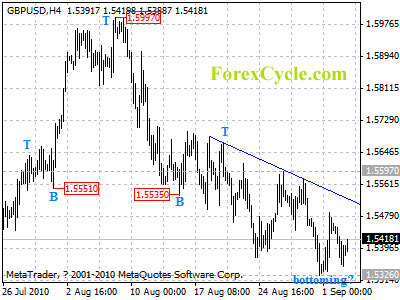
GBPUSD stays below a falling trend line on 4-hour chart and remains in downtrend from 1.5997. As long as the trend line resistance (Now at 1.5525) holds, another fall to 1.5200 is still possible. On the upside, the pair may be forming a cycle bottom at 1.5326, key resistance is at 1.5597, a break above this level will confirm the cycle bottom and indicate that the fall from 1.5997 has completed at 1.5326 already, then the following upward movement could bring price back to 1.5700-1.5800 area.

gbpusd

Daily Forex Signals

Harvest More Pips Today With MT4 Trailing Stop

By Warren Seah

Have you faced the following situations:

1) Feeling under pressure to let go of the trade when you are high on profits? 2) Do not know the ‘perfect time’ to exit your trade? 3) Hanging onto losing trade in hope that it might turn back in your favour? 4) Do not know that there is actually a trailing stop function on MT4 platform?

Well, if you have encounter of these situations, you are not alone. Many thousands of traders at some point do go through these situations even the seasoned traders. There is nothing to be ashamed of as the only shame about this is not finding a solution to your problem.

There a number of traders whom I’ve encounter do not know the existence of a trailing stop function on MT4 platform. Well I can tell you that it is a great tool to have if you want to trail your profits while keeping your stops tight.

But the downside is that you have to specify how many pips you want to trail at a time. Why is this not so good is that you do not know when the market trend might fade and that market condition is changing continuously, you might end up exiting the market prematurely.

The best way is to let the market decide when to move your stops and when to exit. Be reminded that I emphasize only on trending situations here. Trailing stops work well in such situation and save you the time of having to constantly monitor the market.

On the MT4 platform, the trailing stop function is insufficient to allow me to trail the market in the way I want it to be and that the trailing function might have its own hiccups during operations.

Therefore I have work together with a team of traders and bring up this idea of incorporating different exit strategies to allow me to pick and choose which are better to suit my trade for now.

As MT4 has its own programming language, I made use of the Expert Advisor to create an exit strategy EA suitable for manual traders who want to take control their trade and want automation for their trade exits without the need to constantly monitor.

With the development of 11 exit strategies:

1) Partial close 2) Break even stop 3) Time stop 4) MA trailing stop 5) ATR trailing stop 6) Parabolic SAR trailing stop 7) 2 Bar Low 2 Bar High 8) Equity stop 9) Channel Stop 10) N pips stop 11) BB trailing stop

The combination and customization of these exit strategies allows me to decide which strategies are suitable for my current trades and most importantly, I allow the market to track the trend and trail stops for me instead of me having to babysit my trade. Therefore, freeing more time and harvesting more profits.

About the Author

By Warren Seah

“Introducing 11 Exit Strategies, What Every Disciplined Traders Need … Go Without It You Could End Up Being A PIP VICTIM Just Like Thousands Of Traders Out There.”

Download Your Exit Strategy EA Now