Forex: Speculators trim short Euro positions. Swiss franc positions gain for 4th week

By CountingPips.com

The latest Commitments of Traders (COT) report, released on Friday showed that futures speculators trimmed their euro short positions by close to 2,000 contracts, according to data by the Chicago Mercantile Exchange. Non-commercial futures positions, those taken by hedge funds and large speculators, were net short the euro against the U.S. dollar by -23,699 contracts as of September 7th. This is a decrease of 1,870 short contracts after speculators were net short the euro by -25,569 contracts on August 31st. The September 7th data reverses three straight weeks of increased short positions.

Euro Fx, COT, Forex

The COT report is published every Friday by the Chicago Mercantile Exchange (CME) and shows futures positions as of the previous Tuesday. It can be a useful tool for traders to gauge investor sentiment and to look for potential changes in the direction of a currency or commodity. Each currency contract is a quote for that currency directly against the U.S. dollar, where as a net short amount of contracts means that more speculators are betting that currency to fall against the dollar and net long position expect that currency to rise versus the dollar. Open interest is the number of open contracts that have not been closed by a transaction or by delivery.

The euro and the British pound sterling were the only major currencies on the short side against the dollar last week in the CME futures market while the Australian dollar, New Zealand dollar, Japanese yen, Swiss franc, Mexican peso and the Canadian dollar had a net long amount of contracts. Canadian dollar positions increased last week to have a total net long position after decreasing the previous week to level onto the short side.

The British pound sterling short positions rose to -16,068 as of September 7th after being short on August 31st by -15,266 positions. Pound sterling short positions have now increased for two straight weeks.

The Canadian dollar positions rose after declining for three consecutive weeks. Canadian dollar large speculators positions increased to 452 long contracts as of September 7th from a total of -4,764 positions the week prior.

The Japanese yen net long contracts edged higher last week to 52,183 from 49,904 net long contracts reported on August 31st. Yen positions have continued to stay around the +50,000 level for the past six weeks.

Swiss franc long positions increased for a fourth straight week to 16,627 long contracts as of September 7th after rising to 14,281 long contracts the week prior.

The Australian dollar futures positions increased to a net amount of 56,966 long contracts as of September 7th from 43,808 long contracts on August 31st. The gain in Aussie long speculative positions reverses a decline of two consecutive weeks.

New Zealand dollar futures positions also increased with 9,377 long contracts after a total of 6,957 long contracts as of August 31st. Kiwi positions had declined lower for four straight weeks before the September 7th data.

Mexican peso long contracts, meanwhile, dipped for a fourth consecutive week to 14,064 total long positions from 21,004 longs the week prior on August 31st.

COT Data Summary as of September 7th, 2010

Large Speculators Net Positions vs. the US Dollar

Euro: -23,699 short contracts from -25,569 shorts on August 31th
British pound sterling: -16,068 short contracts from -15,266 shorts
Australian dollar: 56,966 long contracts from 43,808 longs
Canadian dollar: 452 long contracts from -4,764 shorts
Japanese yen: 52,183 long contracts from 49,904 longs
Mexican peso: 14,064 long contracts from 21,004 longs
New Zealand dollar: 9,373 long contracts from 6,957 longs
Swiss franc: 16,627 long contracts from 14,281 longs

Other COT Resources:

Forecast The FX Market With The COT Report

The Only Indicator You Will Ever Need

Forex Daily Market Commentary

By GCI Forex Research

Fundamental Outlook at 1400 GMT (EDT + 0400)

The euro appreciated sharply vis-à-vis the U.S. dollar today as the single currency tested offers around the US$ 1.2845 level and was supported around the $1.2700 figure.  The common currency rocketed higher during the Australasian and European sessions on account of two main catalysts. First, it was reported that banks would have as many as eight years to comply with new capital requirement rules that were announced over the weekend in Basel.  The new “Basel III” accord is designed to strengthen banks’ balance sheets and avert another financial meltdown.  The gradual implementation of the accord, however, may leave the global banking system at greater risk.  Second, Chinese economic data released overnight were stronger-than-expected and these data partially altered the view that China’s economic recovery was decelerating.  There were no major economic data released in the U.S. today and August retail sales data will be released tomorrow with many forecasts calling for gains around +0.3%.  U.S. bond giant PIMCO is now forecasting a 10-year U.S. Treasury note yield around 1.75% in Q1 2011, compared with its current level of 2.78%.  In eurozone news, Q2 eurozone labour costs will be released tomorrow along with the September ZEW survey and July industrial production.  German August wholesale prices data will be released tomorrow along with the September ZEW survey and French data released today saw the July current account deficit narrow to -€2.2 billion.  Germany’s Bundesbank reiterated it sees a “significant” capital need for German banks.  ECB President Trichet reported he sees “meager” growth in advanced economies.  The European Union now expects the eurozone economy will have grown about 1.7% in 2010.  ECB member Wellink reported European banks will require hundreds of billions of euro in new capital to comply with the new Basel capital adequacy requirements.  Euro offers are cited around the US$ 1.3240 level.

¥/ CNY

The yen appreciated vis-à-vis the U.S. dollar today as the greenback tested bids around the ¥83.85 level and was capped around the ¥84.35 level.  The pair moved to intraday lows during the European session and North American dealers challenged this area despite the yen’s decline elsewhere.  Stronger-than-expected Chinese economic data kept the greenback on the defensive today.  Bank of Japan Governor Shirakawa was appointed chairman of the Bank for International Settlements Asian Consultative Council.  Institutional investors are said to have asked the Japanese government to maintain the size of its Japanese government bond buyback program.  All eyes are on the Democratic Party of Japan leadership election battle tomorrow between Prime Minister Kan and Ichiro Ozawa.  Many dealers believe Kan will win the battle but a victory by either party is not likely to have a material impact on Japanese economic or financial policy.  The government will likely keep pressure on the central bank to ease policy further.  Data to be released in Japan overnight include August Tokyo-area condominium sales, July industrial production, and July capacity utilization.  The Nikkei 225 stock index climbed 0.89% to close at ¥9,321.82.  U.S. dollar bids are cited around the ¥84.60 level.   The euro moved higher vis-à-vis the yen as the single currency tested offers around the ¥107.90 level and was supported around the ¥106.95 level.  The British pound moved higher vis-à-vis the yen as sterling tested offers around the ¥130.10 level while the Swiss franc moved higher vis-à-vis the yen and tested offers around the ¥83.00 figure. In Chinese news, the U.S. dollar depreciated vis-à-vis the Chinese yuan as the greenback closed at CNY 6.7618 in the over-the-counter market, down from CNY 6.7696.  Economic data released in China overnight was stronger-than-expected and Prime Premier Wen indicated China’s economy is “in good shape.”  Industrial production was up 13.9% y/y and both retail sales and lending data exceeded forecasts.  Data also revealed inflation printed at 3.5%, 1.25% above the benchmark one-year deposit rate.  Some traders believe People’s Bank of China will be forced to raise rates on account of this imbalance while other economists believe these inflation data will cool.  Today’s intraday high for the yuan represented a record high following the end of the dollar peg in July 2005.  The U.S. House Ways and Means Committee will discuss China’s currency policy on 15-16 September.

£

The British pound appreciated vis-à-vis the U.S. dollar today as cable tested offers around the US$ 1.5485 level and was supported around the US$ 1.5350 level.  Data to be released in the U.K. overnight include August RICS house prices, August Nationwide consumer confidence, July DCLG house prices, August consumer price inflation, and August retail prices.  Bank of England Governor King will give a speech this week that will be closely watched given his support for Prime Minister Cameron’s spending cuts.  Cable bids are cited around the US$ 1.5115 level.  The euro appreciated vis-à-vis the British pound as the single currency tested offers around the £0.8335 level and was supported around the £0.8265 level.

CHF

The Swiss franc appreciated vis-à-vis the U.S. dollar today as the greenback tested bids around the CHF 1.0100 figure and was capped around the CHF 1.0205 level.   Data released in Switzerland today saw August producer and import prices climb 0.1% m/m and 0.5% y/y, exceeding forecasts.  The September Credit Suisse ZEW survey will be released on Wednesday.  Swiss National Bank Chairman Hildebrand spoke today and was supportive of the new Basel III capital revisions.  Hildebrand also reported UBS and Credit Suisse maintain “many capital options.” SNB is expected to keep monetary policy unchanged this week when its interest rate announcement is released.  U.S. dollar offers are cited around the CHF 1.0290 level.  The euro appreciated vis-à-vis the Swiss franc as the single currency tested offers around the CHF 1.3035 level while the British pound moved lower vis-à-vis the Swiss franc and tested bids around the CHF 1.5545 level.

Technical Outlook at 1230 GMT (EDT + 0400)

(Bid Price) (Today’s Intraday Range)

EUR/ USD      1.2830                1.2844, 1.2702
USD/ JPY         83.98                  84.35,   83.83
GBP/ USD      1.5398                1.5487, 1.5351
USD/ CHF      1.0124                1.0206, 1.0114
AUD/USD       0.9333                0.9338, 0.9286
USD/CAD       1.0291                1.0344, 1.0281
NZD/USD       0.7317                0.7340, 0.7282
EUR/ JPY       107.68                107.92, 106.94
EUR/ GBP      0.8325                0.8333, 0.8269
GBP/ JPY       129.30                130.09, 129.21
CHF/ JPY         82.86                  82.97,   82.53

Support                       Resistance                  Support                    Resistance

EUR/ USD                                                           USD/ JPY

L1.       1.2575                         1.2870                            81.80                          87.15

L2.       1.2440                         1.3045                            80.80                          88.25
L3.       1.2220                         1.3290                            77.20                          89.45

GBP/ USD                                                        USD/ CHF

L1.       1.5230                         1.5810                         1.0215                         1.0600

L2.       1.5010                         1.6040                         1.0095                         1.0820

L3.       1.4860                         1.6210                         0.9925                         1.1040

AUD/ USD                                                        USD/ CAD

L1.       0.8645                         0.8965                         1.0450                         1.0860

L2.       0.8510                         0.9065                         1.0240                         1.1060

L3.       0.8345                         0.9220                         1.0005                         1.1490

NZD/ USD                                                        EUR/ JPY

L1.       0.6910                         0.7220                         103.40                         108.90

L2.       0.6590                         0.7445                         101.15                         113.25

L3.       0.6265                         0.7585                           99.90                         118.05

EUR/ GBP                                                       EUR/ CHF

L1.       0.7870                         0.8320                         1.2845                         1.3330

L2.       0.7785                         0.8535                         1.2650                         1.3615

L3.       0.7415                         0.8745                         1.2430                         1.3985

GBP/ JPY                                                         CHF/ JPY

L1.       126.70                         135.35                           78.35                          82.65

L2.       123.30                         138.40                           76.45                          85.80

L3.       118.85                         140.70                           75.05                          87.15

Forex Daily Market Commentary provided by GCI Financial Ltd.

GCI Financial Ltd (”GCI”) is a regulated securities and commodities trading firm, specializing in online Foreign Exchange (”Forex”) brokerage. GCI executes billions of dollars per month in foreign exchange transactions alone. In addition to Forex, GCI is a primary market maker in Contracts for Difference (”CFDs”) on shares, indices and futures, and offers one of the fastest growing online CFD trading services. GCI has over 10,000 clients worldwide, including individual traders, institutions, and money managers. GCI provides an advanced, secure, and comprehensive online trading system. Client funds are insured and held in a separate customer account. In addition, GCI Financial Ltd maintains Net Capital in excess of minimum regulatory requirements.

DISCLAIMER: GCI’s Daily Market Commentary is provided for informational purposes only. The information contained in these reports is gathered from reputable news sources and is not intended to be U.S.ed as investment advice. GCI assumes no responsibility or liability from gains or losses incurred by the information herein contained.

Oracle Stocks Soared, Thanks to Mark Hurd

oracle corpoartion, orcl, stock trading, daily stock picks

Good day stock traders! For those who are not aware, the shares of Oracle Corporation soared by about 9.3% last week. As you can see from its daily chart, the bullish gods must be behind the company when its stocks gapped up after dangerously falling below both the 50-day and 200-day moving averages. In the process, the shares of Oracle went back  above the mentioned averages and the resistance just above 24.50. Now, it could use these two averages including the 24.50 marker as supports in case Oracle weakens due to profit taking. Anyhow, Oracle could still rise until it encounters some resistance at its former peaks at 25.50 and at 26.50. A move above these levels could send it on track to another bullish run.

Last week’s jump was due when Mark Hurd, the former president of Hewlett Packard (HP) was hired by Oracle corporation as a co-president, director and board member. Mark Hurd was one of the better CEO’s that brought HP back to its former fame. In fact, he was named as a “TopGun CEO” by Brendan Wood International in 2009. He, however, resigned when he found himself in the middle of a sexual harassment case. Nonetheless, his hiring as the new president of Oracle sent the company’s stocks soaring.

More on LaidTrades.com

The Aussie’s Due For a Retracement

audusd september 2010, audusd, aud, usd, us dollar, australian dollar, aussie, forex trading, forex

Happy weekend FX people! On today’s FX feature is an update of the AUDUSD pair which I posted last September 5 (please see it here). As you can see, the pair has continued to rise within an ascending channel. And as I’ve suggested, the pair indeed rose to mark its fifth wave (wave 5). If the Elliot Wave Principle holds true and if my wave counting is correct then as the theory suggests, the pair should be due for a retracement. Remember that the EWP predicts a correction in the prices after the completion of the fifth wave, starting with wave A and ending with wave C. And given the obvious technical resistances ahead and an overbought condition as indicated in the stochastics, the pair could indeed dip or at least move sideways. If the Aussie weakens against the US dollar, the peak of the third wave around the 0.9200 level and the channel’s support should keep it from falling further.

The Aussie along with the non-dollar currencies rose this Friday due to the better-than-expected July wholesale inventories report in the US. Wholesale inventories has risen by 1.3% as compared to the 0.4% market forecast. China’s better-than-projected industrial production (13.9% vs. 13.1%) , retail sales (18.4% vs. 18.0%), new loans (545 billion vs. 500 billion), M2 money supply (19.2% vs. 17.5%), and the slower PPI (4.3% vs. 4.6%), have also helped the Aussie. Remember that Australia is one of the biggest supplier of raw materials to China. Hence, an increasing business activity means more business for Australia. A weaker PPI, in the same way, benefits the Aussie since a monetary tightening by the Chinese government would be postponed which would allow for business to go on without additional restrictions as of the moment.

For the coming week, no market moving events are scheduled in Australia. Given the lack of economic reports from the country, investors could take this as a chance to pocket some of their profits from their long Aussie positions.

More on LaidTrades.com

AUD/USD Targets the 0.9400 Level

By Yan Petters – The AUD/USD pair continues its bullish trend with full steam. Recently, after peaking at the 0.9200 level, the pair saw a technical correction which took the pair as low as the 0.8775 level. However the pair promptly resumed the bullish trend, and is currently aiming the 0.9400 level.

• The chart below is the AUD/USD daily chart by ForexYard.
• The chart shows that the pair has gained about 1,300 pips in the last 4 months and approximately 600 pips during the past 3 weeks.
• Both the Slow Stochastic and the MACD have completed a bullish cross lately, suggesting that the bullish move has more room to go.
• The pair is currently testing the 0.9325 resistance level. If the pair will manage to breach this level, it has potential to reach the 0.9400 level.
• The next target after reaching the 0.9400 level might be the 0.9520 level.
• The next support levels are the 0.9265 and the 0.9200 levels.

Forex Market Analysis provided by ForexYard.

© 2006 by FxYard Ltd

Disclaimer: Trading Foreign Exchange carries a high level of risk and may not be suitable for all investors. There is a possibility that you could sustain a loss of all of your investment and therefore you should not invest money that you cannot afford to lose. You should be aware of all the risks associated with Foreign Exchange trading.

Euro Maintains Bullish Trend as We Start the Week

Source: ForexYard

Following solid economic news out of China released last Friday, the euro, as well as other so-called riskier currencies, has maintained an upward trend going into this week. That being said, analysts are warning that these gains may only be temporary. Overall economic sentiment regarding the euro zone is still fairly pessimistic. The slightest bit of bad news could cause investors to revert back to the safe haven US dollar and yen, which would lead to a drop for euro pairs.

Economic News

USD – USD Starts Busy Week Down vs. Majors

Despite the significant gains the US dollar made in the first half of last week, a sudden switch to risk-taking among investors eventually caused the currency to slide back into a bearish trajectory. As we start off the week, the greenback continues to lose ground. The EUR/USD pair has gone up over 100 pips since markets opened, and is currently trading around the 1.2790 level. The USD/CAD dropped over 50 pips in overnight trading, reaching as low as 1.0311 before making a slight recovery. Currently the pair stands at around the 1.0325 level.

Today, USD crosses will likely fluctuate based on what ECB President Jean-Claude Trichet says in his speech. Pessimism in the euro zone economies is still relatively high. Should the ECB’s president reflect this sentiment in his speech, the dollar is likely to make steady gains as investors return to safer assets like the greenback.

As for the week ahead, traders will want to pay attention to a batch of potentially significant US economic data. Tuesday’s Retail Sales reports, as well as Thursday’s PPI figure and Unemployment Claims, will likely dictate the direction of dollar pairs for some time. Any gains made in the US economy will likely lead to bullish movement for the buck.

EUR – Analysts Question How Long Euro Can Maintain Current Trend

The euro was able to move up against most of its main currency rivals, including the Japanese yen and UK pound, in overnight trading. The gains can largely be attributed to renewed investor confidence, following positive Chinese data released last week. Since markets opened for the week, the EUR/JPY has gone up around 90 pips, while the EUR/GBP moved up close to 50 pips.

While the euro has been able to make some fairly significant gains as of late, most analysts are questioning how long the currency can maintain this trend. Confidence in the euro zone economic recovery remains particularly low. Today’s speech from ECB President Trichet may highlight these concerns; in which case euro crosses may correct themselves later in the day.

As for the week ahead, traders will want to pay attention to a number of potentially impacting news events. Tuesday’s German ZEW Economic Sentiment figure as well as Wednesday’s CPI and Core CPI figures are all predicted to create market volatility. Traders will want to note that should any of these results come in below analyst predictions, the euro will likely move down as a result.

JPY – Yen Corrects Earlier Gains as Risk Taking Returns

The yen corrected much of its recent gains in trading late last week and into overnight trading today. Positive Chinese economic news, as well as better than expected American labor news are seen as the leading causes for the return to risk taking.

As a result, the yen took some heavy losses against the euro and Swiss franc beginning last Friday. The one exception appears to be the US dollar. After beginning the week with slight upward movement, the USD/JPY pair has since dropped close to 30 pips and is currently trading around the 84.05 level.

This week, yen traders will want to pay attention to European and US economic news. Positive news is likely to give further confidence to investors in the global economic recovery. If so, then the yen will likely continue to lose ground against its main currency rivals.

Crude Oil – Optimism in US Recovery Causes Crude Prices to Soar

Positive US economic news, as well as the most recent US Crude Oil Inventories report has led to a prolonged upward trend for crude prices that appears to be continuing into this week. Crude prices are largely determined by the state of the US economy. Following a number of positive indicators last week, oil demand in the world’s largest energy consuming nation appears to be on the rise.

Since beginning its most recent bullish trend late last week, oil prices have shot up over 300 pips. Currently, a barrel of crude goes for around $77.10. Traders will want to pay careful attention to US economic indicators this week in order to determine the direction crude is likely to take. Should the news again come in above expectations, prices are likely move up further.

Technical News

EUR/USD

There appears to be a fresh bearish cross on the hourly Stochastic (slow), indicating an impending short-term correction for the pair. The 4-hour Stochastic (slow) is also climbing towards the over-bought region and could also form a bearish cross later in the day if upward momentum does not change in the next few hours. Going short with tight stops may be a wise way to gain quick profits in intra-day trading today.

GBP/USD

This pair appears to be trading within a distinct bearish channel, and has recently touched the upper border of this trend. The hourly Stochastic (slow) has a fresh bearish cross, while its RSI may also be just entering the over-bought territory. Short-term downward movements may be expected throughout the first half of the trading day. Selling this pair for short-term profits may be a wise move today.

USD/JPY

Most indicators on this pair appear to be floating in the neutral territory, suggesting the current trend may continue. The long-term movement of this pair is in a very distinct bearish channel spanning the last few months. The only indicator which appears to suggest an upward correction is the weekly chart’s RSI, which has the price of the pair floating just within the over-sold territory. Continuing with the downward direction by opening short positions may prove a smart decision for this pair.

USD/CHF

The hourly Stochastic (slow) on this pair appears to be showing a recent bullish cross, suggesting upward movement may be imminent. The hourly RSI also floats in the over-sold territory, which supports this notion. Additionally, the weekly chart’s RSI has the price of this pair floating deep within the over-sold region and beginning to turn upward. Longer-term upward movements may be expected on this pair.

The Wild Card

Crude Oil

The recent bullish movements on this pair have pushed many indicators into corrective territory. The hourly, 4-hourly, and daily charts’ RSIs all have the price in the over-bought territory. The Stochastic (slow) on all three of these charts also shows either a fresh or an impending bearish cross. Forex traders can usually be certain that after such strong movements there will be similarly strong counter-movements, and Crude Oil is no exception. Going short on oil today may not be a bad idea.

Forex Market Analysis provided by ForexYard.

© 2006 by FxYard Ltd

Disclaimer: Trading Foreign Exchange carries a high level of risk and may not be suitable for all investors. There is a possibility that you could sustain a loss of all of your investment and therefore you should not invest money that you cannot afford to lose. You should be aware of all the risks associated with Foreign Exchange trading.

Short Term Technical Analysis for Majors (08:30 GMT)

EUR/USD

Broke above 1.2765/75, the recent consolidation ceiling and 1.2815, trendline resistance, to extend recovery and focus 1.2920/31, key near-term resistance zone. Clear break here is needed to confirm a higher low at 1.2586 and resume short- term uptrend from 1.1875. Otherwise, lower top under 1.2931 and fresh attempt at 1.2625/1.2586 would be the likely scenario.

Res: 1.2865, 1.2875, 1.2920, 1.2931
Sup: 1.2775, 1.2765, 1.2745, 1.2701

GBP/USD

Maintains positive near-term structure off 1.5295, 07 Sep low, with market currently attempting through 1.5477/90 resistance zone, en-route to 1.5532, key near-term resistance. Break here is required to resume recovery and expose 1.5596/1.5617, 26/23 Aug highs. Failure under 1.5532, however, risks lower top and fresh weakness, and below 1.5343 to open 1.5295 for retest.

Res: 1.5492, 1.5532, 1.5596, 1.5617
Sup: 1.5402, 1.5375, 1.5343, 1.5295

USD/JPY

Recovery off 83.33, year-to-day low, seeks a lower top, likely under 84.47/62, for the next leg lower to 83.33/82.98. Above 84.50/65, delays bears for further recovery 84.95/85.21. However, underlying trend remains firmly negative.

Res: 84.47, 84.62, 84.82, 85.00
Sup: 83.79, 83.51, 83.33, 82.98

USD/CHF

Last Friday’s rejection at 1.0276, just below 38.2% retracement of 1.0625/1.0063 downleg, confirmed the underlying bear structure. Market looks for a final push through 1.0060 support, to open way for fresh bear phase, with 0.9980/60 seen first. Upside, regain of 1.0236/76 is needed to easy the immediate bear pressure.

Res: 1.0205, 1.0237, 1.0276, 1.0310
Sup: 1.0099, 1.0059, 1.0027, 0.9980

Why Forex is so Difficult?

By Danielle Franklin – The opinion about how easy it is to learn forex trading seems to have two sides – while some resources claims that 90% of traders don’t make it, others provide arguments regarding the possibility of mastering forex and earn the living. Which source should you trust? Is it so black and white? Or it is rather gray? Do you have a chance to become a professional trader?

In general, learning the basics of forex trading shouldn’t be a problem. You don’t need to have a phd in economics in order to figure out the essence of currencies. The vital parts that every beginner needs to know by hard are:

1. Technical and fundamental Analysis (yes, both of them, since in order to see the whole picture, you need to use both analysis). 2. Charts and time frames 3. Candlestick 4. The double P (pivot points)! 5. Fibonacci 6. Support and Resistance 7. Price movements 8. Money and risk management 9. Position sizing 10. Trading plan, discipline and daily trading journal

Once the basics are covered every trader realizes that there is more to trading then just the theory, because even if you know it all by heart, you are still most likely to lose money. So what is the solution? Is there a magic trading strategy that assures success? Can you follow what other successful trader does?

The problem is much deeper than you might think – trading is all about emotions and here is where most traders fail. While your trading decisions are majorly influenced by your feelings and emotions, you are most likely to stay on a loser’s bench.

There is no one universal solution to forex, since it is dynamic, flexible and rather complex. In order to become profitable, it is necessary not only to be top-notch analyzer, but also be ready for radical changes and fast logical decision making.

What can possibly go wrong, even if you know it all?! Hesitation, fear, greed and envious frustration are well known pullbacks in trading. Every time a trader is attacked by these poisonous and destructive feelings, most likely the poor decision will be made and, not only will the possibility pass by, but there is a big chance of significant money loss.

So how to stay focused and not join the 90% of proclaimed loser traders? The trick is not to turn yourself into greedy, money-hunting Uncle Scrooge, constantly dreaming about the “deserved” itsy-bitsy slice of the several-billion-a-day-forex pie. Focusing on money is bound to affect the decisions and the quality of your trading.

Instead, your ultimate goal is to brush away the thoughts of soon-to-be-obtained millions in your bank account and year-long holidays in Bahamas, and to concentrate on becoming rather mechanical in your trading, analyzing and profit calculating.

The most difficult part of it all is to chance your perception about profit-loss. It is in human nature to feel guilty, ashamed and hopeless when we find ourselves in the loss situation. The trick is to turn the loss situation into a lesson, write it down in your trading journal and try not to make the same mistake again. With one lesson learned, you are one step closer to unlock the profitable trader in you.

Another worthy tip – keep it simple! Do not use all the indicators possible and do not overanalyze. By thinking too much you block yourself from focusing in order to make decisions!

Lastly, stay away from overtrading. Fear it as you fear the tsunami, the apocalypses, the global earthquakes, demons, cockroaches, graveyards – whatever makes you squeal! I personally have a huge poster right above my computer saying ” Don’t Overtrade Today, Stupid!” and it honestly helps!

In case you cannot define overtrading, here are some examples: * Putting on trades outside your rules / trading plan. * Putting on more trades than you can effectively manage. * Scalping in and out of the market when holding a trade would have produced better profit. * Feeling the need to get the lost money back RIGHT NOW! * Searching frantically for possible trades without any reason for it.

To summarize, yes forex is difficult but with the right set of mind you can earn the living with it. Becoming in a way robotic and much less emotional will tremendously help you not to freak out and cry over the spilled milk, but rather move on to the next challenge. And no, the challenge is not about getting those lost money back. NO! The challenge is to follow the plan, start over the next day and find the best opportunities.

About the Author

Forex Broker Reviews – Forex brokers reviews and rating, comprehensive forex tutorials and articles, latest forex news and forex blog.

Forex Brokers – Top forex brokers reviews, latest bonuses and promotions, free forex tutorial and more.

Forex Directory

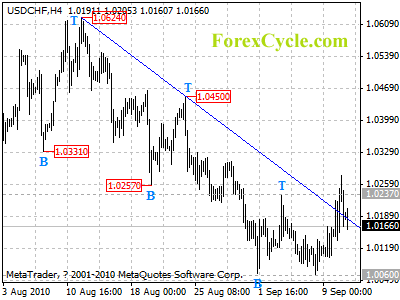
USDCHF broke above downtrend line

USDCHF broke above the downtrend line from 1.0624 to 1.0450, suggesting lengthier consolidation of downtrend is underway. Range trading between 1.0060 and 1.0350 would more likely be seen in next several days. Key support is at 1.0060, a breakdown below this level will indicate that the downtrend from 1.1730 (Jun 1 high) has resumed, then deeper decline could be seen to 1.0000 area.

usdchf

Daily Forex Analysis

Best Technical Indicators for Forex Beginners

By Danielle Franklin – There tones of technical indicators available for forex traders. The question is, which ones are actually working? How many should you include in your strategy? Does the rule the more the matter apply? Or you should keep it simple instead? What are the right forex tools for every day trading?

Even when there are all these elaborate choices of indicators available today, it doesn’t mean you should use them all. In fact, using too many indicators will only confuse you and most probably lead to bad trading decisions.

So, instead of making forex even more complicated than it already is, focus on combining the right set of indicators that will actually show useful information about the market and confirm your ideas about trades.

Why is it important not to use indicators that show the same data? Think about this, instead of getting a so-called “signal confirmation”, you basically look at the duplicated data, which by no means confirms anything.

Below are the indicators that can be used together to confirm your trading decisions:

1. Stochastic – the best timing tool (crossovers with bullish/bearish divergence, chart resistance/support, overbought/oversold levels).

2. Relative Strength Index (RSI) – shows the strength of the trend.

3. The Bollinger Band – shows volatility of the price.

4. Moving Averages – shows when to load in new trades or show the level to trail the stop.

There are other powerful technical indicators such as ADX line and, of course, MACD, however with the above 4 indicators, you are set towards a great trading strategy and profits.

Keep in mind that there is no short cut in forex. You have to blend into real trading and see those indicators in action. Practice, make mistakes, write it down, analyze what went wrong and get back on that bull! Experience is the only reliable indicator you will ever get!

It’s all about combining indicators for profit – no indicator works on its own, so you need indicators that complement each other. Now that you know which indicators to include in your daily trading, let’s see what can happen if you don’t use your indicators correctly.

Below is couple of tips to use the indicators correctly:

1. Don’t use indicators on meaningless data – indicators are pretty much useless on short time frame charts, since daily volatility is pretty much random and no technical indicator will be in any way useful.

2. Make sure you have enough evidence that price momentum is indicating the levels will hold. Good momentum indicators are ones such as, the stochastic and Relative Strength Index (RSI) and if used with pivot points or moving averages, you have a powerful combination

3. Don’t try to predict market direction. It is impossible to predict turning points. PERIOD! What you need to do is to find a confirmation and act accordingly. Only this way you can increase your chances of winning.

Forex trading is not a guessing game, fortune predicting system or perfect gambling technique. The above mentioned indicators have been doing their job for ages for many traders and still are equally effective today. These are the best forex trading indicators and if used correctly can dramatically improve your profits and decrease risks.

About the Author

Forex Broker Reviews – Forex brokers reviews and rating, comprehensive forex tutorials and articles, latest forex news and forex blog.

Online Forex Brokers – Top forex brokers reviews, latest bonuses and promotions, free forex tutorial and more.

Forex Links