Forex Daily Market Commentary

By GCI Forex Research

Fundamental Outlook at 0800 GMT (EDT + 0400)

USD

Dollar performance was mixed amid a relatively quiet session as equities were flat on the day. A disappointing US manufacturing print helped nudge USDJPY higher with no BoJ in sight but the most notable currency movers in the G10 during the US session were the Swiss franc crosses following the SNB’s surprisingly dovish comments. But otherwise, oil drifted lower and gold is $1274.13 at the time of writing. EURUSD traded 1.2976-1.3117, USDJPY 85.23-85.84. Treasury Secretary Geithner testified before Congress on China’s exchange rate policy and said China needed to allow a “significant, sustained” appreciation of its currency and said the US would continue to seek progress along with the G20 on the issue, though he stopped short of any concrete actions. Senator Dodd emphasized that unilateral intervention by “Japan, China or any other nation, represents a gap in international cooperation on exchange rate policy.” In US data, jobless claims fell to 450k and it appears that despite some Labor Day holiday-related volatility, claims are trending down after a midsummer jump. Meanwhile, the Philadelphia Fed rose less than expected to -0.7 and details of the survey were less constructive. PPI figures were in line and the current account deficit widened as expected to 3.4% of GDP, largely on imports. US data has avoided any major disappointments of late but fears of further Fed easing likely remain, though concerns elsewhere are helping mitigate dollar downside at this stage.


EUR

A relatively successful Spanish bond auction helped boost the euro into the US session and it held its gains throughout the day. The bid-cover ratio on the 2020 Spanish bonds was 2.32 compared to 1.89 at an earlier, similar auction. The bid-cover on the 2041 issue was lower but still above two times. A French auction went smoothly but sovereign concerns remain. Portugal announced it would sell bonds maturing in 2014 and 2020 on September 22.
Eurogroup Chairman Juncker again expressed displeasure with Japan’s unilateral intervention but did not think the decision will trouble relations. He said interventions are only fruitful if coordinated and the yen is not overvalued against the euro. He also said problems in Ireland remain but the Irish government is able to deal with them.
JPY

USDJPY was relatively quiet as the BoJ was not seen but several policymakers in both the US and Europe expressed displeasure with the recent intervention. BoJ Governor Shirakawa spoke, but offered no clarity on whether the injection of yen liquidity brought about by the initial intervention would be sterilized. Instead, he again repeated his misgivings about quantitative easing, saying it only had a limited effect on prices, and a limited effect in stimulating the economy. Without citing sources, Nikkei news reported that the intervention would in fact be unsterilized and that intervention was the largest single-day yen selling intervention on record.
GBP

Sterling was hit by far weaker than expected retail sales figures overnight, with August core consumption declining by 0.4% on the month, and headline sales declining by -0.5%. BoE Policymaker Posen said that inflation expectations matter greatly, although policymakers will not need to overreact to the recent elevated inflation readings as long as they can credibly persuade others that the rise in inflation is due to a shock.
Our team continues to see sterling suffering under a weaker growth environment and data has taken a material turn for the worse of late. The BoE will target inflation expectations but the growth rhetoric is clearly to the downside.


CHF

The SNB left rates unchanged with a target range around 0.25% and delivered a remarkably dovish statement. A strong consensus had looked for unchanged rates (UBS went for a hike) but most will have been surprised by the dovishness of the statement. The inflation forecast has been revised down over the entire forecast horizon and the meeting marked a sharp reversal from the June statement, when it appeared that monetary tightening was imminent. The only hawkish element left over was the admission that the expansionary monetary policy was ‘currently appropriate, although it poses long-term risks to price stability’. It seems clear that the strength of the franc has been the key factor in the decision. So if one objective of the SNB was to weaken the franc, the message will likely achieve that target. Many investors will be worried by the gloomy assessment of the SNB and reconsider their CHF longs. The one upside risk for the franc would be if markets more broadly were to become risk averse on the back of the message, in which case safe haven flows would strengthen.
For the next few days, however, it seems likely that the franc will continue to suffer from the realisation that rate hikes are unlikely for the time being. EURCHF may well rise to 1.34 before becoming heavy once again.

TECHNICAL OUTLOOK


EURUSD NEUTRAL Model is neutral; 1.3334 and 1.2588 mark the key near-term directional triggers.
USDJPY NEUTRAL Upside near 85.91 ahead of 86.70 Fibonacci resistance. Near-term support lies at 85.20.
GBPUSD BULLISH While support holds at 1.5297, expect gains towards 1.5731 with scope for 1.5999.
USDCHF BEARISH Focus on 0.9918 with next support at 0.9786. Near-term resistance comes in at 1.0278 ahead of 1.0466.
AUDUSD BULLISH Bullish pressure held at 0.9458 with next resistance at 0.9563. Near-term support is at 0.9309 ahead of 0.9196.
USDCAD BEARISH Following the break of 1.0248, model has turned bearish. Next support at 1.0108 with resistance at 1.0509 ahead of 1.0673.
EURCHF BEARISH Move above 1.3163 exposes 1.3345 next, but broader focus is on the downside with support at 1.2991 intraday low ahead of 1.2766.
EURGBP NEUTRAL 0.8532 and 0.8142 mark the key directional triggers.
EURJPY NEUTRAL Break of 114.74 would put odds in favour of positive tone. Next resistance at 116.68. Support holds at 107.73 ahead of 105.44 key low.

Forex Daily Market Commentary provided by GCI Financial Ltd.

GCI Financial Ltd (”GCI”) is a regulated securities and commodities trading firm, specializing in online Foreign Exchange (”Forex”) brokerage. GCI executes billions of dollars per month in foreign exchange transactions alone. In addition to Forex, GCI is a primary market maker in Contracts for Difference (”CFDs”) on shares, indices and futures, and offers one of the fastest growing online CFD trading services. GCI has over 10,000 clients worldwide, including individual traders, institutions, and money managers. GCI provides an advanced, secure, and comprehensive online trading system. Client funds are insured and held in a separate customer account. In addition, GCI Financial Ltd maintains Net Capital in excess of minimum regulatory requirements.

DISCLAIMER: GCI’s Daily Market Commentary is provided for informational purposes only. The information contained in these reports is gathered from reputable news sources and is not intended to be U.S.ed as investment advice. GCI assumes no responsibility or liability from gains or losses incurred by the information herein contained.
US Economic Recovery Not So Bleak, Data Shows

Source: ForexYard

This past week’s news has given some investors hope that an economic recovery is indeed underway in America, even if recent news has begun to comment about a pause. The US IBD/TIPP Economic Optimism gauge on Tuesday was 1.2 points higher than expected, while American retail sales also beat forecasts. Wednesday saw a minor slowdown in industrial production, but yesterday’s PPI, unemployment claims, and TIC long-term purchases reports all showed forecast-beating growth in the US economy.

Economic News

USD – USD Declines as Data Shows Growth and Risk Appetite Returning

The USD appears to have declined against the bulk of its currency counterparts, with a few exceptions. The EUR/USD has climbed above 1.3100 as of late-Asian trading, while the GBP/USD is climbing towards 1.5650. It appears as if the stronger currencies of the early months of summer are now seeing an autumn correction. The dollar, Swiss franc, and Japanese yen are all losing ground while riskier assets are on the rise.

This past week’s news has given some investors hope that an economic recovery is indeed underway, even if recent news has begun to comment about a pause. The US IBD/TIPP Economic Optimism gauge on Tuesday was 1.2 points higher than expected, while American retail sales also beat forecasts. Wednesday saw a minor slowdown in industrial production, but yesterday’s PPI, unemployment claims, and TIC long-term purchases reports all showed forecast-beating growth in the US economic recovery.

If inflationary figures and economic optimism continue into today’s reports of the same nature, we should see current USD trends continue. Expected today is the US release of its Consumer Price Index (CPI) data, measuring the growth of consumer inflation. If the CPI data is released in-line with yesterday’s Producer Price Index (PPI) growth, then we should see riskier assets continue to rule the market.

The University of Michigan (UoM) is also set to release its Preliminary Consumer Sentiment report which is expected to show confidence on the rise in the United States, fueling the return of risk appetite further.

EUR – Poor European Data Offset by Japanese Currency Intervention

Since the start of the Asian trading session this morning, the EUR has climbed against 15 of its 16 major counterparts. The only currency appearing to outpace the EUR’s recent ascent has been the Australian dollar. Against the US dollar, the euro has soared above 1.3100 and looks to have the momentum to carry on higher. Against the Japanese yen, the 16-nation single currency has risen to as high as 112.35 in late-Asian trading.

Europe’s light news week has helped other economies take the lead in global currency valuation. The United States has released a heavy stream of economic reports which appeared to have dominated market attention. The trend in America seems to be a modest return to growth, for this week’s data at least, while in Europe the few reports published appear to have been far worse than expected.

The shocking drop in the ZEW economic sentiment reports on Tuesday pushed many traders in the direction of safe-haven investments. But the euro was able to rebound sharply following Japan’s intervention in the currency market, devaluing one of the primary global safe-havens, and after the US released report after report showing positive growth. The result was an offsetting jump in the value of riskier assets such as the EUR, despite its own economic woes.

JPY – JPY Plummeting; Will There Be Further Intervention from BOJ?

The Japanese yen remains under the pressure of Wednesday’s intervention by the Bank of Japan (BOJ). The JPY fell to a 5-week low against the US dollar, hitting just below 86.00 after appreciating 71 pips. Against the euro, the JPY has seen a much sharper drop, falling 181 pips to a recent low of 112.35; the GBP/JPY, likewise, has climbed modestly, with a current price just over 134.10.

Despite the absence of further intervention by the BOJ, many speculate that the yen-selling by the central bank may not have yet come to an end. Analysts have recommended keeping an eye on JPY pairs for the second sell-wave, which many claim could happen as early as next week.

Crude Oil – Crude Oil Price Pares Losses, Trading Over $76 a Barrel

The start of this past week saw a rather sharp boom in the price of Crude Oil as a pipeline delivering oil from Canada to the American mid-west suffered a leak, forcing the pipe to be shut down. The resulting speculation of a dip in supply, both from the pipeline leak and from hurricanes in the Gulf of Mexico, led to strong support for oil prices. News that the leak would be fixed by the end of this week has resulted in a paring of those gains, however, as concerns of an over-supply are now hitting the market.

Analysts have begun to claim that despite minor setbacks in production, the fundamentals for Crude Oil remain weak. Even with a short-term decline in supply, inventories remain at record highs. This has been the case especially since the world’s major energy consumers are experiencing a minor pause in recovery. Without a major shift in fundamentals, few are expecting oil prices to break out of the current range between $72 and $77 a barrel.

Technical News

EUR/USD

The pair has recorded much bullish behavior in the past several days. However, the technical data indicates that this trend may reverse anytime soon. For example, the daily chart’s Stochastic Slow signals that a bearish reversal is imminent. A downward trend today is also supported by the 4-hour chart’s RSI. Going short with tight stops may turn out to pay off today.

GBP/USD

The price of this pair appears to be floating in the over-bought territory on the 4-hour chart’s RSI indicating a downward correction may be imminent. The downward direction on the daily chart’s Momentum oscillator also supports this notion. When the downwards breach occurs, going short with tight stops appears to be preferable strategy.

USD/JPY

The USD/JPY cross has experienced a bullish trend for the past 3 days. However, it seems that this trend may be coming to an end. The RSI of the 4-hour chart shows the pair floating in the overbought territory, indicating that a downward correction will happen anytime soon. Going short with tight stops might be a wise choice.

USD/CHF

The daily chart is showing mixed signals with its RSI fluctuating at the neutral territory. However, there is a fresh bearish cross forming on the 4-hour chart’s Slow Stochastic indicating a bearish correction might take place in the nearest future. Going short might be a wise choice.

The Wild Card

Gold

Gold prices rose significantly in the last week and peaked at $1279 for an ounce. However, the 8-hour chart’s RSI is floating in an overbought territory suggesting that a recent upwards trend is loosing steam and a bearish correction is impending. This might be a good opportunity for forex traders to enter the trend at a very early stage.

Forex Market Analysis provided by ForexYard.

© 2006 by FxYard Ltd

Disclaimer: Trading Foreign Exchange carries a high level of risk and may not be suitable for all investors. There is a possibility that you could sustain a loss of all of your investment and therefore you should not invest money that you cannot afford to lose. You should be aware of all the risks associated with Foreign Exchange trading.

Short Term Technical Analysis for Majors (08:10 GMT)

EUR/USD

Extends recovery from 1.2643 higher low, clearing key 1.2931 and 1.3045 resistances, to approach 1.3158, 76.4% retracement of 1.3332/1.2586. Break here to open 1.3227 next, with full retracement at 1.3332 not ruled out. Downside, 1.3047/35 zone offers initial support.

Res: 1.3158, 1.3186, 1.3227, 1.3260
Sup: 1.3047, 1.3035, 1.3010, 1.2975

GBP/USD

Continues to trend higher, clearing the first barrier at 1.5700, en route to 1.5728, 61.8% retracement of 1.5997/1.5295 decline. This may offer a stronger resistance, together with overbought hourly conditions, to trigger a correction before continuing the uptrend. Downside, 1.5650 offers initial support, while below 1.5535 risks deeper pullback

Res: 1.5728, 1.5760, 1.5820, 1.5865
Sup: 1.5650, 1.5595, 1.5575, 1.5535

USD/JPY

Extends rally following the downside rejection at 82.86, with clearance of 85.91 to focus 86.40, 13 Aug high, and 86.67, 38.2% of 92.10/82.86 descend. Correction lower should be contained by yesterday’s higher platform at 85.21, to keep immediate bulls in play.

Res: 85.91, 86.40, 86.89, 86.99
Sup: 85.50, 85.21,  85.00, 84.72

USD/CHF

Soared through 1.0050/61 resistance yesterday, to extend corrective phase off 0.9931. A lower top is anticipated near 1.0197, 76.4% retracement / trendline drawn off 1.0625, 12 Aug high, for a return to 0.9997/31. Break above 1.0276, 10 Sep high, needed to trigger a stronger recovery.

Res: 1.0197, 1.0210, 1.0240, 1.0276
Sup: 1.0137, 1.0110, 1.0060, 1.0050

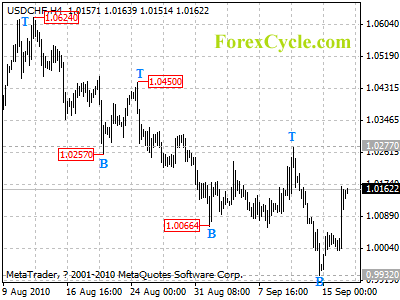
USDCHF formed a cycle bottom at 0.9932

USDCHF formed a cycle bottom at 0.9932 level on 4-hour chart and the bounce extended to as high as 1.0170 level. Further rally is still possible later today and target would be at 1.0277 key resistance, a break above this level will suggest that the fall from 1.1730 (Jun 1 high) has completed at 0.9932 already, then the following upward movement could bring price to 1.1000 area. However, as long as 1.0277 key resistance holds, the price action from 0.9932 could be treated as consolidation of downtrend, and one more fall to 0.9700 area is still possible.

usdchf

Daily Forex Reports

Will Grains Gain OR Wane? Find Out For FREE

Futures Junctures Free Week has begun

By Elliott Wave International

Over the past few months, leading grain prices have climbed up the commodity wall like a “mile-a-minute” kudzu vine. From late June to early August, the big three grain markets (wheat, corn, and soybeans) soared 40%-plus in a coordinated rally to multi-year highs before leveling off.

The question on the minds of market participants is simple: Is the grains’ uptrend set to end?

Well, according to the mainstream experts, the answer is a definite NO — and an equally definite YES. See, according to recent headlines, grain prices are as likely headed for strong gains as they are for a world of pain. On this, following news items capture the very conflicting grain complex picture:

  • “Wheat futures decline, fall most in two weeks after Egypt looks elsewhere for supplies… We have a bearish tone.” (Wall Street Journal)
  • “Wheat Soars Despite Reassurance On German Crop.” (AP)
  • “Corn Above $5-per bushel mark; prices expected to pull back.” (Cattle Network)
  • “Corn (Soybeans) Still King… the bull market is intact for now.” (Farm Forum)
  • “Grain Markets Are Hot: But Is It Too Late? One money manager believes the dance will soon be coming to an end.” (Minyanville)

I rest my case.

(Near-Term Opportunities On The House: On Wednesday September 16, EWI launched its famous Futures Junctures Free Week,providing all Club EWI members with instant, no-cost access to comprehensive near-, and long-term commodity analysis. Sign up today and take advantage of this amazing offer.)

Fortunately, there’s a quick and easy alternative to the mixed messages of the mainstream: the September 14 Daily Futures Junctures. In that publication, EWI’s chief commodity analyst Jeffrey Kennedy presents in depth analysis, labeled price charts, and live video commentary on all three grain markets — a total of 12 charts in all.

The best part is, you can get instant access to Daily Futures Junctures, along with its long-term sister Monthly Futures Junctures at the unbelievable discount of 100% off. This complimentary admission to one of EWI’s most exclusive subscriber resources is the benefit of Futures Junctures Service Free Week. The event runs from 5 pm (EST) on Wednesday September 15 to September 23. Sign up today and start taking advantage of this amazing opportunity.

This article was syndicated by Elliott Wave International and was originally published under the headline Will Grains Gain OR Wane? Find Out For FREE. EWI is the world’s largest market forecasting firm. Its staff of full-time analysts led by Chartered Market Technician Robert Prechter provides 24-hour-a-day market analysis to institutional and private investors around the world.

Forex Daily Market Commentary

By GCI Forex Research

The euro appreciated vis-à-vis the U.S. dollar today as the single currency tested offers around the US$ 1.3085 level and was supported around the $1.2975 level.  Stops were reached above the US$ 1.3050 level as traders took out a key technical level and eyed the $1.3120 area as another major upside target.  Traders continue to punish the U.S. dollar on the expectation that U.S. interest rates will continue to move lower.  U.S. bond market giant PIMCO and some U.S. investment banks are forecasting a 10-year U.S. Treasury Note yield of 1.75% in Q1 2011, lower than the current level of 2.72%.  There is growing speculation the Federal Reserve will resort to additional monetary easing measures, perhaps as early as late Q4, that might include another wave of massive asset purchases.  The FOMC noted at its most recent meeting that it would keep the size of its balance sheet around US$ 2.054 trillion and reinvest mortgage bond proceeds into the U.S. Treasury market.  Additional credit easing policies, if enacted by the Fed, could likely have a downward impact on the U.S. dollar and dealers are reducing long dollar exposure now as a result.  Data to be released in the U.S. today include August producer prices, weekly initial jobless claims, continuing jobless claims, the Q2 current account balance, July TICS flows, and the September Philadelphia Fed activity index.  A further improvement in jobless claims might evidence a little bit of traction in the U.S. labour market that is badly needed.  The current account balance is expected to be as wide as –US$ 125 billion.  In eurozone news, data released today saw the EMU-16 July trade balance climb to €6.7 billion from the revised prior reading of €2.2 billion.  Data to be released tomorrow include EMU-16 July current account numbers, EMU-16 July construction figures, and August producer prices.  German Chancellor Merkel is pressing for sanctions against eurozone countries that do not comply with Growth and Stability Pact spending or deficit measures.  European Union leaders met today in Brussels and squabbled over ways to manage the eurozone’s US$ 12 trillion economy.  Euro bids are cited around the US$ 1.2995 level.

¥/ CNY

The yen appreciated vis-à-vis the U.S. dollar today as the greenback tested bids around the ¥85.20 level and was capped around the ¥85.75 level.  Today’s intraday range was tight following yesterday’s massive yen-selling intervention by Bank of Japan.  While it is not known how much yen was sold, this represented the country’s first official intervention since March 2004 and there is speculation BoJ may continue to intervene.  Some estimates suggest Japan may have sold as much as ¥1.86 trillion yesterday and if so, this would exceed the previous estimated record of ¥1.66 trillion from 9 January 2004.  The Ministry of Finance will confirm on 30 September how much it expended on intervention.  There was talk yesterday that the intervention would remain unsterilized in Japanese money markets, serving as a de facto monetary easing.  Now that the government has decided to intervene again, its options for additional economic stimulus remain limited given Japan’s bloated financial deficits and an interest rate policy that is already near zero per cent.  Furthermore, the BoJ’s ability to purchase additional Japanese government bonds may already be limited by the amount of national debt on its balance sheet from existing Japanese government bond purchases.  Some traders believe Japan’s interventions, if continued, will remain unilateral because other countries are trying to supplement weak domestic consumption with an improved foreign trade position resulting from weakness in their own currencies.  The Obama administration appears unlikely to join any yen-selling intervention at current levels.  Others believe the central bank’s intervention success will be limited and that the dollar will move lower to test lifetime lows below the psychologically-important ¥80 level.  The Japanese intervention could also precipitate a round of intervention throughout Asian countries, especially in South Korea where the won moved lower on speculation the government may sell won to support the export sector.  The won has gained about 3.2% in September vis-à-vis the U.S. dollar.  Bank of Japan Governor Shirakawa reiterated the central bank is monitoring downside risks to the economy and said Japanese export activity has reached a plateau.  Democratic Party of Japan officials are urging the central bank to convene another emergency meeting now to enact additional easing measures by buying more JGBs.  Data to be released in Japan overnight include August Nationwide department sales and August Tokyo-area department store sales.  The Nikkei 225 stock index was off 0.07% to close at ¥9,509.50.  U.S. dollar bids are cited around the ¥84.60 level.   The euro moved higher vis-à-vis the yen as the single currency tested offers around the ¥112.10 level and was supported around the ¥110.65 level.  The British pound moved lower vis-à-vis the yen as sterling tested bids around the ¥132.95 level while the Swiss franc moved lower vis-à-vis the yen and tested bids around the ¥85.00 figure. In Chinese news, the U.S. dollar depreciated vis-à-vis the Chinese yuan as the greenback closed at CNY 6.7250 in the over-the-counter market, down from CNY 6.7433.  Today’s price activity represents the pair’s all-time low and evidences the Chinese government’s attempt to satisfy U.S. Congressional lawmakers who are calling for trade sanctions against China for not allowing its currency to appreciate enough.  It is being reported that China will impose tougher capital adequacy requirements on its bank, perhaps as much as 15%.  This measure could reduce loan growth to 12% from around 20% now.  Chinese banks made a record US$ 1.4 trillion in new loans last year.

£

The British pound depreciated vis-à-vis the U.S. dollar today as cable tested bids around the US$ 1.5535 level and was capped around the US$ 1.5645 level.  Data released in the U.K. today saw August retail sales defy expectations by dropping 0.5% m/m and climbing 0.4% y/y, considerably lower than expectations and July’s readings.  Core readings were also lighter-than-expected and these data suggest final private demand in the U.K. may be waning.  Other data saw the CBI September total orders index decline to -17 from the prior reading of -14.  Bank of England and GfK reported their one-year inflation expectations survey is now evidencing higher inflation expectations.  BoE Governor King spoke yesterday and acknowledged the bank made mistakes that led to the financial crisis, adding the economic recovery “will not be straight.” Cable bids are cited around the US$ 1.5115 level.  The euro appreciated vis-à-vis the British pound as the single currency tested offers around the £0.8390 level and was supported around the £0.8310 level.

CHF

The Swiss franc appreciated vis-à-vis the U.S. dollar today as the greenback tested bids around the CHF 0.9995 level and was capped around the CHF 1.0035 level. Swiss National Bank’s interest rate decision will be released today and most economists believe its three-month franc Libor target rate will remain unchanged at 0.25%.  Traders are curious to see if SNB Chairman Hildebrand makes any comments about the franc’s resurgent strength given the dollar’s move below parity.  The euro is up from a recent low of CHF 1.2765 and this may limit Hildebrand’s comments about exchange rates.  Data released in Switzerland today saw Q2 industrial production up 5.7% q/q and 7.8% y/y.  As expected, the Swiss government overnight raised its economic growth forecast for this year and now sees GDP growth of 2.7% in 2010, up from the previous forecast of 1.8% from June.  The government also sees 2011 GDP growth of 1.2%, down from the previous forecast of 1.6%.  U.S. dollar offers are cited around the CHF 1.0290 level.  The euro appreciated vis-à-vis the Swiss franc as the single currency tested offers around the CHF 1.3120 level while the British pound moved lower vis-à-vis the Swiss franc and tested bids around the CHF 1.5580 level.

Technical Outlook at 1230 GMT (EDT + 0400)

(Bid Price) (Today’s Intraday Range)

EUR/ USD      1.3081                1.3085, 1.2975
USD/ JPY        85.66                  85.76,   85.22
GBP/ USD      1.5607                1.5647, 1.5537
USD/ CHF      1.0025                1.0035, 0.9997
AUD/USD       0.9371                0.9392, 0.9329
USD/CAD       1.0254                1.0283, 1.0242
NZD/USD       0.7251                0.7311, 0.7228
EUR/ JPY       112.03                112.11, 110.64
EUR/ GBP      0.8378                0.8389, 0.8309
GBP/ JPY       133.66                134.04, 132.96
CHF/ JPY         85.40                  85.60,   85.00

Support                       Resistance                  Support                     Resistance

EUR/ USD                                                           USD/ JPY

L1.       1.2575                         1.2870                            81.80                          87.15

L2.       1.2440                         1.3045                            80.80                          88.25
L3.       1.2220                         1.3290                            77.20                          89.45

GBP/ USD                                                        USD/ CHF

L1.       1.5230                         1.5810                         1.0215                         1.0600

L2.       1.5010                         1.6040                         1.0095                         1.0820

L3.       1.4860                         1.6210                         0.9925                         1.1040

AUD/ USD                                                        USD/ CAD

L1.       0.8645                         0.8965                         1.0450                         1.0860

L2.       0.8510                         0.9065                         1.0240                         1.1060

L3.       0.8345                         0.9220                         1.0005                         1.1490

NZD/ USD                                                        EUR/ JPY

L1.       0.6910                         0.7220                         103.40                         108.90

L2.       0.6590                         0.7445                         101.15                         113.25

L3.       0.6265                         0.7585                           99.90                         118.05

EUR/ GBP                                                       EUR/ CHF

L1.       0.7870                         0.8320                         1.2845                         1.3330

L2.       0.7785                         0.8535                         1.2650                         1.3615

L3.       0.7415                         0.8745                         1.2430                         1.3985

GBP/ JPY                                                         CHF/ JPY

L1.       126.70                         135.35                           78.35                          82.65

L2.       123.30                         138.40                           76.45                          85.80

L3.       118.85                         140.70                           75.05                          87.15

Forex Daily Market Commentary provided by GCI Financial Ltd.

GCI Financial Ltd (”GCI”) is a regulated securities and commodities trading firm, specializing in online Foreign Exchange (”Forex”) brokerage. GCI executes billions of dollars per month in foreign exchange transactions alone. In addition to Forex, GCI is a primary market maker in Contracts for Difference (”CFDs”) on shares, indices and futures, and offers one of the fastest growing online CFD trading services. GCI has over 10,000 clients worldwide, including individual traders, institutions, and money managers. GCI provides an advanced, secure, and comprehensive online trading system. Client funds are insured and held in a separate customer account. In addition, GCI Financial Ltd maintains Net Capital in excess of minimum regulatory requirements.

DISCLAIMER: GCI’s Daily Market Commentary is provided for informational purposes only. The information contained in these reports is gathered from reputable news sources and is not intended to be U.S.ed as investment advice. GCI assumes no responsibility or liability from gains or losses incurred by the information herein contained.

Will Japan’s Intervention Weaken the Yen Further?

By Yan Petters – Yesterday, the most fascinating economic development was clearly Japan’s move to devalue the yen. The Japanese leadership saw the yen reaching a 15-year high against the U.S. dollar and understood that severe actions must be taken to halt this bullish trend. The concern was that the strong yen will create critical damage to the country’s export industry, and as a result negatively impact the entire economy. As a result, the yen saw irregular trading, and lost about 3% of its value in a single trading day. This has provided unusual opportunities to create large short-term profits. Today, if news of continued intervention arrives, the bearish trend is likely to continue.

In addition, here are today’s leading economic releases:

• 12:00 GMT, Swiss Libor Rate – The Libor Rate is the Swiss interest rates announcement for the next month. Analysts expect that the Swiss National Bank (SNB) will leave rates at 0.25%. If the SNB will surprise and deicide to hike rates, the CHF may be boosted as a result.

• 12:30 GMT, US Unemployment Claims – This report measures the number of individuals who filed for unemployment insurance for the first time during the past week. If the end result will reach below 400,000 it is likely to boost confidence in the global economic recovery. This would likely boost risk-appetite, and as a result weaken the dollar which is considered to be a safe haven asset.

• 13:00 GMT, US Long-Term Purchases – The report measures the level of foreign investment in US long-term securities, as opposed to local investment. If the end result will beat expectations for 37.9B, the dollar may weaken as a result.

Forex Market Analysis provided by ForexYard.

© 2006 by FxYard Ltd

Disclaimer: Trading Foreign Exchange carries a high level of risk and may not be suitable for all investors. There is a possibility that you could sustain a loss of all of your investment and therefore you should not invest money that you cannot afford to lose. You should be aware of all the risks associated with Foreign Exchange trading.

Rare Japanese Intervention in Yen Trading Manages to Halt Yen’s Bullish Trend

Source: ForexYard

The most significant economic event yesterday was beyond any doubt Japan’s ‎confirmation of a unilateral intervention in yen trading in order to put a stop to the ‎soaring currency. The consequences were seen immediately and the yen saw its ‎biggest daily loss in 22 months. Unusual trading is expected today as well. ‎

Economic News

USD – Dollar Sees Mixed Results Vs. The Majors

The U.S. dollar saw mixed results against most of the major currencies during ‎yesterday’s session. The dollar fell about 80 pips vs. the British pound, causing the ‎GBP/USD pair to reach the 1.5650 level. The dollar also saw an irregular 250 pips gain ‎against the Japanese yen, following the recent 15-year low the USD/JPY pair hit ‎earlier this week. The dollar did not show a clear trend against the euro.‎

The dollar was boosted against the yen yesterday following Japan’s decision to ‎actively intervene in devaluing the national currency. It was only a couple of days ago ‎the yen reached a 15-year high against the dollar. This in turn caused the bank of ‎Japan to unexpectedly buy dollars in order to halt the soaring yen. As a result the JPY ‎sharply fell against all the major currencies, including the greenback. ‎

Against the rest of the major currencies the dollar failed to see similar results ‎following disappointing U.S. economic releases. The Empire State Manufacturing ‎Index showed that manufacturing in the New York region expanded at a slower pace ‎than forecast in September. In addition, the Industrial Production report showed that ‎total value of output produced by manufacturers rose by 0.2% in August. Analysts ‎had originally predicted the figure to come in at 0.3%. As a result, the dollar dropped ‎slightly against the euro and pound.‎

As for today, a batch of data is expected from the U.S. economy. The most significant ‎releases are likely to be the Producer Price Index, the weekly Unemployment Claims ‎and the Philadelphia Manufacturing Index. Each one of these publications is likely to ‎have a large impact on USD trading. ‎

EUR – Euro Slips Against the Pound; Soars Vs. The Yen

The euro saw a volatile session during trading yesterday. The currency mainly saw ups ‎and downs vs. the U.S. dollar, without marking a clear direction. Against the British ‎pound the euro fell about 100 pips. On the other hand, it gained over 350 pips against ‎the Japanese yen.‎

The euro fell against the pound yesterday following the European Consumer Price ‎Index figure for August. The report showed that the euro-zone’s annual inflation rate ‎eased to 1.6% from 1.7% in July, indicating that the European Central Bank has ‎enough room to maintain its loose monetary policy, and to keep interest rates at a ‎record low of 1.00%. Investors interpreted this as an opportunity to open short ‎positions against the euro, especially against high yielding assets, such as the pound.‎
Nevertheless, the euro saw an extraordinary bullish move against the yen. The yen fell ‎against all the major currencies due to the Japanese government’s intervention in JPY ‎trading. ‎

Looking ahead to today, the most significant economic release from the euro-zone ‎seems to be the European Trade Balance figure. Trade balance measures the difference ‎in value between imported and exported goods and services over the previous month. ‎A positive figure might support the euro.‎

JPY – Yen Free-falls Following BoJ Intervention in Yen Trading

The yen tumbled against all the major currencies yesterday. It slipped about 250 pips ‎against the dollar, causing the USD/JPY pair to rise from a 15-year low to the 85.50 ‎level. The yen also lost about 350 pips against the euro and about 500 pips against the ‎British pound.‎

The JPY saw its largest daily loss in 22 months after Japan’s Finance Minister ‎Yoshihiko Noda said the Bank of Japan actively devalued the currency. This was the ‎first time since 2004 that the Japanese leadership decided to intervene in the forex ‎market. The decision came after the yen saw a 15-year high against the dollar. The fear ‎was that the strong yen would damage Japan’s export industry. ‎

As for today, the yen is likely to remain the most volatile currency of all the majors. ‎Traders are advised to look for notifications regarding the BoJ’s actions in the market, ‎and take under consideration that if the Japanese leadership will continue to intervene, ‎the yen may see another bearish session.‎

OIL – Crude Oil Falls For the 3rd Day to $74.70 a Barrel

Crude oil fell to a session low of $74.70 a barrel yesterday. After starting out at ‎around $76.50 a barrel, oil saw a sharp drop before correcting some of its losses to end ‎the day around $75.50 a barrel.‎

Crude fell yesterday after U.S. regulators agreed to a Friday Restart of Enbridge’s ‎biggest pipeline from Canada, restoring crude supplies to Midwest refineries. In ‎addition, reports showed that demand for gasoline in the U.S, the world’s largest oil ‎consumer, fell by 2.6% lately. The combination of bigger supplies and lower demand ‎typically lead to a drop in prices.‎

Looking ahead to today, traders are advised to follow the leading economic ‎publications, especially from the U.S. and the euro-zone, as they tend to have a large ‎impact on crude oil trading. Traders should keep in mind that positive results are likely ‎to support crude oil prices.‎

Technical News

EUR/USD

The bullish trend is losing its steam and the pair seems to be consolidating around the ‎‎1.2990 level. There is a bearish cross forming on the 4-hour Slow Stochastic, ‎indicating a bearish correction might take place in the nearest future. When the ‎downward breach occurs, going short with tight stops appears to be the preferable ‎strategy

GBP/USD

The daily chart is showing mixed signals with its RSI fluctuating in neutral territory. ‎However, the 4-hour chart’s RSI is already floating in the over-sold territory ‎suggesting that the recent downward trend is losing steam and a bullish correction is ‎impending. Going long with tight stops might be the right strategy today.‎

USD/JPY

The volatility this pair has seen recently has created a number of contradictory signals. ‎The hourly chart shows a bullish cross on the Slow Stochastic, indicating an upward ‎movement may be coming. Contrary to this is the bearish cross on the 4-hour chart, ‎signaling an impending upward movement. Waiting for a clear signal might be wise ‎today. ‎

USD/CHF

The pair has been range-trading for a while now, with no specific direction. The Daily ‎chart’s Slow Stochastic providing us with mixed signals. The 4 hour charts do not ‎provide a clear direction as well. Waiting for a clearer sign on the hourlies chart might ‎be a good strategy today.‎

The Wild Card

CAD/CHF

This pair has been trading very flat these past few weeks, but has now begun to show ‎signs of life. The MACD on the hourly and 4-hour chart shows clear bullish crosses, ‎signaling an impending bullish move. The daily chart also has a bullish cross on the ‎Slow Stochastic, which supports this notion. Forex traders can join this upcoming ‎trend by entering early buy positions and riding the upcoming spike for profits this ‎week. ‎

Forex Market Analysis provided by ForexYard.

© 2006 by FxYard Ltd

Disclaimer: Trading Foreign Exchange carries a high level of risk and may not be suitable for all investors. There is a possibility that you could sustain a loss of all of your investment and therefore you should not invest money that you cannot afford to lose. You should be aware of all the risks associated with Foreign Exchange trading.

Short Term Technical Analysis for Majors (08:20 GMT)

EUR/USD

Remains in a consolidative mode, following strong rally from 1.2643. Clearance of the key 1.2920/31 resistance area, reached 1.3035, just under the objective at 1.3045, 61.8% retracement of 1.3332/1.2586 downleg. Break here will open 1.3074/1.3128 next, while reversal under 1.2955/20 would delay.

Res: 1.3035, 1.3045, 1.3074, 1.3128
Sup: 1.2955, 1.2920, 1.2875, 1.2828

GBP/USD

The latest price action has seen a test of 50% of the 1.5996/1.5296 fall, at 1.5648. While 1.5480/47 holds, the recovery remains intact for potential further gains. An eventual lower high is sought for a resumption of the downtrend.

Res: 1.5650, 1.5672, 1.5689, 1.5703
Sup: 1.5575, 1.5510, 1.5480, 1.5447

USD/JPY

Yesterday’s lower rejection at 82.86, fresh yearly low, has triggered strong rally to reach 85.76, near 85.91, 19/30 Aug highs. Hourly studies remain supportive for further upside, and above 85.76/91 to open 86.40 next, though, overbought conditions warn of correction preceding up move. Downside, 85.00/84.72 underpins the advance.

Res: 85.91, 86.40, 86.89, 86.99
Sup: 85.00, 84.72, 84.47, 84.00

USD/CHF

Rejection at 1.0276, near 38.2% of 1.0630/1.0060 decline, confirmed the underlying bear structure. Loss of critical support at 1.0065/60, multi year bear continuation pivot, would project a significant weakness longer-term, with 0.9932 seen so far, just above target at 0.9916, 2009 low. Upside, 1.0050/61 caps for now.

Res: 1.0047, 1.0061, 1.0088, 1.0097
Sup: 0.9965, 0.9932, 0.9916, 0.9900

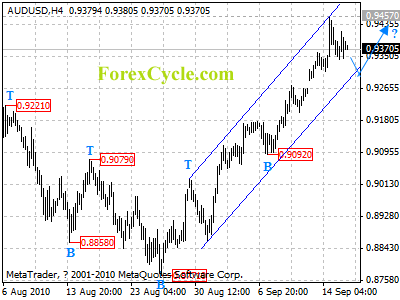
AUDUSD pulled back from 0.9457

After breaking above 0.9404 (2009 high) resistance, AUDUSD pulled back from 0.9457, suggesting minor consolidation of uptrend from 0.8771 is underway. Support is at the lower border of the rising price channel on 4-hour chart, now at 0.9280, as long as the channel support holds, uptrend is expected to resume, and one more rise to 0.9600 is still possible. Key support is at 0.9240, below this level will indicate that the uptrend from 0.8771 has completed at 0.9457 already, then deeper decline could be seen to 0.9000 zone.

audusd

Daily Forex Forecast