Let Elliott Waves Signal Market Direction for You

By Bob Moore – If you were a lone bull in a herd of stampeding buffalo, your survival instincts would tell you to follow the herd, regardless of its direction. The same is true for the successful trader or investor maneuvering within the financial herd called the Stock Market. As trader psychology changes, so do the Markets.

The Elliott Wave Principle captures the essence of trader psychology. It is an effective, visual representation of traders’ human nature to follow ‘in a crowded path’ extreme optimism followed by extreme pessimism, and then repeat the process again and again. The Elliott Wave patterns capture the continuous unfolding of the extremes depicted as Stock Market sentiment.

Traders cannot rely on news and events to drive the Stock Market. History has shown that news and events related to the Market have no consistent effect on its direction because of the influence of unfolding Market sentiment. For instance, Market reaction to the same news can be extremely positive at one given time, but then extremely negative at another given time.

Elliott Wave patterns display to the trader the most likely future Market direction based on current pattern structure. By understanding Elliott Wave pattern characteristics, a trader can identify higher probable outcomes from lower probable outcomes thereby reducing investment risk.

The classic Elliott Wave patterns consist of impulsive and corrective waves. An impulsive wave moves in the same direction as the current trend and is made of five sub-waves. A corrective wave moves against the current trend and is made of three sub-waves.

Traders can increase their probability of success by placing entry and exit points near levels favoring a change in Market direction. For example, placing an entry for a long position near the start of an upward impulsive wave has a higher degree of being successful than placing an entry for a long position near the end of an upward impulsive wave.

Forecasting Market direction from Elliott Wave patterns does not provide certainty, but rather a probability of Market direction. There can be more than one valid interpretation of wave patterns, each carrying a probability of being an accurate portrayal of Market direction.

Traders should keep in mind that it is typical for Elliott Wave patterns to be continually reassessed and altered as Market sentiment unfolds to provide a higher probability of Market forecast. Alteration of wave patterns should be viewed not as a weakness, but as a strength. To be sure, the Market is quite dynamic; therefore, any tool used to help forecast the Market must be dynamic, too.

It is important to note the principals and use of Elliott Waves have persevered for over 70 years, when in 1938, in collaboration with C. J. Collins, R.N. Elliott introduced ‘Elliott Wave Principals’. Mr. Elliott believed that while stock market prices may appear random and unpredictable, they actually follow predictable, natural laws that can be measured and forecast by implementing wave patterns based on Fibonacci number analysis, also pioneered by Mr. Elliott.

Mr. Elliott theorized that common waves are characterized by Fibonacci proportions of 38%, 50%, and 62%. Impulsive waves relate to one another in Fibonacci proportions and corrective waves tend to retrace in Fibonacci proportions.

Mr. Elliott, encouraged so greatly by the response to his theory in the investment world, expanded it to apply to all collective human behaviors. His final and most comprehensive work titled ‘Nature’s Law-The Secret of the Universe’ was published in 1946, two years before his death.

About the Author

Bob Moore is with Taylor Trading Plus, an international data-exchange trading service using George Taylor’s Book Method, Value Area trading, Elliot Wave analysis, and Short-Term Trend analysis to identify trading entries/exits in select instruments of Futures, ForEx, Commodities, Metals and Oil, ETF’s, and Stocks. To request this article with graphic depiction of Elliott Waves, please go to ‘Contact’ tab at: http://www.taylortradingplus.com.

Forex: Speculators sharply add to long Euro positions for highest level since October 09

By CountingPips.com

The latest Commitments of Traders (COT) report, released on Friday by the Chicago Mercantile Exchange, showed that futures speculators sharply increased their bets in favor of the euro against the dollar for a fourth consecutive week. Non-commercial futures positions, those taken by hedge funds and large speculators, were net long the euro against the U.S. dollar by 35,330 contracts as of September 28th following net positioning of 5,097 contracts on September 21st. The September 21st data was the first time contracts had been in positive territory for the euro since early December 2009 and the latest data marked the best euro positioning since October 20, 2009 when contracts were positive by 36,033.

EUR COT Data

The COT report is published every Friday by the Chicago Mercantile Exchange (CME) and shows futures positions as of the previous Tuesday. It can be a useful tool for traders to gauge investor sentiment and to look for potential changes in the direction of a currency or commodity. Each currency contract is a quote for that currency directly against the U.S. dollar, where as a net short amount of contracts means that more speculators are betting that currency to fall against the dollar and net long position expect that currency to rise versus the dollar. Open interest is the number of open contracts that have not been closed by a transaction or by delivery.

The British pound sterling was the only major currency on the short side against the dollar last week in the CME futures market while the euro, Australian dollar, New Zealand dollar, Japanese yen, Canadian dollar, Swiss franc and Mexican peso had a net positive amount of contracts.

The British pound sterling short positions were just -2,194 as of September 28th after being short on September 21st by -8,989 positions. This is the third straight week of improvement for the British pound future positions and could be back on their way towards positive levels.

British Pound COT data

The Japanese yen net long contracts increased to 28,666 as of September 28th from 23,100 net long contracts reported on September 21st. Yen positions had stayed above the 47,000 level for six weeks before the September 21st decline as many speculators may have decreased their yen long positions due to the Bank of Japan’s currency intervention.

Japanese Yen COT data

The Canadian dollar positions edged lower after three consecutive weeks of increases and declined to a net total of 27,870 contracts after totaling 29,815 net longs on September 21st.

Swiss franc long positions advanced higher to 19,993 long contracts as of September 28th after totaling a net of 14,462 long contracts on September 21st. This is the highest level for long Swiss franc positions since December 2009.

The Australian dollar positions continued to rise and reached their highest level since April against the dollar to a net amount of 69,533 long contracts as of September 28th from 64,324 long contracts on September 21st.

New Zealand dollar futures positions declined to a total of 17,270 long contracts after a total of 18,408 long contracts. This decrease breaks a round of three consecutive weeks of increases.

Mexican peso long contracts jumped higher as of September 28th to 66,591 net long positions from 26,376 longs the week prior. Peso positions more than doubled last week and have now risen for three consecutive weeks.

COT Data Summary as of September 28th, 2010
Large Speculators Net Positions vs. the US Dollar

Euro: +35,330 contracts from +5,097 contracts on September 21st
British pound sterling: -2,194 contracts from -8,989 contracts
Australian dollar: +69,533 contracts from +64,324 contracts
Canadian dollar: +27,870 contracts from +29,815 contracts
Japanese yen: +28,666 contracts from +23,100 contracts
Mexican peso: +66,591 contracts from +26,376 contracts
New Zealand dollar: +17,270 contracts from +18,408 contracts
Swiss franc: +19,993 contracts from +14,462 contracts

Go to the Commitment of Traders CME raw futures data

Further COT Resources from around the web:

Forecast The FX Market With The COT Report

The Only Indicator You Will Ever Need

Will the Australian Dollar Reach Parity With the USD?

audusd october 2010, australian dollar, aussie, aud, usd, us dollar, fx, fx market, fx trading, forex, forex market, forex trading, trading forex, currency trading, daily forex picks, forex forecasst, forex analysis

Will the Aussie reach parity with the US dollar or even better in the months to come? Technically speaking, there’s a good chance that it would. As you can see from its daily chart, the AUDUSD pair has recently broken out from a descending right-angled broadening triangle. Having past the 0.9350 and 0.9400 hurdles, the pair could now aim for 1.0000. It could, however, encounter some resistance at its all-time high at 0.9849 which it set back in 2008. Nonetheless, a move above this level could put the AUD on track towards dollar-parity. In fact, if we project the height of the pattern from the point of breakout, its upside target is even better – 1.0600. And as long as the pair’s uptrend channel remains intact, I could say that the Aussie has some more room to move north. But with its present overbought conditi0n and the wall that it is seeing at the channel’s resistance, it could move sideways or even retrace for awhile in the near term before making its journey to the heavens.

A lot of high impact economic reports are due in Australia this week. Tomorrow (October 5), Australia’s retail sales and trade balance figures for the month of August will be on deck. Sales at the retail level are seen to have increased again by 0.5% on top of the previous month’s 0.7% gain. The country’s trade balance is likewise seen to tally handsome surplus of A$2.31 billion from A$1.89 billion due to the country’s expansion in exports to China.

Later that day, the Reserve Bank of Australia will also deliver its monetary policy decision. There, the bank is expected to raise its interest rate by 0.25% to 4.75% after 5 months of holding it at 4.50%. The 1.2% growth rate in Australia’s economy during the second quarter of the year plus the recent improvement in the country’s labor market could indeed warrant a hike in the central bank’s interest rate. A rate hike plus the overall weakness in the greenback would make the Aussie more attractive; imagine netting 4.50% (4.75% – 0.25%) just by going long on the AUDUSD.

More on LaidTrades.com

Forex Update: Traders Eyeing BOJ; EUR Weakening

By ForexYard The euro fell back Monday after a warning that the wave of austerity sweeping across Europe could trigger a new recession. The euro had initially been helped by continued speculation of further quantitative easing by the U.S. as well as by weekend support from Chinese Premier Wen Jiabao as he conducts a tour of Europe this week.

Not only did Wen claim to support a “stable” euro but he said that Beijing would continue buying Greek bonds once the country returns to the bond markets. Wen’s comments came amid reports that China has been holding secret talks with the French to heighten coordination of exchange rates to make them more stable.

By midmorning, the euro had fallen back to $1.3698 from $1.3784 late on Friday in New York, according to analysts. Against the JPY, the euro also slipped back to 113.90 from 114.81, even though there is rising speculation that the Bank of Japan (BOJ) will provide further liquidity to Japanese money markets, one way or another, when it completes its latest two-day policy meeting Tuesday.

Forex Market Analysis provided by ForexYard.

© 2006 by FxYard Ltd

Disclaimer: Trading Foreign Exchange carries a high level of risk and may not be suitable for all investors. There is a possibility that you could sustain a loss of all of your investment and therefore you should not invest money that you cannot afford to lose. You should be aware of all the risks associated with Foreign Exchange trading.

Forex Daily Market Commentary

By GCI Forex Research

Fundamental Outlook at 0800 GMT (EDT + 0400)

USD

The dollar steadied a little during a quiet Asia session, having found itself on the defensive on Friday after at least two Fed speakers gave their conditional support to further easing measures. EURUSD traded 1.3746-1.3807 and USDJPY 83.23-83.87. New York Fed President Dudley, an FOMC voter, sounded especially dovish and clearly favours further policy accommodation. He noted that “the current levels of employment and inflation, and the timeframe over which they are likely to return to levels consistent with our mandate, are unacceptable”. Chicago Fed President Evans, who becomes an FOMC voter in January, worried aloud that the economic recovery seemed to have lost some forward momentum. However, Dallas Fed President Fisher, who also obtains FOMC voting rights in January, sounded less convinced about the merits of further easing, saying that the efficacy of further asset purchases is unclear. On the data front, the September manufacturing ISM index came in just below consensus at 54.4 (cons. 54.5, prev. 56.3). Looking into the detail, our US economics team notes that the new orders, employment, and export orders components all softened. The University of Michigan confidence reading was stronger than expected, rising to 68.2 (cons. 67.0).
EUR

China’s Premier Wen said China supports a stable euro and will not reduce its holdings of European bonds. He also offered to increase holdings of Greek debt when Greece returns to debt markets in search of funding. Wen continues his visit to Europe this week to propose what Xinhua call “practical actions” to help solve Europe’s continuing woes. The three countries on his itinerary, Greece, Italy and Belgium, are the most indebted in the Eurozone.
ECB Governing Council Member Draghi struck a hawkish note, observing that many banks have a “serious exposure” to the risk of a sudden rise in interest rates. Referring to the ECB’s unconventional measures, he said that their withdrawal should be timed so as not to sow the seeds of future crises by leaving too much liquidity in the system. Like some of his ECB colleagues, he noted that some banks remain addicted to ECB funding but that this issue should be addressed by national authorities, and not the central bank.
EU Commissioner Almunia expressed some satisfaction with the Irish government’s plans to restructure parts of the domestic banking system, and said the EU Commission would “proceed rapidly” towards making a final decision on whether the plan would be permitted under EU rules.
JPY

The BoJ’s latest policy meeting gets underway today, with a decision expected on Tuesday. The local press reports that the policy board is close to taking further easing steps. Possible measures reportedly include an expansion of the scale of fixed-rate liquidity operations from ¥30 trn to ¥40 trn, combined with a maturity extension from 6 months to “around one year”. An increase in the monthly intake of JGBs is also reportedly under consideration, along with the purchase of private sector assets and further “yen-selling operations”.
On Friday, a Japanese government official indicated that the MoF would seek to impress upon the BoJ that any future interventions should remain unsterilized. The local press also reported that the T-bill issuance calendar for October, published on Friday, shows that the MoF does not plan to issue financing bills this month to repay funds borrowed from the BoJ to fund the recent intervention operations. Any such issuance would have absorbed the excess yen liquidity the BoJ injected through its yen selling operations.
GBP

Our analysts team has pushed back his BoE rate call by six months, and now sees the first hike coming in Q3 2011. They  also lowered the end-2011 policy rate forecast to 1.0% from 2.0%.

TECHNICAL OUTLOOK


EURJPY clears 114.74.
EURUSD BULLISH Bull trend continues; targets 1.3896 next with scope for 1.4194. Near-term support comes in at 1.3619 ahead of 1.3381.
USDJPY BEARISH Focus is back on the downside; break of 82.88 would expose 79.75. Resistance remains at 84.50 ahead of 85.40.
GBPUSD BULLISH Bull stalls in front of 1.5999 key high; support at 1.5670 ahead of 1.5503.
USDCHF BEARISH Bearish pressure held at 1.9709 ahead of 0.9625. Resistance at 0.9918 breakout low.
AUDUSD BULLISH The pair is expected to target 0.9850 with scope for 1.000 psychological resistance next. Support is at 0.9559 ahead of 0.9463.
USDCAD BEARISH Break below 1.0192 opens up the way towards 1.0108 and 0.9931 next. Resistance comes in at 1.0380.
EURCHF BULLISH Expect recovery to targets 1.3651; need a break above 1.3924 to confirm the positive trend. Downside risk capped at 1.3361.
EURGBP BULLISH Violation of 0.8736 exposes 0.8808 next. Support holds at 0.8659 ahead of 0.8563.
EURJPY BULLISH Clears 114.74; expect gains to extend towards 116.68 and 119.33 next. Near-term support comes in at 113.76 ahead of 112.67.

Forex Daily Market Commentary provided by GCI Financial Ltd.

GCI Financial Ltd (”GCI”) is a regulated securities and commodities trading firm, specializing in online Foreign Exchange (”Forex”) brokerage. GCI executes billions of dollars per month in foreign exchange transactions alone. In addition to Forex, GCI is a primary market maker in Contracts for Difference (”CFDs”) on shares, indices and futures, and offers one of the fastest growing online CFD trading services. GCI has over 10,000 clients worldwide, including individual traders, institutions, and money managers. GCI provides an advanced, secure, and comprehensive online trading system. Client funds are insured and held in a separate customer account. In addition, GCI Financial Ltd maintains Net Capital in excess of minimum regulatory requirements.

DISCLAIMER: GCI’s Daily Market Commentary is provided for informational purposes only. The information contained in these reports is gathered from reputable news sources and is not intended to be U.S.ed as investment advice. GCI assumes no responsibility or liability from gains or losses incurred by the information herein contained.

Dollar Pairs Losses but Remains Weak

Source: ForexYard

The U.S dollar held near its lowest levels in 6 months against the euro on Monday after Federal Reserve officials said more quantitative easing might be needed if the U.S. economic outlook remained weak.

Economic News

USD – Dollar near Latest Lows vs. Euro

The U.S currency was not far from an 8 month low against a basket of currencies on Monday with expectations increasing that the Fed would resort to a second round of bond purchases.

U.S. manufacturing growth slowed last month and inflation remained subdued in August, leaving the door open for the Federal Reserve to launch a fresh round of monetary policy easing.
How fast that happens will depend on economic indicators to be released before the Fed’s next policy meeting on November 2-3.

The dollar looked vulnerable against a basket of currencies, hovering near Friday’s 8 month low, but had edged up 0.2% against a basket of currencies in early trade on Monday.

EUR – Euro Falls On Debt Issues Concern

The euro weakened from a six-month high against the U.S dollar as Europe’s sovereign debt concerns reduced demand for the region’s assets.

The euro ended 4 days of gains versus the greenback after the Financial Times reported Ireland’s budget deficit this year will be higher than previously forecasted. The Financial Times said, citing unidentified officials, that Ireland’s budget figures, due out today, are a result of a slowing economy rather than a reduction in project tax receipts.

Analysts said that the euro remains under pressure because some countries such as Germany are running trade surpluses while Ireland, Portugal, Greece and others have deficits, which may lead to selling of the euro and buying of the dollar and the yen.

JPY – Yen Declines on BOJ Economic Outlook

The yen retreated from near a 2 week high versus the U.S dollar as gains in Asian shares boosted demand for higher- yielding assets and on prospects Japanese importers sold the currency to take advantage of recent strength. Japan’s currency weakened against all of its 16 major counterparts as the Bank of Japan begins a two-day policy meeting today.

Japan’s currency also fell to a 4 month low against the euro on speculation the Bank of Japan will take more credit-easing measures at a meeting starting today. The market is waiting to see if the BOJ eases policy further to shore up the economy and dampen strength in the yen.

OIL – Oil Ends at 7 Week High

Oil was steady on Monday after earlier touching a 2 month high near $82 on expectations that the slow pace of the U.S. economic recovery will prompt a monetary boost that would spur energy consumption.

Oil becomes relatively cheaper for buyers outside the U.S. when the greenback weakens. But a stronger dollar against a basket of currencies, up 0.15 percent on Monday, capped oil’s gains.

The International Energy Agency said on Friday it anticipated upward pressure on oil prices in the second half of 2011 due to a projected decline in oil stocks.

Technical News

EUR/USD

The daily chart shows the pair may be relatively moving higher. The Relative Strength Index has the pair’s price floating in the oversold zone, hinting at the possibility of further price appreciation. Traders may see this as a buy opportunity to go long on this pair.

GBP/USD

The hourly chart is showing a tightening of the pair’s Bollinger Bands, indicating the potential for an imminent breach. On the daily chart, the price is floating near the lower border, indicating the potential for the pair’s break out to be higher. Traders may want to be long on the pair with take profit at the significant resistance level of 1.5850.

USD/JPY

Signals are pointing to a correction for the pair. The daily chart is displaying a bearish cross on the pair’s Slow Stochastic Oscillator, indicating the potential for a downward correction. The chart has the pair floating in the oversold range on the Relative Strength Index, signaling further potential for downward movement. Being short on this pair today may be the right move.

USD/CHF

This pair is in the middle of a very intensive downtrend that was initiated 3 days ago and it still shows great momentum that on a bigger scale appears to have more room to run. In the shorter time frame, there might be a minor bullish correction before the bearish move resumes. Selling on highs appears to be preferable today.

The Wild Card

Silver

The violent bullish trend continues as all technical indicators on the daily and the 4 hour charts are showing that the direction is up and the momentum is high. This provides forex traders with a great chance of enjoying the additional upwards momentum which still reigns for this commodity.

Forex Market Analysis provided by ForexYard.

© 2006 by FxYard Ltd

Disclaimer: Trading Foreign Exchange carries a high level of risk and may not be suitable for all investors. There is a possibility that you could sustain a loss of all of your investment and therefore you should not invest money that you cannot afford to lose. You should be aware of all the risks associated with Foreign Exchange trading.

Online Forex Trading: Better than Futures Trading?

By Jared Ingram – Online forex trading has a lot of differences with futures trading. However, there are futures traders who see that trading to futures is just a natural transition into trading to forex. Market liquidity, structure of pricing, and existing leverage are just few of the differences.

The online forex market has very smooth trends that are available in today’s financial markets. There’s no other market that can match the participation and volume in forex trading so it becomes a haven for forex traders who want smaller gaps on prices and inconsistent spikes and other changing and uncontrollable conditions that are common in other low-volume markets like futures. Since the market is closed for a short time on weekends, market gaps are limited but possible that’s why forex trading is consistently liquid.

Given the trending nature of forex trading, a trader, whether technical or fundamental, is attracted to it. Fundamental traders monitor the cash flows globally and position themselves between mid-term and long-term depending on the analysis of the demand and supply of a particular currency. For technical traders, they observe and wait for recurring patterns that are displayed on forex price charts and these are utilized as indicators whether there is overbuying or overselling of a currency.

Some investors may not know it, but all financial trade markets have a spread which is the difference between the bidding and asking price. In futures market, you also have to pay for commission, exchange fees and clearing. In forex trading, your broker may earn profit from his activities as a dealer of currency.

In forex market, real time price is utilized for the price offer and this is the price used when buying or selling. In the case of futures, the selling and buying price is dependent on the last trading or tick price. Since futures utilizes tick prices, it is expected that the moment your order is put into place, the price that you actually buy or sell is different from the recognized tick price.

In online forex, an investor has one margin rate for trading that is placed 24 hours per day. Your margin requirement may be less than one percent but it depends on the size of your trade. In futures market, the margin rate is varying the whole day and it is dependent on the volatility of the market. Also, the rate becomes higher at night as the market closed down and the brokers make their move to cover up their risks.

Online forex trading is open 24 hours a day for 5.5 days per week. Take note that, when one market is closing up in one time zone, another market is just opening up. So, as the markets in the Pacific begin to slow down, the markets in Europe like England, Germany and Switzerland are just beginning their operations.

There’s no need to hang around while the market you want is closed when there is news that future pits have actually closed as the day ends. This is an advantage for forex traders since there’s flexibility and non-stop opportunities are available in forex market which are not true in futures. Keep in mind, however, that forex and futures markets are both risky markets. So, be careful when investing your money.

About the Author

Are you looking for more information regarding online forex trading ? Visit http://www.globalonlineforextrading.com/ today!

Using Average True Range to Guide Entry/Exit Points for Day and Swing Trading

By Bob Moore – The Average True Range (ATR) is not only useful in setting stop loss limits, but also is helpful in determining entry/exit points for day and swing trading.

But first, let’s review what ATR is and how it is derived. ATR is exactly what the name implies. That is, it is a numerical value that depicts the average of the true, daily range of an instrument (the range is the difference between an instrument’s high and low within one day).

Simply stated, the ATR is an average of the daily True Ranges of an instrument. The daily True Range is derived by taking the greatest of the following: 1) Difference between the High and Low for the day; 2) Difference in the day’s high and yesterday’s close, if there is a gap up at the open; and 3) Difference in the day’s low and yesterday’s close, if there is a gap down at the open.

So how is ATR useful? ATR is useful because it tells you that, on average, an instrument’s price should be trading within the Average True Range during any given day.

Setting Stop Loss Limits with ATR

When traders use Stop Loss Limits (SLL) based on the ATR, they are basically stating that they believe the instrument will not decline more than the ATR (SLL = entry price – ATR) or some percent of the ATR (SLL = entry price – ?%ATR). The amount of ATR used in the calculation is determined, in part, by your tolerance for risk. Depending on your tolerance for risk, 50% of ATR may be an appropriate stop limit for day trades, whereas 100% or more of ATR may be appropriate for longer held trades.

Determining Entry and Exit Points using ATR

Let’s consider the perspective of an S&P 500 eMini (ES) trader considering a trade near market opening on February 16, 2010. Overall Market momentum certainly appeared to be positive based on the following: 1) The S&P 500 and Nasdaq Composite were poised to penetrate their Key Resistance Levels of 1085 and 2184, respectively, indicating possible development of upward Elliott Wave 3’s (assuming the trader followed Elliott Wave patterns);

2) Short-Term Trends in most instruments had changed to Positive from Negative (assuming the trader followed Short-Term Trend analysis); and

3) A new Taylor Trading Technique 3-Day Cycle had just begun (assuming the trader followed Taylor Trading Methods).

Before placing an order, however, the trader predetermines a Stop Loss Limit. Since the trader planned to hold the position intra-day to no more than a day, a Stop Loss Limit derived from 50% Average True Range (ATR) was determined to be appropriate.

The trader assesses the appropriateness of entering the trade by assessing the likelihood of the position reaching his/her Stop Loss Limit. In the case of ES on February 16th, 50%ATR=10.75. Therefore, if the day trader entered an order at, say, 1080, then he/she would set the Stop Loss Limit at 1069.25 (1080 – 10.75). Upon review by the trader, the ES shows support at 1073.5 (Buy Day Low) and had not been at 1069.25 during the regular trading session since the week before. Therefore, there appeared to be a good chance the ES would not decline to the Stop Loss Limit considering the Market’s currently upward momentum.

The trader also predetermines when to exit the position to keep emotion (in the form of greed) out of his/her decision. Again considering ATR, the upward limit for the ES determined by ATR would be 1095 (ie, 1073.5 (day’s low) + 21.5[ATR]). The trader decides on an exit point lower than the upper limit of 1095 to increase the probability of completing the trade during the day.

The ES established a high of 1094 on February 16th and a high of 1100 on February 17th. If the trader had decided to make an intra-day trade, he/she would have made a 7-point profit (minus expenses) if he/she exited at 1087, or a 12-point profit (minus expenses) if he/she exited at 1092, both conservatively below the upward ATR limit of 1095. If the trader had decided to hold onto the trade overnight, he/she would have made an 15 point profit (minus expenses) if he/she exited at 1095, the upward ATR limit of the day before.

Either trade is a winner. And the point is to eliminate, or at least reduce, the losers, so you can keep the profits from your winners.

About the Author

Bob Moore is with Taylor Trading Plus, an international data-exchange trading service using George Taylor’s Book Method, Value Area trading, Elliott Wave analysis, and Short-Term Trend analysis to identify trading entries/exits in select instruments of Futures, ForEx, Commodities, Metals and Oil, ETF’s, and Stocks. To request chart example pertaining to this article, please go to ‘Contact’ tab at: http://www.taylortradingplus.com.

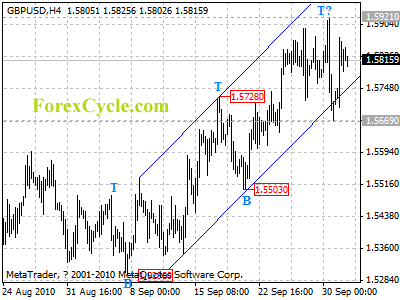
GBPUSD rebounded from 1.5669

After touching the lower border of the rising price channel on 4-hour chart, GBPUSD rebounded from 1.5669. Range trading between 1.5669 and 1.5921 is expected in a couple of days. As long as 1.5669 support holds, the price action in the trading range is treated as consolidation of uptrend from 1.5296, and another rise towards 1.5997 (Aug 6 high) is possible. However, a breakdown below 1.5669 will indicate that the rise from 1.5296 has completed at 1.5921 already, then the following downward move could bring price back to 1.5200 area.

gbpusd

Daily Forex Analysis

Trading In The Forex Market – Opportunity For Long Term Wealth

By Cedric Welsch – The securities market offers a lot of opportunity for individuals to build long term wealth or make some quick cash buying and selling stocks. It is common knowledge that public companies offer shares of stock for sale on centralized exchanges such as the New York Stock Exchange. Not many people know however about the numerous other securities that are traded every day in markets around the world. One of the most interesting markets that aren’t well known still by many is the foreign currency exchange market also known as FOREX, FX or simply the currency exchange.

What is the FOREX market?

This exchange is different than other securities exchanges around the world. It is known as an over the counter market in which there is no centralized trading authority that handles transactions such as the NASDAQ or NYSE entities. So if you go to your broker and say you want to exchange your 500 dollars in American currency for the equivalent in Japanese Yen, he won’t be of much help. One of the main reasons that the FOREX market exists is to facilitate investment and international trade. Businesses and investors around the world can change one form of money to another in order to do business or to participate in investment activities with money. For example, some investors will borrow less valuable monies and lend or invest in higher value monies in order to turn a profit. The FX market is one of the most liquid financial markets in the world because all that is being traded is money.

Who invests in the FX market?

The currency market is a bit different than other securities markets and as such the participants are also very different. Instead of individual investors, there are huge centralized banks, corporations, currency speculators, governments, large banks and other financial institutions. Small investors would have trouble realizing any profits or other gains by participating in this market. Central banks makeup the bulk of trading volume followed by smaller banks and then by large international corporations that have needs like paying people that work in different countries or the importation of goods that requires a different currency for payment. Trading occurs in these levels and the top tier levels of trading have information that is not known to the lower tiers.

The FOREX market does trillions of dollars in volume every day and helps foster international trade. Without this decentralized market, it would be very difficult for international business to thrive. Major participants such as central banks, commercial companies, speculators and corporations use the market to their advantage for investment purposes. However the average Joe off of the street will have a hard time making any money on this type of market unlike other securities exchanges such as the New York and NASDAQ exchanges.

About the Author

Do you want to really make profits with forex? Make sure you get fresh updates ahead of everybody else here: Forex News

Also, you need to know how to read and analyze the trading market well. Learn Currency Trading News