Forex daily analysis: 11-10-2010

USD/CHF

Daily graph: http://www.real-forex.com/charts-daily/111010/CHF_DAILY_111010.JPG

One hour graph: http://www.real-forex.com/charts-daily/111010/CHF_1H_111010.JPG

We can identify a clear and sharp downtrend for the pair during the last few weeks. The bearish envelope template appeared during the 06-10-2010 and 07-10-2010 sessions suggest a close reversing trend, creating an opportunity for a “Long”. In order to catch this opportunity, we suggest looking for an ascending configuration on the one-hour graph.

According to our opinion, the required configuration will be created if the once the resistance 0.9711 will be crossed upward.


Potential trade

  • “Limit” order on “Long” position 10 pips above the resistance mentioned previously, meaning 0.9701.
  • “Stop Loss” order on the last low occurred: 0.9592

USD/CAD

Daily graph: http://www.real-forex.com/charts-daily/111010/CAD_DAILY_1101010.JPG

For the last few weeks, the pair doesn’t follow any specific trend. However, three days ago, the currency crossed a very important support level for a daily graph at 1.0111. Once crossed, a bullish envelope template appeared. A breach of the 07-10-2010 would confirm the template, suggesting a reversing trend upward oriented, creating an opportunity for a “Long” transaction.

We suggest waiting for the breach required, and looking for an ascending configuration on one hour graph in order to enter the transaction.

Have a nice day!

Real forex team

Sponsored by: Real-Forex

Forex Daily Market Commentary

By GCI Forex Research

Fundamental Outlook at 0800 GMT (EDT + 0400)

USD

Price action on Friday evening was dictated by the US payrolls report. Both the headline print and the private payrolls component disappointed expectations. US 2y yields fell to another lifetime low of 33.5bp, which piled further downward pressure on USDJPY, and took the pair to a new 15-year low. The euro saw some erratic price swings immediately after the numbers, but soon settled back to pre-announcement levels. EURUSD traded 1.3834-1.3986, USDJPY 81.73-82.57. Our US economics team now believe that the FOMC will formally announce renewed balance sheet expansion on Nov 3. The change in forecast comes after a week in which Fed officials continued to express concern about the state of the US recovery, and to make the case for a pre-emptive monetary policy response.
Nevertheless, our analysts see a risk that, after rallying hard on the prospect of QE, the US Treasury market could yet be disappointed if the Fed fails to commit to buying a large and specific sum of Treasury securities over several quarters. The September payrolls report confirmed that the trend in private employment growth was fairly steady in Q3. However, the report also showed a sharp decline in government payrolls which was much broader than Census-related effects could explain. The weekend G7/IMF/World Bank meetings ended without any specific agreement on FX matters and the issue will likely resurface at the G20 meeting of finance ministers and central bankers which begins on October 22. More specifically, there was no official criticism of Japan’s decision to intervene in the FX market by selling yen. We believe this increases the chance of a further round of intervention should the yen continue to appreciate.
EUR

ECB President Trichet said he does not believe the term “currency wars” reflects the current reality, a view also expressed by ECB Governing Council Member Weber. Both agreed that exchange rates should reflect economic fundamentals. Eurogroup Chairman Juncker said that the dollar is currently not in line with economic fundamentals and that he is not happy with the euro having reached $1.40. ECB Governing Council Member Nowotny said that the euro’s increase is not helping the Eurozone recovery.
Juncker added that there is no need for a new global currency deal. France’s Finance Minister Lagarde said that, as far as currencies are concerned, the G7 agreed that concerted action is preferable to unilateral action.
ECB Executive Board Member Stark continued to take a moderately hawkish stance, noting that the risks to the inflation outlook remain “slightly tilted to the upside”. He expressed concern that maintaining accommodative monetary policy for too long can pose serious risks both to the economy and to price stability. He did concede though that the phasing out of unconventional measures would need to be gradual. An IMF spokesperson implied that the recent tightening of Greece bond yields suggests that Greece will be able to return to international debt markets in 2012 and would then be able to fully cover its external financing needs. However, she added that, were refinancing concerns to linger, the IMF and the EU have the option to extend Greece’s loans further out. ECB Executive Board Member agreed, but noted that no extension had yet been finalised.
EU Economic and Monetary Affairs Commission Rehn said that he sees risks that the fiscal consolidation plans of some European countries lack specifics, and include over-optimistic macroeconomic assumptions.
JPY

There was no specific public criticism of Japan’s FX intervention policy at the series of weekend meetings, which raises the risk of further intervention in our view. Finance Minister Noda emerged from the G7 meeting to say that “we did not discuss anything about the future, but I believe we’ve gained understanding on our basic stance”.
Noda and US Treasury Secretary Geithner met separately for a bilateral meeting, at which Noda explained the details of Japan’s fiscal stimulus steps. Noda said no specific mention of Japan’s intervention policy was made.
CAD

Canada’s Finance Minister Flaherty said that IMF/G20 countries need to work towards “rules of engagement” on the circumstances that would justify FX intervention. Flaherty said that although he is concerned about Canada’s weak export growth, no currency intervention is being considered. Looking ahead to the upcoming G20 meetings, he said he does not expect any complete resolution of currency discussions even then.
Employment declined by -6.6K in September, falling well short of consensus expectations. However, the unemployment rate unexpectedly ticked lower to 8.0% (cons. 8.1%, prev. 8.1%). The BoC’s senior loan officer survey showed an overall easing in business lending conditions to Q3. This was the fourth successive quarter in which loan availability improved.


AUD

On Friday, RBA Deputy Governor Battellino said it would be a mistake for Australia to try to manage the AUD, effectively ruling out the possibility of FX intervention. He pointed to the important role a strong currency plays in helping the economy.

TECHNICAL OUTLOOK


EURGBP stalled at 0.8808.
EURUSD BULLISH Violation of 1.4029 will trigger further acceleration to 1.4194. Near-term support holds at 1.3799 ahead of 1.3637.
USDJPY BEARISH Bearish trend remains intact; break of 82.88 exposes 79.75. Resistance remains at 83.99 ahead of 85.40.
GBPUSD BULLISH Sustained break of 1.6018/69 would expose 1.6276. Support at 1.5670 ahead of 1.5503.
USDCHF BEARISH Next support below 0.9500 lies at 0.9078. Resistance at 0.9739 ahead of 0.9918 breakout low.
AUDUSD BULLISH Upside potential held at 0.9918 ahead of 1.000 psychological resistance. Pullback clears 0.9773 exposing 0.9542.
USDCAD BEARISH Recovery has resistance at 1.0380. Violation of 1.0108 shifts focus to 0.9931 with scope for 0.9820 next.
EURCHF BULLISH Clearance of 1.3482 puts odds in favor of bullish trend; expect gains to target 1.3697 measured objective. Support at 1.3265.
EURGBP BULLISH Bullish pressure stalled in front of 0.8808 with next resistance at 0.8894. Support holds at 0.8689 ahead of 0.8563.
EURJPY BULLISH Upside potential capped at 116.68 ahead of 119.33. Near-term support comes in at 113.89 ahead of 111.47.

Forex Daily Market Commentary provided by GCI Financial Ltd.

GCI Financial Ltd (”GCI”) is a regulated securities and commodities trading firm, specializing in online Foreign Exchange (”Forex”) brokerage. GCI executes billions of dollars per month in foreign exchange transactions alone. In addition to Forex, GCI is a primary market maker in Contracts for Difference (”CFDs”) on shares, indices and futures, and offers one of the fastest growing online CFD trading services. GCI has over 10,000 clients worldwide, including individual traders, institutions, and money managers. GCI provides an advanced, secure, and comprehensive online trading system. Client funds are insured and held in a separate customer account. In addition, GCI Financial Ltd maintains Net Capital in excess of minimum regulatory requirements.

DISCLAIMER: GCI’s Daily Market Commentary is provided for informational purposes only. The information contained in these reports is gathered from reputable news sources and is not intended to be U.S.ed as investment advice. GCI assumes no responsibility or liability from gains or losses incurred by the information herein contained.

Dollar Continues To Slide Amid Disappointing Jobs Data

Source: ForexYard

The U.S. dollar continues to slide on almost all fronts. As a result, during the past week the euro reached a 5-month high against the dollar and the Japanese yen saw a 15-year high vs. the greenback. Dollar-dominated commodities soared as well during the process; gold saw an all-time high of $1,364 an ounce, and crude oil marked a 5-month high of $84.40 a barrel. Can this trend continue this week as well?

Economic News

USD – Dollar Closes another Bearish Week

The U.S. dollar continued to drop against most of the major currencies during last week’s trading session. The dollar fell about 300 pips against the euro and the EUR/USD pair crossed the 1.4000 level for the first time in 5 months. The dollar continued its depreciation against the Japanese yen as well, falling to a 15-year low against the yen.

The dollar’s ongoing devaluation is the result of positive indications from the U.S. economy, which supports risk appetite in the market. Economic reports from the past week show that the number of contracts to purchase previously owned homes increased by 4.3% in August, following a 4.5% rise in July. In addition, the Non-Manufacturing Purchasing Managers’ Index report showed on Tuesday that service companies in the U.S. have expended at a faster pace than projected in September, indicating the economic recovery is picking up. The disappointing Non-Farm Payrolls results, which showed that the U.S. lost more jobs than forecast in September, should have corrected the bearish dollar. However, it was the unemployment rate, which stayed at 9.6%, and didn’t rise to the expected 9.7%, that maintained the dollar’s fall.

Looking ahead to this week, the most significant news releases from the U.S. look to be the inflation reports. The Producer Price Index (PPI), which is scheduled for Thursday, and the Consumer Price Index (CPI), which is scheduled for Friday are likely to have a large impact on dollar’s trading. Positive results will show that the economy is indeed recovering, and the dollar might drop further as a result.

EUR – Reduced Risk Aversion Boosts the Euro

The euro strengthened against most of the major currencies on last week’s trading. The euro gained about 300 pips against the dollar, and the EUR/USD was traded over 1.40 for the first time in 5 months. The euro continued to strengthen against the British pound as well, gaining about 100 pips last week.

The positive economic releases from Germany continue to support the euro-zone’s currency. German factory orders rose more than expected in August, the nation’s economics ministry said Wednesday, as seasonally-adjusted orders increased by 3.4% in August. In addition, the German industrial production expended as well in August, at by 1.7%. Germany holds the strongest and largest economy among the EU nations, and thus recovery signals from the German economy are supporting the local currency. Another motive for the euro’s appreciation is the recovery indications from the U.S. economy. Various reports which were released last week showed that the U.S. economy is recovering, and isn’t likely to enter yet another recession. All this reduces risk-aversion and drives investors to look for relatively riskier assets, such as the euro.

As for the following week, traders are advised to follow the leading publications from the German and French economies, as these are likely to have the largest affect on the euro this week. Traders should also watch the euro-zone’s Consumer Price Indices, which are scheduled for Friday. Further positive reports from the euro-zone have the potential to boost the euro farther against the dollar to the 2009 December low at the resistance level of 1.4210.

JPY – Yen Continues To Rise on All Fronts

The Japanese yen rallied against all of its major counterparts during last week’s trading session. The yen’s most notable appreciation came against the U.S. dollar. The USD/JPY fell to the 81.40 level, marking a 15-year low. The yen gained almost 150 pips against the euro and the British pound as well.

The yen continued to strengthen last week due to speculations that despite Japan’s desire to devaluate the national currency in order to aid exports, the international criticism following its last intervention will prevent the Japanese government from acting again. Over the weekend Japan escaped overt criticism from the G7 and G20 for its yen selling intervention. Yet it seems that the Japanese leadership understands that the industrial world isn’t accepting its unilateral intervention, and that investors’ bets that Japan will not interfere in the currency trading have so far been fulfilled.

As for the week ahead, traders are advised to keep following Japanese statements regarding their currency intervention plans. For the moment it seems that Japan will reluctantly abandon their wish to devaluate the yen. If this occurrence will indeed take place, the yen might strengthen even further during the upcoming week.

OIL – Crude Oil Recovers To $83 a Barrel

Crude oil saw an extremely volatile session during last week’s trading. Crude gained on a daily basis up until Friday, and reached as high as $84.40 a barrel. This was followed by a sharp fall, and crude was traded for $80.30 a barrel. However, crude prices promptly corrected the bearish move, and are now trading around $83.0 a barrel.

Crude is constantly rising over the past three weeks due to growing speculations that the Federal Reserve will need to start debt purchases to prevent the U.S. economy from falling back into recession. This has weakened the U.S. dollar, and as a result boosted demand for dollar-dominated commodities, such as crude oil and gold. It currently seems that as long as the dollar continues to slide against its major rivals, especially the euro and the Japanese yen, crude might face further bullishness.

As for this week, traders are advised to continue following the major news releases from the U.S. and the euro-zone, as these usually have significant impact on crude oil trading. Traders should also follow the U.S. Crude Oil Inventories release on Thursday as this report tends to have an instant impact on the market.

Technical News

EUR/USD

There is a very accurate bullish channel formed on the 4-hour chart, as the pair is now floating in the middle of it. As the RSI and the MACD are still pointing up at the daily chart, the pair looks to rise further, with potential to reach the 1.4050 level.

GBP/USD

The cable closed a rather volatile week around the 1.5940 level. A bearish cross on the daily chart’s Slow Stochastic suggests that a bearish trend might take place this week. Going short might be the preferable strategy today.

USD/JPY

The USD/JPY pair saw a 15-year low last week, and yet it continues to drop further. The MACD and the Slow Stochastic on the weekly chart indicate that the bearish move has more room to go, with key target level of 81.35.

USD/CHF

The USD/CHF continued to drop on Friday, yet it begins to provide correction signals. A bullish cross of the 4-hour chart’s MACD and the daily chart’s Slow Stochastic indicate that the pair might see a bullish correction today. Going long with tight stops might be a good strategy.

The Wild Card

USD/CAD

The pair saw a mild bullish correction until Friday and reached as high as the 1.0235 level. However, it has already corrected most of the bullish movement and is now trading around the 1.0100 level. And now, as all the oscillators on the 8-hour chart are pointing down, the pair looks to prolong the bearish trend. This might be a good opportunity for forex traders to join a very popular trend.

Forex Market Analysis provided by ForexYard.

© 2006 by FxYard Ltd

Disclaimer: Trading Foreign Exchange carries a high level of risk and may not be suitable for all investors. There is a possibility that you could sustain a loss of all of your investment and therefore you should not invest money that you cannot afford to lose. You should be aware of all the risks associated with Foreign Exchange trading.

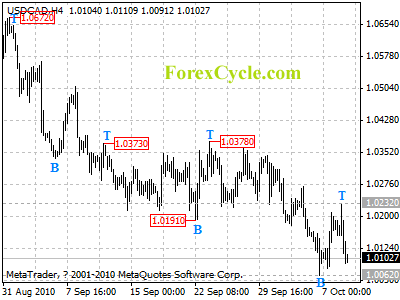
USDCAD has formed a cycle top at 1.0232

USDCAD has formed a cycle top at 1.0232 level on 4-hour chart. Range trading between 1.0062 and 1.0232 would more likely be seen in a couple of days. Support is at 1.0062, a breakdown below this level will indicate that the downtrend from 1.0672 has resumed, then next target would be at 1.000 area. Key resistance is at 1.0232, a break above this level will suggest that the fall from 1.0672 has completed at 1.0062 already, then the following upward movement could bring price to 1.0600 zone.

usdcad

Daily Forex Signals

Why Buy Forex Signals and Forex Alerts

By Nancy Margolis – The opportunity to earn an income from forex trading is there for those that are willing to work for it. But before getting started, there is a checklist you should first follow. 1, find a forex broker you can trust. The forex industry is riddled with brokers that are less than honest. Try to stay away from market makers. They take the other side of the trade and win only when you lose. It’s a conflict of interest because they tend to stop hunt in order to get a losing trade. 2, Think about the amount you want to open your account with. Open with a small amount. As a beginner (or a veteran trying a new method), the focus should not be on making money, it should be on consistently accruing those pips. 3, go to forex school. There are many sites on the net that offer free education. Learn as many styles and methods of trading that you possibly can. From there develop a trading plan and trade with those strategies using a demo account or very small risk size. 4, if success at Forex Trading seems to slip by you no matter what you do, then you may want to consider using a Forex Signals alert service.

If you are a trader lacking experience in the forex market or you are struggling to make profitable trades, using a good Forex Signal service is a no-brainer. If you’ve invested in other markets, you realize the sacrifice made for not being an educated trader. Most traders are too busy to trade because they have a full-time job or have commitments that limit their time to properly analyze the market and place trades. Furthermore, the fact that the Forex Market is a 24 hour exchange, Monday through Friday, makes the task even more difficult.

Many signal companies on the net offer alerts in various methods. They send alerts to you via email, cell phone instant messenger and even online rooms where you log in and mimic their trades. Many of these companies are very much reputable but remember, a major reason for buying forex trading signals is due to their inability to find the time. Waiting on an SMS or email then having to place the trades immediately requires time and standing by or reacting takes time Most alerts that are sent require immediate attention. If you are busy working, sleeping or basically living your life, entering the trade fast enough will be an issue. Remember, forex trading is 24/5. The solution is simple. Find a Forex Trading Signals service that provide their alerts direct to your trading software. There should be no reason for you to place a trade. Many providers can directly connect with the Metatrader trading platform, the most popular forex trading platform available. It requires nothing more than attaching an expert advisor which transfers the alerts, which should be provided by the Forex alerts company.

Many new forex traders pay steep fees for forex signals because they think their return will be much more than what they paid. Although this is quite possible, one must still perform due diligence in looking for a low priced service that is relatively consistent, making sure to try their service first via a free trial. Prices in the $50 to $150 range are reasonable. Sometimes the Forex signals you buy do make money and sometimes they lose. As in any type of investment, there are risks of loss. No Forex signals, Forex robots or Forex trading strategies can guarantee a quick profitable return but they should be profitable on a long term basis.

When looking to buy Currency Signals, be certain you do business with firms that provide a free trial. If they don’t, walk away. A good firm should be willing to let potential users test their forex trading signals before subscribing to the service or at a minimum offer a money back guarantee policy. If their picks are any good, they should be more than willing to provide free access so that you can judge for yourself the profitibility of their service. There is no reason for you to risk your hard-earned money on fx signals from firms that don’t provide a free trial.

About the Author

Nancy works with Easy Pips Forex Signals. Easy Pips sends direct to you Metatrader Platform 24/5 Forex Signals and Forex Alerts. Visit their site today and try their Forex Alerts service at no charge. Simply click on the Free Trial link.

Language Of The Market: Understanding Forex Charts

By James McKee – One of the scariest and most intimidating things about starting out as a forex trader are the complicated charts used to gauge the forex market value for a given pair of currencies. As foreboding as they might appear to a newcomer these charts are one of (if not the MOST) important things to understand when coming into the market to trade. Having up to date and continuous data for the transaction you are considering to enter into is absolutely vital for your success. There are three types of charts available to you for analysis and they are bar, line, and “candlestick” charts. The predominant chart being used by most traders today is indeed the bar chart, but I have decided to discuss the candlestick chart due to its more esoteric nature.

Candlestick charts originated in Japan due to a Japanese rice trader’s desire to view changes in the price of rice within a given period of time. It is a combination of both a line and a bar graph, each bar or “candlestick” represents the range of price movement over a given period of time. This is crucial when you consider that the Forex market is constantly in motion and the value of a given currency could rise or fall in moments. The candlestick is composed of a single “bar” and has a “wick” both above and below it. The width of the candle is used to demonstrate the span of time it covers, and the wick represents the highest and lowest prices the currency was traded for during that period of time.

An advanced application one could apply to a candlestick chart would be Fibonacci retracement, this is a method used to help you calculate the best place at which to buy and sell currency. As with anything else there are no guarantees but it is certainly a helpful mathematics tool. It has been said that the market (stock and Forex alike) is like gambling, and in some respects I’d have to agree with them. Very much like gambling in the market you can calculate your odds of success and bet (or invest) accordingly and if your system is sound you will come out on top overall and that overall profit is what trading is all about.

The software used to create these charts is just as important as the charts them selves, Meta Trader 4 is one of the most popular software suites available to traders and it has stood the test of time for a while now. Featuring a multitude of charting options, customization, and stop loss/take profit warnings to keep your objectives front and center. This software (or something like it) is necessary to pursue your financial goals in the Forex market.

Charts are nothing more than lines and pretty colors without the proper amount of understanding being applied to what you are viewing. Due diligence and effort must be put forth to apply this knowledge in a way that will be profitable. Don’t hesitate to ask questions and read absolutely everything you can about how to develop your trading strategy in conjunction with software such as MT4. Happy trading!

About the Author

Author is a Forex trader and financial analyst residing in Denver, Colorado with 5 years of experience in trading with an attitude of cooperation through education. It is vital to remain in the loop where new technologies are concerned, make sure to stay up to date and aware of forex chartsand developments

Back-Testing – A Good Way To Determine The Profitability Of A Forex Strategy

By James Woolley – If you have been involved in forex trading for any length of time, you will know that there are literally thousands of different trading systems being sold online. There are also plenty of systems being given away for free on forums and websites, for instance. So how can you tell if any of these systems are worth using or not?

Well you obviously have to test to see if they are profitable and this involves one thing – back-testing. Back-testing is simply where you use some kind of software to enter the trading conditions and see what kind of profits it generated in the previous months and years.

This can be quite a complex process and one that not many people can do, simply because they are traders not programmers. However it is definitely worth learning how to do this because then you can quickly evaluate whether a particular system is profitable or not in a matter of minutes, or seconds in some cases.

The alternative approach is to do all of this back-testing manually. This is a long time-consuming process, but it is no less valid. It basically involves opening up your charting software, plotting the indicators used by the trading system, and looking at every instance where the system would have entered and exited a trade. You then need to write down the running profit and loss, as well as the number of winning and losing trades.

As regards how far you go back in time, the general rule is the longer the better. The more data you analyze, the better you can assess how profitable a particular trading method is because you can see how it performs in various different market conditions.

One final point I want to make about back-testing is that you shouldn’t just look at the total profit for a given period. You should also look at the maximum drawdown during this time as well because you may find that although a particular strategy generates profits in the long run, there may be times when it suffers say 5-10 losing trades in a row. Therefore if this were to happen again in the future, it could decimate your trading account.

So the point is that the only way to thoroughly test out a trading system is to do some back-testing, whether you do this manually or use some kind of software to help you. This will allow you to see how profitable a system is in various market conditions, and will allow you to see what kind of drawdown you are likely to suffer if you were to start trading it for real. The best trading strategies will obviously generate steady profits with very little drawdown along the way.

About the Author

Click here for more information about a forex trading course that will teach you all the basics of currency trading, and to read a full review of Forex Nitty Gritty.

Stay in Touch with Basics of Investment

By Oleg Kolomatskiy – The Present Day situation with the Markets Implies Going Back to the Basics.

Taking into the account the turmoil with global markets, it’s high time we revisited the reasons why we invest and re-consider the goals.

In the last year many investors were abandoned with the bull market and some of their portfolios almost vanished. So, the outcome is that lots of them went for the exit, complaining never to come back. Now, we have reached the point when we need to refocus our allocations that correspond to our initial objectives of investment.

First, consider the various asset classes one might consider. Please remember that not everything is suitable for everyone. Each asset has its own risks and potential rewards so one should seek out professional advice before investing.

First of all, consider the different classes of assets. Just remember, that not all of them fit your investment plan. Each asset has both risks and future awards, that’s why you have to find out the advice from professionals before making inputs.

Here are some examples where to invest: Real estate, international fixed-income, hedge funds, commodities, private equity, domestic fixed-income, domestic equities, emerging market equities, international equities and other alternative asset classes.

The above written list doesn’t include all the possibilities of investment and it shouldn’t terrify you. It’s really hard to understand which type of asset class will fit best your goals and your personality too. Putting it another way – how much risk, credit and currency is an investor able to consider to reach his aim in the investment. So it’s not acceptable for everyone.

The Tendency is in Moving to Active Managers, rather to the Passive ones.

The recent research made by a firm Greenwich Associates, has shown the tendency in the decreasing number of institutional investors that are of passive domestic equity type and in increasing rate of active ones. The gist of such a movement is that active managers are able to make an additional profit.

Investments in Stocks and Bonds

Inputs to domestic fixed-income had the tendency of being cut down and it moved to the active managers at the expenditure of passive ones. The biggest reason for that is that the credit postpones debts and that the active managers are able to add a definite amount of value.

Going Back to the Basics

You have to just keep in mind that if someone else acts his own way, it doesn’t imply you are to do the same. The majority of institutional investors own resources that individual ones don’t have. Eventually, each investor has to focus on the sources behind the inputs and that an investor is satisfied with his portfolio.

About the Author

Oleg Kolomatskiy is the author of the free video course “5 Days Money Course” http://www.wiseformulaofinvestment.com that gives absolutely the best tips and advice in handling money and wise investments ever! This information is going to explode your income and capital in the nearest future! So, click the following link now! http://www.wiseformulaofinvestment.com

How to Make Money in Forex without Actually Trading

Forex (also known as FX, foreign exchange) is the market where one currency is being exchanged for another one. The volume of transactions taking place on the foreign exchange market is mind-blowing. Some estimates, based on the earlier surveys made by the Bank for International Settlements, mention an average daily figure of over US$3 trillion per day!  The daily combined turnover of all major world stock exchanges is only around US$200 billion.

Earning money trading forex  is not as easy as it is sometimes portrayed: you are advised to learn as much about forex trading and practice trading on a demo account before investing real money. Investments in forex are also potentially risky to investor. You should not invest in forex the money you cannot afford to lose.  You might decide forex trading is not for you because the only way you can make real money is by investing lots of money. You might decide to stay away from forex because it’s too complicated and risky. Wrong decision! Even if you cannot invest time and money required or if you just don’t have the mindset for forex, you can still make big money…even without trading and we will show you how.

If you own a website, you can reap real profits with little effort by joining a forex affiliate program. This opportunity may potentially generate thousands a month in extra income for you. The maximum you would need to do is to put a banner or a link on your website through which customers can be referred to your broker and you will receive a commission for every referral.

Commission structures differ across affiliate programs.  Some affiliate programs will offer several commission options and will even allow using each option at the same time.  Some brokers reward active partners and will agree to tailor their commission structure to your specific needs. Second-tier affiliate programs will pay commissions for the sales made by people who signed up under you.

Some of the commonly-used commission options are: (1) CPA (cost per action), meaning that you will receive a fixed sum for every new trading account opened by your referral, (2) CPD (cost per deposit)-a certain percentage from the deposit made by the people you refer, and (3) CPV (cost per volume)- a pip commission  from the trading made by people you refer. Imagine a person, who opened an account through your link and deposited $1000 into his trading account. If you signed up under CPD option, you will automatically get $100 commission for that. Let’s say you signed up under CPV of 1 pip per lot option. This means that if, for example, someone opens a trade on EURUSD you will get a commission equal to 1 pip. One pip in this case is equal to $10. Considering that an average customer trades a few dozens of lots a day, you can get hundreds of dollars in commission just from one customer just for one day! For as long as the customer is trading, you will be receiving the commission automatically every time s/he makes a trade.

As you can see, it is not necessary to have a significant knowledge of forex to become a forex affiliate.  Just a little effort can make you hundreds of thousands of extra income within weeks. Why not give it a try?

Maritza Garcia is an investor, educator, author, and marketing expert. She is now employed as business development consultant to Forex-Metal broker. You can learn more about Forex-Metal IB programs at  https://forex-metal.com/broker_inquiries/new

CFD FOREX Trading

By Vincent Parker – There is lots of knowledge and interest out there about FOREX trading. FOREX (Foreign Exchange) is simply purchasing a currency at one price and selling it at another price to make a profit. Currency markets are well known around the world, and your average Joe will have exposure to them when you go travelling to Europe or Asia as you will need to change your currency to be able to purchase things in the new country. You also may have exposure to foreign exchange markets if you ever made a purchase from overseas and had to calculate what the cost of the product was in your local currency.

There are many providers out there that let you trade FOREX. You can simply open an account and say you want to purchase x amount of dollars and sell x amount of Euros and hey presto, it all happens automatically.

Contracts for difference (CFDs) work as a form of financial derivative that creates a contract between two parties that states that one party will have to pay the other the difference in the value of the underlying asset that the contract was made on.

What this means is that you can make a contract saying you will buy the USD at $1.10 Canadian Dollars, and if it is higher than that (say $1.20 Canadian Dollars) at the time you decide to sell it, the other party will have to pay you the difference, but if it is lower (say $1.00) you will have to pay them the difference. This is basically the same as trading the currency its self.

FOREX trading accounts will also allow you to purchase on leverage (borrow to make bigger purchases than the actual amount of cash you have). CFD accounts also let you do this.

As you can see, CFD accounts allow you to do almost everything that a standard FOREX account could do, but they also offer so much more. Like the ability to trade shares in almost any market, the ability to trade indices, commodities and many other different options.

So I ask you, why would you trade FOREX when you could trade CFDs?

About the Author

123CFD is a resource for Types of CFDs where we cover topics like CFD FOREX Trading