SP 500 To Take Breather?

By TheMarketTrendForecast.com

The Big Bullish Picture for Stocks

Back in late February 2009 I decided enough was enough, and I stuck my neck out and called for a massive bull market in stocks. I based this prediction purely on Elliott Wave patterns I identified as bottoming and the sentiment gauges were off the charts bearish. We had not seen sentiment that negative since the 2002 lows.  The re-tracement of the SP 500 over the eight odd years was a textbook Elliott Wave pattern, and frankly I think I was the only person who noticed the significance of the 666 low as it related to the 1974 SP 500 lows to 1999/2000 highs.  Why was that 666 number so significant and a key indicator of a major bear market cycle low?  Well the reason is that marked a clear wave 2 elliott wave bottom both in price, and sentiment, and time all at once.

At that level, the SP 500 believe it or not,  had retraced an exact 61.8% Fibonacci retracement of the 1974 lows to the 1999 highs.  That was very significant in that the market bottomed right there, and then began rallying upwards.  At that point, it confirmed what I predicted in February of 2009, that we would begin a massive bull market up in stocks.  The correction from the 1999-2000 highs lasted about 8 fibonacci years roughly, and retraced 61% (Fibonacci golden ratio) of the 25 year advance.  Everyone was bearish at the lows, again, a confirming piece of evidence to get long in the winter of 2009. That brings us forward in this new bull market to October, 2010.  Clearly, we bottomed in March of 2009 at 666, but it was not random at all.

We are now in the early stages of a big wave 3 up in the markets.  Wave 1 ended in April 2010 (A 5 wave structure completes a large wave 1 pattern).  Then wave 2 corrected in A B C fashion, which had a 38% fibonacci retracement of the prior 13 month rally.  That  completed wave 2 down into July 1st, and sentiment again was horrible at the recent 1040 pivot.

Now, a wave 3 structure (5 total waves) to the upside begins at 1010 on July 1st with a move to 1130, then a wave 2 to 1040, and now a wave 3 up still in progress to 1220 if I’m right.  Bottom line is the long term trends are bullish until the wave patterns materially change. Once 1220 is hit, we likely get a pullback wave 4 down, then a 5th wave up to new highs past the April 2010 highs.

Subscribers to our TMTF are educated as much as possible by me on Elliott Wave Theory, but everyone who is an investor should consider reading up on the basics of the subject so you have a base understanding.  There are many free sources online to google. Consider joining my TMTF service now and stay ahead of the bull and bear moves in the market, and profit! Go to www.themarkettrendforecast.com to sign up.

Below is the simplest of SP 500 charts with some basic Elliott Wave labels. Getting complex with Elliott Wave forecasting is not a good idea: Best to you and your trading!

Article by themarkettrendforecast.com
Inflation Expectations Differ for US and UK

By Russell Glaser – When it comes to inflation, the US stands pale in comparison to its rivals across the pond in Britain.

Given the loose monetary policies that have been in place since the beginning of the financial crisis in 2007, the US and British economies are in two opposite positions when dealing with inflation. But much of the same discussion is occurring in both central banks as to when another round of quantitative easing will occur. This may be fitting for the US, but disastrous for the UK.

Today and tomorrow the US will release two key inflationary data pieces. Today will see the release of PPI with an expectation of a measly rise of 0.2%, while the previous month showed an increase of 0.4%. Tomorrow will bring core CPI data which is forecasted to rise by only 0.1%. Last month core CPI was unchanged at 0.0%.

The lack of inflation in the US is a troubling sign that could lead to deflation and stagnant growth in the US economy. Therefore, the Fed is preparing another round of quantitative easing. This appears to be no longer a question of if, but when. The goal of this second parlay of asset purchases by the Fed is to stimulate not only the US economy but also increase inflation. This comes in stark contrast to the British economy which has been unable to reign in inflation.

Following Tuesday’s inflation numbers from the UK, Britain appears to have runaway inflation. British CPI climbed by 3.1%, which was in line with expectations. But core CPI, which doesn’t take into account the highly variable costs of food and energy products, climbed by 2.7%, above expectations for a rise of only 2.6%.

This bout of inflation may have been caused by loose monetary policy by the Bank of England (BOE) in their fight against the economic downturn.

But despite the rising inflation numbers, new discussions are appearing in the British media of another round of quantitative easing by the BOE to stimulate the UK economy, similar to their US counterparts at the Fed. This could lead to UK CPI rates in the range of 4%.

Typically currency traders fear inflation, unless it comes with expectations of rising interest rates along with it. Given that an increase in interest rates could stymie the tepid 1.2% growth in the UK economy, the BOE will most likely not raise interest rates anytime soon. Therefore, it appears the pound could be a fundamental sell following any rally in its value.

Forex Market Analysis provided by ForexYard.

© 2006 by FxYard Ltd

Disclaimer: Trading Foreign Exchange carries a high level of risk and may not be suitable for all investors. There is a possibility that you could sustain a loss of all of your investment and therefore you should not invest money that you cannot afford to lose. You should be aware of all the risks associated with Foreign Exchange trading.

Forex Daily Market Commentary

By GCI Forex Research

Fundamental Outlook at 0800 GMT (EDT + 0400)

USD

The dollar weakened across the board.during the Asia session, with the latest bout of weakness brought on by a further round of tightening by the Monetary Authority of Singapore. The euro and the yen made strong gains, and the Australian dollar approached, but did not reach, parity before retreating. EURUSD traded 1.3949-1.4094, USDJPY traded 81.17-81.90, and AUDUSD traded 0.9892-0.9982.
Asia stocks rallied through the session, with the Nikkei 2.1% higher at the time of writing, despite the stronger yen. Richmond Fed President Lacker said inflation is now on target as far as he was concerned. He added that he would probably not support more easing if economic conditions remain as they are. Lacker does not currently have an FOMC vote, and is not due to receive one until 2012.There were no top-tier 1 US economic data releases. However, import prices fell -0.3% (cons: -0.2%) in September after a +0.6% gain in August. Jobless claims due later will likely be the key focus today, ahead of Fed Chairman Bernanke’s speech on Friday entitled “Monetary Policy Objectives in a Low Inflation Environment”.
EUR

ECB Governing Council Member Nowotny said that the ECB’s sovereign bond buying program has been effective in the past when it was needed, and should not be disbanded too soon, as it “makes sense” to use it as a “safety belt”. His remarks come after fellow Governing Council Member Weber yesterday called for the program to be discontinued.
Nowotny also warned that unilateral steps on FX matters could be detrimental to the world economy. At 7.9% (cons. 7.5%, prev. 7.1%) and 1.0%, cons. 0.8%, prev. 0.0%) industrial production for August was released above expectations.
JPY

Finance Minister Noda repeated that Japan is closely watching FX moves. Economics Minister Kaieda said that the stronger yen is driving down sentiment significantly.
GBP

At 5.3k (cons. 5.0k, prev. 2.3k) claimant count in September rose broadly in line with market expectations. Average weekly earnings were released at 1.7% (cons. 1.6%, prev. 1.5%). According to our economist the only notable news is that labour earnings are gradually picking up. Latest data will unlikely have any major impact on the MPC.
BoE MPC member Sentance maintained his hawkish stance, saying that gradual rate increases constituted the right policy and would not endanger a pick-up in the economy.


CHF

In Switzerland, September producer and import prices fell 0.1% m/m (cons. 0.1%m/m) and rose 0.3% y/y (cons. 0.4%, prev. 0.5%). According to our economists lower import prices have been key in driving the headline reading lower. In Sweden, and according to the Swedish Public Employment Service, the unemployment rate rose in September to 8.3% from 8.1% in August.

TECHNICAL OUTLOOK


EURUSD clears 1.4045.
EURUSD BULLISH Recovery through 1.4045 exposes 1.4194 and 1.4371 Fibonacci resistance. Support at 1.3775.
USDJPY BEARISH The pair targets 79.75 with scope for 77.91 next. Resistance holds at 83.03 ahead of 83.99.
GBPUSD BULLISH Move above 1.6018/69 would trigger further gains towards 1.6276. Support at 1.5670 ahead of 1.5503.
USDCHF BEARISH Outlook is bearish; break below 0.9500 exposes 0.9225. Resistance at 0.9729 ahead of 0.9918 breakout low.
AUDUSD BULLISH Pressure on 1.000 psychological resistance; a break here would expose 1.0166. Support at 0.9834 ahead of 0.9709 reaction low.
USDCAD BEARISH Sharp decline targets 0.9931 ahead of 0.9820. Resistance at 1.0106.
EURCHF BULLISH Upside potential held at 1.3494 ahead of 1.3665. Initial support lies at 1.3265 ahead of 1.3072.
EURGBP BULLISH Break of 0.8808 exposes 0.8894 and 0.9039. Support holds at 0.8689 ahead of 0.8563.
EURJPY BULLISH Clearance of 113.26 exposed 110.66 support, but overall outlook is bullish with resistance at 115.68 ahead of 116.68 Fibonacci resistance.

Forex Daily Market Commentary provided by GCI Financial Ltd.

GCI Financial Ltd (”GCI”) is a regulated securities and commodities trading firm, specializing in online Foreign Exchange (”Forex”) brokerage. GCI executes billions of dollars per month in foreign exchange transactions alone. In addition to Forex, GCI is a primary market maker in Contracts for Difference (”CFDs”) on shares, indices and futures, and offers one of the fastest growing online CFD trading services. GCI has over 10,000 clients worldwide, including individual traders, institutions, and money managers. GCI provides an advanced, secure, and comprehensive online trading system. Client funds are insured and held in a separate customer account. In addition, GCI Financial Ltd maintains Net Capital in excess of minimum regulatory requirements.

DISCLAIMER: GCI’s Daily Market Commentary is provided for informational purposes only. The information contained in these reports is gathered from reputable news sources and is not intended to be U.S.ed as investment advice. GCI assumes no responsibility or liability from gains or losses incurred by the information herein contained.

Dollar Falls Sharply vs. Rivals

Source: ForexYard

The US dollar tumbled against a wide range of currencies Thursday, hit by continued weakness ahead of expected easing by the Federal Reserve, and quickly accelerated by a surprise decision by the Monetary Authority of Singapore to tighten its monetary policy.

Economic News

USD – US dollar Drops after Singapore News

The US currency marked a 10-month low against a basket of currencies on Thursday, coming under broad selling pressure after Singapore widened the trading band of the Singapore dollar, letting its currency hit a new record high.

At a semi-annual meeting Thursday morning, the Singapore central bank surprised many economists by effectively tightening its policy with an increase in slope of its Singapore dollar NEER band, at the same time maintaining its policy of modest and gradual appreciation of the Singapore dollar. Traders said selling in the greenback picked up momentum after the Monetary Authority of Singapore’s (MAS) move.

The dollar also fell 0.6% against the Japanese yen to hit a fresh 15-year low of 81.28 yen, despite constant wariness about Japanese intervention. While traders think Japan could intervene to keep the yen in check at any moment, some market participants speculated that Tokyo may prefer to avoid intervention ahead of the G20 meetings.

Still, some market players have said that financial markets may have already priced in quantitative easing by the Federal Reserve early next month and that the dollar’s decline may have soon run its course, in which case, any move by the Fed could significantly raise the USD’s value.

EUR – Euro Rises to 8-Month High

The euro rose to an 8-month high against the US dollar on Thursday, in a move one trader said might be spillover from Singapore’s central bank tightening of monetary policy. The euro jumped 0.9% to $1.4086, after rising as far as $1.4095, its highest in more than eight months.

The euro also gained 0.2% against the British pound to 88.23 pence yesterday. The euro may extend gains versus the pound after surpassing 88 pence for the first time since May on speculation the European Central Bank (ECB) will tighten monetary policy before the Bank of England (BOE) does, according to economists.

The euro is the top-performing currency in the past month, beating its major trading partners with a 4.3% advance. And now, as the euro has broken above key technical resistance at $1.4050, it may now trend as high as $1.4300 in coming weeks, according to analysts.

JPY – Yen Hits 15 Year Peak

The Japanese yen rose to its highest price level in 15 years versus the US currency before reports this week may fuel speculation that the Federal Reserve will ease its monetary policy further in order to support prices.

The dollar/yen cross dropped to 81.28, the weakest since April 1995, and traded at 81.32 yen, from 81.81 yesterday. While traders think Japan could intervene in the forex market to keep the yen in check at any moment, some participants speculate that Tokyo may prefer to avoid intervention ahead of the G20 meetings this weekend.

Crude Oil – Oil Gains on Rising Global Demand

Crude Oil prices snapped a 2 session losing streak to close higher Wednesday, on the heels of increased forecasts for world oil demand and a weaker dollar.

Oil climbed for a second day, rising 0.9 percent to $83.77 a barrel , ahead of a meeting of the Organization of Petroleum Exporting Countries (OPEC) today at which the group is expected to keep production unchanged and urge increased adherence to output quotas.

The price of crude in recent months has meandered between $75 and $85 a barrel, although it has been heading higher as the US dollar continues to soften.

Technical News

EUR/USD

It appears as if the Bollinger Bands on the 4H chart have begun to tighten in expectation of a volatile movement. Most indications show the pair floating in neutral territory, which is common before a large jump. However, the hourly and daily MACD all show bearish crosses, suggesting that a level of downward pressure does exist. Going short may be today’s preferable strategy.

GBP/USD

The price of this pair appears to be floating in the over-sold territory on the 4-hour RSI, suggesting upward pressure. The bullish crosses on the hourly MACD support this notion. With an impending bullish cross on the daily Slow Stochastic, the upward movement may be confirmed. Going long could prove to be a wise choice today.

USD/JPY

The daily chart is showing that the pair is still in the bearish configuration. However, the 4-hour chart’s RSI is already floating in the over-sold territory indicating that a bullish correction might take place in the nearest future. When the upwards breach occurs, going long with tight stops may be a wise tactic.

USD/CHF

Exhibiting similar behavior as the EUR/USD, this pair shows a tightening of the Bollinger Bands on the hourly chart, but with a level of upward pressure. Going long on this pair could prove beneficial in the hours ahead.

The Wild Card

Gold

Gold prices have rose significantly in the past two days and peaked at $1377 an ounce. However, a bearish cross on the hourly chart’s Slow Stochastic suggests that a bearish correction is impending. This might be a great opportunity for forex traders to enter the trend at a very early stage.

Forex Market Analysis provided by ForexYard.

© 2006 by FxYard Ltd

Disclaimer: Trading Foreign Exchange carries a high level of risk and may not be suitable for all investors. There is a possibility that you could sustain a loss of all of your investment and therefore you should not invest money that you cannot afford to lose. You should be aware of all the risks associated with Foreign Exchange trading.

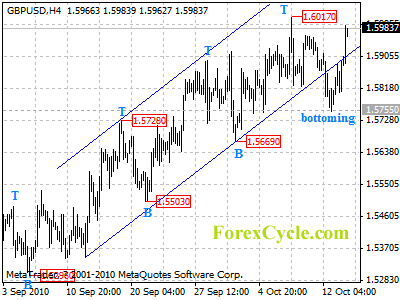
GBPUSD rebounded strongly from 1.5755

GBPUSD rebounded strongly from 1.5755, suggesting that a cycle bottom is being formed on 4-hour chart. Now the rise from 1.5755 is more likely resumption of uptrend from 1.5296, further rise towards 1.6017 is possible later today, a break above this level will confirm that the uptrend has resumed, then next target would be at 1.6200 area. Key support is now at 1.5755, only break below this level will indicate that the uptrend from 1.5296 has completed at 1.6017 already, then the following downward move could bring price back to 1.5200 area.

gbpusd

Daily Forex Signals

Forex Trading and the Yen Spread Betting Market

By Thomas Bainbridge

So the Bank of Japan (BoJ) finally decided enough was enough and bought approximately $3 billion versus the Yen.

On a long-term basis it is difficult to argue that the BoJ are throwing ‘good money after bad’ as the cross rate moved below ¥83.00 which was clearly absurd on valuation levels.

As Simon Denham of Tradefair remarked, “The country’s currency seems to defy logic as, apart from their trade surplus, practically every other serious determining factor for valuation would indicate that the current levels of the Yen are far too high.

“The cross rate hit the long-term bear support at ¥82.85/83.00 and someone in the BoJ was clearly looking at the same chart as any forex trader. On the first day of trading after the intervention, the cross bounced around 200 points in early morning trade from ¥82.85 up to a price of ¥85.20”.

It has been quite some time since a major central bank has taken on the market, however with the new Japanese Prime Minister Naoto Kan looking for some breathing space on the currency front to enact his fiscal squeeze, the recent events are perhaps understandable.

The question we must ask is whether this heralds a more interventionist chapter in world markets. The rather extreme forex spread betting moves over the last decade have caused significant problems. The Euro practically doubled versus the Dollar from 2001 to 2008, with the Yen also appreciating some 30% in the last couple of years.

For this reason, the argument about the demise of the Dollar seems somewhat overdone. Global industry is transacting deals almost exclusively in the Dollar. Until another floating currency challenges the Dollar’s dominance – and this includes getting financial futures contracts traded in anything other than the Dollar – its superiority will remain.

Whilst the Dollar bounced sharply versus the Yen, the same cannot be said against the other majors: both the Euro and Pound had strong sessions taking their crosses up to $1.30 and $1.55 respectively.

The moves were slightly odd considering that the more recent US data was better than expected and one could be forgiven for expecting this to lead to some increased buying of the Dollar. It appears that, firstly, too many people got it the ‘wrong way round’ and that, secondly, there was a sense that if the American numbers were good then the European numbers would be better.

Of course if you are trading the forex markets then be aware that further intervention is more than possible. There are even rumours of the BoJ getting ready to sell one trillion Yen.

A word of warning before you trade though, ensure that spread betting matches your investment objectives, it carries a high level of risk to your capital and you can lose more than your initial investment. Make sure you familiarise yourself with the risks involved. Spread trading carries a high level of risk to your capital. Seek independent advice if necessary.

About the Author

A leading financial author based in the heart of London’s Canary Wharf. Thomas Bainbridge is a respected commentator on the financial markets including the Financial Spreads markets.

Forex daily analysis

USD/CHF

Daily graph: http://www.real-forex.com/charts-daily/141010/CHF_DAILY_141010.JPG

CHF daily

One-hour graph: http://www.real-forex.com/charts-daily/141010/CHF_1H_141010.JPG

CHF 1H

For the last few weeks, the pair was clearly downtrend oriented. The last decrease started at the level 0.9851 and last for about 300 pips. However, it corrected itself until 0.9730, which is exactly a correction of two thirds.

Once this level reached, a bullish envelope template appeared, suggesting the end of the correction, and the beginning of a reversing trend, creating the opportunity for a “Short”.

Potential trade

Suggestion: Looking for a descending configuration on one-hour graph. Our analysis suggests the apparition of this configuration once the support level 0.9545 crossed.

  • “Limit” order on “Short” position 10 pips below the support, meaning: 0.9535.
  • “Stop Loss” order on the last high occurred: 0.9641

Our suggestion to reduce this large “Stop loss”: Wait for a first breach and its technical correction. When the second breach occurs, place your “Stop order” on the last high appeared.

USD/CAD

Daily graph: http://www.real-forex.com/charts-daily/141010/CAD_DAILY_141010.JPG

CAD daily

After the breach of an important support level at 1.011 occurred a few sessions ago,a non confirmed bullish envelope template appeared. The expected reversal didn’t occur and the pair is still decreasing.

Please pay attention to the important support at 0.9974. If the pair crosses that support, a stop in the trend followed by a correction may be expected. A confirmation of this could be a daily reversing candle on the support mentioned.

If such a candle appears, opening a “Long” transaction might be a great option of trade.

Have a profitable day!

Real Forex team. logo

Further your Forex Education with More Support & Resistance Tips

By Chris Donnell – When a Forex trader looks for an opening, they examine charts that display all the clear balance point lines and moving averages. You can see the trend tools. What do you do?

With effective Forex training, you’ll know about support and resistance. If you know where to find the support and resistance areas, you’ll be in good shape. If you know the trend direction, you can know what to do. (We can go over time frame analysis elsewhere.) However, what time is the best time to enter?

You can’t conjure up the absolute perfect time to enter. Check out these tricks that Top Gun Forex trading courses provide that can give you an edge.

Don’t buy 10 to 20 pips prior to encountering resistance. This way, you won’t have to worry about getting reversed or stopped out by random market bouncing.

After that, don’t sell 10 to 20 pips if support is coming. You do this for the same reason; don’t get reversed or stopped out of the trade before you make good.

After that, wait out the price. Head fakes is a problem a lot of traders worry about. If you want to minimize your risk, pull back after the support or resistance is broken, and once the trend line breaks, you then go in, giving yourself the advantage. (Every Top Gun course covers this very effective method.) You can see this in action in our Forex Videos.

Keep a close eye on trends. If you start seeing divergence in your trends, or even if the trade loses momentum, you might lose the trade in the end. Therefore, it would be advantageous to just see where the price goes before dumping money into it.

Only bet on sure things! Just wait a bit before going in if you have the slightest doubt about a trade. If you plan on waiting for awhile, write down what opening you’re anticipating, so that when it finally arrives, you can successfully enter the trade and earn more profit.

Don’t just take a trade for a single reason. If you want to go long in the EURUSD because their trend indicators show that the EURUSD will be bullish for awhile, people have been receiving good news about the EUR, and the resistance for it suddenly became support, you might find it advantageous to actually go long with this trade. On the other hand, you might want to use multiple time frame analysis before you go in.

Trend lines are your friend. The Top Gun Forex courses cover this topic on a regular basis.

Stops also help! In order to protect their investments from turning on them and making them lose money, stops are put into effect by traders.

Momentum indicators will be useful. With the help of LeverageFX Forex Software, you can determine how the momentum of the trade is doing using moment indicators.

Traders find these tips incredibly useful and advantageous to their trading portfolios, as they can figure out the best times to go in or duck out of a trade.

About the Author

Chris Donnell trades and teaches Currency Trading. You can see examples of his trades/systems on our ForexBlogFX.com site.

GBP/USD – Negative Divergence Shows Weakening Trend

By Russell Glaser – Over the last two days the price of the GBP/USD has pulled back from its test of the 1.60 level. Signs of negative divergence appear on the daily chart signaling a weakening trend and a possible reversal.

Looking at the daily chart, two trend lines have been drawn. The short term trend line begins at the June low (not shown) and the intermediate trend line starts in mid-September. The second trend line was broke during yesterday’s trading in a sharp decline over the past two trading days. In today’s European trading session the GBP/USD has climbed has high as the broken trend line and is now acting as a resistance level.

The daily chart highlights a potential reversal of the trend due to the close below the trend line and also negative divergence that has appeared on the Momentum (14) indicator.

The price for the pair was rising and reached a new high (1.6017) in the uptrend while the momentum line was falling, thus creating negative divergence. This is a possible warning sign of a reversal in the trend.

Traders may want to scale back any long positions they may have in the GBP/USD or tighten stops. A close below the support level of 1.5670 (S1), the low from September 30th and a break of the long term trend line will signal a shift in the long term uptrend.

Forex Market Analysis provided by ForexYard.

© 2006 by FxYard Ltd

Disclaimer: Trading Foreign Exchange carries a high level of risk and may not be suitable for all investors. There is a possibility that you could sustain a loss of all of your investment and therefore you should not invest money that you cannot afford to lose. You should be aware of all the risks associated with Foreign Exchange trading.

Forex Daily Market Commentary

By GCI Forex Research

Fundamental Outlook at 0800 GMT (EDT + 0400)

USD

The dollar continued to weaken against the euro during the Asia session in the wake of the FOMC minutes. EURUSD traded 1.3838-1.3979 and USDJPY traded 81.67-82.01. The minutes themselves kept expectations alive that another round of quantitative easing might begin as early as November. Several members considered it appropriate “to take action soon”, but the minutes also made it clear that any additional easing would “depend upon future information about the economic situation and outlook.” Market attention also focused on the presence of New York Fed economist Eggertsson at the meeting. Eggertsson’s field of expertise is the conduct of monetary policy when interest rates are near zero. His attendance at this time is noteworthy given he last appeared at an FOMC meeting in December 2008, the meeting where the original MBS purchase program was launched.
Equities also found some support with the S&P500 closing +0.4% higher. The minutes were vague on what form any additional easing should take, but participants were said to have “focused primarily on further purchases of longer-term Treasury securities and on possible steps to affect inflation expectations.” Possible strategies to affect short-term inflation expectations included “providing more detailed information about the rates of inflation…consistent with its dual mandate, targeting a path for the price level…and targeting a path for the level of nominal GDP.” Attention will now likely focus on Fed Chairman Bernanke’s speech on monetary policy which is scheduled for Friday.
EUR

ECB Governing Council Member Weber repeated his opposition to the ECB’s sovereign bond buying program, saying there is no evidence the purchases have had any significant impact on average Eurozone yields. He said the program “should now be phased out permanently”. Although he stressed the current policy stance is appropriate given that inflation risks are low, he warned that the risks from exiting too late are greater than exiting too early. On the question of how the exit strategy should be sequenced, Weber said that, “in principle”, rate hikes could begin before the phasing out of non-standard measures had finished. He repeated the now familiar ECB position that it is not the job of the central bank to provide long-term liquidity support to the banking system, and invited national governments and bank shareholders instead to provide the cash the banks need.
ECB Governing Council member Noyer said that price stability is still not in danger, and that upside risks are very limited. Elsewhere, ECB Governing Council member Nowotny said that there is no danger of inflation or deflation, and that the idea of a currency war is absurd. However, ECB President Trichet was more cautious and called on the international community to say “no to protectionism and no to beggar-thy-neighbour policies”.
JPY

Finance Minister Noda repeated that Japan reserves the right to intervene in FX markets when needed. BoJ Governor Shirakawa said that he is watching FX markets with great interest and the BoJ could extend the new asset purchase facility it announced at the latest policy meeting depending on the needs of the economy. The facility was originally intended to hold up to ¥5trn in new assets, ¥3.5trn of which may be JGBs.
GBP

UK consumer confidence fell sharply in September to 53 (cons. 59, prev. 62). This was the weakest reading in 18 months.
MPC Member Miles said that the outlook for growth and inflation remains exceptionally uncertain and that quantitative easing remains a potentially powerful tool. He added that it is not yet obvious in what direction monetary policy will next be adjusted, but said the BoE may yet come to use quantitative easing. Cable fell sharply in response to the latter remark.
Yesterday, CPI fell slightly in September, coming in at 0.0% m/m (cons. +0.1%, prev. +0.5%), and at 3.1% y/y (cons. 3.1%, prev. 3.1%). Our economists note that the CPI release is in line with the BoE’s inflation report and should therefore have no material impact on the MPC’s immediate policy decisions. We are cautious on sterling as fiscal austerity will likely dampen growth and keep monetary policy accommodative.


AUD

Consumer confidence stayed firm in October, rising 3.3% m/m to 117.0. Yesterday we learned business confidence only fell very slightly in September. Both readings support our analysts’ expectations for an RBA rate hike at the November meeting.

TECHNICAL OUTLOOK


EURGBP 0.8894 next resistance.
EURUSD BULLISH Focus is on 1.4029 break of which would open up the way towards 1.4194. Support at 1.3775.
USDJPY BEARISH Trend is bearish; initial support at 81.39 ahead of 79.75. Resistance holds at 83.03 ahead of 83.99.
GBPUSD BULLISH Move above 1.6018/69 would trigger further gains towards 1.6276. Support at 1.5670 ahead of 1.5503.
USDCHF BEARISH Look for a break below 0.9500 which will expose 0.9078 next. Resistance at 0.9739 ahead of 0.9918 breakout low.
AUDUSD BULLISH Upside potential held at 0.9918 below 1.000 psychological resistance next. Support at 0.9709 reaction low.
USDCAD BEARISH As long as resistance at 1.0380 holds, expect losses to target 1.0063 with scope for 0.9931 and 0.9820 next.
EURCHF BULLISH Pressure on 1.3265 ahead of 1.3072, but focus is on upside trigger defined at 1.3494 ahead of 1.3665.
EURGBP BULLISH Break of 0.8808 exposes 0.8894 and 0.9039. Support holds at 0.8689 ahead of 0.8563.
EURJPY BULLISH Clearance of 113.26 exposed 110.66 support, but overall outlook is bullish with resistance at 115.68 ahead of 116.68 Fibonacci resistance.

Forex Daily Market Commentary provided by GCI Financial Ltd.

GCI Financial Ltd (”GCI”) is a regulated securities and commodities trading firm, specializing in online Foreign Exchange (”Forex”) brokerage. GCI executes billions of dollars per month in foreign exchange transactions alone. In addition to Forex, GCI is a primary market maker in Contracts for Difference (”CFDs”) on shares, indices and futures, and offers one of the fastest growing online CFD trading services. GCI has over 10,000 clients worldwide, including individual traders, institutions, and money managers. GCI provides an advanced, secure, and comprehensive online trading system. Client funds are insured and held in a separate customer account. In addition, GCI Financial Ltd maintains Net Capital in excess of minimum regulatory requirements.

DISCLAIMER: GCI’s Daily Market Commentary is provided for informational purposes only. The information contained in these reports is gathered from reputable news sources and is not intended to be U.S.ed as investment advice. GCI assumes no responsibility or liability from gains or losses incurred by the information herein contained.